A new collection of poetry from the winner of the National Book Critics Circle Award
. . . we are fixed to perpetrate the species—
I meant perpetuate—as if our duty
were coupled with our terror. As if beauty
itself were but a syllabus of errors.
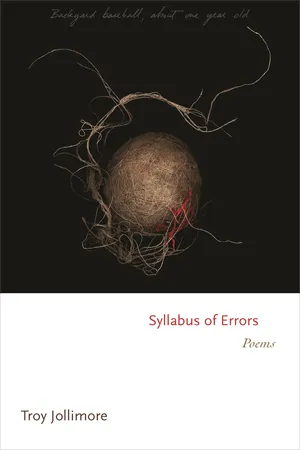
Troy Jollimore's first collection of poems won the National Book Critics Circle Award, was hailed by the New York Times as "a snappy, entertaining book," and led the San Francisco Chronicle to call him "a new and exciting voice in American poetry." And his critically acclaimed second collection expanded his reputation for poems that often take a playful approach to philosophical issues. While the poems in Syllabus of Errors share recognizable concerns with those of Jollimore's first two books, readers will also find a voice that has grown more urgent, more vulnerable, and more sensitive to both the inevitability of tragedy and the possibility of renewal.
Poems such as "Ache and Echo," "The Black-Capped Chickadees of Martha's Vineyard," and "When You Lift the Avocado to Your Mouth" explore loss, regret, and the nature of beauty, while the culminating long poem, "Vertigo," is an elegy for a lost friend as well as a fantasia on death, repetition, and transcendence (not to mention the poet's favorite Hitchcock film). Ingeniously organized into sections that act as reflections on six quotations about birdsong, these poems are themselves an answer to the question the poet asks in "On Birdsong": "What would we say to the cardinal or jay, / given wings that could mimic their velocities?"
- 112 pages
- English
- ePUB (mobile friendly)
- Available on iOS & Android
eBook - ePub
About this book
Information
Publisher
Princeton University PressYear
2015Print ISBN
9780691167688
9780691167589
eBook ISBN
9781400873449
II ON BEAUTY
the Airs which belong to Birds have
led our lives to be these things instead of Kings
led our lives to be these things instead of Kings
—CHARLES OLSON
ON BEAUTY
Beauty, some have ventured, is proportional:
the right relative ratio of the actual
against the actual. Others hypothesize
that beauty’s roots lie buried in the sexual,
insisting that aesthetics are relational:
the eye of the beholder is the noumenal
perceiving core, where spores of the phenomenal
sprout into lit-screen images. The visual
is permeated, down to the foundational,
with lust, with longing. Say it: we are animals,
which does not mean that we must all be criminals,
but only that desire is constitutional,
that we are fixed to perpetrate the species—
I meant perpetuate—as if our duty
were coupled with our terror. As if beauty
itself were but a syllabus of errors.
SYLLABUS OF ERRORS
You will first treat of the restricted light,
then, having achieved full adequacy
in this, of the free light, and finally, after
many exercises and much
disciplined contemplation, you will treat
of the light of luminous bodies.
Only then will you be ready
to make a study of love, of the void
that precipitates longing, of the soft tissues
that compose the kissing organs in humans,
the slow, cold fire these organs encompass.
Young women, their hearts. Passion, the diverse
expressions of and the obstructions thereto.
Whence comes the construction of children, then children,
the neglect and abandonment of. Having mastered
this, you will next turn to the pursuit
of competence in the fields of cartography,
of argumentation, of the imitation of beasts,
and of archery. As it comes to the arrow
in midair that the bow is the only
home it will ever really know,
and that it does not love the target at all,
so the seeds of delayed understanding
will come to you, drifting softly from some
high branch or low cloud to lodge in your hair,
on a Tuesday morning, perhaps. Whence come tears.
Whence comes the tuning of faint melodies
voiced by devices of ancient assembly.
Whence the correction of orbits, the rotation
of the eyes or of songbirds when the one
draws the other after. Why a prick
to the syrinx may still the heart of a man.
Whence frenzy by virtue of illness. Whence envy.
Whence shame. Whence trembling. Whence sleep. A figure
to show whence comes the semen. Whence urine.
Whence milk. Thunderbolts, their fatal capacity.
Joy, the diverse simulacra of.
Of the habits of men. Of ceaseless sobbing.
CUTTING ROOM
Sooner or later everyone needs a haircut.
—THE MAN WHO WASN’T THERE (JOEL AND ETHAN COEN, 2001)
The note of longing that creeps into the voice
of the woman who cuts my hair when she says
“Oh, it was amazing”—she is speaking of the time
she was twenty-one and went for a weeklong cruise
around the Virgin Islands on a friend’s sailboat—
is so heartfelt, so hushed,
so purely human that it makes me wonder
what parts of the story she is leaving out,
what she isn’t saying, which suspends itself,
as the unsaid always does, like a shadow or aura
over the words she has allowed herself to say.
Meanwhile her scissors sing the snip snip snip
of revision, and small seed-packets of my hair
are drifting to the floor as if through humid forest
air. As always I have let it grow too long
and have come in looking like a middle-aged professor
of philosophy who is trying to look a little
like Roger Daltrey, or, if he’s lucky, Robert Plant;
a gesture, perhaps, toward the life I get to live
in the alternative plotline, the deleted scenes
hidden in my life’s Special Edition DVD.
■
Desire is always a hazardous thing
to reveal. That bold, slightly unfed look
you direct without intending to toward a stranger
you suddenly want—does she remind you of your mother,
or your first girlfriend, or does she represent
the possibility of an alternate life,
one very much like this one in all the ways that ...
Table of contents
- Cover Page
- Title Page
- Copyright Page
- Dedication Page
- Contents
- I On Birdsong
- II On Beauty
- III On Blindness
- IV When You Lift the Avocado to Your Mouth
- V Vertigo
- VI Concluding Unscientific Postscript
- Notes and Acknowledgments
Trusted by 375,005 students
Access to over 1.5 million titles for a fair monthly price.
Study more efficiently using our study tools.
Frequently asked questions
Yes, you can cancel anytime from the Subscription tab in your account settings on the Perlego website. Your subscription will stay active until the end of your current billing period. Learn how to cancel your subscription
No, books cannot be downloaded as external files, such as PDFs, for use outside of Perlego. However, you can download books within the Perlego app for offline reading on mobile or tablet. Learn how to download books offline
Perlego offers two plans: Essential and Complete
- Essential is ideal for learners and professionals who enjoy exploring a wide range of subjects. Access the Essential Library with 800,000+ trusted titles and best-sellers across business, personal growth, and the humanities. Includes unlimited reading time and Standard Read Aloud voice.
- Complete: Perfect for advanced learners and researchers needing full, unrestricted access. Unlock 1.5M+ books across hundreds of subjects, including academic and specialized titles. The Complete Plan also includes advanced features like Premium Read Aloud and Research Assistant.
We are an online textbook subscription service, where you can get access to an entire online library for less than the price of a single book per month. With over 1.5 million books across 990+ topics, we’ve got you covered! Learn about our mission
Look out for the read-aloud symbol on your next book to see if you can listen to it. The read-aloud tool reads text aloud for you, highlighting the text as it is being read. You can pause it, speed it up and slow it down. Learn more about Read Aloud
Yes! You can use the Perlego app on both iOS and Android devices to read anytime, anywhere — even offline. Perfect for commutes or when you’re on the go.
Please note we cannot support devices running on iOS 13 and Android 7 or earlier. Learn more about using the app
Please note we cannot support devices running on iOS 13 and Android 7 or earlier. Learn more about using the app
Yes, you can access Syllabus of Errors by Troy Jollimore in PDF and/or ePUB format, as well as other popular books in Literature & Literary Collections. We have over 1.5 million books available in our catalogue for you to explore.