The first English translation of Jung’s landmark lecture on Nerval’s hallucinatory memoir
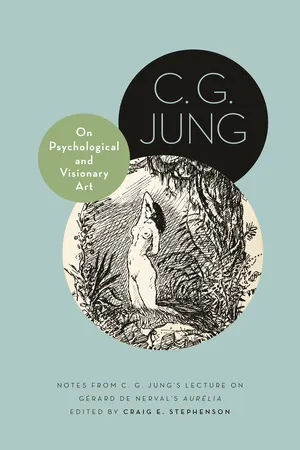
In 1945, at the end of the Second World War and after a long illness, C. G. Jung delivered a lecture in Zürich on the French Romantic poet Gérard de Nerval. The lecture focused on Nerval's visionary memoir, Aurélia, which the poet wrote in an ambivalent attempt to emerge from madness. Published here for the first time, Jung’s lecture is both a cautionary psychological tale and a validation of Nerval’s visionary experience as a genuine encounter.
Nerval explored the irrational with lucidity and exquisite craft. He privileged the subjective imagination as a way of fathoming the divine to reconnect with what the Romantics called the life principle. During the years of his greatest creativity, he suffered from madness and was institutionalized eight times. Contrasting an orthodox psychoanalytic interpretation with his own synthetic approach to the unconscious, Jung explains why Nerval was unable to make use of his visionary experiences in his own life. At the same time, Jung emphasizes the validity of Nerval’s visions, differentiating the psychology of a work of art from the psychology of the artist. The lecture suggests how Jung’s own experiments with active imagination influenced his reading of Nerval’s Aurélia as a parallel text to his own Red Book.
With Craig Stephenson’s authoritative introduction, Richard Sieburth’s award-winning translation of Aurélia, and Alfred Kubin’s haunting illustrations to the text, and featuring Jung’s reading marginalia, preliminary notes, and revisions to a 1942 lecture, On Psychological and Visionary Art documents the stages of Jung’s creative process as he responds to an essential Romantic text.
eBook - ePub
On Psychological and Visionary Art
Notes from C. G. Jung’s Lecture on Gérard de Nerval's Aurélia
- 240 pages
- English
- ePUB (mobile friendly)
- Available on iOS & Android
eBook - ePub
On Psychological and Visionary Art
Notes from C. G. Jung’s Lecture on Gérard de Nerval's Aurélia
About this book
Information
Publisher
Princeton University PressYear
2015Print ISBN
9780691270975
9780691162478
eBook ISBN
9781400873470
Index
Note: Page numbers in italic type indicate illustrations.
aestheticism, 83
Africa, 147, 149, 151
Agathos Daimon, 64, 98
alchemy: and anima mundi, 72, 73, 74, 103, 111; and bird of Hermes, 62, 62n24; and colors, 55, 55n11; Enigma of Bologna and, 46; in first notes, 110; and gardening, 64, 65, 66; Hermes and, 62, 62n24, 64, 68, 69; identity of lowest and highest in, 63n26; Jung’s interest in, 40, 40n; Nerval’s knowledge of, 64, 64n29; in Swiss lecture notes, 93, 98; in Zurich lecture, 63–64
alcheringa time, 62, 62n23, 98
Alphonse, Noël Léon, portrait of Jenny Colon, 5
Amphitryon, 154
Andreae, Johann Valentin, 57n16
anima: as alchemical figure (anima mundi), 72, 73, 74, 103, 111; in Aurélia, 134; in discussion after Zurich lecture, 80–83, 85–86; in editor’s commentary, 46; in first notes, 108, 109, 112; Haggard’s figure of, 58n17; in Jung’s abstract on Nerval, 49; in Swiss lecture notes, 92–93, 97, 100, 105; in Zurich lecture, 57, 63
animals: as double of genius, 75–76; inner man vs. animal man, 58n16; souls of the dead appearing as, 62–63, 96–98, 109, 129, 130. See also bird; llama
animus, 85–86, 134n25
antiquity: in discussion after Zurich lecture, 82; in first notes, 108; in Swiss lecture notes, 93; in Zurich lecture, 57–58
Apollyon, 192, 192n68
Apuleius, Lucius, The Golden Ass, 17, 120
art, psychology of, 1, 40–41
Artaud, Antonin, 16, 16n5, 41
art brut (outsider art), 42
artist, psychology of, 1, 27n, 28, 33. See also psy...
Table of contents
- Cover Page
- Copyright Page
- Title Page
- Contents
- Illustrations
- Acknowledgments
- Permissions
- One - Introduction Craig E. Stephenson
- Two - Jung’s Abstract on Nerval from The Symbolic Life (Collected Works, Volume 18)
- Three - Jung’s Lecture on Gérard de Nerval at the Psychology Club, 1945
- Four - Minutes of the Discussion following the 1945 Lecture
- Five - Jung’s Notes to the 1942 Lecture
- Six - Jung’s First Notes on Aurélia, 1942
- Seven - Nerval’s Aurélia (1855) Translated by Richard Sieburth (1999); illustrations by Alfred Kubin (1910)
- References
- Index
Trusted by 375,005 students
Access to over 1.5 million titles for a fair monthly price.
Study more efficiently using our study tools.
Frequently asked questions
Yes, you can cancel anytime from the Subscription tab in your account settings on the Perlego website. Your subscription will stay active until the end of your current billing period. Learn how to cancel your subscription
No, books cannot be downloaded as external files, such as PDFs, for use outside of Perlego. However, you can download books within the Perlego app for offline reading on mobile or tablet. Learn how to download books offline
Perlego offers two plans: Essential and Complete
- Essential is ideal for learners and professionals who enjoy exploring a wide range of subjects. Access the Essential Library with 800,000+ trusted titles and best-sellers across business, personal growth, and the humanities. Includes unlimited reading time and Standard Read Aloud voice.
- Complete: Perfect for advanced learners and researchers needing full, unrestricted access. Unlock 1.5M+ books across hundreds of subjects, including academic and specialized titles. The Complete Plan also includes advanced features like Premium Read Aloud and Research Assistant.
We are an online textbook subscription service, where you can get access to an entire online library for less than the price of a single book per month. With over 1.5 million books across 990+ topics, we’ve got you covered! Learn about our mission
Look out for the read-aloud symbol on your next book to see if you can listen to it. The read-aloud tool reads text aloud for you, highlighting the text as it is being read. You can pause it, speed it up and slow it down. Learn more about Read Aloud
Yes! You can use the Perlego app on both iOS and Android devices to read anytime, anywhere — even offline. Perfect for commutes or when you’re on the go.
Please note we cannot support devices running on iOS 13 and Android 7 or earlier. Learn more about using the app
Please note we cannot support devices running on iOS 13 and Android 7 or earlier. Learn more about using the app
Yes, you can access On Psychological and Visionary Art by C. G. Jung, Craig E. Stephenson, Craig Stephenson in PDF and/or ePUB format, as well as other popular books in Psychology & Literary Criticism. We have over 1.5 million books available in our catalogue for you to explore.