A close-up look at the contradictions and wonders of the modern zoo
Orangutans swing from Kevlar-lined fire hoses. Giraffes feast on celebratory birthday cakes topped with carrots instead of candles. Hi-tech dinosaur robots growl among steel trees, while owls watch animated cartoons on old television sets. In American Zoo, sociologist David Grazian takes us on a safari through the contemporary zoo, alive with its many contradictions and strange wonders.
Trading in his tweed jacket for a zoo uniform and a pair of muddy work boots, Grazian introduces us to zookeepers and animal rights activists, parents and toddlers, and the other human primates that make up the zoo's social world. He shows that in a major shift away from their unfortunate pasts, American zoos today emphasize naturalistic exhibits teeming with lush and immersive landscapes, breeding programs for endangered animals, and enrichment activities for their captive creatures. In doing so, zoos blur the imaginary boundaries we regularly use to separate culture from nature, humans from animals, and civilization from the wild. At the same time, zoos manage a wilderness of competing priorities—animal care, education, scientific research, and recreation—all while attempting to serve as centers for conservation in the wake of the current environmental and climate-change crisis. The world of the zoo reflects how we project our own prejudices and desires onto the animal kingdom, and invest nature with meaning and sentiment.
A revealing portrayal of comic animals, delighted children, and feisty zookeepers, American Zoo is a remarkable close-up exploration of a classic cultural attraction.
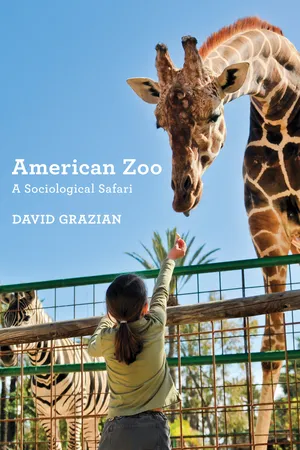
- 344 pages
- English
- ePUB (mobile friendly)
- Available on iOS & Android
eBook - ePub
About this book
Information
Publisher
Princeton University PressYear
2015Print ISBN
9780691178424
9780691164359
eBook ISBN
9781400873616
Topic
SozialwissenschaftenSubtopic
ZoologieChapter 1
Where the Wild Things Aren’t
Exhibiting Nature in American Zoos
THE AIR WAS HEAVY with humidity and dewy mist as I traipsed through the rainforest. Through the thick vegetation I could make out shocks of bright orange and red as a distant cackle grew louder. And WHOOSH—a fairy bluebird swooped in and I ducked. Glancing downward, I caught a glimpse of a Victoria crowned pigeon strutting to my right, and up in the tall trees I spotted the rest of them, almost all at once. First a rhinoceros hornbill, followed by a green toucan, and then an honest-to-god Micronesian kingfisher! Funny, I thought they went extinct in the wild. But of course, this was not the wild—it was the artificial tropical rainforest of the Philadelphia Zoo’s McNeil Avian Center, where visitors can enjoy watching birds from Africa, South America, and the Pacific Islands that would never actually mingle in nature, at least not on the same continent.
As the Earth’s most biodiverse ecological habitats disappear along with untold species of fauna and flora in the age of the Anthropocene, we rely ever more heavily on distinctly man-made environments to experience what we have traditionally considered the natural living world. But whereas modernist zoo exhibits of the past emphasized functionality through cheerless and antiseptic living spaces adorned with barred steel cages and easily washable concrete floors, recent decades have seen the emergent popularity of what has been called the “new naturalism” in zoos, whereby exhibit designers envelop animals and audiences together in landscaped gardens that simulate the wild bush, all while providing realism based on scientific field research on wildlife environments and their topography.1
To this end, the best American zoos today use scenic backdrops, lifelike props, soundscapes, and other elements of stagecraft to furnish seemingly authentic and realistic depictions of the Gobi Desert, the Everglades, Malaysia’s mangrove forests, and other habitats of life on Earth. Just as contemporary audiences experience the spirituality and enchantment attributed to consecrated wilderness spaces by consuming nature documentaries and other popular cultural entertainments, naturalistic zoo exhibits similarly capture visitors’ imaginations by transporting them to exotic landscapes of sublimity around the Earth’s biosphere, if only in their mind’s eye.2 As feats of both engineering and imagination, these exhibits best represent how zoos attempt to both literally and figuratively construct the natural world according to human desire and will, much like the Earth itself. In doing so, zoos fuse together modern science with the craft of storytelling and the aesthetics of visual art, just as paleontologists create colorful and seemingly lifelike models of dinosaurs no human has ever actually seen. As the biologist Edward O. Wilson observes, “The role of science, like that of art, is to blend exact imagery with more distant meaning, the parts we already understand with those given as new into larger patterns that are coherent enough to be acceptable as truth.”3
Yet the fabrication of the idealized natural world is always a complicated proposition—especially for zoos, given the challenges inherent in staging live animal exhibits that offer authentic-looking depictions of wild habitats, endangered or otherwise. Zoo visitors gravitate toward African lions to observe them at play and hear their ferocious roars, yet in the wild lions rest approximately twenty hours a day.4 Audiences delight in watching furry zoo creatures frolicking about in sociable groups, but many captive animals are solitary creatures by nature, while others resort to dangerous games of hierarchical dominance when placed in close proximity to one another. American zoo-goers revere the stately bald eagle, our national totemic symbol, and yet at feeding time some visitors might find its diet of thawed rats or mice unsettling, or simply gross. On this first leg of our safari we will explore how the built environment of the zoo and other idealized representations of nature ultimately rely on the synthetic and symbolic materials of culture, the man-made tools of imagination and art. Given how often Americans today experience the outdoors in highly controlled environments that manage audience perception and meaning—national and state parklands, wildlife and game preserves, themed amusement parks, natural history museums, even shopping malls—the zoo is an ideal social world for examining the cultural construction of nature in the age of the Anthropocene.5
Zoo Design as Nature Making
First things first—nothing could be more self-evident than the staged or manufactured authenticity exhibited in zoo displays, no matter how naturalistic. No visitor approaching an Amur tiger’s enclosure at the Philadelphia Zoo would somehow mistake its glass-walled habitat for the Siberian tundra. Yet as audiences we nevertheless expect zoo exhibits to prominently display landscapes that we at least associate with the natural environment, however imaginary and romanticized such renderings might be. Like moviegoers and theater buffs who give themselves over to the virtual realities provided by the special effects of cinema and the stage despite their obviously engineered quality, zoo visitors enjoy lush, immersive habitats that evoke a sense of authenticity, however illusory.6
For this reason, the biggest impediment to exhibiting nature in metropolitan zoos is not technical but organizational. Staging naturalistic exhibits requires that zoo designers and staff negotiate among a variety of competing institutional priorities. Zoos simultaneously serve as providers of animal care, promoters and funders of zoological research and endangered species conservation, and purveyors of both recreational amusement and scientific education. Therefore, zoo architects must build aesthetically alluring and sufficiently entertaining animal displays that offer enough scientific realism that they can serve an educational purpose, while also providing safe and comfortable living quarters for the zoo’s resident species.
Negotiating these competing priorities—the cultural expectations of audiences, the educational mission of zoos, and the practicalities of managing live animals—gives rise to a particular bundle of stagecraft techniques, a kind of collaborative team performance that I call nature making.7 Nature making in zoos requires adherence to a set of aesthetic conventions regarding what audiences collectively imagine the natural world to look and sound like, as illustrated by the popularity of attractively landscaped immersive exhibits densely overrun with lush vegetation, and frosty polar bear and penguin habitats filled with snow and ice. In such exhibits, designers attempt to hide all visible signs of artificiality, man-made technology, and human domination over displayed animals, just as modern societies erect mental barriers between human settlements and the surrounding environment, however imaginary and elusive such borders may be.8
American zoos engage in nature making not only to create delightful and aesthetically pleasing cultural attractions but to provide educational opportunities for the public as well, which the zoo industry celebrates as one of its paramount goals.9 According to the Association of Zoos and Aquariums (AZA), two-thirds of all grown-up zoo visitors accompany children to the zoo, and these adults are primarily women, specifically mothers aged twenty-five to thirty-five.10 Within both the zoo industry as well as among middle-class families, specifically those attentive to parenting strategies that emphasize what my Penn colleague Annette Lareau refers to as the “concerted cultivation” of their children through participation in enriching leisure activities, scientific education provides a loftier warrant for the existence of zoos than mere entertainment.11 In keeping with their educational priorities, zoos must therefore present aesthetically attractive animal displays to the public while adhering to scientifically accurate and thus edifying renderings of the environment and its ecological realities. This can be a tricky feat, because although zoo visitors might think they crave realism in naturalistic zoo displays, it is often an idealized realism void of unpleasantries such as animal feces and regurgitated prey. As James Parker observes in the Atlantic in an essay on nature-based reality television shows, “Nature unobserved, unsentimentalized, unpolluted with our delusions, is just a bunch of stuff eating itself.”12
Nature making in zoos also requires balancing the aesthetic tastes shared among visitors with the health and safety of the animals in their collections. This includes designing and maintaining secure yet comfortable enclosures for a variety of living creatures, feeding them individually calibrated diets, and providing veterinary care, exercise, behavioral stimulation, and opportunities for reproduction. While in the past zoo collections consisted of healthy specimens taken from the wild, today zoos usually rely on animal populations either born and bred in captivity, abandoned by negligent owners, or else injured in the wild and subsequently rescued and rehabilitated.13 These managed populations therefore completely depend on their caretakers for their fitness, sustenance, and protection, and indeed many zoo animals could not survive in the wild at all without such assistance.
Sensitive to the treatment of captive animals, audiences themselves often try to evaluate the naturalism of zoo exhibits on behalf of the creatures they display. Of course, what nonexperts deem accommodating to zoo animals does not always correspond to their genuine needs. As animal scientist and advocate Temple Grandin argues,
Zoos have gotten sidetracked by bad ideas about animal welfare. One of the most common is the “back to nature” approach where the goal is to make the enclosures as close to the animal’s natural habitat as possible. That sounds logical until you stop to think that “nature” in a zoo is nothing like nature in the real world. Real nature means predators or prey, disease, hunger, and danger. “Zoo nature” doesn’t have any of those things except disease, and a sick zoo animal gets immediate attention from a veterinarian. The result is that some zoos have spent a lot of money building fancy enclosures that appear natural to people, but are just as boring and painful for the animals as a barren concrete cage. I remember one tiger exhibit that looked really pretty with lots of rocks molded from concrete. There was absolutely nothing for the tiger to do. The enclosure was visually stimulating for people, but it was a barren environment for the tiger.14
Staging naturalistic exhibits in zoos therefore requires careful sensitivity to the concerns of resident animals, the goals of zoo educators and other stakeholders, and the cultural expectations of audiences. Given the organizational complexities and tensions involved in portraying nature to the public under such conditions, the diverse and multidisciplinary network of zoo participants that I call nature makers—the exhibit designers, landscape architects, horticulturalists, animal curators, veterinarians, animal care keepers, and zoo educators responsible for bringing naturalistic zoo exhibits to life—must work collaboratively to solve routine dilemmas encountered in the everyday functioning of zoos.15
Dilemmas in Exhibiting Nature
In many ways, the social and collective nature of zoo work does not really differ from the production of art and popular culture more generally.16 Perhaps this is why renowned zoo designer Jon Coe draws on the metaphor of the stage to advise contemporary nature makers in zoos to conjure up a “scenario that fully describes the exhibit context, just as a cinematic or theatrical scenario sets the scene for a performance.”17 Yet even under the most favorable of circumstances, nature makers run into difficulties when creating naturalistic zoo exhibits. Consider the design of animal enclosures. Most obviously, managing captive zoo animals requires the use of elaborate technologies designed to prevent escape, for the safety of both the animals as well as the public at large, and for good reason. On Christmas Day in 2007 Tatiana, a Siberian tiger, escaped from its exhibit at the San Francisco Zoo and killed Carlos Sousa, Jr., a teenage boy, while in March 2011 a venomous Egyptian cobra escaped from its Reptile House enclosure at the Bronx Zoo and evaded capture for nearly a week.18
It also bears remembering that barriers not only keep zoo animals inside their enclosures, but also keep dangerous animals out, whether they be stray dogs, foxes, raptors, or even other escaped zoo animals. And lest we forget, zoo animals can find themselves visited upon by the least predictable trespassers of them all, Homo sapiens. In July 1999, twenty-seven-year-old Daniel Dukes snuck into an orca exhibit at Sea-World Orlando and was drowned by a five-ton killer whale. In November 2011, a group of territorial spider monkeys from the Sorocaba Zoo in São Paulo, Brazil, viciously attacked an inebriated zoo visitor after he foolishly climbed into their enclosure. Human intruders occasionally sneak into lion and other wildcat enclosures both during and after zoo hours, only to be devoured or at least badly injured. While such instances are statistically rare, human recklessness often prevails nonetheless, as when the Guardian reported in July 2014 that among drunken visitors partying at Friday night events at the London Zoo, one man poured a beer over a tiger while another stripped off his own clothing and attempted to enter the penguin pool.19
But while enclosure technologies may remain crucial to the display of live zoo animals, most of us regard traditional zoo cages lined with iron or steel bars as antiquated and inhumane, just as audience research shows that zoo visitors dwell longer at exhibits unobstructed by visual obstacles such as fences or screens.20 (There are therefore stark differences between the mammal exhibits that zoos present to the public and the offstage holding cells hidden from audiences, behind the scenes. For instance, although Zoo Atlanta displays its massive collection of over twenty gorillas—the largest in the nation—in a spectacularly verdant rainforest habitat of an acre and a half, at night these apes sleep in small indoor cages reminiscent of a medieval dungeon.)21 It would therefore seem that nature makers ought simply to replace remaining old-timey zoo cages with either less conspicuous technologies of captivity, such as razor-thin electric wiring or large panes of transparent glass, or else naturalistic moats that allow for unobstructed and thus more seemingly realistic depictions of zoo wildlife.
Yet each of these technologies creates a new set of problems that runs counter to the aforementioned priorities established by zoos. While thin electric cables, or “hot wires,” can seem practically invisible even at close range, they are no panacea, and only most obviously because electric shocks can be hazardous and painful to zoo creatures. In fact, they often do not work at all, as thick-skinned animals such as rhinoceroses can withstand their high voltages. In one instance, chimpanzees in a New Mexico facility seemed oblivious to the hot current produced by an electrified fence, while an orangutan at Seattle’s Woodland Park Zoo appeared entertained as an electrified windowpane sent shocks coursing through its arms. Elsewhere, animals have learned to short-circuit the cables with sticks, while elephants have done so with their tusks.22
Meanwhile, other seemingly invisible enclosure technologies such as glass can be just as conspicuous as iron cages or fences. For safety reasons, protective glass-paneled enclosures must be constructed thicker than some walls, much less fencing. According to Jeffrey Smith, an architect at a leading American zoo design firm,
We always look for the magic barrier where there’s “nothing” there…. We joke about a “force field” where the animals can’t get out—you’re always trying to get rid of the barriers, or not see the barriers, to get this interaction with the animals. Glass, obviously, is one of the best ways to do that. So a lot of thinking goes into it, as you can imagine. We hire glazing engineers, glass engineers that we say, “Okay, we have a four-hundred-pound gorilla that could be running at this thing at twenty miles an hour, can you help us out? And how thick of a glass does that need to be?” Usually this exhibit’s glazing is several pieces of glass laminated together, so it may be two or three (usually we don’t get above three layers), but those layers of glass can be anywhere from a quarter-inch thick to a half-inch more thick with a membrane in between them to help adhere it, and actually the membrane gives it a little bit of strength as well. Glazing engineers help us come up with that sandwich, the appropriate thickness of that, as well as how much the edge frames need to ...
Table of contents
- Cover Page
- Title Page
- Copyright Page
- Dedication Page
- Contents
- Introduction | The World in a Zoo
- Chapter 1 | Where the Wild Things Aren’t: Exhibiting Nature in American Zoos
- Chapter 2 | Animal Farm: Making Meaning at the Zoo
- Chapter 3 | Birds of a Feather: Zookeepers and the Call of the Wild
- Chapter 4 | Life Lessons: The Zoo as a Classroom
- Chapter 5 | Bring on the Dancing Horses: American Zoos in the Entertainment Age
- Chapter 6 | Simply Nature: Zoos and the Branding of Conservation
- Chapter 7 | Wrestling with Armadillos: Animal Welfare and the Captivity Question
- Chapter 8 | The Urban Jungle: The Future of the American Zoo
- Acknowledgments
- Notes
- Index
Trusted by 375,005 students
Access to over 1.5 million titles for a fair monthly price.
Study more efficiently using our study tools.
Frequently asked questions
Yes, you can cancel anytime from the Subscription tab in your account settings on the Perlego website. Your subscription will stay active until the end of your current billing period. Learn how to cancel your subscription
No, books cannot be downloaded as external files, such as PDFs, for use outside of Perlego. However, you can download books within the Perlego app for offline reading on mobile or tablet. Learn how to download books offline
Perlego offers two plans: Essential and Complete
- Essential is ideal for learners and professionals who enjoy exploring a wide range of subjects. Access the Essential Library with 800,000+ trusted titles and best-sellers across business, personal growth, and the humanities. Includes unlimited reading time and Standard Read Aloud voice.
- Complete: Perfect for advanced learners and researchers needing full, unrestricted access. Unlock 1.5M+ books across hundreds of subjects, including academic and specialized titles. The Complete Plan also includes advanced features like Premium Read Aloud and Research Assistant.
We are an online textbook subscription service, where you can get access to an entire online library for less than the price of a single book per month. With over 1.5 million books across 990+ topics, we’ve got you covered! Learn about our mission
Look out for the read-aloud symbol on your next book to see if you can listen to it. The read-aloud tool reads text aloud for you, highlighting the text as it is being read. You can pause it, speed it up and slow it down. Learn more about Read Aloud
Yes! You can use the Perlego app on both iOS and Android devices to read anytime, anywhere — even offline. Perfect for commutes or when you’re on the go.
Please note we cannot support devices running on iOS 13 and Android 7 or earlier. Learn more about using the app
Please note we cannot support devices running on iOS 13 and Android 7 or earlier. Learn more about using the app
Yes, you can access American Zoo by David Grazian in PDF and/or ePUB format, as well as other popular books in Sozialwissenschaften & Zoologie. We have over 1.5 million books available in our catalogue for you to explore.