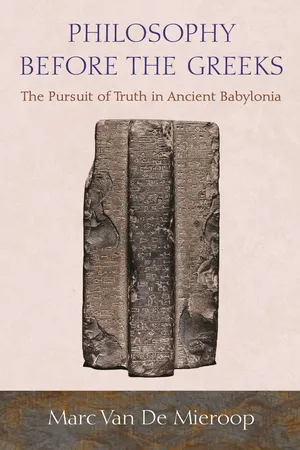
There is a growing recognition that philosophy isn't unique to the West, that it didn't begin only with the classical Greeks, and that Greek philosophy was influenced by Near Eastern traditions. Yet even today there is a widespread assumption that what came before the Greeks was "before philosophy." In Philosophy before the Greeks, Marc Van De Mieroop, an acclaimed historian of the ancient Near East, presents a groundbreaking argument that, for three millennia before the Greeks, one Near Eastern people had a rich and sophisticated tradition of philosophy fully worthy of the name.
In the first century BC, the Greek historian Diodorus of Sicily praised the Babylonians for their devotion to philosophy. Showing the justice of Diodorus's comment, this is the first book to argue that there were Babylonian philosophers and that they studied knowledge systematically using a coherent system of logic rooted in the practices of cuneiform script. Van De Mieroop uncovers Babylonian approaches to knowledge in three areas: the study of language, which in its analysis of the written word formed the basis of all logic; the art of divination, which interpreted communications between gods and humans; and the rules of law, which confirmed that royal justice was founded on truth.
The result is an innovative intellectual history of the ancient Near Eastern world during the many centuries in which Babylonian philosophers inspired scholars throughout the region—until the first millennium BC, when the breakdown of this cosmopolitan system enabled others, including the Greeks, to develop alternative methods of philosophical reasoning.
eBook - ePub
Philosophy before the Greeks
The Pursuit of Truth in Ancient Babylonia
- 312 pages
- English
- ePUB (mobile friendly)
- Available on iOS & Android
eBook - ePub
About this book
Information
Publisher
Princeton University PressYear
2015Print ISBN
9780691176352
9780691157184
eBook ISBN
9781400874118
PART I

AN ESSAY IN BABYLONIAN EPISTEMOLOGY
CHAPTER 1
At the Time of Creation
I Read, Therefore I Am
When the Greek historian Diodorus of Sicily wrote his Library of History in the first century BC—a universal history in the sense that he mentioned Egyptians and other “barbarians” briefly before embarking on a detailed account of Greeks and Romans from the Trojan War until his own time—he made only a few remarks about the Chaldeans, who were, he said, the most ancient inhabitants of Babylonia. Unlike the Assyrians and Medes he had just discussed, Diodorus found the Chaldeans interesting not because of their military feats, but because, “being assigned to the service of the gods, they spend their entire life philosophizing, their greatest renown being in the field of astrology” (Diodorus II 29.2). Many modern translators of this passage avoid the term “philosophize” and prefer the broader word “study,” but the original Greek is precise. The text uses the verb filosofeo, to love knowledge and pursue it. Diodorus did not, then, share the modern reluctance to grant those outside the western tradition the ability to practice philosophy. Hegel’s notorious dismissal of non-European thought in his Philosophy of History—China’s philosophy was alien to anything that relates to the Spirit and India’s was dream-like—may no longer be universally shared, and the concept of world philosophies may now finally be breaking the Eurocentric barrier.1 Still, rare are the students of philosophy who consider the Near Eastern traditions that dominated the eastern Mediterranean world for millennia before the Classical Greeks. I say rare because there is an increasing awareness of a Near Eastern background to ancient Greek culture, including its philosophy, in which the clearest traces of such influence appear in the pre-Socratic corpus. A recent authoritative handbook on that corpus, for example, includes an essay that points out how ideas from the East inspired early Greek thought.2 The focus of the essay is fully on content, not on form, as especially in the area of cosmogony it is clear that Hesiod and others knew of earlier Near Eastern traditions. Egyptians, Babylonians, Hittites, Hebrews, and some of their neighbors left behind engaging works of literature that illustrate their perceptions on how everything came into being. The ideas were very diverse even within the individual cultures, but undoubtedly elements from them reached the Greek world. The parallels between Hesiod’s Theogony and the Hittite Kumarbi Cycle are so obvious that few would deny that the Greek author was aware of the Anatolian tradition.3
A closer look at the most elaborate discussion of cosmogony from the Near East shows that we deny it full credit by focusing on such details of content alone, however. The Babylonian Creation Myth—a modern title for a poem known in Mesopotamian antiquity as Enūma eliš, its first two words—relates how the universe evolved from nothingness to an organized structure with the city of Babylon at its center. When the primordial sweet and salt waters—male Apsu and female Tiamat—mingled, two beings appeared: Laḫmu and Laḫamu, that is, mud and muddy. The image suits the southern Babylonian view over the Persian Gulf perfectly: when the sea recedes, mud arises.4 A chain reaction had started: the male and female heavenly and earthly horizons brought about by the mud flats gave birth to the god of heaven, and in due course other gods came into being, as well as conflict between them. Soon the prima materia sweet water Apsu tried to destroy his offspring for the noise they made, but Ea, the god of wisdom, cast a spell on him and killed him. Henceforth Apsu was the name of the waters beneath the earth in whose midst Ea established his house. There the god’s wife Damkina gave birth to Marduk, a raucous youth whose games so disturbed the prima materia salt water Tiamat that she too wanted to rid herself of all others. This time Marduk was the gods’ champion, and the tale details how he battled Tiamat’s ghouls. Victorious, he used Tiamat’s body to create the heavenly sky, in which he organized the stars and the progression of time:
He made the position(s) for the great gods,
He established (in) constellations the stars, their likeness.
He marked the year, described (its) boundaries,
He set up twelve months of three stars each.
Marduk brought order into the universe, assigned gods their places in heaven and the netherworld, and made the Tigris and Euphrates rivers flow using Tiamat’s eyes as the sources from which their waters arose. As his last act he created humankind, who “shall bear the gods’ burden that those may rest.” In gratitude the other gods elected Marduk their king and built Babylon as his resplendent residence, the place where they could gather in assembly.5
One could say that creation was complete at this point in the poem, and many modern summaries of the Enūma eliš indeed portray the subsequent lines as a liturgical praise of the god Marduk, an appendix.6 So far the tale revealed a wealth of ideas about creation current at least among some Babylonians. As the Enūma eliš was recited during the New Year’s festival when the gods met to renew Marduk’s kingship, we imagine that its contents had official sanction, but we cannot say that its ideas were exclusive. Some aspects are clear: water was the prima materia, intercourse between male and female elements led to a lineage of gods, and generational conflict caused change. In the Enūma eliš progress was the result of younger gods pacifying the chaos their ancestors generated. Parallels with pre-Socratic Greek ideas are obvious: Thales too regarded water as the basis of all else, and Hesiod’s Theogony portrayed progress as the result of generational conflict and parricide.
When ending our reading of the Enūma eliš at this point, it is easy to conclude that the concepts it expresses are in the domain of myth rather than reason. They explain natural phenomena, such as the Tigris and Euphrates rivers or the movements of stars and planets, as the outcome of a divine act. No other rationale was needed. Read this way, the poem belongs “before philosophy,” as in the title of a popular book from the 1940s that studied “the intellectual adventure of ancient man” through the mythologies of Egypt and Mesopotamia. The collection of essays—admirable in many respects and naturally a product of its time, the mid-twentieth century—discusses at length mythopoeic thought, speculation that “was not restricted by a scientific (that is, a disciplined) search for truth.”7 And indeed these ancient peoples did not present a systematic analysis of the origins of the universe and its structure that uses the principles we today see as essential for scientific explanation. Nor did they analyze other topics with the methods Greeks started to develop so thoroughly in the sixth century BC and which we see as foundational for western rationality. If we read Enūma eliš purely as a myth, we may be tempted to dismiss it as unworthy of serious attention, following Hegel’s paraphrase of Aristotle, “It is not worth while to treat seriously of those whose philosophy takes a mythical form.”8 Yet, Before Philosophy and many other engagements with Near Eastern writings present a very partial analysis of the materials available. Such an approach would be as if we only consider Hesiod and forget about Thales and other early Greek philosophers. A reading to the end of the Enūma eliš, the cosmogonic poem from Babylonia, the ancient culture that will preoccupy the rest of my discussion, reveals a much different system of thought.
Before we consider the rest of the poem, we need to make a short excursus to explain the basic principles of the writing system the author used. The cuneiform script was one of the longest in use in world history, for more than three thousand years, and an unknown number of people, at times from all over the Near East, recorded a multitude of languages with it. It was not alphabetic, but used several hundreds of signs to indicate both entire words and single syllables. Opaque to those unfamiliar with it, the principles are straightforward and easy to learn. My remarks here are commonplace to those who have studied it, but will, I hope, clarify the basics to those who have not.
The cuneiform script was probably invented to render the Sumerian language—specialists debate the issue—and its connection to that language was essential. At first each sign denoted an entire word, regularly with a connection between the visual representation and the item recorded: the outlines of a river for water (Sumerian a), the ox-head for an ox (Sumerian gud), and so on. Through simple logic the pictures of physical objects were used to depict conceptually related verbs and abstract ideas. The foot indicated “to walk” (Sumerian du) and “to stand firm” (Sumerian gin). Homophony between the words for physical and nonphysical items allowed for the depiction of the latter. Sumerian til, “to live,” sounded like ti, “arrow,” so the drawing of a bow and arrow indicated the verb. The dominance of words made up of single syllables in the Sumerian language made it easy to use word-signs (or logograms) as the building blocks of longer words and grammatical chains, where they lost their connection to concepts and represented sound. In the development of syllabic meanings, consonants were more stable than vowels, but b could easily become p, g could become k, and so on. The ability to render syllables was crucial for the adoption of cuneiform to write the Akkadian language, with its multisyllabic words, and at the same time, the connection to this other language added new potential readings to individual signs. With this increased flexibility users of the script could write down texts in any language whatever its linguistic background: Semitic Akkadian, Indo-European Hittite, and a mixture of others without clear cognates, such as Sumerian, Hurrian, and Elamite. Throughout its history, scholars of the cuneiform script expanded the possible readings and meanings of signs, as we will see in detail in the next chapters.
A student of cuneiform writing is at first thrown off by a number of characteristics that were essential to the script’s flexibility. They are rooted in the bilingualism that was essential to Babylonian literate culture, which treated Sumerian and Akkadian as parallel languages that worked in harmony, a topic I will address in more detail in the next section. Although Sumerian and Akkadian were linguistically very distinct, the Babylonians considered the languages to be inherently tied together and even to be interchangeable. Words in either language could substitute for one another, and, as is true for all translations, various Akkadian equivalents existed for every Sumerian word, and vice versa. Moreover, because the readings of signs as syllables derived from their connections to different Sumerian and Akkadian words, they had multiple phonetic renderings. A single sign could be read as du, de, gin, kin, gub, ra, re, or tum. Conversely, the same syllable or word could be written with various signs (modern scholars assign them numbers, e.g., du, du2, du3, etc.). Thus there existed a large variety of potential readings and interpretations of every word and cuneiform sign. While all this seems confusing on the level of the individual signs, when they were read in a sequence the correct reading was obvious to anyone who knew the language, certainly when practical writing was involved. The multiplicity also allowed for intricate explanations of the various options, however, and this is what the author of the Enūma eliš used in order to give additional meaning to the text.
When the poet reached the point where Marduk had completed his work and the other gods made him king, he (although women belonged to the literate elites of Babylonia, the chances that a woman wrote the Enūma eliš are very small9) had written some 900 verses, which in the standard version of the first millennium filled most of six cuneiform tablets. He did not end hastily, however, but devoted another 200 lines to a passage in which the gods recite fifty names of Marduk, explaining what each one means. These present a work of explanatory philology so complex that later Mesopotamian commentators provided clarifications in order to show how the analyses came about. While the later scholars did not necessarily disclose the original author’s intent, they shared with him the same approach to reading the cuneiform signs and establishing what they reveal about reality. Most modern scholars paid little attention to the passage—they called it a solemn recitation of names—until Jean Bottéro unlocked its structure and showed its importance in 1977.10 One example suffices to make the point. Marduk’s thirty-sixth name is
LUGALABDUBUR
The king who thwarted the maneuvers of
Tiamat uprooted her weapons
whose support was firm in front and rear.11
In order to interpret the name dLUGAL.AB2.DU10.BUR3 as explained in the subsequent three verses, the author established multiple equivalences for each of the five signs used to write it, as the ancient commentary text explains. He relied on the basic characteristics of cuneiform writing I just explained, and used them to the fullest extent possible. The information the later commentary provides allows us to interpret the hermeneutic procedures in the passage just quoted as follows:
LUGAL = šarru, a common translation from Sumerian into Akkadian of the word “king.”
BUR3 is equated to BIR2, (which is easy because of the secondary character of vowels). Sumerian BIR2 can be translated in Akkadian as sapāḫu, “to scatter, thwart.”
DU10 is equated to its homophone DU3, which means “to build.” An Akkadian noun derived from that verb is epšētu, that is, “action, maneuvers.”
AB2 is equated to its homophone AB, which is taken as the abbreviation of the Sumerian word A.AB.BA, whose Akkadian translation is tâmtu, “sea.” By extension it indicates the goddess of the sea, Tiamat.
BUR3 is taken to be the same as its component BU, which has the Akkadian equivalent nasāḫu, “to uproot.”
DU10 is equated again to DU3, a cuneiform sign that can also be read KAK, the first syllable of the Akkadian word kakku, “weapon.”
LU2, the first part of LUGAL, is equated to the Akkadian relative pronoun, ša, “whose.”
DINGIR, the determinative sign at the start of the entire name used to indicate that a divine name is following (rendered d in the transliteration above), is equated with Akkadian ša rēši, “in front.”
At this point the commentary is damaged and its explanation of the final equivalences is no longer preserved, but we know the system well enough to restore at least some of it with confidence. The concluding two elements of the name DU10.BUR3 render the Sumerian word DUBUR, which means “foundation, support,” and ...
Table of contents
- Cover Page
- Title Page
- Copyright Page
- Contents
- Preface
- Part I: An Essay in Babylonian Epistemology
- Part II: The Order of things (Les Mots Et Les Choses)
- Part III: Writings of the Gods
- Part IV: The Word of the Law
- Part V: A Babylonian Epistemology
- Notes
- Bibliography
- Index
Trusted by 375,005 students
Access to over 1.5 million titles for a fair monthly price.
Study more efficiently using our study tools.
Frequently asked questions
Yes, you can cancel anytime from the Subscription tab in your account settings on the Perlego website. Your subscription will stay active until the end of your current billing period. Learn how to cancel your subscription
No, books cannot be downloaded as external files, such as PDFs, for use outside of Perlego. However, you can download books within the Perlego app for offline reading on mobile or tablet. Learn how to download books offline
Perlego offers two plans: Essential and Complete
- Essential is ideal for learners and professionals who enjoy exploring a wide range of subjects. Access the Essential Library with 800,000+ trusted titles and best-sellers across business, personal growth, and the humanities. Includes unlimited reading time and Standard Read Aloud voice.
- Complete: Perfect for advanced learners and researchers needing full, unrestricted access. Unlock 1.5M+ books across hundreds of subjects, including academic and specialized titles. The Complete Plan also includes advanced features like Premium Read Aloud and Research Assistant.
We are an online textbook subscription service, where you can get access to an entire online library for less than the price of a single book per month. With over 1.5 million books across 990+ topics, we’ve got you covered! Learn about our mission
Look out for the read-aloud symbol on your next book to see if you can listen to it. The read-aloud tool reads text aloud for you, highlighting the text as it is being read. You can pause it, speed it up and slow it down. Learn more about Read Aloud
Yes! You can use the Perlego app on both iOS and Android devices to read anytime, anywhere — even offline. Perfect for commutes or when you’re on the go.
Please note we cannot support devices running on iOS 13 and Android 7 or earlier. Learn more about using the app
Please note we cannot support devices running on iOS 13 and Android 7 or earlier. Learn more about using the app
Yes, you can access Philosophy before the Greeks by Marc Van De Mieroop in PDF and/or ePUB format, as well as other popular books in History & Ancient History. We have over 1.5 million books available in our catalogue for you to explore.