An in-depth exploration of how biomechanics and ecology work together
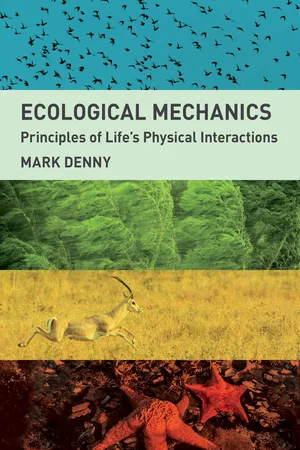
Plants and animals interact with each other and their surroundings, and these interactions—with all their complexity and contingency—control where species can survive and reproduce. In this comprehensive and groundbreaking introduction to the emerging field of ecological mechanics, Mark Denny explains how the principles of physics and engineering can be used to understand the intricacies of these remarkable relationships.
Denny opens with a brief review of basic physics before introducing the fundamentals of diffusion, fluid mechanics, solid mechanics, and heat transfer, taking care to explain each in the context of living organisms. Why are corals of different shapes on different parts of a reef? How can geckos climb sheer walls? Why can birds and fish migrate farther than mammals? How do desert plants stay cool? The answers to these and a host of similar questions illustrate the principles of heat, mass, and momentum transport and set the stage for the book's central topic—the application of these principles in ecology. Denny shows how variations in the environment—in both space and time—affect the performance of plants and animals. He introduces spectral analysis, a mathematical tool for quantifying the patterns in which environments vary, and uses it to analyze such subjects as the spread of invasive species. Synthesizing the book's materials, the final chapters use ecological mechanics to predict the occurrence and consequences of extreme ecological events, explain the emergence of patterns in the distribution and abundance of organisms, and empower readers to explore further.
Ecological Mechanics offers new insights into the physical workings of organisms and their environment.
- 532 pages
- English
- PDF
- Available on iOS & Android
eBook - PDF
About this book
Information
Topic
Sciences biologiquesSubtopic
ÉcologieTable of contents
- Cover
- Title
- Copyright
- Dedication
- Contents
- List of Illustrations
- List of Tables
- Acknowledgements
- Chapter 1 ECOLOGICAL MECHANICS An Introduction
- Part I Basic Concepts
- Part II The Mechanics of Transport
- Part III Solid Mechanics
- Part IV Ecological Mechanics
- References
- Symbol Index
- Author Index
- Subject Index
Trusted by 375,005 students
Access to over 1.5 million titles for a fair monthly price.
Study more efficiently using our study tools.
Frequently asked questions
Yes, you can cancel anytime from the Subscription tab in your account settings on the Perlego website. Your subscription will stay active until the end of your current billing period. Learn how to cancel your subscription
No, books cannot be downloaded as external files, such as PDFs, for use outside of Perlego. However, you can download books within the Perlego app for offline reading on mobile or tablet. Learn how to download books offline
Perlego offers two plans: Essential and Complete
- Essential is ideal for learners and professionals who enjoy exploring a wide range of subjects. Access the Essential Library with 800,000+ trusted titles and best-sellers across business, personal growth, and the humanities. Includes unlimited reading time and Standard Read Aloud voice.
- Complete: Perfect for advanced learners and researchers needing full, unrestricted access. Unlock 1.5M+ books across hundreds of subjects, including academic and specialized titles. The Complete Plan also includes advanced features like Premium Read Aloud and Research Assistant.
We are an online textbook subscription service, where you can get access to an entire online library for less than the price of a single book per month. With over 1.5 million books across 990+ topics, we’ve got you covered! Learn about our mission
Look out for the read-aloud symbol on your next book to see if you can listen to it. The read-aloud tool reads text aloud for you, highlighting the text as it is being read. You can pause it, speed it up and slow it down. Learn more about Read Aloud
Yes! You can use the Perlego app on both iOS and Android devices to read anytime, anywhere — even offline. Perfect for commutes or when you’re on the go.
Please note we cannot support devices running on iOS 13 and Android 7 or earlier. Learn more about using the app
Please note we cannot support devices running on iOS 13 and Android 7 or earlier. Learn more about using the app
Yes, you can access Ecological Mechanics by Mark Denny in PDF and/or ePUB format, as well as other popular books in Sciences biologiques & Écologie. We have over 1.5 million books available in our catalogue for you to explore.