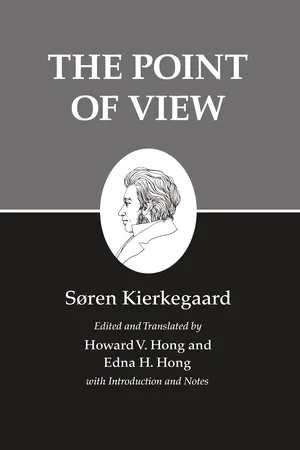
As a spiritual autobiography, Kierkegaard's The Point of View for My Work as an Author stands among such great works as Augustine's Confessions and Newman's Apologia pro Vita Sua. Yet Point of View is neither a confession nor a defense; it is an author's story of a lifetime of writing, his understanding of the maze of greatly varied works that make up his oeuvre.
Upon the imminent publication of the second edition of Either/Or, Kierkegaard again intended to cease writing. Now was the time for a direct "report to history" on the authorship as a whole. In addition to Point of View, which was published posthumously, the present volume also contains On My Work as an Author, a contemporary substitute, and the companion piece Armed Neutrality.
eBook - ePub
The Point of View
- 376 pages
- English
- ePUB (mobile friendly)
- Available on iOS & Android
eBook - ePub
The Point of View
About this book
Information
Publisher
Princeton University PressYear
2009Print ISBN
9780691140803
9780691058559
eBook ISBN
9781400832408
Topic
PhilosophySubtopic
Ethics & Moral PhilosophyPart One
A [XIII 521]
The Equivocalness or Duplexity in the Whole Authorship,* Whether the Author Is an Esthetic or a Religious Author
Accordingly, what is to be shown here is that there is such a duplexity from beginning to end. It is not, then, as is ordinarily the case with a supposed duplexity, that others have discovered it and it is the task of the person concerned to show that it is not. By no means, just the opposite. Insofar as the reader might not be sufficiently aware of the duplexity, it is the author’s task to make it as obvious as possible that it is there. In other words, the duplexity, the equivocalness, is deliberate, is something the author knows about more than anyone else, is the essential dialectical qualification of the whole authorship, and therefore has a deeper basis.
But is this really the case, is there such a sustained duplexity? Can the phenomenon not be explained in another way, that it is an author who was first an esthetic author and then in the course [XIII 522] of years changed and became a religious author? I will not now discuss the point that if this were so the author certainly would not have written a book such as the present one, would scarcely, I dare say, have taken it upon himself to give an overview of the writing as a whole, at least would not have chosen to do so at the very time he meets his first work again.10 Nor will I discuss the point that it would indeed be odd that such a change would occur in the course of so few years. Ordinarily, when it is seen that an esthetic author becomes a religious author, at least a considerable number of years intervenes, so that the explanation of the change is not implausible, so that it is consistent with the author’s actually having become significantly older. But I will not discuss this, since even if it were odd, almost inexplicable, even if it might make one inclined to seek and find any other explanation, it would still not be impossible that such a change could occur in the course of three years. On the contrary, I will show that it is impossible to explain the phenomenon in this way. If, namely, one looks more closely, one will see that three years are certainly not allowed for the occurrence of the change, but that the change is concurrent with the beginning, that is, that the duplexity is there from the very beginning. Two Upbuilding Discourses is concurrent with Either/Or. The duplexity in the deeper sense, that is, in the sense of the whole authorship, was certainly not what there was talk about at the time: the first and second parts of Either/Or. No, the duplexity was: Either/Or—and Two Upbuilding Discourses.
The religious is present from the very beginning. Conversely, the esthetic is still present even in the last moment. After the publication of only religious works for two years, a little esthetic article follows.* Therefore, at the beginning and at the end, there is assurance against explaining the phenomenon by saying that the writer is an esthetic author who in the course of time had changed and had become a religious author. Just as Two Upbuilding Discourses came out approximately two or three months after Either/Or, so also that little esthetic article appeared about two or three months after two years of exclusively religious writings. The two upbuilding discourses and the little article match each other conversely and conversely show that the duplexity is both first and last. Although Either/Or attracted all the attention and [XIII 523] no one paid attention to Two Upbuilding Discourses, this nevertheless signified that it was specifically the upbuilding that should advance, that the author was a religious author who for that reason never wrote anything esthetic himself but used pseudonyms for all the esthetic works, whereas the two upbuilding discourses were by Magister Kierkegaard. Conversely, whereas the exclusively upbuilding books of the two years may have attracted the attention of others, perhaps no one in turn has noticed in the deeper sense the little article, what it signifies—that now the dialectical structure of this whole authorship is complete. The little article is an accompaniment precisely for documentation, for the sake of confrontation, in order at the end to make it impossible (as the two upbuilding discourses do at the beginning) to explain the phenomenon in this way—that it is an author who in the beginning was an esthetic author and then later changed and thus became a religious author—inasmuch as he was a religious author from the very beginning and is esthetically productive at the last moment.
The first division of books is esthetic writing; the last division of books is exclusively religious writing—between these lies Concluding Unscientific Postscript as the turning point. This work deals with and poses the issue, the issue of the entire work as an author: becoming a Christian. Then in turn it calls attention* to the pseudonymous writing along with the interlaced 18 discourses11 and shows all this as serving to illuminate the issue, yet without stating that this was the object of the prior writing—which could not be done, since it is a pseudonymous writer12 who is interpreting other pseudonymous writers, that is, a third party who could know nothing about the object of writings unfamiliar to him. Concluding Unscientific Postscript is not esthetic writing, but, strictly speaking, neither is it religious. That is why it is by a pseudonymous writer, although I did place my name as editor, which I have not done with any purely esthetic production**—a hint, at least for someone who is concerned with or has a sense for such things. Then came the two years in which there appeared only religious writings under my name. The time of the pseudonyms was over; the religious author had extricated [XIII 524] himself from the disguise of the esthetic—and then, then for documentation and by way of a precaution came the little esthetic article by a pseudonymous writer: Inter et Inter. In a way it at once calls attention to the whole authorship; as said previously, it calls to mind conversely Two Upbuilding Discourses.
*In order to have them at hand, here are the titles of the books. First division (esthetic writing): Either/Or, Fear and Trembling, Repetition, The Concept of Anxiety, Prefaces, Philosophical Fragments, Stages on Life’s Way—together with eighteen upbuilding discourses, which came out successively. Second division: Concluding Unscientific Postscript. Third division (only religious writing): Upbuilding Discourses in Various Spirits, Works of Love, Christian Discourses—together with a little esthetic article: The Crisis and a Crisis in the Life of an Actress.9
*The Crisis and a Crisis in the Life of an Actress. Fædrelandet, July 1848.
*See pp. 187–227 [SV VII 212–257; KW XII. 1, pp. 251–300], a section with which I would ask the reader to become familiar.
**The literary review of Two Ages is no argument against this, both because it is not, after all, esthetic in the sense of being a poet-production but is critical, and because it has a totally religious background in its understanding of “the present age.”
B
The Explanation: That the Author Is and Was a Religious Author
It might seem that a simple declaration by the author himself in this regard is more than adequate; after all, he must know best what is what. I do not, however, think much of declarations in connection with literary productions and am accustomed to take a completely objective attitude to my own. If in the capacity of a third party, as a reader, I cannot substantiate from the writings that what I am saying is the case, that it cannot be otherwise, it could never occur to me to want to win what I thus consider as lost. If I qua author must first make declarations, I easily alter all the writing, which from first to last is dialectical.
Consequently I am unable to make any declaration, at least not until I in some other way have made the explanation so obvious that the declaration in that sense is entirely superfluous, because then it can be admitted as a lyrical satisfaction, insofar as I feel a need for it, and it can be demanded as a religious duty. In other words, qua human being I may be justified in making a declaration, and from the religious point of view it may be my duty to make a declaration. But this must not be confused with the authorship—qua author it does not help very much that I qua human being declare that I have intended this and that. But presumably everyone will admit that if it can be shown that such and such a phenomenon cannot be explained in any other way, and that on the other hand it can in this way be explained at every point, or that this explanation fits at every point, then the correctness of this explanation is substantiated as clearly as the correctness of an explanation can ever be substantiated.
But is there not a contradiction here? If it is substantiated in [XIII 525] the preceding that the equivocalness is present to the very last, to the same degree as this succeeds, to the same degree it is made impossible to substantiate which is the explanation, then to that extent a statement, a declaration, seems here to be the only way to break the dialectical tension and knot. This seems very perspicacious [skarpsindig] and yet is actually only subtle [spidsfindig]. If, for example, someone in a certain situation found a mystification necessary, it is perfectly consistent with subtlety for him to do it in such a way that—the comic emerges—that he himself cannot make head nor tail of it. But this is also a lack of earnestness and an infatuation with mystification in and for itself instead of having its teleological truth. Thus where a mystification, a dialectical redoubling [Fordoblelse], is used in the service of earnestness, it will be used in such a way that it only wards off misunderstandings and preliminary understandings, while the true explanation is available to the person who is honestly seeking. To use the supreme example: Christ’s whole life here on earth would indeed have become a game if he had been so incognito that he had gone through life totally unnoticed—and yet he truly was incognito.
So also with a dialectical redoubling, and the dialectical redoubling is that the equivocalness is maintained. Once the requisite earnestness takes hold, it can also solve it, but always only in such a way that the earnestness itself vouches for the correctness. Just as a woman’s demureness relates to the true lover, and then, but only then yields, so also a dialectical redoubling relates to true earnestness. Therefore the explanation cannot be communicated to a less earnest person, since the elasticity of the dialectical doubleness is too great for him to manage; it takes the explanation away from him again and makes it dubious for him whether it is indeed the explanation.
Let us make the attempt; let us try to explain this whole authorship on the assumption that it is the work of an esthetic author. It will readily be seen that from the beginning this explanation is not in accord with the phenomenon but promptly runs aground on Two Upbuilding Discourses. If, however, we attempt to explain the authorship by assuming that it is the work of a religious author, we will see that step by step it tallies at every point. The only thing inexplicable is how it ever occurred to a religious author to use the esthetic in this way. That is, we are once again face-to-face with the equivocalness or the dialectical redoubling. The difference is only that the assumption that it is a religious author will have been established and the task is to [XIII 526] explain the equivocalness. Whether another person can do this, I do not decide; but the explanation is what becomes the content of the second part of this little book.
Just...
Table of contents
- Cover Page
- Title Page
- Copyright Page
- Contents
- Historical Introduction
- On My Work as an Author
- The Accounting
- Appendix My Position as a Religious Author in “Christendom” and My Strategy
- The Point of View for My Work as an Author
- Introduction
- Part One
- Part Two The Authorship Viewed as a Whole, and From The Point of View that the Author is a Religious Author
- Supplement
- Editorial Appendix
Trusted by 375,005 students
Access to over 1.5 million titles for a fair monthly price.
Study more efficiently using our study tools.
Frequently asked questions
Yes, you can cancel anytime from the Subscription tab in your account settings on the Perlego website. Your subscription will stay active until the end of your current billing period. Learn how to cancel your subscription
No, books cannot be downloaded as external files, such as PDFs, for use outside of Perlego. However, you can download books within the Perlego app for offline reading on mobile or tablet. Learn how to download books offline
Perlego offers two plans: Essential and Complete
- Essential is ideal for learners and professionals who enjoy exploring a wide range of subjects. Access the Essential Library with 800,000+ trusted titles and best-sellers across business, personal growth, and the humanities. Includes unlimited reading time and Standard Read Aloud voice.
- Complete: Perfect for advanced learners and researchers needing full, unrestricted access. Unlock 1.5M+ books across hundreds of subjects, including academic and specialized titles. The Complete Plan also includes advanced features like Premium Read Aloud and Research Assistant.
We are an online textbook subscription service, where you can get access to an entire online library for less than the price of a single book per month. With over 1.5 million books across 990+ topics, we’ve got you covered! Learn about our mission
Look out for the read-aloud symbol on your next book to see if you can listen to it. The read-aloud tool reads text aloud for you, highlighting the text as it is being read. You can pause it, speed it up and slow it down. Learn more about Read Aloud
Yes! You can use the Perlego app on both iOS and Android devices to read anytime, anywhere — even offline. Perfect for commutes or when you’re on the go.
Please note we cannot support devices running on iOS 13 and Android 7 or earlier. Learn more about using the app
Please note we cannot support devices running on iOS 13 and Android 7 or earlier. Learn more about using the app
Yes, you can access The Point of View by Søren Kierkegaard, Howard V. Hong, Edna H. Hong, Howard V. Hong,Edna H. Hong in PDF and/or ePUB format, as well as other popular books in Philosophy & Ethics & Moral Philosophy. We have over 1.5 million books available in our catalogue for you to explore.