This anthology presents, for the first time, full texts of the twenty most important works of American legal thought since 1890. Drawing on a course the editors teach at Harvard Law School, the book traces the rise and evolution of a distinctly American form of legal reasoning. These are the articles that have made these authors--from Oliver Wendell Holmes, Jr., to Ronald Coase, from Ronald Dworkin to Catherine MacKinnon--among the most recognized names in American legal history.
These authors proposed answers to the classic question: "What does it mean to think like a lawyer--an American lawyer?" Their answers differed, but taken together they form a powerful brief for the existence of a distinct and powerful style of reasoning--and of rulership. The legal mind is as often critical as constructive, however, and these texts form a canon of critical thinking, a toolbox for resisting and unravelling the arguments of the best legal minds. Each article is preceded by a short introduction highlighting the article's main ideas and situating it in the context of its author's broader intellectual projects, the scholarly debates of his or her time, and the reception the article received.
Law students and their teachers will benefit from seeing these classic writings, in full, in the context of their original development. For lawyers, the collection will take them back to their best days in law school. All readers will be struck by the richness, the subtlety, and the sophistication with which so many of what have become the clichés of everyday legal argument were originally formulated.
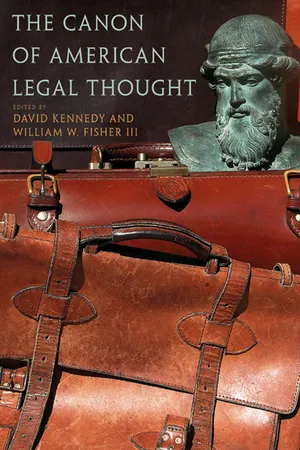
eBook - PDF
The Canon of American Legal Thought
- 936 pages
- English
- PDF
- Available on iOS & Android
eBook - PDF
The Canon of American Legal Thought
About this book
Information
Publisher
Princeton University PressYear
2018Print ISBN
9780691120003
9780691120010
eBook ISBN
9780691186429
Table of contents
- Cover
- Title Page
- Copyright Page
- CONTENTS
- Preface
- Introduction
- Part I: Attacking the Old Order: 1900–1940
- Part II: A New Order: The Legal Process, Policy, and Principle: 1940–1960
- Part III: The Emergence of Eclecticism: 1960–2000
Trusted by 375,005 students
Access to over 1.5 million titles for a fair monthly price.
Study more efficiently using our study tools.
Frequently asked questions
Yes, you can cancel anytime from the Subscription tab in your account settings on the Perlego website. Your subscription will stay active until the end of your current billing period. Learn how to cancel your subscription
No, books cannot be downloaded as external files, such as PDFs, for use outside of Perlego. However, you can download books within the Perlego app for offline reading on mobile or tablet. Learn how to download books offline
Perlego offers two plans: Essential and Complete
- Essential is ideal for learners and professionals who enjoy exploring a wide range of subjects. Access the Essential Library with 800,000+ trusted titles and best-sellers across business, personal growth, and the humanities. Includes unlimited reading time and Standard Read Aloud voice.
- Complete: Perfect for advanced learners and researchers needing full, unrestricted access. Unlock 1.5M+ books across hundreds of subjects, including academic and specialized titles. The Complete Plan also includes advanced features like Premium Read Aloud and Research Assistant.
We are an online textbook subscription service, where you can get access to an entire online library for less than the price of a single book per month. With over 1.5 million books across 990+ topics, we’ve got you covered! Learn about our mission
Look out for the read-aloud symbol on your next book to see if you can listen to it. The read-aloud tool reads text aloud for you, highlighting the text as it is being read. You can pause it, speed it up and slow it down. Learn more about Read Aloud
Yes! You can use the Perlego app on both iOS and Android devices to read anytime, anywhere — even offline. Perfect for commutes or when you’re on the go.
Please note we cannot support devices running on iOS 13 and Android 7 or earlier. Learn more about using the app
Please note we cannot support devices running on iOS 13 and Android 7 or earlier. Learn more about using the app
Yes, you can access The Canon of American Legal Thought by David Kennedy, William W. Fisher, David Kennedy,William W. Fisher III, David Kennedy, William Fisher in PDF and/or ePUB format, as well as other popular books in Law & Law Theory & Practice. We have over 1.5 million books available in our catalogue for you to explore.