For the first time, novelist Iris Murdoch's life in her own words, from girlhood to her last years
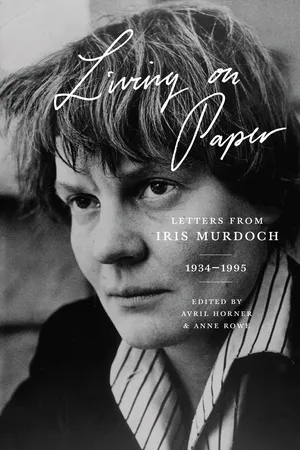
Iris Murdoch was an acclaimed novelist and groundbreaking philosopher whose life reflected her unconventional beliefs and values. But what has been missing from biographical accounts has been Murdoch's own voice—her life in her own words. Living on Paper—the first major collection of Murdoch's most compelling and interesting personal letters—gives, for the first time, a rounded self-portrait of one of the twentieth century's greatest writers and thinkers. With more than 760 letters, fewer than forty of which have been published before, the book provides a unique chronicle of Murdoch's life from her days as a schoolgirl to her last years. The result is the most important book about Murdoch in more than a decade.
The letters show a great mind at work—struggling with philosophical problems, trying to bring a difficult novel together, exploring spirituality, and responding pointedly to world events. They also reveal her personal life, the subject of much speculation, in all its complexity, especially in letters to lovers or close friends, such as the writers Brigid Brophy, Elias Canetti, and Raymond Queneau, philosophers Michael Oakeshott and Philippa Foot, and mathematician Georg Kreisel. We witness Murdoch's emotional hunger, her tendency to live on the edge of what was socially acceptable, and her irreverence and sharp sense of humor. We also learn how her private life fed into the plots and characters of her novels, despite her claims that they were not drawn from reality.
Direct and intimate, these letters bring us closer than ever before to Iris Murdoch as a person, making for an extraordinary reading experience.
eBook - ePub
Living on Paper
Letters from Iris Murdoch, 1934–1995
- 688 pages
- English
- ePUB (mobile friendly)
- Available on iOS & Android
eBook - ePub
Living on Paper
Letters from Iris Murdoch, 1934–1995
About this book
Information
Publisher
Princeton University PressYear
2016Print ISBN
9780691180922
9780691170565
eBook ISBN
9781400880300
PART ONE:
Schoolgirl and Student
August 1934 to December 1941
Iris Murdoch was born on 15 July 1919 at 59 Blessington Street, North Dublin, her mother’s home town. She and her mother soon moved to 12 Caithness Road, Hammersmith in London to join her father, Hughes Murdoch, who had taken the post of second-class clerk at the Ministry of Health in 1919 after having served as second lieutenant in the 1st King Edward’s Horse regiment during the First World War. In 1926 the Murdochs moved to 4 Eastbourne Road, Chiswick where the family of three, remembered with great fondness by Murdoch as ‘a perfect trinity of love’,i was to live for many years. Although they lived in London, they returned to Ireland most years for holidays. At the age of five, Murdoch was sent to the Froebel Demonstration School at Colet Gardens, Hammersmith where she was very happy, later recalling those years as a time of ‘light, of freedom’ during which she enjoyed ‘the great greedy pleasures of learning, the calm kindly authority of teachers, the instant amiability of the children’.ii Excelling at all aspects of her learning, she was made head girl in her final year. In 1932, Murdoch won one of the two open scholarships to Badminton School, Bristol, a small, ‘internationally minded’, ‘forward-looking’, tolerant and liberal institution with only 163 girls, of whom ninety-six were boarders.iii After an unhappy and homesick start, she soon settled in and began to thrive on its atmosphere of rigorous learning and left-wing politics. In 1938 she was awarded an Open Exhibition to read English at Somerville College, Oxford. She quickly changed direction, however, moving to Classics in order to study ‘Mods’ (Greek and Latin language and literature) and ‘Greats’ (philosophy and ancient history). Here she met Mary Scrutton (later to become Mary Midgley), Philippa Bosanquet (later to become Philippa Foot), David Hicks, Frank Thompson, M. R. D. Foot, Hal Lidderdale and Leo Pliatzky, who would all feature significantly in her life.
The short run of eleven early letters that comprise this section spans the years from 1934, when Murdoch was a fifteen-year-old at Badminton School, to the end of 1941, when she was in her final year at Oxford. A number are to her school friend, Ann Leech, the youngest daughter of a Manchester doctor, whom she met on her first day at Badminton and who was to become a lifelong friend. Murdoch’s future talents and interests are already evident: the teenager’s excited recording of a dramatic incident on a family holiday in Ireland presages more mature impulses to transform life into narrative. An early love of the visual arts, as well as a determination to paint, foreshadows her courting the company of painters and the inclusion of favourite paintings in her novels. Her enthusiastic reading of Gorki and Mallarmé anticipates her subsequent intoxication with European philosophy and literature.
The zeitgeist of the late 1930s generated a fierce left-wing political idealism, and Murdoch became heavily involved in Labour Club activities and joined the Communist Party soon after arriving at Oxford. On the one hand she loathed politics, much preferring the study of Classics; on the other she believed that in such times no one had any choice but to be politically engaged. Her radical leanings are expressed in her letters to Ann Leech and include an animated account of ‘The Festival of Music for the People’ at the Royal Albert Hall in 1939. Her Communist sympathies had stripped her of the Protestantism of her youth and she defined her religion at this point in her life as a passionate belief in the beautiful and a faith in the ultimate triumph of the people. In 1939 she shared the common anxiety that Britain might be overrun by Nazis in the near future; indeed, in March of that year some of her Oxford contemporaries, including Frank Thompson and Leo Pliatzky, acted in and produced their own play, It Can Happen Here, which imagined Britain as a fascist state.iv Later that year Murdoch performed with an acting troupe, the Magpie Players, a travelling theatre comprising young men and women from Oxford who toured the West Country from 28 August to 16 September 1939, performing in small theatres, village halls, schools and in the open air. All proceeds were donated to various humanitarian organisations. Murdoch became fully aware of the privileged life she led during the war years that followed, when so many were suffering and dying, and in 1940 confessed to Eduard Fraenkel, her tutor, that she felt guilty about her inability to participate in the war effort. One of the central tenets of her philosophy, that morally improving the self is a fundamental prerequisite for a healthy society, is seen to emerge during these years, as does persistent insecurity about her intellectual abilities. In a more intimate vein, Murdoch confides to Ann Leech that she already has the capacity to be in love with six men at once. Such ‘complications and distresses’ will continue well into her adult life and will also feature in the fictional lives of her characters.
To Ann Leech, written from Ireland where Murdoch was on holiday with her parents.
15 Mellifont Av
Kingstown
Co. Dublin
29 August 1934
Kingstown
Co. Dublin
29 August 1934
Dear Ann,
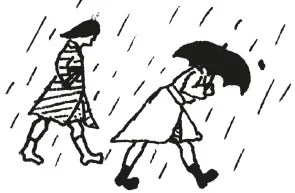
Hello! A grey and relentless sky has been pouring rain on us for the last week, and the sun has forgotten how to shine.
I will come to Manchester on September 4th, Tuesday, by the train arriving at London Road station at 2.10 p.m., 10.30 from Euston. Will that be all right? Please write to 4 Eastbourne Rd and say if it is.
Great excitement here! Last Sunday week night (that sounds queer) a terrible storm got up, and on Monday morning about 8 a.m. the first maroon1 went for the lifeboat. I was in the bathroom at the time. I never got washed so quick as I did then. I was dressed and doing my hair when the second maroon went. Then I flew out of the house. Doors were banging all the way down the street, and the entire population of Dun Laoghaire2 seemed to be running to the harbour. Doodle (Daddy) and my cousin had already left with the first maroon.
The lifeboat was in the harbour mouth when I arrived. I asked a man what was up. A yacht had evidently broke its moorings and drifted out of the harbour or something, anyway we could just see it on the horizon. A high sea was running and I was glad to have my mackintosh with me. I dashed down the pier – which by the way is a mile long – and was drenched by the spray and the waves breaking over the pier. The sand whipped up by the wind, drove in clouds and I got some in my eye, which hurt like anything.
The lifeboat had an awful job, it was pitching and tossing, and once we thought it was going down, but it got to the yacht, which turned out to be empty, and towed it back amid the enthusiastic cheers of the populace. Three other yachts broke their moorings in the harbour, of these, two went down, and the other was saved and towed to calmer waters just as it was dashing itself to pieces against the pier. That was a great thrill. The next excitement was a huge German liner – three times as big as the mail boat – that anchored in the bay. It was too big to get into the harbour. Launches took the passengers ashore and the officers conversed in German, much to everyone’s delight. The ship was touring Ireland and the tourists were taken in buses round the Wicklow Mountains. Today they are raising one of the yachts that sunk.
We go back to England tomorrow, and I hope we have a better crossing this time. Goodbye Ann.
See you on Tuesday.
Lots of love
From
Iris
To Ann Leech.
Badminton School
Bristol
17 July 1938
Bristol
17 July 1938
Dear Ann,
You angel! Thanks ever so much. Your present was Lust for Life by Irving Stone – a novel about Van Gogh. I read it most of Friday, finished it about 6.30 – 500 large pages, not bad going – and shall probably change it tomorrow! I may add 2s 6d and get Herbert Read’s Art Now.3 I haven’t quite decided. Lust for Life was terrific. It just knocked me off my feet – I had no idea Van Gogh was such a wonderful, passionate, dramatic sort of person. He began as a clerk in an art dealer’s, where he was not successful, as he refused to humour customers who had bad taste. Then he tried teaching, tried to go to a university, went as an Evangelist to the worst Belgian mining districts. Here he lost his job because the heads of his missionary society, coming round unexpectedly, found him conducting a service in a filthy hut, all covered with coal dust and dressed in sacking, as he had given all his clothes away. This, they thought, was a most shameful degradation of the dignity of the church!
He was heartbroken – and one day, sitting outside the mine, he began to sketch the miners as they came out – and that was the beginning. During his whole life he only sold one picture – and had to be supported by his brother Theo, a Paris art dealer and one of the salt of the earth. He went to Arles eventually and lived with Gaugin [sic], painting passionately, wildly all day in the terrific heat, quarrelling about art with Gaugin all night, and living on absinthe. This couldn’t last long – he began to have epileptic fits, and finally shot himself lest he should become permanently mad and be a burden on Theo. Theo was heartbroken and died a few months later.
I am now, consequently, consumed with the desire to paint all day and all night – and am making a start this morning with an oil painting of Maria. If only I were about six times as good as I am, I’d chuck up Oxford and go to an art school. I’d sell every faculty I have to paint one good picture.
Sorry – I hope all this hasn’t bored you.
Yesterday Architecture Club and me went to Montacute House, near Yeovil – my God it was glorious. It’s a huge Elizabethan house, in perfect preservation inside and out, full of the most exquisite carving, and surrounded by the most perfect Elizabethan gardens. It’s just the place Bacon4 would have loved – square velvety lawns, lily ponds, yew trees centuries old, and two ‘gazebos’. (Bet you don’t know what they are!) There were white fantail doves flying about it all the while, and there were peacocks to walk on the terraces, but apparently the ungrateful birds spend all their time roosting in the depths of the wood! I wonder what they think they’re kept for?
Good luck for Sweden – I expect you are feeling thrilled. […] Some people have all the luck! We shall probably go to Ireland and join in the family quarrel – ugh.
I hope you have a marvellous time – and thanks awfully for the present.
Lots of love
Iris
Finished the painting – it’s frightful!
To Ann Leech.
4 Eastbourne Rd
Chiswick
London
W4
27 September 1938
Chiswick
London
W4
27 September 1938
Dear Ann,
Thank the gods for one piece of good news – I a...
Table of contents
- Cover Page
- Title Page
- Copyright Page
- Dedication Page
- Contents
- List of Illustrations
- Introduction
- Part One: Schoolgirl and Student, August 1934 to December 1941
- Part Two: Work and War, July 1942 to October 1947
- Part Three: Academic and Author, October 1947 to September 1954
- Part Four: Decisions, February 1955 to December 1962
- Part Five: The RCA Years, January 1963 to November 1967
- Part Six: Woman of Letters, January 1968 to December 1978
- Part Seven: Dame Iris, January 1979 to December 1989
- Part Eight: Last Letters, February 1990 to September 1995
- Directory of Names and Terms
- Murdoch’s Novels and Their Dedicatees
- Sources of Letters
- Abbreviations
- Notes
- Acknowledgements
- Index
- Plate 1
- Plate 2
Trusted by 375,005 students
Access to over 1.5 million titles for a fair monthly price.
Study more efficiently using our study tools.
Frequently asked questions
Yes, you can cancel anytime from the Subscription tab in your account settings on the Perlego website. Your subscription will stay active until the end of your current billing period. Learn how to cancel your subscription
No, books cannot be downloaded as external files, such as PDFs, for use outside of Perlego. However, you can download books within the Perlego app for offline reading on mobile or tablet. Learn how to download books offline
Perlego offers two plans: Essential and Complete
- Essential is ideal for learners and professionals who enjoy exploring a wide range of subjects. Access the Essential Library with 800,000+ trusted titles and best-sellers across business, personal growth, and the humanities. Includes unlimited reading time and Standard Read Aloud voice.
- Complete: Perfect for advanced learners and researchers needing full, unrestricted access. Unlock 1.5M+ books across hundreds of subjects, including academic and specialized titles. The Complete Plan also includes advanced features like Premium Read Aloud and Research Assistant.
We are an online textbook subscription service, where you can get access to an entire online library for less than the price of a single book per month. With over 1.5 million books across 990+ topics, we’ve got you covered! Learn about our mission
Look out for the read-aloud symbol on your next book to see if you can listen to it. The read-aloud tool reads text aloud for you, highlighting the text as it is being read. You can pause it, speed it up and slow it down. Learn more about Read Aloud
Yes! You can use the Perlego app on both iOS and Android devices to read anytime, anywhere — even offline. Perfect for commutes or when you’re on the go.
Please note we cannot support devices running on iOS 13 and Android 7 or earlier. Learn more about using the app
Please note we cannot support devices running on iOS 13 and Android 7 or earlier. Learn more about using the app
Yes, you can access Living on Paper by Iris Murdoch, Avril Horner,Anne Rowe, Avril Horner, Anne Rowe in PDF and/or ePUB format, as well as other popular books in Literature & Literary Biographies. We have over 1.5 million books available in our catalogue for you to explore.