Timeless wisdom on growing old gracefully from one of ancient Rome's greatest philosophers
Worried that old age will inevitably mean losing your libido, your health, and possibly your marbles too? Well, Cicero has some good news for you. In How to Grow Old, the great Roman orator and statesman eloquently describes how you can make the second half of life the best part of all—and why you might discover that reading and gardening are actually far more pleasurable than sex ever was.
Filled with timeless wisdom and practical guidance, Cicero's brief, charming classic—written in 44 BC and originally titled On Old Age—has delighted and inspired readers, from Saint Augustine to Thomas Jefferson, for more than two thousand years. Presented here in a lively new translation with an informative new introduction and the original Latin on facing pages, the book directly addresses the greatest fears of growing older and persuasively argues why these worries are greatly exaggerated—or altogether mistaken.
Montaigne said Cicero's book "gives one an appetite for growing old." The American founding father John Adams read it repeatedly in his later years. And today its lessons are more relevant than ever in a world obsessed with the futile pursuit of youth.
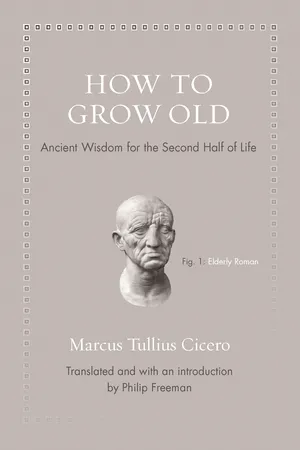
eBook - ePub
How to Grow Old
Ancient Wisdom for the Second Half of Life
- 216 pages
- English
- ePUB (mobile friendly)
- Available on iOS & Android
eBook - ePub
How to Grow Old
Ancient Wisdom for the Second Half of Life
About this book
Information
Topic
FilosofiaSubtopic
Filosofia antica e classicaHOW TO GROW OLD
Dedication to my friend Atticus
1. Oh Titus, if I can give you any help,
if I can lighten the cares fixed in your breast
that now roast you and turn you on a spit,
what will be my reward?1
And so, Atticus, may I address you in the same lines which
that man of little wealth but rich in loyalty
speaks to Flamininus—although I’m sure that you’re not like Flamininus
who is tossed about by worry, Titus, day and night.
I know that you are a man of moderation and even temper, who brought home from Athens more than just a name!2 You brought back a cultured and prudent mind as well. Yet I suspect that you are troubled by the same political events of our day that are causing me such anxiety. But looking for comfort from such things is too difficult to do now and is a topic we’ll have to put off until another time.
2. Instead, I would like to write something for you now about the subject of growing old. This burden is common to both of us—or at least it’s quickly and unavoidably approaching—and I want to lighten the burden for you and me alike.3 I know that you of course are facing the prospect of aging calmly and wisely, and that you will continue to do so in the future, just as you approach everything in life. But still, when I was thinking about writing on the subject, you kept coming to mind. I would like this little book to be a worthy gift that we can enjoy together. In fact, I’ve so much enjoyed composing this work that writing it has wiped away all thoughts of the disadvantages of growing older and made it instead seem a pleasant and enjoyable prospect.
We truly can’t praise the love and pursuit of wisdom enough, since it allows a person to enjoy every stage of life free from worry.
3. I’ve written a great deal on other matters and will again in the future, but, as I said, this book that I’m sending you now is about growing old. When Aristo of Ceos wrote about the subject, he made Tithonus his spokesman, but I think it’s wrong to give a mythological character such authority.4 Instead, I have put my words into the mouth of the aged Marcus Cato so that they might be taken more seriously. I imagine Laelius and Scipio with him at his house, admiring how he is handling his age so well.5 If he seems to reply in a way that is more learned than he appears in his own writings, attribute it to the Greek literature he studied carefully in his later years.
But why should I say more? From here on, the words of Cato himself will unfold to you my thoughts on growing older.
THE CONVERSATION WITH CATO
4. Scipio: When Gaius Laelius and I are talking, Marcus Cato, we often admire your outstanding and perfect wisdom in general, but more particularly that growing old never seems to be a burden to you. This is quite different from the complaints of most older men, who claim that aging is a heavier load to bear than Mount Etna.6
Cato: I think, my young friends, that you are admiring me for something that isn’t so difficult. Those who lack within themselves the means for living a blessed and happy life will find any age painful. But for those who seek good things within themselves, nothing imposed on them by nature will seem troublesome. Growing older is a prime example of this. Everyone hopes to reach old age, but when it comes, most of us complain about it. People can be so foolish and inconsistent.
They say that old age crept up on them much faster than they expected. But, first of all, who is to blame for such poor judgment? Does old age steal upon youth any faster than youth does on childhood? Would growing old really be less of a burden to them if they were approaching eight hundred rather than eighty? If old people are foolish, nothing can console them for time slipping away, no matter how long they live.
5. So if you compliment me on being wise—and I wish I were worthy of that estimate and my name7—in this way alone do I deserve it: I follow nature as the best guide and obey her like a god. Since she has carefully planned the other parts of the drama of life, it’s unlikely that she would be a bad playwright and neglect the final act. And this last act must take place, as surely as the fruits of trees and the earth must someday wither and fall. But a wise person knows this and accepts it with grace. Fighting against nature is as pointless as the battles of the giants against the gods.8
6. Laelius: True, Cato, but we have a special request to make of you—and I think I speak for Scipio as well. We both hope to live long enough to become old someday, so we would be very grateful if you could teach us even now how we can most reasonably bear the weight of the approaching years.
Cato: It would be my pleasure, Laelius, if you would really like me to.
Laelius: We would indeed, if it’s not too much trouble. You’ve already traveled far on the road we will follow, so we would like to learn about the journey from you.
7. Cato: I’ll do my best. I have often heard the complaints of people my age—“like gathers with like,” says the old proverb—especially Gaius Salinator and Spurius Albinus, my near-contemporaries and former consuls, who were constantly moaning about how age had snatched away the sensual pleasures of life, pleasures without which—at least to them—life was not worth living.9 Then they complained that they were being neglected by those who had once paid them attention. But in my view, their blame was misplaced. If aging were the real problem, then the same ills would have befallen me and every other old person. But I have known many people who have grown old without complaint, who don’t miss the binding chains of sensual passion, and who aren’t neglected by their friends. Again, the blame for all these sorts of complaints is a matter of character, not of age. Older people who are reasonable, good-tempered, and gracious will bear aging well. Those who are mean-spirited and irritable will be unhappy at every period of their lives.
8. Laelius: That is undoubtedly true, Cato. But what if someone were to say that your wealth, property, and social standing—advantages in life that few people possess—are what have made growing older so pleasant for you?
Cato: There is some truth in that, Laelius, but it isn’t the whole story. Remember the tale of Themistocles and the man from Seriphos.10 The two were having an argument one day during which the Seriphian said that Themistocles was famous only because of the glory of his city, not his own achievements. “By Hercules, that’s true,” said Themistocles. “I would never have been famous if I was from Seriphos—nor you if you were from Athens.” The same can be said of old age. It isn’t a light burden if a person, even a wise man, is poor. But if someone is a fool, all the money in the world won’t make aging easier.
9. My dear Scipio and Laelius, old age has its own appropriate defenses, namely, the study and practice of wise and decent living. If you cultivate these in every period of your life, then when you grow old they will yield a rich harvest. Not only will they produce wondrous fruit even at the very end of life—a key point in our discussion—but you will be satisfied to know that you have lived your life well and have many happy memories of these good deeds.
10. When I was young, I was fond of Quintus Maximus, who recaptured Tarentum, as if we were the same age, although he was an old man and I just a lad.11 He was a man of dignity seasoned with friendliness, and age had not changed him. When I first began to get to know him, he was not yet of great old age but certainly growing advanced in years. He had first become a consul the year after I was born. In his fourth term as consul, I was a young soldier marching with him to Capua, then five years later to Tarentum. Four years after that, when Tuditanus and Cethegus were consuls, I became a quaestor. At that same time Quintus Maximus was giving speeches in favor of the Cincian Law on gifts and rewards, though he was quite elderly by then.12
Even though he was old, he waged war like a young man, and wore down Hannibal’s youthful exuberance by his persistence. My friend Ennius spoke splendidly about him:
One man, by delaying, saved our country.
He refused to put his reputation above the safety of Rome,
so that now his glory grows ever brighter.
11. Such vigilance and skill he displayed in recapturing Tarentum! I myself heard Salinator—the Roman commander who had lost the town and fled to the citadel—boast to him, “Quintus Fabius, you owe the retaking of Tarentum to me.”13 The general laughed and said in reply, “That’s certainly true, since I wouldn’t have had to recapture it if you hadn’t lost it in the first place.”
Nor was Fabius more distinguished as a soldier than as a statesman. When he was consul the second time, the tribune Gaius Flaminius was trying to parcel out Picene and Gallic land against the express will of the Senate. Even though his colleague Spurius Carvilius kept silent, Fabius made every effort to oppose Flaminius.14 And when he was an augur, he dared to say that the auspices favored whatever was for the good of the state and that what was bad for the state was against the auspices.15
12. I can assure you from personal observation that there were many admirable qualities in that man, but nothing was more striking than how he bore the death of his son, a distinguished former consul. His funeral oration is available for us to read, and when we do, what philosopher is not put to shame? But Fabius wasn’t just commendable in public while under the gaze of his fellow citizens. He was even more admirable in the privacy of his own home. His conversation, his moral advice, his knowledge of history, his expertise in the laws of augury—all were astonishing! He was very well read for a Roman, and knew everything not only about our own wars but also about foreign conflicts. I was eager to listen to him at the time, as if I foresaw, as indeed happened, that when he was gone I would have no one else to learn from.
13. Why have I said so much about Fabius Maximus? So that you might see how wrong it would be to describe an old age like his as unhappy. Of course, not everyone is able to be a Scipio or a Fabius and talk about the cities they have conquered, the battles they have fought on land or sea, the wars they have waged, and the triumphs they have won. But there is another kind of old age, the peaceful and serene end of a life spent quietly, blamelessly, and with grace. Plato lived this way in his last years, still writing when he died at eighty-one.16 Isocrates is another example, who tells us himself he was ninety-four when he composed his Panathenaicus—and he lived another five years after that!17 His teacher Gorgias of Leontini reached his one hundred and seventh birthday, never resting from his studies and work.18 When someone asked him why he wished to live so long, he replied, “I have no reason to complain about old age.” A noble answer, worthy of a scholar.
14. Foolish people blame old age for their own faults and shortcomings. Ennius, whom I mentioned just a little while ago, certainly didn’t do this, for he compares himself as an old man to a gallant and victorious racehorse:
Like a courageous steed that has often won Olympic races
in the last lap, now weakened by age he takes his rest.
You probably remember Ennius quite clearly, for he died only nineteen years before the election of our present consuls, Titus Flamininus and Manius Acilius, back when Caepio and Philippus were consuls (the latter for the second time). I was sixty-five when he died and I made a speech in favor of the Voconian Law with a loud voice and mighty lungs.19 Ennius was seventy at the time and suffered what men suppose are the two greatest burdens of life—poverty and old age. But he bore them so well you might think he enjoyed them.
15. When I think about old age, I can find four reasons why people consider it so miserable:
First, because it takes us away from an active life.
Second, because it weakens the body.
Third, because it deprives us of almost all sensual pleasures.
Fourth, because it is not far from death.
If you don’t mind, let’s look at each of these reasons one by one to see if they are true.
The Active Life
Let’s consider first the claim that old age denies us an active life. What kind of activities are we talking about? Don’t we mean the sort we engage in when young and strong? But surely there are activities suitable for older minds even when the body is w...
Table of contents
- Cover Page
- Title Page
- Copyright Page
- Contents
- Introduction
- How to Grow Old
- Cato Maior De Senectute (Latin Text)
- Notes
- Further Reading
Trusted by 375,005 students
Access to over 1.5 million titles for a fair monthly price.
Study more efficiently using our study tools.
Frequently asked questions
Yes, you can cancel anytime from the Subscription tab in your account settings on the Perlego website. Your subscription will stay active until the end of your current billing period. Learn how to cancel your subscription
No, books cannot be downloaded as external files, such as PDFs, for use outside of Perlego. However, you can download books within the Perlego app for offline reading on mobile or tablet. Learn how to download books offline
Perlego offers two plans: Essential and Complete
- Essential is ideal for learners and professionals who enjoy exploring a wide range of subjects. Access the Essential Library with 800,000+ trusted titles and best-sellers across business, personal growth, and the humanities. Includes unlimited reading time and Standard Read Aloud voice.
- Complete: Perfect for advanced learners and researchers needing full, unrestricted access. Unlock 1.5M+ books across hundreds of subjects, including academic and specialized titles. The Complete Plan also includes advanced features like Premium Read Aloud and Research Assistant.
We are an online textbook subscription service, where you can get access to an entire online library for less than the price of a single book per month. With over 1.5 million books across 990+ topics, we’ve got you covered! Learn about our mission
Look out for the read-aloud symbol on your next book to see if you can listen to it. The read-aloud tool reads text aloud for you, highlighting the text as it is being read. You can pause it, speed it up and slow it down. Learn more about Read Aloud
Yes! You can use the Perlego app on both iOS and Android devices to read anytime, anywhere — even offline. Perfect for commutes or when you’re on the go.
Please note we cannot support devices running on iOS 13 and Android 7 or earlier. Learn more about using the app
Please note we cannot support devices running on iOS 13 and Android 7 or earlier. Learn more about using the app
Yes, you can access How to Grow Old by Marcus Tullius Cicero, Philip Freeman, Philip Freeman,Philip Freeman in PDF and/or ePUB format, as well as other popular books in Filosofia & Filosofia antica e classica. We have over 1.5 million books available in our catalogue for you to explore.