Twenty essential tips for picking great leaders from the father of modern politics
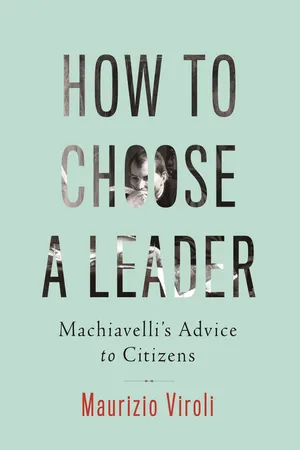
One of the greatest political advisers of all time, Niccolò Machiavelli thought long and hard about how citizens could identify great leaders—ones capable of defending and enhancing the liberty, honor, and prosperity of their countries. Drawing on the full range of the Florentine's writings, acclaimed Machiavelli biographer Maurizio Viroli gathers and interprets Machiavelli's timeless wisdom about choosing leaders. The brief and engaging result is a new kind of Prince—one addressed to citizens rather than rulers and designed to make you a better voter.
Demolishing popular misconceptions that Machiavelli is a cynical realist, the book shows that he believes republics can't survive, let alone thrive, without leaders who are virtuous as well as effective. Among much other valuable advice, Machiavelli says that voters should pick leaders who put the common good above narrower interests and who make fighting corruption a priority, and he explains why the best way to recognize true leaders is to carefully examine their past actions and words. On display throughout are the special insights that Machiavelli gained from long, direct knowledge of real political life, the study of history, and reflection on the political thinkers of antiquity.
Recognizing the difference between great and mediocre political leaders is difficult but not at all impossible—with Machiavelli's help. So do your country a favor. Read this book, then vote like Machiavelli would.
- 144 pages
- English
- ePUB (mobile friendly)
- Available on iOS & Android
eBook - ePub
About this book
Information
NOTES

1. Leo Strauss, Thoughts on Machiavelli (Glencoe, Ill.: Free Press, 1958).
2. C. Bradley Thompson, “John Adams’s Machiavellian Moment,” Review of Politics 57 (1995), pp. 389–417. See also Karl Walling, “Was Alexander Hamilton a Machiavellian Statesman?” Review of Politics 57 (1995), pp. 419–447; and Brian Danoff, “Lincoln, Machiavelli, and American Political Thought,” Presidential Studies Quarterly 30 (2000), pp. 290–310.
3. On the intellectual features of the American Revolution, see Gordon S. Wood, The Creation of the American Republic, 1776–1787 (Chapel Hill: University of North Carolina Press, 1969); Bailyn Bernard, The Ideological Origins of the American Revolution (Cambridge, Mass.: Belknap Press of Harvard University Press, 1967).
4. Niccolò Machiavelli to Francesco Vettori, August 26, 1513, in Machiavelli and His Friends: Their Personal Correspondence, trans. and ed. James B. Atkinson and David Sices (DeKalb, Ill.: Northern Illinois University Press, 1996), p. 258.
5. Discourses on Livy I.58.
6. Discourses on Livy III.28.
7. A Discourse on Remodeling the Government of Florence, in Machiavelli: The Chief Works and Others, trans. Allan Gilbert (Durham, N.C. and London: Duke University Press, 1989), vol. I, p. 115; The Prince XXI.
8. Discourses on Livy I.5.
9. Discourses on Livy I.7.
10. Discourses on Livy I.58.
11. The Prince XXI.
12. The Prince XVIII.
13. The Prince XVIII.
14. The Prince XXII.
15. The Prince XXIII.
16. Jean Edward Smith, FDR (New York: Random House, 2007), pp. 262–263.
17. Discourses on Livy II.2.
18. Discourses on Livy III.8.
19. Discourses on Livy I.40.
20. Discourses on Livy III.9.
21. Stephen G. Walker and Akan Malici, U.S. Presidents and Foreign Policy Mistakes (Stanford: Stanford University Press, 2011), pp. 120–121.
22. Walker and Malici, U.S. Presidents, p. 7.
23. Discourses on Livy III.9.
24. Discourses on Livy I.58.
25. Discourses on Livy I.53.
26. Walker and Malici, U.S. Presidents, pp. 145–146.
27. The Prince VI.
28. Discourses on Livy I.14.
29. “FDR’s Models, Theodore Roosevelt and Woodrow Wilson,” chapter I.1 in fdr4Freedoms, accessed November 29, 2015, http://fdr4freedoms.org/wp-content/themes/fdf4fdr/DownloadablePDFs/I_FDRBeforethePresidency/01_FranklinDRooseveltsModels.pdf
30. Frank James, “Obama Cites Lincoln as Principled Politician Who Compromised,” NPR “it’s all politics,” July 22, 2011, accessed November 29, 2015, http://www.npr.org/sections/itsallpolitics/2011/07/22/138619171/obama-cites-lincoln-as-model-of-principled-politician-who-compromised.
31. Discourses on Livy I.39.
32. Francesco Guicciardini, Maxims and Reflections of a Renaissance Statesman (Ricordi), trans. Mario Domandi; introduction by Nicolai Rubinstein (Gloucester, Mass.: P. Smith, 1970).
33. Tercets on Fortune 25–30.
34. Machiavelli to Giovan Battista Soderini, September 13–21, 1506, in Machiavelli and His Friends, p. 135.
35. The Prince XXV.
36. Discourses on Livy II.27.
37. Discourses on Livy III.31.
38. Abraham Lincoln, Speeches and Writings, 1859–1865 (New York: Library of America, 1989), p. 586.
39. The Prince XX...
Table of contents
- Cover Page
- Title Page
- Copyright Page
- Contents
- Introduction: Why Ask Machiavelli?
- I: Citizens ought to “keep their hands on the republic” and “choose the lesser evil.”
- II: “Judge by the hands, not by the eyes.”
- III: “It is the common good which makes republics great.”
- IV: “Whoever desires constant success must change his conduct with the times.”
- V: “How by the delusions of seeming good the people are often misled to desire their own ruin; and how they are frequently influenced by great hopes and brave promises.”
- VI: “Men almost always follow the beaten track of others, and proceed in their actions by imitation.”
- VII: “Great men and powerful republics preserve an equal dignity and courage in prosperity and adversity.”
- VIII: “And although these men were rare and wonderful, they were nevertheless but men, and the opportunities which they had were far less favorable than the present; nor were their undertakings more just or more easy than this; neither was God more a friend of them than of you.”
- IX: “For it is the duty of any good man to teach others that good which the malignity of the times and of fortune has prevented his doing himself; so that amongst the many capable ones whom he has instructed, someone perhaps, more favored by Heaven, may perform it.”
- X: “It is very difficult, indeed almost impossible to maintain liberty in a republic that has become corrupt or to establish it there anew.”
- XI: “Poverty never was allowed to stand in the way of the achievement of any rank or honor and virtue and merit were sought for under whatever roof they dwelt; it was this system that made riches naturally less desirable.”
- XII: “In well-regulated republics the state ought to be rich and the citizens poor.”
- XIII: “Prolonged commands brought Rome to servitude.”
- XIV: “I love my country more than my soul.”
- XV: “For where the very safety of the country depends upon the resolution to be taken, no considerations of justice or injustice, humanity or cruelty, nor of glory or of shame, should be allowed to prevail. But putting all other considerations aside, the only question should be, ‘what course will save the life and liberty of the country?’”
- XVI: “The authority of the dictatorship has always proved beneficial to Rome, and never injurious; it is the authority which men usurp, and not that which is given them by the free suffrages of their fellow-citizens, that is dangerous to civil liberty.”
- XVII: “I say that I have never practiced war as my profession, because my profession is to govern my subjects and to defend them, and, in order to be able to defend them, to love peace and to know how to make war.”
- XVIII: “An excellent general is usually an orator because, unless he knows how to speak to the whole army, he will have difficulty in doing anything good.”
- XIX: “A prince becomes esteemed when he shows himself either a true friend or a real enemy.”
- XX: “To insure a long existence to religious sects or republics, it is necessary frequently to bring them back to their original principles.”
- Notes
- Sources of the Quotations
- Note on the Texts
Trusted by 375,005 students
Access to over 1.5 million titles for a fair monthly price.
Study more efficiently using our study tools.
Frequently asked questions
Yes, you can cancel anytime from the Subscription tab in your account settings on the Perlego website. Your subscription will stay active until the end of your current billing period. Learn how to cancel your subscription
No, books cannot be downloaded as external files, such as PDFs, for use outside of Perlego. However, you can download books within the Perlego app for offline reading on mobile or tablet. Learn how to download books offline
Perlego offers two plans: Essential and Complete
- Essential is ideal for learners and professionals who enjoy exploring a wide range of subjects. Access the Essential Library with 800,000+ trusted titles and best-sellers across business, personal growth, and the humanities. Includes unlimited reading time and Standard Read Aloud voice.
- Complete: Perfect for advanced learners and researchers needing full, unrestricted access. Unlock 1.5M+ books across hundreds of subjects, including academic and specialized titles. The Complete Plan also includes advanced features like Premium Read Aloud and Research Assistant.
We are an online textbook subscription service, where you can get access to an entire online library for less than the price of a single book per month. With over 1.5 million books across 990+ topics, we’ve got you covered! Learn about our mission
Look out for the read-aloud symbol on your next book to see if you can listen to it. The read-aloud tool reads text aloud for you, highlighting the text as it is being read. You can pause it, speed it up and slow it down. Learn more about Read Aloud
Yes! You can use the Perlego app on both iOS and Android devices to read anytime, anywhere — even offline. Perfect for commutes or when you’re on the go.
Please note we cannot support devices running on iOS 13 and Android 7 or earlier. Learn more about using the app
Please note we cannot support devices running on iOS 13 and Android 7 or earlier. Learn more about using the app
Yes, you can access How to Choose a Leader by Maurizio Viroli in PDF and/or ePUB format, as well as other popular books in Politics & International Relations & Civics & Citizenship. We have over 1.5 million books available in our catalogue for you to explore.