How American childhood and parenting have changed from the nation's founding to the present
The End of American Childhood takes a sweeping look at the history of American childhood and parenting, from the nation's founding to the present day. Renowned historian Paula Fass shows how, since the beginning of the American republic, independence, self-definition, and individual success have informed Americans' attitudes toward children. But as parents today hover over every detail of their children's lives, are the qualities that once made American childhood special still desired or possible? Placing the experiences of children and parents against the backdrop of social, political, and cultural shifts, Fass challenges Americans to reconnect with the beliefs that set the American understanding of childhood apart from the rest of the world.
Fass examines how freer relationships between American children and parents transformed the national culture, altered generational relationships among immigrants, helped create a new science of child development, and promoted a revolution in modern schooling. She looks at the childhoods of icons including Margaret Mead and Ulysses S. Grant—who, as an eleven-year-old, was in charge of his father's fields and explored his rural Ohio countryside. Fass also features less well-known children like ten-year-old Rose Cohen, who worked in the drudgery of nineteenth-century factories. Bringing readers into the present, Fass argues that current American conditions and policies have made adolescence socially irrelevant and altered children's road to maturity, while parental oversight threatens children's competence and initiative.
Showing how American parenting has been firmly linked to historical changes, The End of American Childhood considers what implications this might hold for the nation's future.
eBook - ePub
The End of American Childhood
A History of Parenting from Life on the Frontier to the Managed Child
- 352 pages
- English
- ePUB (mobile friendly)
- Available on iOS & Android
eBook - ePub
The End of American Childhood
A History of Parenting from Life on the Frontier to the Managed Child
About this book
Information
Publisher
Princeton University PressYear
2016Print ISBN
9780691178202
9780691162577
eBook ISBN
9781400880430
CHAPTER 1
Childhood and Parenting in the New Republic
Sowing the Seeds of Independence, 1800–1860
When Americans declared their independence from Britain and royal authority, they left behind not only a political system but also a way of understanding the world. Rather than a single ruler, they adopted the idea of the republic and of the shared authority for governance among its citizenry. Rather than submit to a dominant father figure, they looked to secure their future through divided authority. Americans continued to be connected to the European world in many essential ways, but they also altered these in important aspects. They maintained the English language and many English institutions, like the common law. They inherited a long tradition of Western philosophy and the basics of the Protestant faith. They ate foods familiar to their ancestors. Each of these practices was naturalized and subtly altered in the American environment: American intonations and rhythms changed the language; American sectarianism freed the nation from state-sponsored religion; some philosophical perspectives became part of the American grain at the expense of others; they added an array of New World foods to their diets.
In 1800, as Thomas Jefferson, whose famous Declaration had launched the Revolution, was elected president of the republic, the United States was on its way to becoming a distinct nation, with a culture that was both Western and unique to the American continent. In its various consequences, the American Revolution was thus far more than an expression of political difference with Great Britain. It expressed the changed circumstances of the environment that Americans inhabited and also created an impulse toward change as Americans began to see themselves as inheritors of a revolutionary tradition and reflected on its consequences for social life.1 The intimate sphere of family life was probably the most fundamental location of this change, as Americans reimagined how parents and children should relate and what the generations owed each other.
In the first half of the nineteenth century, Americans elaborated this difference in generational practices and attitudes. Deeply embedded in the politics of revolution and the economics of a new environment, the differences also reflected changes in gender roles and the allocation of power in the family as well as revised views of the reach of the law. They were connected to alterations in Protestant beliefs about the child as a trembling being who needed to be made ready for life as well as for death. Some things had not changed very much. The devastating mortality rate of infants and young children still bound Americans into the circle of sorrow that all Western parents, even those who saw themselves as harbingers of a new future, had to confront.
As they created their special variant of childhood and parenting, Americans were creating a social revolution fully in line with the political changes that began with the famous revolt of 1776.2 Both rejected entrenched hierarchy, and embraced independence and more personal autonomy. Both revolutions were uneasy and often hazardous undertakings. Together they made the United States into a very strange place in the world.
I
That strangeness is captured in many of the opinions voiced by articulate Americans in the first sixty years of the republic. “Our children,” Nathaniel Willis declared in 1827 as he launched his new publication, The Youth’s Companion, “are born to higher destinies than their fathers.” 3 This vision has become a cliché to us today. But it was alien to most Europeans and would have been unfamiliar to American colonists. For centuries in the Western world, elders reigned and were assumed to possess knowledge and wisdom as well as power. Their welfare and needs were primary and their dictates unquestioned. This perspective is still common in many parts of the world today. Lady Elphinstone of Scotland captured its essential meaning when she declared, “My children from the youngest to the eldest love me and fear me as sinners dread death. My look is law.”4 Views like these dominated Old World values regarding the appropriate reverence and obedience of children toward their parents.
American revolutionaries had rejected this tyrannical posture in the political arena. In the circumstances of the world they were creating, Americans also rejected such views as a guide to household affairs. Although Europeans, too, were changing their perspective on childhood as they absorbed the lessons of the Enlightenment, and as they responded to the political revolutions erupting throughout the continent, the social conditions of European life made it more difficult for them to change as rapidly or as fully as Americans in regard to how the generations treated each other.5
Why and how had things become so different in the nascent United States? Historians of the American Revolution have long understood that the changes articulated in that event were deeper than politics, that they had roots in cultural and social life, and affected the domestic realm and private relations. American children, famed historian Bernard Bailyn speculated over fifty years ago, needed a different, more open-ended kind of schooling. Since they needed to adapt to the new circumstances of a changing landscape, following in their fathers’ footsteps was not good enough. That knowledge was often inadequate to the circumstances. Individual resourcefulness and the willingness to adjust to the unexpected and to create the still un-imagined became basic values as Americans defined a new type of individual adequate to the possibilities of the new world they were creating. Children, who were less constrained by ingrained habits, had an advantage over their elders in the American environment. At a time when European Enlightenment thinkers were seeking to throw off the shackles of custom and tradition, Americans reorganized their lives in ways that unselfconsciously adapted those perspectives, removing layers of tradition and encrusted custom.
Even before the Revolution, Enlightenment European thinkers, such as John Locke and Jean-Jacques Rousseau, were read with marked appreciation by Americans who believed that these philosophers’ views about children, and about childhood as a formative phase of life, were especially relevant to their environment. John Locke is best known today for political writings that helped to establish the basis for America’s commitments to liberty, for opposing tyrannical rule, and for ideas that Jefferson and others used in formulating their views about freedom of religion and conscience. But Locke was also looked to as a pioneer in ideas about how children could be raised to become responsible citizens and trusted to exercise their independent judgment. He believed that children were malleable and childhood was a time when habits were laid down that would shape later life. He urged parents to appeal to children’s reason, not to their fear of punishment. Fewer restraints and adult impositions during childhood and a willingness to accept a child’s natural inclinations as a basis for learning underwrote Rousseau’s more radical beliefs in the innate wisdom and natural sensibilities of children. Rousseau looked to rid society of traditional ideas and social patterns by giving children more leeway to grow and time to exhibit that wisdom. In tracts written from the late seventeenth through the mid-eighteenth century, these two philosophers helped to shape modern ideas about children that were important throughout the West. For Americans eager to be informed, Locke and Rousseau captured the special importance of childhood to the ideals of a reformed society.
By the beginning of the nineteenth century, questions regarding parents and children and what they owed each other were very much part of the American conversation. After the Revolution, Americans eagerly addressed parent-child relations, sometimes with considerable urgency, because they saw the Revolution and republican government as setting special requirements for childrearing. Fathers’ injunctions, like kings’ dictates, were problematic in the new society they sought to create. The American revolutionaries spoke regularly of the rule of law and argued that they were trying to maintain liberties threatened by British imperial action. But even as they spoke about conserving older liberties, they turned toward more radical social notions. In attacking the legitimacy of the king—the most revered of earthly authorities—they undercut the unquestioned authority of fathers.6 That authority remained elsewhere the guiding basis for domestic and social relationships. In France, whose own revolution similarly raised fundamental questions about the rule of kings and fathers, republican beliefs initially dismantled patriarchy after the Revolution of 1789, but it was reassembled within a decade as the French republic tumbled and fell. In the United States, preexisting conditions and the continuity of republican and democratic ideas created a context in which social and family changes were sustained and elaborated.7
Not only were old-fashioned fathers deeply suspect in the United States, but Americans were asking what kinds of children were needed to maintain the revolution that Americans continued to embrace. This made matters regarding childrearing part of the national agenda from the very beginning of the republic. Most American historians have not fully appreciated how radically the American environment and the revolution that it spawned were revising the most fundamental of human bonds.
European visitors to the United States in the half-century after the Revolution saw it clearly. As they witnessed the behaviors and demeanors of the old and the young, they witnessed a series of historically important changes. The great observer and French political theorist, Alexis de Tocqueville, devoted a chapter of Democracy in America to the unusual nature of American family relations. Among chapters registering his observations about (and sometimes disdain for) Americans’ peculiar cultivation of the arts, their transformations of the English language, and their neglect of traditional philosophy, Tocqueville was much more admiring when describing “The Influence of Democracy on the Family.” That influence, he argued, was in line with other leveling effects of the greater equality experienced in the United States. “It has been universally remarked that in our time [1830s] the several members of the family stand upon an entirely new footing toward each other; that the distance which formerly separated a father from his sons has been lessened; and that paternal authority, if not destroyed, is at least impaired.”8
Societies throughout Europe and the Americas were also starting to feel the crosswinds of change, as the Western world came under the influence of democratizing conditions,9 but Tocqueville found it to be “even more striking” in the United States. Speaking of young people beyond the earliest years, he observed: “The same habits, the same principles, which impel the one to assert his independence predispose the other to consider the use of that independence as an incontestable right.” In Tocqueville’s view, independence in children was more than a practice; it had become a conscious part of a child’s self-understanding. This all took place peacefully, since there was no struggle between the generations. Fathers feel “none of that bitter and angry regret which is apt to survive a bygone power.” Instead the expectations had become an instinctive part of the culture as “the father foresees the limits of his authority long beforehand, and when the time arrives, he surrenders it without a struggle.”10
Tocqueville went on to contrast the quality of feelings in more traditional societies with those in the United States. In the one, the father “is listened to with deference, he is addressed with respect, and the love that is felt for him is always tempered by fear.” But in democratic America, as fathers yielded authority, “the relations of father and son become more intimate and more affectionate; rule and authority are less talked of, confidence and tenderness are often increased, and it would seem that the natural bond is drawn closer in proportion as the social bond is loosened.”11 Tocqueville was probably too quick to identify these two—the social, with its weakened emphasis on hierarchy, and the emotional, whose qualities Tocqueville argued resulted in an increase of “tenderness” on both sides. We would do well, for the moment at least, to separate these two aspects of the changed relationship between parents and children. Many memoirs from the period document the former; few tell us much about the latter. Tocqueville’s observations about greater warmth and affection may have been (and not for the first time) an instance of wishful thinking by a social observer eager to believe that natural “feelings” and natural “bonds” would grow when social ties were loosened.
Somewhat later than Tocqueville, another observer of American domestic relations, Polish count Adam de Gurowski, concluded that in the United States, children matured early and were early “emancipated … from parental authority and domestic discipline.” In this way, Gurowski accounted for the observations common at the time that “[c]hildren accustomed to the utmost familiarity and absence of constraint with their parents, behave in the same manner with other older persons, and this sometimes deprives the social intercourse of Americans of the tint of politeness, which is more habitual in Europe.”12 Many Europeans commented on the rude manners of American children, but few appreciated, as Tocqueville and Gurowski did, that this resulted not from parental laziness or indifference to child governance but from a different kind of disciplinary regime.
One who did and who made the contrast with European children explicit was the author of a volume called America as I Found It. “English children in the presence of strangers are reserved and shy. They feel that the nursery and school room are their proper sphere of action…. Most unlike to these is the sentiment of the American, both parent and child. The little citizen seems to feel at a surprisingly early age, that he has a part on the stage of the world, and is willing enough to act a little before his time.”13 The notion that children believed they had a part to play on the stage of the world was an unusually effective way of seeing that American children had large expectations and they were early trained toward the appropriate habits of mind and demeanor.
Probably nowhere else in the Western world could one visit the homes of respectable families and find children who so easily took part in the family circle and were so comfortably regarded as equals, not as subordinates or dependents. In fact, throughout the West during the nineteenth century, middle-class opinion was endowing children with special appeal and setting childhood apart, and family practices were distinguishing children’s activities from those of their parents. While Americans, too, saw something precious and important about childhood as a stage of life, their cruder conditions and more demanding economy made it far less likely that children would inhabit an exclusive world in nurseries and at play away from the travails of the world.
II
Ulysses S. Grant, who would become a great Civil War general and then the eighteenth president of the United States, grew up in the kind of household that Tocqueville or Gurowski may have observed as they traveled through rural Ohio (a state that produced more than its share of generals and presidents). Grant’s father was a prosperous leather tanner, and in “comfortable circumstances,” according to Grant, but young Ulysses was expected to do his share of work on the land that his father owned. His father, Jessie, did not force him to labor in his own trade, which his son “detested,” but Ulysses began to work in the woods from the time he was seven or eight years of age “hauling all the wood used in the house and shops.”
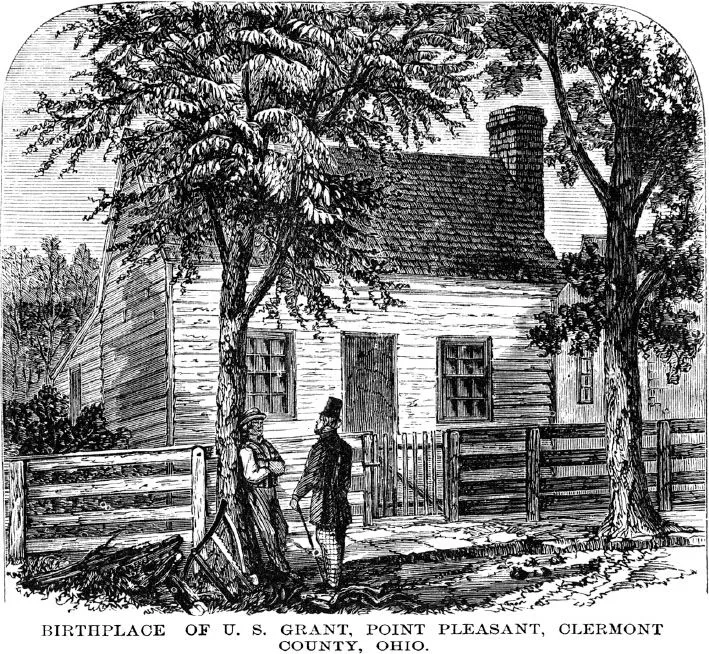
“Birthplace of U. S. Grant, Point Pleasant, Clermont County, Ohio.” Illustration from the Rev. P. C. Headley, The Life and Campaigns of Lieut.-Gen. U. S. Grant: From His Boyhood to the Surrender of Lee (New York: Derby & Miller, 1866).
“When about eleven years old I was strong enough to hold a plow,” Grant recalled. “From that age until seventeen I did all the work done with horses, such as breaking up the land, furrowing, plowing corn and potatoes, bringing in the crops when harvested, hauling all the wood, besides tending two or three horses, a cow or two, and sawing wood for stoves, etc., while still attending school.”14 As he did almost all the tasks of farming, young Ulysses was playing a significant part in the affairs of the Grant household, and he knew that this part was important and valuable. He was assuming a role on the world’s stage.
Grant’s early life reflected the kind of special American circumstan...
Table of contents
- Cover Page
- Title Page
- Copyright Page
- Dedication Page
- Contents
- Acknowledgments
- Introduction: Young in America
- 1. Childhood and Parenting in the New Republic: Sowing the Seeds of Independence, 1800–1860
- 2. Children Adrift: Responding to Crisis, 1850–1890
- 3. What Mother Needs to Know: The New Science of Childhood, 1890–1940
- 4. A Wider World: Adolescence, Immigration, and Schooling, 1920–1960
- 5. All Our Children: Race, Rebellion, and Social Change, 1950–1990
- 6. What’s the Matter with Kids Today?
- Epilogue
- Notes
- Suggestions for Further Reading
- Index
Trusted by 375,005 students
Access to over 1.5 million titles for a fair monthly price.
Study more efficiently using our study tools.
Frequently asked questions
Yes, you can cancel anytime from the Subscription tab in your account settings on the Perlego website. Your subscription will stay active until the end of your current billing period. Learn how to cancel your subscription
No, books cannot be downloaded as external files, such as PDFs, for use outside of Perlego. However, you can download books within the Perlego app for offline reading on mobile or tablet. Learn how to download books offline
Perlego offers two plans: Essential and Complete
- Essential is ideal for learners and professionals who enjoy exploring a wide range of subjects. Access the Essential Library with 800,000+ trusted titles and best-sellers across business, personal growth, and the humanities. Includes unlimited reading time and Standard Read Aloud voice.
- Complete: Perfect for advanced learners and researchers needing full, unrestricted access. Unlock 1.5M+ books across hundreds of subjects, including academic and specialized titles. The Complete Plan also includes advanced features like Premium Read Aloud and Research Assistant.
We are an online textbook subscription service, where you can get access to an entire online library for less than the price of a single book per month. With over 1.5 million books across 990+ topics, we’ve got you covered! Learn about our mission
Look out for the read-aloud symbol on your next book to see if you can listen to it. The read-aloud tool reads text aloud for you, highlighting the text as it is being read. You can pause it, speed it up and slow it down. Learn more about Read Aloud
Yes! You can use the Perlego app on both iOS and Android devices to read anytime, anywhere — even offline. Perfect for commutes or when you’re on the go.
Please note we cannot support devices running on iOS 13 and Android 7 or earlier. Learn more about using the app
Please note we cannot support devices running on iOS 13 and Android 7 or earlier. Learn more about using the app
Yes, you can access The End of American Childhood by Paula S. Fass in PDF and/or ePUB format, as well as other popular books in History & Education General. We have over 1.5 million books available in our catalogue for you to explore.