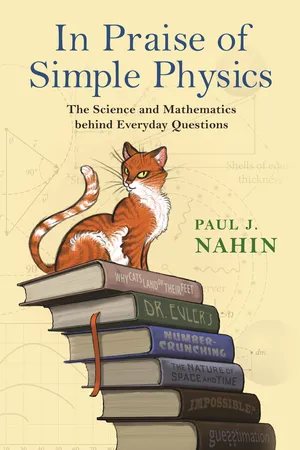
Fun puzzles that use physics to explore the wonders of everyday life
Physics can explain many of the things that we commonly encounter. It can tell us why the night is dark, what causes the tides, and even how best to catch a baseball. With In Praise of Simple Physics, popular math and science writer Paul Nahin presents a plethora of situations that explore the science and math behind the wonders of everyday life. Roaming through a diverse range of puzzles, he illustrates how physics shows us ways to wring more energy from renewable sources, to measure the gravity in our car garages, to figure out which of three light switches in the basement controls the light bulb in the attic, and much, much more.
How fast can you travel from London to Paris? How do scientists calculate the energy of an atomic bomb explosion? How do you kick a football so it stays in the air and goes a long way downfield? Nahin begins with simpler problems and progresses to more challenging questions, and his entertaining, accessible, and scientifically and mathematically informed explanations are all punctuated by his trademark humor. Readers are presumed to have some background in beginning differential and integral calculus. Whether you simply have a personal interest in physics' influence in the world or you're an engineering and science student who wants to gain more physics know-how, this book has an intriguing scenario for you.
In Praise of Simple Physics proves that if we look carefully at the world around us, physics has answers for the most astonishing day-to-day occurrences.
What would life be without arithmetic, but a scene of horrors?
—Sydney Smith1(in a letter dated July 22, 1835)
In this opening chapter I’ll discuss several examples of the kind of mathematics we’ll encounter in “simple physics” questions that may (or anyway could) occur in “ordinary life.” These are questions whose intent, I think, anybody can understand but that require at least some analytical thinking to answer. The math examples are very different from one another, with their only “unifying” (if I may use that word) feature being a progressively increasing sophistication. The central question to ask yourself as you read each example is, do I follow the arguments? If you can say yes, even if you can’t initially work through the detailed analysis yourself, then your understanding is sufficient for the book.
Example 1
Our first example of analytical thinking requires no formal math but, rather, logic and a bit of everyday knowledge (lit lightbulbs get hot). Think about it as you work through the rest of the examples, and, as with the wind-and-airplane problem at the end of the preface, I’ll give you the answer at the end of the chapter.
Imagine that you are in a multistory house with three electrical switches in the basement and a 100-watt lightbulb in the attic. All three switches have two positions, labeled ON and OFF, but only one of the switches controls the lightbulb. You don’t know which one. All three switches are initially OFF. One way to determine the controlling switch is with the following obvious procedure: Flip any one of the switches to ON, and then go up to the attic to see if the bulb is lit. If it is, you are done. If it isn’t, go back to the basement, turn one of the other OFF switches to ON, and then go back up to the attic to see if the bulb is lit. If it is, then the switch you just turned ON controls the bulb. If the bulb is not lit, then the switch that has never been ON controls the bulb. So, you can obviously figure out which switch controls the lightbulb with at most two trips to the attic.
There is, however, another procedure that guarantees your being able to make that determination with just one trip up to the attic. What is it?
Example 2
This question also requires no real math but, again, logical reasoning (although it does require an elementary understanding of kinetic and potential energy). Suppose you fire a gun, sending a bullet straight up into the air. Taking air resistance into account, is the time interval during which the bullet is traveling upward greater than or less than the time interval during which the bullet falls back to Earth? You might think you need to know the details of the air-resistance drag-force law, but that is not so. All you need to know is that air resistance exists.2 You may assume that the Earth’s gravitational field is constant over the entire up-down path of the bullet (it remains the same, independent of the bullet’s altitude). As in Example 1, think about this question as you work through the rest of the examples, and I’ll give you the answer at the end of the chapter. Hint: Potential energy is the energy of position (taking the Earth’s surface as the zero reference level, a mass m at height h above the surface has potential energy mgh, where g is the acceleration of gravity, about 32 feet/seconds-squared), and kinetic energy is the energy of motion (a mass m moving at speed v has kinetic energy
).
Example 3
This question does require some math, but it’s really only arithmetic involving a lot of multiplying and dividing of really big numbers. In the 1956 science fiction story “Expedition” by Fredric Brown (1906–1972), the following situation is the premise. There are 30 seats available on the first rocket ship trip to colonize Mars, with the seats to be filled by selecting at random 30 people from a pool of 500 men and 100 women. What is the probability that the result (as in the story) is one man and 29 women?
We start by imagining the 30 seats lined up, side by side, from left to right, and then we compute the total number of distinguishable (we assume each person is uniquely identifiable) ways to fill the seats without regard to gender from the pool of 600 people. That number, N1, is3
Next, if N2 is the total number of distinguishable ways to fill the 30 seats with exactly one man and 29 women, then the probability we seek is
. We calculate N2 as follows:
there are 30 different ways to pick the seat for the one man
and
there are 500 different ways to pick the one man for that seat.
So,
The formal answer to our question is then
I use the word formal because we still don’t have a single number for P.
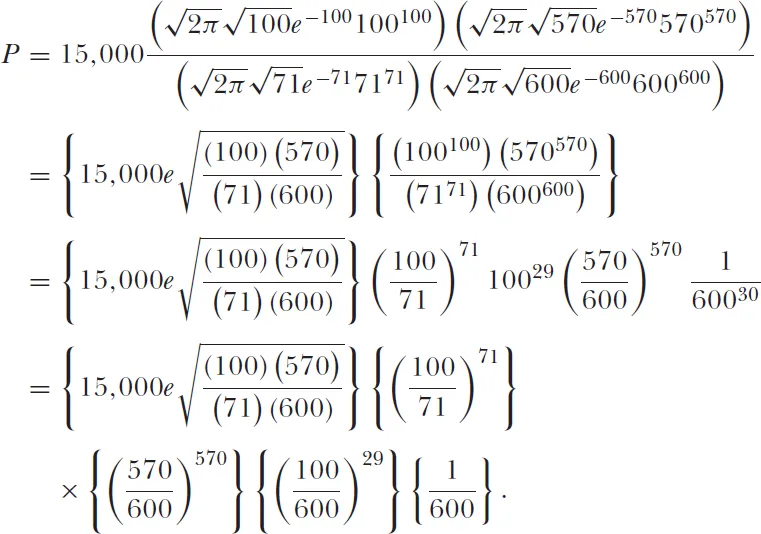
The factorials in this expression are all huge numbers, numbers that are far too large for direct calculation on a hand calculator (my calculator first fails at 70!). So, to make things more manageable, I’ll use Stirling’s asymptotic4 approximation for
. Then,
Each of the factors in the curly brackets is easily computed on a hand calculator, and the result is
The premise in Brown’s story is therefore highly unlikely. No matter, though, because while it is so unlikely as to be verging on the “just can’t happen,” it is not impossible, and besides, it’s a very funny story and well worth a willing suspension of disbelief.5
Example 4
Quadratic equations are routinely encountered in mathematical physics (you’ll see an example of this in Chapter 9), and here’s an example of a quadratic in the form of a type of problem that many readers will recall from a high school algebra class. Readers may take some comfort in ...
Access to over 1.5 million titles for a fair monthly price.
Study more efficiently using our study tools.
Frequently asked questions
Yes, you can cancel anytime from the Subscription tab in your account settings on the Perlego website. Your subscription will stay active until the end of your current billing period. Learn how to cancel your subscription
No, books cannot be downloaded as external files, such as PDFs, for use outside of Perlego. However, you can download books within the Perlego app for offline reading on mobile or tablet. Learn how to download books offline
Perlego offers two plans: Essential and Complete
Essential is ideal for learners and professionals who enjoy exploring a wide range of subjects. Access the Essential Library with 800,000+ trusted titles and best-sellers across business, personal growth, and the humanities. Includes unlimited reading time and Standard Read Aloud voice.
Complete: Perfect for advanced learners and researchers needing full, unrestricted access. Unlock 1.5M+ books across hundreds of subjects, including academic and specialized titles. The Complete Plan also includes advanced features like Premium Read Aloud and Research Assistant.
Both plans are available with monthly, semester, or annual billing cycles.
We are an online textbook subscription service, where you can get access to an entire online library for less than the price of a single book per month. With over 1.5 million books across 990+ topics, we’ve got you covered! Learn about our mission
Look out for the read-aloud symbol on your next book to see if you can listen to it. The read-aloud tool reads text aloud for you, highlighting the text as it is being read. You can pause it, speed it up and slow it down. Learn more about Read Aloud
Yes! You can use the Perlego app on both iOS and Android devices to read anytime, anywhere — even offline. Perfect for commutes or when you’re on the go. Please note we cannot support devices running on iOS 13 and Android 7 or earlier. Learn more about using the app
Yes, you can access In Praise of Simple Physics by Paul Nahin,Paul J. Nahin in PDF and/or ePUB format, as well as other popular books in Physical Sciences & Mathematics General. We have over 1.5 million books available in our catalogue for you to explore.