How the role of the philosopher has changed over time and across cultures—and what it reveals about philosophy today
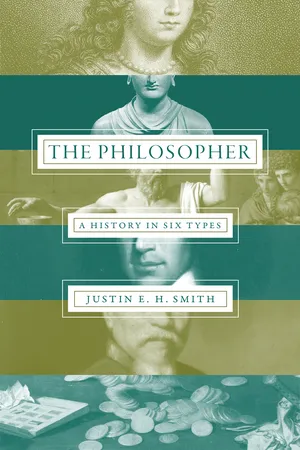
What would the global history of philosophy look like if it were told not as a story of ideas but as a series of job descriptions—ones that might have been used to fill the position of philosopher at different times and places over the past 2,500 years? The Philosopher does just that, providing a new way of looking at the history of philosophy by bringing to life six kinds of figures who have occupied the role of philosopher in a wide range of societies around the world over the millennia—the Natural Philosopher, the Sage, the Gadfly, the Ascetic, the Mandarin, and the Courtier. The result is at once an unconventional introduction to the global history of philosophy and an original exploration of what philosophy has been—and perhaps could be again.
By uncovering forgotten or neglected philosophical job descriptions, the book reveals that philosophy is a universal activity, much broader—and more gender inclusive—than we normally think today. In doing so, The Philosopher challenges us to reconsider our idea of what philosophers can do and what counts as philosophy.
- 288 pages
- English
- ePUB (mobile friendly)
- Available on iOS & Android
eBook - ePub
About this book
Information
Publisher
Princeton University PressYear
2016Print ISBN
9780691178462
9780691163277
eBook ISBN
9781400880577
Topic
PhilosophySubtopic
Philosophy History & Theory1
SINGULAR THINGS AND TIMELESS TRUTHS
Featuring the Curiosa
One of the very earliest occurrences of the agentive term “philosopher” is found in a fragment of Heraclitus, in which, evidently, he is mocking the school of the Pythagoreans with this term. In fragment 35, the Greek philosopher writes that “men who are philosophoi must be inquirers into many things indeed.”1 The author, whom we now think of as one of the founders of the tradition of philosophy, expresses uncertainty and bemusement as he attempts to understand who exactly the philosophers are. Our own confusion will only be heightened when we learn that the term translated here as “inquirers” is, in the original, historas, which might also be translated as “historians,” in the sense of people who are interested in singular things, and in telling “stories,” or giving accounts that range over the actual, rather than over the possible, thus in contrast to both poetry and philosophy in Aristotle’s later understanding.
Heraclitus is writing long before Aristotle would offer us his definition of “history” in contrast with poetry, already considered in the introduction. We might see Heraclitus’s uncertainty about the scope of the term “philosopher” as a simple consequence of the unsurprising imprecision of a term that has just come into existence and has no established patterns of usage. But in fact something very much like an assimilation of “philosopher” to “historian,” where a historian is understood simply as the person who inquires into many things, or the person with an appetite for singular facts about nature or society, continues beyond the archaic era and well into the golden age of Greek philosophy. Most of us are familiar, for example, with the accusations leveled against Socrates by his peers at the Athens court, that he sought to make the weaker argument the stronger, and that he had corrupted the youth of the city and denied its gods. But there is another accusation, corollary to the denial of the gods, that is often passed over without comment but that might be the most significant of all of them—namely, that Socrates has an excessive interest in the physical causes of phenomena that happen in the heavens above and in the earth below. In other words, the great philosopher is accused of being what would later be called a “natural historian.” He is too curious about particulars and believes that by their investigation we can understand the workings of nature. It is in this connection that Aristophanes will lampoon the character of Socrates as holding, for example, that thunderclouds in the heavens function no differently than flatulence in human beings.2
Certainly, Socrates’s accusers are wrong about him: he is no more a curious investigator of nature than he is a Sophist, and he does not appear to care much about what goes on in the heavens or below the earth. Yet while we are all familiar with the defenses of Socrates against the accusation of sophistry, the accusation of supporting natural-scientific inquiry passes under our radar, for we no longer even understand why such an accusation would be in any way damaging. But the historical record could not be clearer: until well into the early modern period, the people who were called “philosophers” were regularly accused of the transgression of looking into the workings of the heavens and of earth no less often than they were accused of making the weaker argument the stronger. Particularly when the term “philosopher” was used pejoratively (and we may say with confidence that the majority of its occurrences throughout history have been at least moderately pejorative), it was understood to suggest the activity of a “curiosus naturae,” someone who is curious about the particular workings of nature, about the formation of clouds and icicles and will-o’-the-wisps. Consider, for example, Laurent Lange’s 1735 description of the disposition of the “curious” practitioners of natural philosophy in their study of mammoth remains in Siberia:
They say that [the mammoth] has a great horn in front, of which it makes use for pushing the earth in front of it and carving a path, and that the bones of which we have just spoken are nothing other than this horn, which has much in common with the tooth of the elephant that is found in Siberia. Some curious practitioners of natural philosophy [Des curieux dans la Philosophie naturelle] maintain that this Mammoth is the Behemoth mentioned in chapter 40 of [the Book of] Job, and whose description agrees so well with this beast: for its jaws are of a substance that appears externally to be false copper, and as hard as a stone.3
Lange, following an established convention, intends a slightly mocking sense of “natural philosophy,” as straying too far from the very concrete matter of describing paleonto-logical remains in order to speculate on matters of biblical exegesis. But still, he also takes for granted that mammoth bones are within the normal purview of the natural philosopher, and that it is the virtue of curiosity that drives the natural philosopher to study them. By contrast the negative connotation of “philosopher” today is more often one of pure windbaggery, speculation detached from a concrete referent in the real world, the capacity to blow hot air about meaningless abstractions, to invent words that no one, including their inventor, could possibly understand, and so on. It is not a connotation of excessive curiosity. The reason for this shift has very much to do with the rise of modern science.
Philosophy seems to have effectively distanced itself fairly early on from sophistry (bracketing, for now, the compromising fact that professional philosophers continue to accept remuneration), and its relations with the institutions of religious faith have generally been too unstable for these two to be confused for very long. But the shared ancestry of philosophy and what would eventually be called “science” is a good deal more complicated, and in many respects the effort to understand the overlap between these two human endeavors continues to define what philosophy is. We might venture in a preliminary way that philosophy, or at least the tradition that descends from Philosophia, consists in the tension between Socratic disengagement from the world in search of adequate knowledge of fixed and unchanging concepts, on the one hand, and, on the other, the curious inquirer’s investigation of what goes on in the heavens above and the earth below. If we leave this latter half out, if we pass too quickly over this part of the accusation against Socrates (whether it was justified or not), we will misunderstand much of what philosophy has been all along. In so doing, we will fail to understand what philosophy is.
One of the most significant developments in philosophy since the eighteenth century, to which we have already alluded, is that it has gradually lost its institutional connection with science, and so also its self-understanding as not just being interested in science or “pro-science,” but as including science. Nietzsche intriguingly observes that science first emerges when people are no longer able to “think the gods well” (Wissenschaft … entsteht, wenn die Götter nicht gut gedacht werden). His meaning here is somewhat cryptic, but one plausible interpretation is that Nietzsche understands “science” in the sense in which this term was beginning to be understood during his lifetime, as a practical, fact-oriented matter independent of philosophy.4 Science arises, on this reading, when the profound philosophical questions, about the first causes or ultimate principles of nature, come to be seen as irrelevant to the matter of measuring, classifying, and harnessing the powers of the things of the natural world.
There are many good arguments for reaffirming the union of science and philosophy, not least that doing so could well be one of the best hopes for the continued thriving of philosophy within the university and within the broader culture. We have seen, recently, some promising steps in this direction, notably the movement that has called itself “experimental philosophy.”5 But it is a testament to the partial character of the turn for which the new experimental philosophy is pushing that most of its advocates do not even know, or really appreciate, that they are recycling a label, that there were self-described experimental philosophers some centuries before them, who had a conception of philosophy that was rather more fully thought out and complete than that of many of our contemporaries. A more thorough reunification, one that is closer to the spirit of early modern experimental philosophy, would be one that does not simply adopt the methods of one branch of empirical science—psychology in the case of recent experimental philosophy—nor would it, as analytic philosophy has often done, position itself as a clarifier or analyst of the logic and methodology deployed by scientists in the making of their contentful claims. Rather, it would see the making of contentful claims about the world as themselves fully and unproblematically philosophical.
Such an approach seems to have been characteristic of most European philosophers until at least the mid-eighteenth century. Interestingly, vestiges of it remain in the life sciences even into the twentieth century. Thus, for example, D’Arcy Wentworth Thompson writes in his monumental 1917 work, On Growth and Form, of Kant’s short-sightedness in supposing that the growth and development of living beings could never be accounted for in quantitative terms, yet the work, which is a demonstration of just this possibility is also precisely and explicitly a continuation of the tradition of philosophical reflection, from Aristotle through Kant, on the limits of mechanism and the value of teleological explanation. Like “warp and woof,” the author comments, “mechanism and teleology are interwoven together, and we must not cleave to the one nor despise the other: for their union is rooted in the very nature of totality.” It is, moreover, for Thompson, philosophy that “bids us hearken and obey the lessons both of mechanical and of teleological interpretation.”6 His work is a response to, and a continuation of, the philosophical tradition, and it is also, eminently, a work of science. One is in fact consistently surprised by the level of interest among biologists, writing just a century ago, in questions such as the value of Aristotelian teleology in accounting for the mechanisms of Darwinian natural selection. Biologists continued to think about the content of their discipline by reference to authors and texts that have over the course of just the last several decades been cordoned off as “philosophy” in an era in which other sciences, notably physics and chemistry, had become relatively more independent of their philosophical sources.
There has been tremendous progress in the life sciences since the beginning of the twentieth century, and there is a familiar argument that identifies the source of this progress in the specialization of its practitioners, in the freeing of them from the old weight of speculative tradition, instead allowing them do the hard laboratory-based and quantitative work necessary to make real discoveries about how living nature actually works. This is no doubt correct, but what it leaves out is that a capacity for self-understanding, cultivated through reflection on the natural world, and for engagement with age-old questions, might be among the legitimate desiderata, alongside “progress” in the narrowest sense, of what is now called “scientific” inquiry. In the early seventeenth century Francis Bacon had implored his contemporaries to “lay their notions by,” in order to go about the urgent task of collecting empirical data.7 He did not, however, think that notions should be lain by forever, that is, that people should altogether stop reflecting or speculating on the significance of the accumulated data. He simply thought that it was urgent, in the name of what we today would call “scientific” progress, to reform the institutions of data collection. By now, however, the institutions have been reformed, and the progress that has been made since Bacon has been astounding. If Bacon were to be resuscitated, and to be given a tour of nuclear power plants, to be shown how microprocessors work, and so on, he would likely declare that he is most impressed, but also that it is perhaps time, now, to bring our notions back.
What is more, at the moment he made the call Bacon did not think of the laying by of notions as a suspension of philosophy; he thought of it as a particular approach to philosophy, one among others that had been inherited from antiquity. This inheritance is one that has been largely forgotten, and that makes John Evelyn’s epigrammatic allusion above to the discourses of the philosopher upon the quality of the air seem so foreign. It is not a marginal or subterranean current in the history of philosophy, either, but one of the prevailing visions throughout history of what philosophy is or ought to be. Again, in one of the very first occurrences of the term “philosopher,” there is an explicit description, however critical, of this character as someone who is “interested in many things indeed.” And this is similarly the understanding of philosophy in the title of the Philosophical Transactions, the journal of the Royal Society of London that began appearing in 1666 and that may be seen as a sort of realization of many of the hopes for the organization of natural-philosophical inquiry that Bacon had spelled out some decades earlier.
It is also the understanding of philosophy that we find among some of the major thinkers of early modern philosophy, whom we would later retroactively transform into philosophers in the etiolated sense that better suits our own sensibilities. Leibniz offers a revealing case in point. The perception that Leibniz was more at home when engaged in a priori speculations than when investigating particulars seems to have hounded him even during his own lifetime. Thus he complains to his friend, the Swedish linguist J. G. Sparwenfeld, in a letter of 1698, that “people … tell me I am wrong to abandon solid and eternal truths in order to study the changing and perishable things that are found in history and its laws.”8 Later, in a 1708 draft of a proposal to Peter the Great for the classificatory system to be used in the eventual library of the Saint Petersburg Academy of Sciences, Leibniz identifies history—recall, again, Heraclitus’s description of the philosophoi as historas—as one of the three “Realien” or distinct domains of science, alongside mathematics and physics. It is, namely, the one that “involves the explanation of times and places, and thus of singular things [res singulares].”9
The Curiosus or Curiosa is a figure who has some characteristics in common with the “philosopher of science” and with the current incarnation of the “experimental philosopher,” but who differs from these in his or her understanding of the relationship between the content of science and the project of philosophy. It is through the figure of the Curiosus/a that we might hope to regain, for philosophy, a forgotten way of understanding the interest and value of singular things.
For most of the history of the term “scientia” and its equivalents in the various national languages of Europe, such as “science,” “wetenskap,” or “Wissenschaft,” designated any systematic body of knowledge, including those we would recognize today as science, but including also such evidently unscientific endeavors as theology. In German universities today—institutions traditional enough to retain some of the taxonomy of the disciplines that preceded the reshuffling that occurred in the Enlightenment—one may still study theologische Wissenschaft: theological science. In general, this broader meaning of “science” remains more salient in continental Europe than in the English-speaking world: in France one may still study “the human sciences,” in Germany the “sciences of spirit,” and these include, not least, the academic discipline of philosophy. In any case, here, when we speak of the intricate relationship between philosophy and science, we do not mean by the latter one of the fields that has been designated by scientia or by any of its cognates, but rather the sort of inquiry into the workings of nature, in the heavens above and the earth below, for which Socrates was accused by the court at Athens, and which has in other times and places been called “natural history,” “natural philosophy,” or, simply, “philosophy.” Scholars both within and outside of the academic discipline of philosophy today often comment on the vestigial use of “philosophy” in the “PhD” degree that is given out to new doctors in, for example, biology or chemistry. It is noted with passing curiosity that everything used to be philosophy. But the full significance of this observation is seldom appreciated. What it really means, among other things, is that if we are going to write a history of philosophy that takes actors’ categories seriously, it will be a history of metallurgy and distillation as much as it will be a history of metaphysics or logic.
But beyond this, there is another very important reason to pay attention to all the varieties of “philosophy” that would bequeath to us the “Ph” in “PhD.” While there were often clear attempts to articulate t...
Table of contents
- Cover Page
- Title Page
- Copyright Page
- Dedication Page
- Contents
- Acknowledgments
- Introduction
- 1: Singular Things and Timeless Truths
- 2: Philosophy and Philosophia
- 3: Inside and Out
- 4: Body and Soul
- 5: Mountains and Valleys
- 6: Money and Love
- Conclusion
- Notes
- Bibliography
- Index
Trusted by 375,005 students
Access to over 1.5 million titles for a fair monthly price.
Study more efficiently using our study tools.
Frequently asked questions
Yes, you can cancel anytime from the Subscription tab in your account settings on the Perlego website. Your subscription will stay active until the end of your current billing period. Learn how to cancel your subscription
No, books cannot be downloaded as external files, such as PDFs, for use outside of Perlego. However, you can download books within the Perlego app for offline reading on mobile or tablet. Learn how to download books offline
Perlego offers two plans: Essential and Complete
- Essential is ideal for learners and professionals who enjoy exploring a wide range of subjects. Access the Essential Library with 800,000+ trusted titles and best-sellers across business, personal growth, and the humanities. Includes unlimited reading time and Standard Read Aloud voice.
- Complete: Perfect for advanced learners and researchers needing full, unrestricted access. Unlock 1.5M+ books across hundreds of subjects, including academic and specialized titles. The Complete Plan also includes advanced features like Premium Read Aloud and Research Assistant.
We are an online textbook subscription service, where you can get access to an entire online library for less than the price of a single book per month. With over 1.5 million books across 990+ topics, we’ve got you covered! Learn about our mission
Look out for the read-aloud symbol on your next book to see if you can listen to it. The read-aloud tool reads text aloud for you, highlighting the text as it is being read. You can pause it, speed it up and slow it down. Learn more about Read Aloud
Yes! You can use the Perlego app on both iOS and Android devices to read anytime, anywhere — even offline. Perfect for commutes or when you’re on the go.
Please note we cannot support devices running on iOS 13 and Android 7 or earlier. Learn more about using the app
Please note we cannot support devices running on iOS 13 and Android 7 or earlier. Learn more about using the app
Yes, you can access The Philosopher by Justin Smith-Ruiu in PDF and/or ePUB format, as well as other popular books in Philosophy & Philosophy History & Theory. We have over 1.5 million books available in our catalogue for you to explore.