How individuals and the government are changing life in China's polluted cities
Over the past thirty years, even as China's economy has grown by leaps and bounds, the environmental quality of its urban centers has precipitously declined due to heavy industrial output and coal consumption. The country is currently the world's largest greenhouse-gas emitter and several of the most polluted cities in the world are in China. Yet, millions of people continue moving to its cities seeking opportunities. Blue Skies over Beijing investigates the ways that China's urban development impacts local and global environmental challenges. Focusing on day-to-day choices made by the nation's citizens, families, and government, Matthew Kahn and Siqi Zheng examine how Chinese urbanites are increasingly demanding cleaner living conditions and consider where China might be headed in terms of sustainable urban growth.
Kahn and Zheng delve into life in China's cities from the personal perspectives of the rich, middle class, and poor, and how they cope with the stresses of pollution. Urban parents in China have a strong desire to protect their children from environmental risk, and calls for a better quality of life from the rising middle class places pressure on government officials to support greener policies. Using the historical evolution of American cities as a comparison, the authors predict that as China's economy moves away from heavy manufacturing toward cleaner sectors, many of China's cities should experience environmental progress in upcoming decades.
Looking at pressing economic and environmental issues in urban China, Blue Skies over Beijing shows that a cleaner China will mean more social stability for the nation and the world.
eBook - ePub
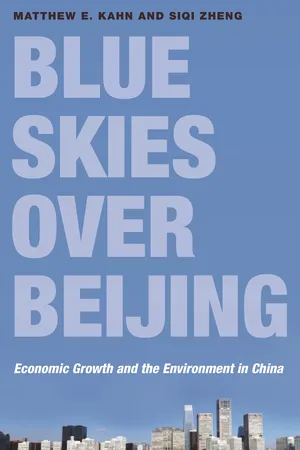
Blue Skies over Beijing
Economic Growth and the Environment in China
- 288 pages
- English
- ePUB (mobile friendly)
- Available on iOS & Android
eBook - ePub
About this book
Information
Publisher
Princeton University PressYear
2016Print ISBN
9780691192819
9780691169361
eBook ISBN
9781400882816
CHAPTER ONE
Introduction
Mr. Wu is thirty-eight years old and has a doctoral degree in civil engineering from Tsinghua University. Originally from Hunan Province, he moved to Beijing, where he now manages a department in a large, state-owned building design company. He earns a good salary. He and his wife, who works in a state-owned hospital, have a five-year-old daughter. Like many young urban couples in China, they bought their condominium and car before their daughter was born so she could grow up comfortably.
Mr. Wu enjoys a much better quality of life than his parents did. Thirty years ago, the Communist Party of China would allocate jobs and dormitory housing to college graduates like Mr. Wu’s parents. For most basic necessities—from grain, meat, and cooking oil to clothes, soap, and bicycles—the party distributed ration coupons.
But Mr. Wu faces challenges that his parents did not. If he doesn’t reach his profit target at work, he faces income deductions. If he suffers from health problems, such as a serious cough from the terrible pollution in Beijing, the fierce competition with his colleagues forces him to stay on the job. When he goes out to dinner, he is careful about what he eats because he has read about the excessive levels of drugs and hormones fed to chickens as they’re growing. At home, he must care for his parent in their retirement and plan his daughter’s schooling. The nation’s one-child policy creates extra anxiety for urban parents as they focus so much energy on their sole child’s success. There is a limited number of elite slots in high-quality schools and colleges, and this puts heavy pressure on every child. Worried about his daughter’s future, Mr. Wu might move to Canada or the United States.
Young Chinese also face very high home prices in the major cities. Ms. Feng has a graduate degree from Tsinghua University, and works at a major real estate company. She recognizes that the booming market has brought her company enormous business opportunities, but she laments the soaring house prices in Beijing. Her family rents a small, old apartment in the Xicheng District. To buy a hundred-square-meter condominium unit, they would have to save for ten or fifteen years. Ms. Feng describes her workweek as “five plus two, and white plus black”—that is, all five weekdays, both weekend days, and always late into the night. The extra hours are considered voluntary, so she does not receive overtime pay. Those who do not follow this routine lag behind in their performance evaluations and are pressured to leave.
Ms. Feng works a much longer week than would a typical worker in western Europe. Indeed, a comparison between daily life in urban China and western Europe yields striking contrasts. Urban China’s material standard of living is rising, but urban pollution and stress are extreme. Western Europe’s cities offer a high quality of life, and their inhabitants have ample leisure time to enjoy it.1
Over the last thirty years, China’s economy has grown at an amazing rate of 10 percent per year, and the share of people living below the poverty line fell from 84 percent to 13 percent. There are still hundreds of millions of poor households in rural China, but hundreds of millions have also escaped poverty. The horrible famine of 1959–61 is now a distant memory, and improvements in medical care and diet have lengthened life expectancy. Over the last thirty years, the average life expectancy at birth has increased from sixty-six to seventy-three years.
Despite this progress, Chinese urbanites must reckon with the reality that the nation’s standard of living is not improving as quickly as its economy is growing. Their cities suffer from limited access to health care and education as well as disastrous environmental quality.
The Chinese and Western media have published high-profile and lengthy exposés on environmental and other problems such as lead pollution in Deqing, toxic chemicals created by the mining of rare earths in Inner Mongolia, a proven decrease in life expectancy in northern China due to coal burning, fox and rat meat sold as mutton, and even thousands of dead pigs floating down the river in Shanghai—all salient examples of the costs of China’s economic growth.
In early 2013 the incredible smog in northern China caught the world’s attention.2 In January 2013 the particulate matter concentration in Beijing reached levels of two, three, and even four times the public health emergency threshold of 250 micrograms per cubic meter—and up to forty times what the World Health Organization (WHO) considers a healthy level.3 Based on one key indicator of outdoor air pollution, twelve of the twenty most polluted cities in the world are in China.4 In 2003, 53 percent of the 341 monitored Chinese cities—accounting for 58 percent of the country’s urban population—reported annual average pollution levels that exceeded the WHO’s standard. One percent of China’s urban population lives in cities that meet the European Union’s air-quality standards.5 One study estimates that such extreme pollution may cause twelve hundred premature deaths per year in Hong Kong alone.6
Another cause for concern is water pollution. According to a report by the Chinese Ministry of Environmental Protection, 57 percent of the groundwater in 198 cities was officially rated as “bad” or “extremely bad” in 2012, while more than 30 percent of the country’s major rivers were found to be “polluted” or “seriously polluted.”7
China is the world’s largest emitter of greenhouse gases, and these emissions exacerbate the risk of climate change. While per capita energy consumption in China is still less than 30 percent of that in the United States, China’s total energy consumption surpassed total US energy consumption in 2009. Data from the World Bank shows that China’s per capita greenhouse gas emissions grew by 186 percent (to 5.2 tons per person) between 1990 and 2010, while the world’s emissions grew by 16 percent (to 4.9).8
We’ve Been There
Today China faces many local environmental challenges, and an unintended consequence of its industrial production, increased motor vehicle use, and coal reliance is growing greenhouse gas emissions. In contrast, cities in the United States have enjoyed great progress toward cleaner air and water in the last forty years.
Not long ago, the cities of the West were much more polluted. Coal burning in major cities such as London and New York City created soot that killed thousands; London’s Great Smog of 1952 alone killed at least four thousand (and by some estimates, as many as twelve thousand) people as coal emissions from residential burning greatly elevated local particulate levels. Also in the mid-twentieth century, heavy manufacturing in major cities like Los Angeles, New York, and Pittsburgh (whose booming steel industry offered high-paying but dirty jobs) led to severe air and water pollution. Meanwhile, rising motor vehicle use relying on leaded gasoline caused high levels of urban lead emissions. In the 1960s and 1970s, smog in Los Angeles increased dramatically due to an increased number of vehicles traveling greater distances.
But the combination of new regulations (perhaps spurred by the horrible consequences of the Great Smog), energy efficiency gains, and rising household incomes that encouraged the substitution away from dirty fuels such as coal toward cleaner fuels such as natural gas fostered air-quality improvements for dense cities during times of growth. The birth of the environmental movement in the 1960s, often associated with the publication of Rachel Carson’s Silent Spring, helped mobilize the growing number of educated people in US cities to work toward a cleaner environment and preserving natural capital.
In the case of vehicle emissions, effective environmental regulations in the United States have offset the growth in total annual miles driven. Vehicles built in 2015 emit 99 percent less local air pollution per mile than those built before 1975. Thus, despite continuous vehicle use growth and increased mileage, over the last several decades levels of Los Angeles smog have plummeted.9
Starting in the early 1960s, Pittsburgh and other Rust Belt cities lost thousands of manufacturing jobs. The silver lining was blue skies: as industrial activity declined, air and water quality sharply improved. Pittsburgh reinvented itself as an attractive city on the Allegheny and Monongahela rivers, with new firms that relied on an educated workforce benefiting from access to leading research universities such as Carnegie Mellon and the University of Pittsburgh. Boston and Chicago enjoyed similar transitions to blue skies, as did London.
The US experience offers some lessons for predicting future dynamics for China’s environmental quality. While the two nations differ on many levels, the experience of cities in the United States highlights the role that fossil fuel consumption, the scale of industrial activity, and private vehicle use play in contributing to urban pollution. A city of given population size will experience an improvement in environmental quality if its power plants and industrial boilers move away from coal, there is a transition away from heavy industries, and firms introduce new technologies that reduce emissions. The transportation sector will create fewer emissions if people drive less or if private vehicles emit less pollution per mile of driving. The two key variables here are the scale of economic activity (i.e., industrial production or total miles driven) and the pollution intensity per unit of economic activity. For a growing economy to accomplish improvement to the environment, pollution per unit of economic activity must decline faster than economic activity grows. For example, if the people of Beijing drive 100 percent more miles in the year 2015 than they did in the year 1990, aggregate vehicle emissions can only decline if emissions per mile of driving decline by more than 50 percent over this same time period. Tracing the scale and the pollution intensity of economic activity in a growing city provides a framework both for tracking pollution dynamics in a Chinese city and comparing Chinese cities’ environmental performance over time.
Reasons for Hope
Will the 2013 Beijing haze be China’s equivalent of the Great Smog of 1952—a catalyst for genuine environmental change?10 There are several trends now unfolding in China that suggest that many of China’s cities will experience positive environmental change in the coming decades.
Of eighty-three major Chinese cities for which we can access urban air pollution data (measured as particulate matter up to ten micrometers in size, or PM10) we predict that forty-nine will experience near-term progress in curbing air pollution.
From 2001 to 2013, Beijing’s annual ambient particulate levels have declined by 39 percent. This reduction in pollution has taken place at a time when Beijing’s population, number of motor vehicles, and per capita income have continued to grow. An examination of PM10 levels across eighty-three of China’s major cities over the years 2005–10 indicates that, controlling for a city’s population size and its share of employment from manufacturing, pollution is declining by 2.8 percent per year. Assuming that this past statistical relationship continues to hold, we predict that a city whose population and manufacturing share does not change over time would enjoy a 28 percent decline in PM10 levels over a ten-year period. While China’s cities are growing in size, and city size is positively correlated with PM10 levels, the impact of city growth on urban pollution levels is small. A 10 percent increase in a city’s population (e.g., Beijing growing by two million people) is associated with only a 1.3 percent increase in ambient PM10 levels.
Many Chinese urbanites are becoming increasingly aware of the threats and impositions on their quality of life, and as more people obtain higher education and better wages, their standards and demands are rising. Indeed, the pollution in Chinese cities has sparked widespread complaints and calls for a cleanup.11 Via the Internet, the Chinese people are discussing and debating the causes and consequences of urban pollution. Under the Dome is a 2015 self-financed Chinese documentary film produced by Chai Jing, a former China Central Television journalist. The film, which openly criticizes state-owned energy companies, steel producers, and coal factories that are responsible for pollution, has struck a nerve in China; within three days of its release it was viewed over 150 million times on the Tencent video portal. Chen Jining, the former president of Tsinghua University and, as of February 2015, the head of China’s Ministry of Environmental Protection, praised the film, comparing its significance with Carson’s Silent Spring.12 Over 18 percent of the world’s population lives in China, and a majority of China’s population now lives in cities. The quality of life for the growing urban middle class is a key determinant of political stability for the nation, the region, and the world. 13
A Preview
In this volume we seek to understand how China’s urban economic growth impacts local and global environmental challenges, and we adopt a microeconomics perspective focused on the choices made by households, firms, and various levels of the Chinese government that in aggregate impact the environment. No rational actor actively seeks to damage the environment; instead, environmental damage often emerges as an unintended byproduct of individuals’ choices and firms’ production decisions.
To understand how improvements in the environment could take place, we must identify the incentives that would allow Chinese cities to achieve improved environmental performance. For example, why do Chinese industrial plants use coal if burning this fuel causes so much pollution? The economic approach asks who bears the costs and who gains the benefits from such a practice. If there are social costs associated with coal burning (i.e., hazards that a factory brings to bear on the surrounding residential area), do any local government officials have an incentive to protect the residential communities, or are these officials close to the polluting firms and thus hesitant to regulate them? If such factories unintentionally elevate local air pollution, what self-protection strategies can Chinese urbanites use to protect themselves?
We have been working together on joint research projects related to China’s urban development and pollution challenges since 2006. Over the years, Matthew E. Kahn has visited and lectured in China, and Siqi Zheng has been a visiting scholar at various US research universities. This international collaboration has allowed us both to more clearly see the strengths and weaknesses of our respective political and economic systems. This book is stronger than if either of us had tried to write it alone, as it yields a more balanced examination of the challenges and opportunities for China’s cities.
Matt is an expert in environmental economics, a branch of applied microeconomics that seeks to understand the causes and consequences of pollution production. Siqi is an expert on the Chinese urban economy and real estate markets. In writing this book together, we seek to convey our excitement about our joint research discoveries and to bring our research to life by weaving in personal stories about life in modern urban China. Such personal observations of people like Mr. Wu and Ms. Feng allow us to explore the human element of the massive urbanization that is now unfolding.
We seek to understand the emerging quality-of-life challenges in China from a microeconomic perspective. For China’s hundreds of millions of urbanites, how does pollution affect their daily quality of life? How do their day-to-day choices in aggregate impact local and global environmental challenges? Why is their demand for a cleaner environment likely to increase over time? How will government policies influence urban environmental quality dynamics?
In chapter 2, we study the scale and the economic geography of China’s massive urban industrialization. As China produces an increasing number of goods, using more electricity generated from coal, a tremendous source of pollution is its energy-intensive manufacturing sector. In 2013, 67.5 percent of China’s energy was fueled by coal, compared to 20.1 percent in the United States.14 Indeed, the tota...
Table of contents
- Cover Page
- Title Page
- Copyright Page
- Dedication Page
- Contents
- Acknowledgments
- Chapter One: Introduction
- Part I: A Geographic Overview of Urban Pollution Production in China
- Part II: The Rising Demand for Green Cities
- Part III: Promoting Environmental Accountability in a One-Party State
- Appendix 1
- Appendix 2
- Notes
- Index
Trusted by 375,005 students
Access to over 1.5 million titles for a fair monthly price.
Study more efficiently using our study tools.
Frequently asked questions
Yes, you can cancel anytime from the Subscription tab in your account settings on the Perlego website. Your subscription will stay active until the end of your current billing period. Learn how to cancel your subscription
No, books cannot be downloaded as external files, such as PDFs, for use outside of Perlego. However, you can download books within the Perlego app for offline reading on mobile or tablet. Learn how to download books offline
Perlego offers two plans: Essential and Complete
- Essential is ideal for learners and professionals who enjoy exploring a wide range of subjects. Access the Essential Library with 800,000+ trusted titles and best-sellers across business, personal growth, and the humanities. Includes unlimited reading time and Standard Read Aloud voice.
- Complete: Perfect for advanced learners and researchers needing full, unrestricted access. Unlock 1.5M+ books across hundreds of subjects, including academic and specialized titles. The Complete Plan also includes advanced features like Premium Read Aloud and Research Assistant.
We are an online textbook subscription service, where you can get access to an entire online library for less than the price of a single book per month. With over 1.5 million books across 990+ topics, we’ve got you covered! Learn about our mission
Look out for the read-aloud symbol on your next book to see if you can listen to it. The read-aloud tool reads text aloud for you, highlighting the text as it is being read. You can pause it, speed it up and slow it down. Learn more about Read Aloud
Yes! You can use the Perlego app on both iOS and Android devices to read anytime, anywhere — even offline. Perfect for commutes or when you’re on the go.
Please note we cannot support devices running on iOS 13 and Android 7 or earlier. Learn more about using the app
Please note we cannot support devices running on iOS 13 and Android 7 or earlier. Learn more about using the app
Yes, you can access Blue Skies over Beijing by Matthew E. Kahn,Siqi Zheng in PDF and/or ePUB format, as well as other popular books in Economics & Economic Theory. We have over 1.5 million books available in our catalogue for you to explore.