"A superb case of deep intellectual renewal and the most important book to have been written about [Nietzsche] in the past few years."—Gavin Jacobson, New Statesman
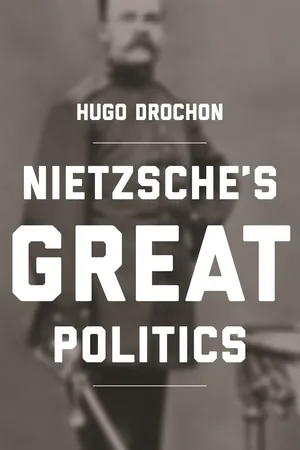
Nietzsche's impact on the world of culture, philosophy, and the arts is uncontested, but his political thought remains mired in controversy. By placing Nietzsche back in his late-nineteenth-century German context, Nietzsche's Great Politics moves away from the disputes surrounding Nietzsche's appropriation by the Nazis and challenges the use of the philosopher in postmodern democratic thought. Rather than starting with contemporary democratic theory or continental philosophy, Hugo Drochon argues that Nietzsche's political ideas must first be understood in light of Bismarck's policies, in particular his "Great Politics," which transformed the international politics of the late nineteenth century.
Nietzsche's Great Politics shows how Nietzsche made Bismarck's notion his own, enabling him to offer a vision of a unified European political order that was to serve as a counterbalance to both Britain and Russia. This order was to be led by a "good European" cultural elite whose goal would be to encourage the rebirth of Greek high culture. In relocating Nietzsche's politics to their own time, the book offers not only a novel reading of the philosopher but also a more accurate picture of why his political thought remains so relevant today.
- 224 pages
- English
- ePUB (mobile friendly)
- Available on iOS & Android
eBook - ePub
Nietzsche's Great Politics
About this book
Information
Publisher
Princeton University PressYear
2016Print ISBN
9780691180694
9780691166346
eBook ISBN
9781400881031
CHAPTER 1
THE GREEKS
Looking back over his life in 1888—“What I Owe to the Ancients” serves as the starting point for Nietzsche’s “autobiography” Ecce Homo—Nietzsche declares that The Birth of Tragedy, first published in 1872, was his “first revaluation of all values’ (TI Ancients 5). It is from this “soil”—that is, his study of the Greeks—that his “will,” his “abilities grow.” During this time Nietzsche had noted a series of reflections on The Birth in preparation for his “Revaluation of All Values,” demonstrating that the book and its themes were on his mind, and a number of letters of December 1888 echo this sentiment.1 To his confidant Heinrich Köselitz, whom he had dubbed “Peter Gast,” Nietzsche claims on December 22 that “since the last four weeks I understand my works,” singling out The Birth as “something indescribable, profound, tender, happy” (KSB 8). But he does not only claim to fully understand his books for the first time; he adds that he now “values” them, concluding that he is “absolutely convinced that everything has been successful, since the beginning—that everything tends toward unity.” “I have done everything very well, without realizing it,” he opines, feeling “for the first time up to the task.”
The purpose of this chapter is to take seriously Nietzsche’s claim that The Birth was his first revaluation, less in terms of acquiring a better understanding of The Birth itself, than in view of gaining an insight into what the project for a revaluation of all values entails.2 I am less interested in following Heidegger in wanting to read into Nietzsche’s early writings the embryonic forms of his main philosophical theories—the will to power, eternal return, and even perhaps overman, although I am sympathetic to certain aspects of that claim, as I will return to in chapter 4—but rather I wish to posit a structural similarity—in terms of the respective parts and overall purpose, instead of the actual content, which importantly will change—between The Birth and the “Revaluation.”3 What I mean to suggest is that Nietzsche’s goal with his revaluation project will remain the same as that of The Birth: restoring a healthy culture as the ancient Greeks had from which true philosophy can grow. And while he will maintain that to do so a hierarchical society is indispensable, he will come to reject certain aspects he thought necessary for such a transformation to take place. This latter will arise mainly from his split with Wagner: Nietzsche will come to reject Wagner’s anti-Semitism, pan-German nationalism, and return to the “true essence of Christianity,” the latter of which he claimed not to have been particularly taken with in the first place (BT P 5).
The relationship that The Birth of Tragedy entertains with Wagner’s total revolution will be the subject of the following chapter, especially how a disagreement over the role slavery played in the production of the Greek drama—the purest art form in history that Wagner’s own Gesamtkunstwerk, his “total work of art,” aimed to revive—obscured the political character of Nietzsche’s first work. The focus of this chapter, instead, will be on the soil from which Nietzsche claims his “abilities grow”: the Greeks. From his study of the Greeks, Nietzsche will garner a number of insights. First, as we have just seen, and again as will be examined more closely in the next chapter, a slave class is indispensable for culture. Nietzsche will remain faithful to this inference for the rest of his intellectual career, and we will have reason to return to it on numerous occasions throughout the book. Second, only from a healthy culture can genuine philosophers appear. One does not reestablish a healthy culture through decadent philosophy; rather, one must first restore the healthy instincts that are a prerequisite to a healthy culture. Finally, from his interpretation of Plato’s legislative mission, Nietzsche will glean a political strategy comprised of two elements: legislating for a new state, and training the men who will found it with him.
SOCRATES AND GREEK CULTURE
Nietzsche concurred with Wagner that only the ancient Greeks had attained the highest form of culture. For Wagner they had achieved “drama,” the highest form of art that combined all its expressions (dance, tone, and poetry), which his own “total artwork” aimed to reproduce. The Birth of Tragedy echoes the view that the Greeks had produced the highest art form, which Nietzsche would call tragedy, and the book concludes with a stirring defense of Wagner’s project—something it has often been criticized for.4 But for Nietzsche the Greeks were also the first to produce something else—something they have so far remained unrivaled at producing: philosophers.
Nietzsche developed this thought in “Philosophy in the Tragic Age of the Greeks,” drafted in an incomplete form in 1873, itself drawn from a lecture series that Nietzsche had worked on and given in Basel throughout the 1870s, of which he wrote out a full manuscript version in 1872.5 Ironically, “Philosophy in the Tragic Age of the Greeks” remained incomplete due to Wagner, who insisted Nietzsche turn his attention to writing a polemical tract, which was to become the first Untimely Meditation, against David Strauss. Nietzsche, however, thought his study indispensable, conceiving it as a “hook” to The Birth of Tragedy.6 Nietzsche had started to work on the theme at the same time as he was writing The Birth, as the passing remarks on Heraclitus, among others, hint at.7 In fact, through the notions of the “aesthetic man” and “child at play,” Heraclitus, the hero of Nietzsche’s study and the philosopher to whom he was to remain—by his own avowal—the closest to, already appears as the antithesis of the “Socratism in ethics” that caused the downfall of tragedy and consequently the Greeks.8 If the Greeks are therefore the soil from which Nietzsche’s desires and abilities grow, his studies of the “Pre-Platonic Philosophers,” as the lecture series are known, comprised his first harvest.
His second was in his preparation for the “Revaluation of All Values.” In a letter to Carl von Gersdorff of April 5, 1873, anticipating his visit to Bayreuth where he would read sections of “Philosophy in the Tragic Age” to the Wagners, indicating that it is “still very far from a standard form of a book,” Nietzsche explains that he has already made three attempts to synthesize the pre-Platonic philosophers. The first was his 1865 study of Democritus through Friedrich Lange’s History of Materialism.9 The second was his lectures on the pre-Platonics, and his third was “Philosophy in the Tragic Age.” He writes: “I have become increasingly harder toward myself and must still allow much time to pass in order to consider another treatment (the fourth on this same theme).”10 This fourth systematic treatment would only come when Nietzsche (re)turns to his revaluation project, having in the meantime developed his own philosophical position, finding its fullest expression in “The Problem of Socrates” and “What I Owe to the Ancients” in Twilight of the Idols. Indeed, it appears that Nietzsche reread his studies during that time—even annotating “Philosophy in the Tragic Age”—and consequently there are remarkable continuities, as we will see, between these earlier and later treatments.11
The thesis of “Philosophy in the Tragic Age” is that the Greeks have “justified philosophy once and for all simply because they have philosophized” (PTAG 1). They justify philosophy because for them it sprung from a healthy culture, characterized—anticipating the first Untimely Meditation—as the “unity of style.” Only from such a genuine culture can philosophy manifest itself as “helpful, redeeming, or prophylactic.” As Nietzsche puts it, there is an “iron law” that binds a philosopher to a genuine culture. As such, the Greeks began philosophizing at the “right time,” which is to say in the “midst of good fortune, at the peak of mature manhood, as a pursuit springing from the ardent joyousness of courageous and victorious maturity.” When they engaged in philosophy, they did so as “civilized human beings,” with “highly civilized aims.” Their activity—though they were “quite unconscious of it,” as Nietzsche observes—tended toward the “healing and purification of the whole” (PTAG 2).12
While a healthy culture can exist without philosophy, or with a moderate exercise of it—the Romans lived, according to Nietzsche, their “best period” without it (PTAG 1)—when philosophy takes root in an unhealthy society it spells disaster for both itself and the society in question. “Where could we find an instance of cultural pathology that philosophy restored to health?” Nietzsche asks. If a culture is sick, then philosophy will make it even sicker. When a culture is disintegrating, philosophy is unable to reintegrate the individual back into the group. This is vital because a people is characterized not so much by its great men but instead by the way in which it “recognizes and honors” them. When the philosopher takes root in a healthy culture, he “shines like a stellar object of the first magnitude.” In contrast, in a degenerate one, he appears as a “chance wanderer,” “lonely in a totally hostile environment that he either creeps past or attacks with clenched fists”; or again, as a “comet, incalculable and therefore terror inspiring.”13 The Greeks thus “justify” philosophy, according to Nietzsche, because only among them the philosopher is neither a chance wanderer nor a comet. In fact, they produced the “archetypes of philosophical thought,” to which posterity, in Nietzsche’s view, has not made an essential contribution to since. These archetypes constitute the republic of geniuses that stretches from Thales to Socrates. They are what Nietzsche variously calls either “monolithic” or “one-sided,” settling on the term “pure types” of philosophers, as while they may influence one another—calling and bridging out to one another through the “desolate intervals of time”—they are all the “first-born sons of philosophy” because they all generated from within themselves their own personal, fundamental idea (e.g., for Thales everything is water, and for Heraclitus everything is fire) (PTAG 1–2).
With Plato, however, starts something new. If the republic of geniuses consists of pure philosopher types of the “one idea,” Plato is the first great mixed type, both in his philosophy—his doctrine of Ideas combines Socratic, Pythagorean, and Heraclitean elements, and therefore should not be considered, according to Nietzsche, an entirely original conception—and personality, which mingles the features of a “regally proud Heraclitus with the melancholy, secretive and legislative Pythagoras and the reflective dialectician Socrates” (PTAG 2).14 All philosophers after Plato are such mixed types. Furthermore, instead of working for the “healing and purification of the whole,” the mixed types are founders of sects, in opposition to the previous unity of style.15 If their philosophy also sought salvation, it is only for the individual or a small group of people—the sect. Rather than protect their native land, philosophers, with Plato, become exiles, “conspiring against their fatherland.”
This is in effect one of the fundamental differences between Socrates and Plato, and it is a political difference: while Socrates is still a “good citizen” who tries to help his fellow countrymen, Plato desires, as I will explore further in the following section, to overthrow his contemporary polis to found a new state.16 We now also understand the meaning of the title of the lecture series “The Pre-Platonic Philosophers”: the separation occurs between the pure types from Thales to Socrates and the mixed types starting with Plato. The existence of an “Athenian school,” comprised of Socrates, Plato, and Aristotle—and hence before them the more conventionally called pre-Socratics—is hereby challenged by Nietzsche: Plato is a mixed type consisting of non-Athenian elements such as Heraclitus and the Pythagoreans. But more fundamentally: Why this disjuncture? To answer that question we must turn to Nietzsche’s understanding of Socrates and Plato, who stand on either side of the turning point, and thereby investigate his account of the decadence of the Greeks.
Nietzsche’s relationship to Socrates has been the subject of an extensive and discordant debate, ranging from Socrates being depicted as Nietzsche’s ultimate “villain” in the history of philosophy with Nietzsche himself as the final hero, to being presented by him as a “demigod,” equal in stature to Apollo and Dionysus.17 In what follows I will side with those who see Nietzsche’s view of Socrates as inherently ambivalent, understood as Nietzsche being of two minds about Socrates: while he is the last genius of the republic of philosophers, Socrates is also the first decadent philosopher whose moralism corrupted all those after him.18 So if Nietzsche takes on the Socratic role of being the “critic,” “gadfly,” or “bad conscience” of his time (PPP Socrates; HH 433; BGE 212; CW P), he rejects the moral method that Socrates employs. This position vis-à-vis Socrates is perhaps best summed up by an early note that Nietzsche pens, in which he remarks that “Socrates, to confess it frankly, is so close to me that I almost always fight with him” (KSA 8 6 [3]).19 Nietzsche feels close to Socrates in being the gadfly of his time, yet fights against the legacy of his moralism. Moreover, as throughout the book, I want to underline certain basic continuities between Nietzsche’s early and later thinking—in this case, his t...
Table of contents
- Cover Page
- Title Page
- Copyright Page
- Dedication Page
- Contents
- Acknowledgments
- Editions and Translations Used
- Abbreviations
- Introduction
- Chapter 1. The Greeks
- Chapter 2. The State
- Chapter 3. Democracy
- Chapter 4. Philosophy and Politics
- Chapter 5. Revaluation
- Chapter 6. Great Politics
- Conclusion: Nietzsche Now
- Bibliography
- Index
Trusted by 375,005 students
Access to over 1.5 million titles for a fair monthly price.
Study more efficiently using our study tools.
Frequently asked questions
Yes, you can cancel anytime from the Subscription tab in your account settings on the Perlego website. Your subscription will stay active until the end of your current billing period. Learn how to cancel your subscription
No, books cannot be downloaded as external files, such as PDFs, for use outside of Perlego. However, you can download books within the Perlego app for offline reading on mobile or tablet. Learn how to download books offline
Perlego offers two plans: Essential and Complete
- Essential is ideal for learners and professionals who enjoy exploring a wide range of subjects. Access the Essential Library with 800,000+ trusted titles and best-sellers across business, personal growth, and the humanities. Includes unlimited reading time and Standard Read Aloud voice.
- Complete: Perfect for advanced learners and researchers needing full, unrestricted access. Unlock 1.5M+ books across hundreds of subjects, including academic and specialized titles. The Complete Plan also includes advanced features like Premium Read Aloud and Research Assistant.
We are an online textbook subscription service, where you can get access to an entire online library for less than the price of a single book per month. With over 1.5 million books across 990+ topics, we’ve got you covered! Learn about our mission
Look out for the read-aloud symbol on your next book to see if you can listen to it. The read-aloud tool reads text aloud for you, highlighting the text as it is being read. You can pause it, speed it up and slow it down. Learn more about Read Aloud
Yes! You can use the Perlego app on both iOS and Android devices to read anytime, anywhere — even offline. Perfect for commutes or when you’re on the go.
Please note we cannot support devices running on iOS 13 and Android 7 or earlier. Learn more about using the app
Please note we cannot support devices running on iOS 13 and Android 7 or earlier. Learn more about using the app
Yes, you can access Nietzsche's Great Politics by Hugo Drochon in PDF and/or ePUB format, as well as other popular books in Politics & International Relations & Political Philosophy. We have over 1.5 million books available in our catalogue for you to explore.