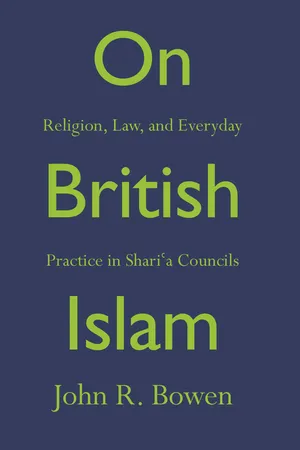
On British Islam examines the history and everyday workings of Islamic institutions in Britain, with a focus on shari?a councils. These councils concern themselves with religious matters, especially divorce. They have a higher profile in Britain than in other Western nations. Why? Taking a historical and ethnographic look at British Islam, John Bowen examines how Muslims have created distinctive religious institutions in Britain and how shari?a councils interpret and apply Islamic law in a secular British context.
Bowen focuses on three specific shari?a councils: the oldest and most developed, in London; a Midlands community led by a Sufi saint and barrister; and a Birmingham-based council in which women play a leading role. Bowen shows that each of these councils represents a prolonged, unique experiment in meeting Muslims' needs in a Western country. He also discusses how the councils have become a flash point in British public debates even as they adapt to the English legal environment.
On British Islam highlights British Muslims' efforts to create institutions that make sense in both Islamic and British terms. This balancing act is rarely acknowledged in Britain—or elsewhere—but it is urgent that we understand it if we are to build new ways of living together.
- 288 pages
- English
- ePUB (mobile friendly)
- Available on iOS & Android
eBook - ePub
About this book
Information
Topic
Scienze socialiSubtopic
Teologia islamicaPART 1
PATHWAYS
CHAPTER 1
Why Shariʿa in Britain?
IN OCTOBER 2013, BRITISH PRIME MINISTER DAVID CAMERON ANNOUNCED THE launch of an Islamic bond (a sukuk) and celebrated his government’s commitment to make London one of the world’s great centers for shariʿa financing. But a few months later, a moral panic swept Britain over claims that state-aided schools in Birmingham were promoting shariʿa and Islamic extremism. BBC programs, the home secretary, and several prominent members of the House of Lords warned of shariʿa councils endangering the rule of law and gender equality throughout Britain.
This study of British Islam highlights issues and practices surrounding shariʿa. Shariʿa is both lauded and denounced more loudly and more often in Britain than anywhere else in the West. Both Prince Charles and then archbishop of Canterbury Rowan Williams have called for drawing on Islamic principles to, respectively, save the environment and resolve conflicts among Muslims. But Britain also has some of the most vehement Islam bashing anywhere, with the Daily Mail, the Sun, and on occasion the Telegraph warning of threats to Britain posed by Islam and particularly by shariʿa. Already in 1997, the chilly climate toward Islam led the Runnymede Trust to issue an influential report denouncing “Islamophobia.”1
“Shariʿ (sharīʿa) can mean both the broad path God set out for Muslims and a particular set of normative teachings.2 In both senses it has a particularly high profile in Britain. Why? I try to account for this particularity by looking at British Islam through two lenses. The first is historical: How and why did Muslims create distinctive religious institutions in Britain? How did the pathways they followed shape what sort of Islam they built? The argument is implicitly contrastive: What features of the British experience with Islam differentiate it from the experiences of other European countries?
The second lens is ethnographic and focuses on everyday practices in Britain’s shariʿa councils, tribunals that answer Muslims’ questions and give Islamic divorces. (These divorces have no effect in English law.) I trace the ways the Muslim scholars who sit on these councils apply the resources of Islam to resolve immediate practical issues. I also mention schooling, mosques, finance, and halal certification, but I concentrate on the shariʿa councils for three reasons. First, they represent a prolonged and unique experiment in meeting Islamic needs in a Western country. Second, they highlight and illuminate Britain’s specific relation to Islam. Finally, they have become a flashpoint in British public debates, drawing the ire and fire of many commentators even as they adapt to the English legal environment.
How can this work? How can such a well-developed set of quasi-legal shariʿa-based institutions function relatively smoothly in a secular society? And how does this work? How do clients approach councils, and how do Islamic scholars from diverse origins make judgments? Do their judgments show up in court? And what does and should the broader public think about how they judge?
COMMUNITIES
The first question—how can this work?—leads us toward the notion, more widely accepted in Britain than most anywhere else in Europe, that values come from communities, mainly religious ones, whether Christian, Jewish, Muslim, or other. Such was the force of then archbishop of Canterbury Rowan Williams’s 2008 defense of Muslims who wished to draw on shariʿa to run their own affairs. The idea of distinct communities avoids posing difficult and often uncomfortable questions about “British values” or Englishness. It gives (and draws on) an imperial tone: we share the fact that we don’t have to share. It also allows one to defend an Anglican, public-school elitism as constituting just another “community.”3
But how broadly accepted is this notion of multiple, diverse communities? In 2014, half of the people living in Britain thought that to be “truly British” you had to have British ancestry. One-quarter said you needed to be Christian. No doubt had the question been about “Englishness,” the numbers would have been much higher. These responses remind us that many Britons remain suspicious of a Britishness that wanders too far from a shared cultural core of pubs and churches.4
Indeed, extending the national welcome to new religious communities has always been problematic. It has involved “tolerating” dissenting Protestants, and then Catholics and Jews, and now Muslims.5 The effort is always resisted and always shaky, and gives rise to particular anxieties and challenges, once about Catholics and now about Muslims. Even well-informed commentators draw lines between “conservative” Islam and its “liberal” counterparts, considering the former as dangerously close to the Taliban, and only the latter as truly integrated, particularly when these liberal Muslims dance at nightclubs, offer red wine to guests, and profess their love for the queen.6 These cultural preferences are understandable, but they may keep us from attending to the ways even conservative British Muslims can adapt to conditions of life in Britain, including how they have construed and applied shariʿa: without the red wine but within the law.
What of Muslims’ ideas about Britain? A Gallup poll taken in 2009 in Britain showed that when compared with the population as a whole, Muslims identified more strongly with Britain (77 percent versus 50 percent) and had more confidence in the judiciary (76 percent versus 55 percent). British Muslims also more strongly identified with both their country and their religion than did French or German Muslims. A 2011 poll of two thousand people taken by the think-tank Demos revealed that Britons differed little by religion in how likely they were to say that they were “proud to be a British citizen”: 88 percent of self-declared Anglicans and Jews, 83 percent of Muslims, and 79 percent of the population as a whole agreed with this statement.7
And yet things are not all rosy. A few years earlier, a Pew survey showed that British Muslims were more likely than Muslims in other European countries to see relations between “Muslims” and “Westerners” as generally poor, and more likely to say that there is a conflict between “being a devout Muslim” and “living in a modern society”—indeed, more likely to say both things than were people in Jordan or Pakistan.8 So, perhaps British Muslims find British institutions to be fine but modern British society to present problems.
In the popular British press, Muslims appear as self-isolating. In recent years this portrayal has focused on Islamic institutions, including schools and shariʿa councils; critics claim that these institutions oppress women, violate human rights, and aim at setting up a parallel society, with its own legal system. “One Law for All” is the slogan of some who rail against this supposed separatism. These criticisms of Muslims could be set aside as instances of “Islamophobia.” Some commentators do so. But those who criticize the direction of British Islam can point to the growth of private Islamic schools that have resisted outside inquiry. They can point to conservative positions on issues of gender and politics taken by some Islamic public actors in Britain. How readily can these Muslims be considered as simply one more community within the loosely structured British state?
APPROACH
In what follows, I examine how and why Islamic institutions developed as they did in Britain. I argue that the particular contours of Islam in Britain have much to do with British imperial history and what we may call British applied political philosophy. If French republicanism, applied at home and to some extent abroad, helps explain the shape of Islam in that country, as I have argued in earlier works,9 the corresponding case can be made for Britain.
So goes part of this book. But the empirical difference between the two countries means that we must examine different objects in the two cases. If, in earlier works on France, I traced how French Islamic leaders taught and debated Islamic norms in rather unexceptional, even anodyne settings—schools, mosques, and large assemblies—it was because French Muslim public figures were adapting their institutions to the tight legal and cultural constraints of French public life. France does not see itself as multiple communities in one state but as a collection of citizens ideally subjecting themselves to the dictates of their shared ideas and habits through the medium of the state. French Muslims built institutions that either mirrored their non-Islamic French counterparts (Islamic schools and institutes look like other schools and institutes) or mirrored their already-legitimate Muslim-world equivalents (mosques that resembled those in Fez were fine). Ways of preparing halal foods followed a pattern already made legitimate by Jewish dietary and abattoir practices. French Muslims have made very little institutional innovation, in part because there is low tolerance for such innovation in France, and in part because the relatively low level of doctrinal differences among them meant that there was little impulse for institutional specialization.
In Britain, by contrast, Islam is fractured, divergent, and institutionally creative. The legal pluralism of the Indies administration, the fractious character of North Indian Islam, and the British idea that religious communities nurture social life have, together, contributed to the emergence of a British Islam with multiple institutional forms. Some British schools or councils have sought to highlight continuities with their Asian sources, and often that choice has meant erecting boundaries in their new homeland. Others have emphasized new roots in a British urban neighborhood and have drawn on Asian ties for that new purpose. Still others have constructed new internal pluralisms that play out old divisions in new places.
This varied British topography of Islam has engendered open disagreements and debates. It has also nurtured the continued existence of conservative Islamic traditions that are easy to present in the press as exhibiting insufficient integration into British life—and that contrast sharply with the progressive direction of Islamic thought found in US mosques.10 The visibility of Asian modes of dress, the continued high rates of transcontinental marriage, and, my focus here, the very public flourishing of shariʿa-oriented bodies all signal to many in Britain a problem with the integration, modernity, or gender relations associated with Islam. But the take-home message of this book is that British Muslims, most of them anyway, are in the long and messy process of creating institutions that make sense in Islamic terms and also in British ones. British Muslims are adapting to British ways of life, as are French and German Muslims to ways of life in those countries.11 This message is rarely heard in Britain—or elsewhere—but it is urgent that we hear it if we are to build new ways of living together.
Understanding the shape of British Islam today demands both history and ethnography: how things developed and how they work. I begin by sketching out the sources and broad contours of British Islamic institutions before focusing on the shariʿa councils. I argue that British Islamic life is not the simple transposition to Britain of Asian practices; it is filtered through new institutions that are both British and Islamic. To understand them, we must look at their specific historical trajectories and their everyday practices.12
Studying these shariʿa-based institutions requires studying how they adapt to their environment and how their diverse participants adjust to each other. Institutional analysis, as I see it, requires both a genealogy of specific institutional forms and an ethnography of the processes and debates that shape everyday working life—and that may recursively reshape those forms. This last component of the study will lead us to ask how conditions for “performativity” are debated and provisionally realized, and how actors propose multiple and context-specific justifications for their judgments. This dimension of the project brings it into the domain of what I have been calling the anthropology of public reasoning, extended in this work to take on a more thoroughgoing analysis of institutional workings and changes.13
Studying reasoning and justification also highlights the ways in which British Muslims draw on pan-Islamic as well as British ways of judging—transnational continuity as well as local fit. British Islamic scholars sitting on shariʿa councils see themselves as following in a long lineage of Islamic scholars and judges. In fourteenth-century Morocco or in twenty-first-century Britain, Indonesia, or Egypt, scholars and judges arrive at judgments only after considering the texts and traditions of Islam, the way their society works, the personal situation of a client or litigant, and the many legal and political constraints they face. They do not so much “apply” the law as seek to render a judgment that will be fair, acceptable, and workable. Of course, this is also what British civil court judges do, working from different texts and traditions.14
EXPOSITION
The book proceeds in four parts. In part 1, “Pathways” (chapters 1 to 3), I examine how Muslims came to Britain, settled, and developed Islamic spaces and boundaries. Chapter 2 traces physical movement. Muslims came to Britain mainly (though not only) from South Asia, and they settled in certain cities and neighborhoods. They encouraged others to join them. Many of these new residents of Britain have sought to maintain their ties to the homeland through marriage and through forms of economic cooperation. These practices befuddle the logic of generations: Can you be of the third generation when your mum was born in Pakistan? They also reinforce ties of shared ethnic and religious community within certain British neighborhoods. Transnational connections and local concentrations reinforce each other.
Chapter 3 follows a second kind of pathway, one concerning ideas and practices of religion and politics. In India, British rule both validated religious governance of family affairs and drove Islamic leaders to carve out their own spaces for teaching, learning, and the administration of Islamic law. In postcolonial Britain, the same logics of religious governance and autonomy facilitate efforts to transpose Islamic institutions to London or Birmingham. We travel to London, the Midlands, and the North to see how these politico-religious pathways inscribe certain spatial patterns of boundaries and networks on Britain. These patterns inject religious meaning into the demographic processes examined in chapter 2.
In part 2, “Practices” (chapters 4–7), I examine the workings of Britain’s most extensive shariʿa council, headquartered in eastern London but with branches across England. Chapter 4 provides the background on women’s divorce and the emergence of the councils and attempts to explain why Islamic divorce has become the focus of shariʿa council practices. In chapter 5 I examine the social life of the London council, shaped as it is by the temporalities of moving along files and receiving clients. Chapters 6 and 7 concern two overriding and perennial worries of this and other councils—and, indeed, of state Islamic bodies in the Muslim-majority world. The anxiety of performativity asks about the capacity of scholars (or judges) to divorce a couple: Whence that authority? What justifies dissolving marriages at all? On a theoretical plane, this case recalls Jacques Derrida’s critique of J. L. Austin on performativity: namely, that “felicity conditions” are never assumed; they can always be challenged. No foundations exist for the shariʿa councils—but do they exist for courts in Muslim countries? The anxiety of justification asks about the selection among competing types of argumentation. ...
Table of contents
- Cover Page
- Title Page
- Copyright Page
- Dedication Page
- Contents
- Acknowledgments
- Part 1: Pathways
- Part 2: Practices
- Part 3: Variants
- Part 4: Boundaries
- Glossary
- Notes
- References
- Index
Trusted by 375,005 students
Access to over 1.5 million titles for a fair monthly price.
Study more efficiently using our study tools.
Frequently asked questions
Yes, you can cancel anytime from the Subscription tab in your account settings on the Perlego website. Your subscription will stay active until the end of your current billing period. Learn how to cancel your subscription
No, books cannot be downloaded as external files, such as PDFs, for use outside of Perlego. However, you can download books within the Perlego app for offline reading on mobile or tablet. Learn how to download books offline
Perlego offers two plans: Essential and Complete
- Essential is ideal for learners and professionals who enjoy exploring a wide range of subjects. Access the Essential Library with 800,000+ trusted titles and best-sellers across business, personal growth, and the humanities. Includes unlimited reading time and Standard Read Aloud voice.
- Complete: Perfect for advanced learners and researchers needing full, unrestricted access. Unlock 1.5M+ books across hundreds of subjects, including academic and specialized titles. The Complete Plan also includes advanced features like Premium Read Aloud and Research Assistant.
We are an online textbook subscription service, where you can get access to an entire online library for less than the price of a single book per month. With over 1.5 million books across 990+ topics, we’ve got you covered! Learn about our mission
Look out for the read-aloud symbol on your next book to see if you can listen to it. The read-aloud tool reads text aloud for you, highlighting the text as it is being read. You can pause it, speed it up and slow it down. Learn more about Read Aloud
Yes! You can use the Perlego app on both iOS and Android devices to read anytime, anywhere — even offline. Perfect for commutes or when you’re on the go.
Please note we cannot support devices running on iOS 13 and Android 7 or earlier. Learn more about using the app
Please note we cannot support devices running on iOS 13 and Android 7 or earlier. Learn more about using the app
Yes, you can access On British Islam by John R. Bowen in PDF and/or ePUB format, as well as other popular books in Scienze sociali & Teologia islamica. We have over 1.5 million books available in our catalogue for you to explore.