Making a Good Life takes a timely look at the ideas and values that inform how people think about reproduction and assisted reproductive technologies. In an era of heightened scrutiny about parenting and reproduction, fears about environmental degradation, and the rise of the biotechnology industry, Katharine Dow delves into the reproductive ethics of those who do not have a personal stake in assisted reproductive technologies, but who are building lives inspired and influenced by environmentalism and concerns about the natural world's future.
Moving away from experiences of infertility treatments tied to the clinic and laboratory, Dow instead explores reproduction and assisted reproductive technologies as topics of public concern and debate, and she examines how people living in a coastal village in rural Scotland make ethical decisions and judgments about these matters. In particular, Dow engages with people's ideas about nature and naturalness, and how these relate to views about parenting and building stable environments for future generations. Taking into account the ways daily responsibilities and commitments are balanced with moral values, Dow suggests there is still much to uncover about reproductive ethics.
Analyzing how ideas about reproduction intersect with wider ethical struggles, Making a Good Life offers a new approach to researching, thinking, and writing about nature, ethics, and reproduction.
- 248 pages
- English
- ePUB (mobile friendly)
- Available on iOS & Android
eBook - ePub
About this book
Information
Publisher
Princeton University PressYear
2016Print ISBN
9780691171753
9780691167480
eBook ISBN
9781400881062
1
Ethical Labour
Why, hopelessly and romantically, do we imagine a natural preserve of feeling, a place to be kept “forever wild”? The answer must be that it is becoming scarce.
—Arlie Russell Hochschild
In This Day and Age
When I joined Joanna and Sophie for breakfast in the wildlife centre café one Sunday morning, I knew from their animated faces that something had happened. Sophie quickly told me that Joanna, a health care assistant and wildlife centre volunteer in her mid-twenties, had just found out that her teenaged sister, Gemma, was pregnant. It was clear that Joanna disapproved of her sister’s actions. She seemed most concerned about their mother, whom she felt would be the one to pick up the pieces. Joanna explained as we ate our breakfast that what frustrated her most about Gemma’s pregnancy was that it was planned. She told us this with characteristic openness and paid little attention to whether the other diners heard her, but suddenly lowered her voice to a whisper when she added, “She even went off the Pill.”
Joanna’s disapproval was primarily motivated by concern and care—for her sister, her parents, and her future niece. As she got used to the idea, however, she became excited and happy for her sister and was as supportive as she could be, given that they lived five hundred miles apart. Joanna, like her colleagues and friends, believed that people should plan to have children when they are ready. Her initial reaction to her sister’s decision to become a mother whilst she was still legally a child herself reflected her judgement that Gemma lacked the maturity, sense of responsibility, and resources to be a good mother. Because of her youth, Gemma’s choice to become a mother was not viewed as an index of her readiness but quite the opposite.
I came across another, stronger reaction of disapproval to an “inappropriate” pregnancy whilst chatting with Margaret, a Spey Bay resident in her sixties who originally comes from Perthshire, in the wildlife centre one afternoon. She spotted Paula, a single mother and waitress in her mid-twenties who lives in Spey Bay with her parents and preschool daughter, in the distance.
“Is Paula pregnant again?” Margaret asked me in a hushed voice. The word “pregnant” was barely audible. I nodded. “Does she have a steady boyfriend?”
“I don’t know,” I replied, though I was fairly sure she did not.
“In this day and age, ken?1 Unbelievable,” Margaret said, shaking her head.
Not long afterwards, the same subject came up in conversation with Willow, a member of the wildlife centre staff in her mid-twenties. She also asked me if I knew whether Paula was in a relationship but caught herself and added, “That’s an awful question to ask, I know.”
//
People in Spey Bay rarely brought up ideas of inheritance in the sense of either phenotype or property when I talked with them about reproduction, but they did share the sense that future generations will inherit the environments that they create. This is encapsulated, in a practical sense, by their assumption that parental responsibility begins with planning and creating a “stable environment” for children to be born into. This term, which was coined by Erin, who is married with a daughter, describes the ideal conditions in which to become a parent. Her deeply resonant phrase eloquently condenses her aspirations and anxieties for future generations, which were shared by everyone I knew in Spey Bay. The stable environment parents are expected to create for their children includes financial security, being in a happy relationship, emotional maturity, and a willingness to take on the responsibilities and sacrifices of parenthood. This reflects an ethic that children should be planned for and that ideally they will be conceived in a context that is conducive to their physical and emotional well-being and that will also enable their parents to be “good” parents. This resonates with middle-class ideals about good parenting and the assumption that reproductive decision making needs to be balanced against parents’ careers.
The idea of the stable environment runs through this book, but it is particularly prominent in this chapter and the next one. In this chapter, I will explore people’s ideas about good parenting by focusing on how those who do not have children plan for parenthood by creating a stable environment for their future children. In the next chapter, I will broaden the focus by looking at how conceptions of the environment and the state of the natural world are implicated in people’s ideas about parenthood, fertility, and future generations. This chapter will also continue the scene-setting of the introduction, so I will describe the work that goes on in the wildlife centre before discussing the plans for future parenthood of those staff members who did not have children, both of which can be seen as forms of ethical labour. Later in this chapter, I will dwell on the concept of ethical labour to explore the links between profession and parenthood in more depth.
This chapter takes the connection between career aspirations and planning for parenthood seriously by tracing the relationship between the professional and parental ethics of the people with no children who live and work in Spey Bay. As I will discuss further in chapter 3, although people in Spey Bay were supportive of gender equality at work, they did assume that women would be the primary caregivers of children, so their careers would be most affected by parenthood. Charity work is a female-dominated form of labour, and this is reflected in the staff of the wildlife centre in Spey Bay, which is mostly made up of women. Charity work is also popularly seen as a feminine field, in which values of care, altruism, flexibility, and dedication go alongside a blurring of professional and personal boundaries and identities, so this is a fruitful form of work to consider alongside women’s aspirations for future motherhood.
Doing a Good Job
Every hour during daylight in the summer months, a wildlife centre staff member stands, dressed in warm clothing branded with the conservation charity’s logo, on the small mound by the icehouse with a pair of powerful binoculars and a stopwatch, clipboard, and pencil. After scanning the sea for ten minutes, she records the time, visibility, sea state (on the Beaufort scale), type, and number of birds and boats visible and any dolphin, seal, whale, or porpoise sightings, by number, the amount of time for which they were visible, and their behaviour. This is Shorewatch, the hands-on research that they do at Spey Bay and one of the jobs I did regularly as a volunteer.
Dolphins are much more commonly sighted in the summer, not only because that is when they tend to be feeding in the shallower bays of the inner Moray Firth but also because the seas are usually calmer so they are easier to spot. Typically the first sign for dolphin-watchers is a dorsal fin cutting through the water. Since bottlenose dolphins are grey (though they appear almost black from a distance) and the sea has a rather greyish hue, they can be quite difficult to spot, but once seen they are unmistakeable, especially if they then begin to hunt or “play,” leaping through the air, throwing fish, or slapping the water with their tails. Usually dolphin sightings, being unpredictable, happened outside the allotted minutes of Shorewatch. At these times, a rush of excitement would pass through the wildlife centre as word spread that dolphins had been spotted.
In Spey Bay, it was difficult to avoid having conversations about dolphins and whales with locals and visitors alike. Indeed, whilst in the field, cetaceans seeped into my mind so deeply that I regularly dreamed about them. Quite a few villages along the Moray Firth coast have dolphins painted on local signs or in the decoration of shops, and locally made greetings cards often display photographs of dolphins taken in the firth. It is also common for people to hang small blue plastic dolphin figures from their car rearview mirrors. Dolphins and whales are often on the minds of people in Moray. In fact, when I first met one wildlife centre employee and described my interest in reproductive technologies, she replied quite matter-of-factly, “Oh, did you know, dolphins do surrogacy? When the babies are born the females take turns to look after them.”
The conservation charity that runs the wildlife centre in Spey Bay employs six full-time paid staff based in the centre plus two who are not office based and two more in its smaller sister centre near Inverness that opened in 2007. During the summer, they employ around five residential volunteers (this was extended to cover the winter season as well after I left the field). Residential volunteers, who stay for about six months, are provided with accommodation and a weekly food allowance and many told me that part of the appeal of working at Spey Bay was that, unlike many overseas conservation projects, they did not have to contribute towards their living costs to work there. Most of these volunteers were recent graduates in their twenties, from the UK or Western Europe, but a few were also in their thirties or forties, taking “career breaks” or trying something new. Non-residential volunteers are called “local volunteers” and they typically give about a day a week of their time to helping out in the wildlife centre and at events. They include students getting work experience in conservation, retired or school-age locals from Spey Bay and neighbouring villages, and recent incomers to the area who support the cause and are interested in meeting new people. The charity, whose headquarters is based in southwest England but which has four more international offices, also part-funds a scientific research project with Aberdeen University on the Black Isle, on the other side of the Moray Firth, and volunteers and staff typically participate in annual surveys of the local cetacean population run by this team.
The public area of the wildlife centre is made up of the shop, café, icehouse, wildlife garden, and exhibition area, which also serves as a location for talks and a children’s play area. There is also an office, storeroom, and volunteer accommodation on site. The exhibition area is reached through the shop and consists of a series of interpretation boards with information about the Moray Firth dolphins, local wildlife, climate change, and animal conservation. It is also the location of the sightings board, where staff members record the most recent wildlife sightings at Spey Bay and elsewhere nearby. The rest of the exhibition is in the separate icehouse, usually only open in the summer as it is prone to flooding in wet weather, where visitors are shown a DVD about whales and dolphins, given a talk on the history of Spey fishing, and shown historical fishing equipment. In the shop they sell books, soft toys, gifts, ornaments, and clothes branded with the charity’s logo or with pictures of wildlife on them, as well as some locally flavoured items such as folk music CDs by local bands, tea towels printed with humorous ditties about Scotland, and guides to the local area.
During summer, the centre is open seven days a week, whilst in winter it is only open on weekends. On a typical summer day, some of the paid staff will be working in the office, whilst the education officer might be leading a school group. At least one residential volunteer will be guiding on a wildlife-watching boat out from neighbouring Buckie. Either a paid employee or residential volunteer will be in charge of the shop, supported by one or more local volunteers, who keep in touch with staff in the office via walkie-talkies. Other staff members, often volunteers, will also be running regular talks in the exhibition space such as a guide to the best places to spot dolphins, with an emphasis on promoting reputable tour operators, as well as hourly tours of the icehouse. One staff member will also be on rota doing Shorewatch.
Wildlife centre staff had daily direct contact with supporters and members of the public, which they saw as an opportunity to educate people about the threats faced by cetaceans, focusing particularly on the Moray Firth dolphins, and to promote the interests and causes of the charity as a whole. Many local school parties visit the centre during the spring and summer months to take part in educational activities hosted by them. I helped out on many of these occasions, assisting children in making sea-themed musical instruments, participating in games that illustrate the importance of recycling rubbish, and leading nature trails along the banks of the Spey. Staff members also travel to local sites for special events. Such events are multipurpose, providing opportunities for fund-raising, education, advocacy, and the promotion of environmentally responsible behaviour in the local population.
Thousands of visitors come to the wildlife centre each year, lured by the opportunity of seeing dolphins, ospreys, seals, and other wildlife in their natural habitats. The two main groups who visit the centre are families with young children and naturalists (which includes birdwatchers as well as cetacean-watchers), but it also appeals to passing tourists who do not have a specific interest in cetaceans. A large number of visitors are holidaymakers from England, and many of these are repeat visitors to Spey Bay and the wildlife centre. Many locals also visit the centre, either by themselves or with visiting friends and family, including especially children and grandchildren. The centre is well-known locally and has in a sense put the village on the map. A sizeable proportion of visitors I met whilst volunteering in the centre expressed great affection for the place and saw a visit there as a treat, for adults and children alike.
Behind the scenes, staff members are positive about visitors and many were adept at drawing people into friendly conversations and making them feel welcome by listening attentively to accounts of their experiences wildlife-watching or their holiday plans. Since the centre is small and often has quiet periods with only a few visitors present, there is time to talk to people and so create a sense that they are being personally attended to. As the centre is free to visit, staff members were also very open about recommending other places to visit to tourists, since they did not see themselves in competition with other sites, as the wildlife centre is unique in the area.
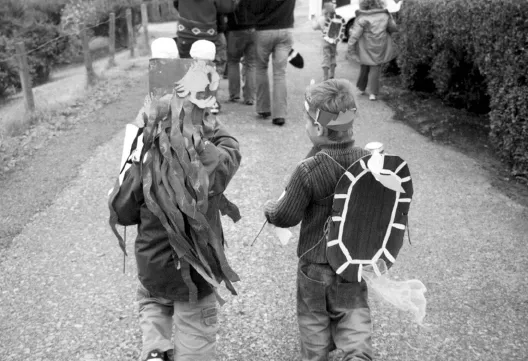
Figure 4. Children take part in an annual Save the Whale parade in Spey Bay, dressed in sea creature costumes made by them earlier in the day. Photo by author.
One cause of consternation amongst centre staff, though, was the relative regularity with which visitors would come into the centre and ask where they keep the dolphins, as if it were a dolphinarium. There are no dolphinariums in the UK because, although they are not illegal as such, the animal welfare regulations are so restrictive as to make them unviable, and one of the main points that staff members in the centre are keen to get across to visitors is that capturing and keeping cetaceans for public exhibition is, in their view, cruel. Staff members see educating people about cetacean welfare as one of their main roles and they produce literature, which they give out for free in the wildlife centre, that argues that keeping them in captivity drastically reduces their life span and quality of life. The misperception of visitors and potential visitors that they might be running a dolphin captivity programme at Spey Bay is exasperating for them, as it is a fundamental misunderstanding of what they stand for and it demonstrates that there is still a lack of awareness about the problems of keeping cetaceans in captivity amongst the general public. Whilst telling me about such visitors who had asked about seeing dolphins in captivity at Spey Bay, one staff member said to me, “We don’t keep dolphins in tanks like SeaWorld! You have to come and watch and wait, you can’t just expect to get everything you want whenever you want it!”2
As an alternative to seeing dolphins and whales in captivity, the wildlife centre promotes “responsible” wildlife-watching from small boats that do not “harass” wildlife. The wildlife-watching industry is growing steadily in the area, benefitting not only from an apparently ready market but also from the infrastructure of the local fishing industry. The wildlife-watching trips on which the Spey Bay volunteers guide are on a repurposed lifeboat led by a former fisherman and his wife, and a number of other tour operators have adapted fishing boats for wildlife cruises and operate out of the many local harbours that would once have been filled with fishing boats.
The presence of wildlife is also an important selling point for local tourism more generally. The Moray Firth coast is dotted with bed and breakfasts, hotels, guesthouses, and quite a few caravan and camping sites with mobile homes perched on the edges of the coast so as to maximise the sea views, which (mostly British) tourists stay in over the summer. Quite a few families in Spey Bay make the most of the local landscape and wildlife in their own business enterprises including the family that runs the café in the wildlife centre. Not surprisingly, although the café is technically a separate venture from the conservation charity, it is decorated with many depictions of dolphins including stencils of leaping dolphins on the walls. They also display for sale some of the artwork of a local retired couple, originally from Yorkshire, whose house in Spey Bay is crammed with their various arts and crafts projects, all of which in some way reflect the local environment but especially the sea. Margaret, who asked me above about Paula’s relationship status, and her husband run a bed and breakfast that is explicitly sold to visitors on the promise of seeing dolphins, as the upstairs sitting room has an enormous full-length window that overlooks the bay and so provides ample opportunities for warm, comfortable dolphin-watching.
Making a Stable Environment
The idea of the stable environment indicates the importance of location and a sense of home in people’s ideas about reproduction and parenting. Rural areas of Scotland have higher birthrates compared to those of cities, and Moray has one of the highest rates in Scotland, along with neighbouring Aberdeenshire and the Shetland Isles.3 According to the Scottish Government, some of this may be “driven by selective migration of people wishing to start or increase their families from cities to suburban areas as a result of housing market and quality of life issues.”4 The people I l...
Table of contents
- Cover Page
- Title Page
- Copyright Page
- Dedication Page
- Contents
- Acknowledgements
- Prologue: The Sperm Whale’s Teeth
- Introduction: Life in a Nature Reserve
- 1: Ethical Labour
- 2: Future Generations
- 3: Origin Stories
- 4: Ties That Bind
- 5: Money Talks
- 6: A Stable Environment
- Notes
- Bibliography
- Index
Trusted by 375,005 students
Access to over 1.5 million titles for a fair monthly price.
Study more efficiently using our study tools.
Frequently asked questions
Yes, you can cancel anytime from the Subscription tab in your account settings on the Perlego website. Your subscription will stay active until the end of your current billing period. Learn how to cancel your subscription
No, books cannot be downloaded as external files, such as PDFs, for use outside of Perlego. However, you can download books within the Perlego app for offline reading on mobile or tablet. Learn how to download books offline
Perlego offers two plans: Essential and Complete
- Essential is ideal for learners and professionals who enjoy exploring a wide range of subjects. Access the Essential Library with 800,000+ trusted titles and best-sellers across business, personal growth, and the humanities. Includes unlimited reading time and Standard Read Aloud voice.
- Complete: Perfect for advanced learners and researchers needing full, unrestricted access. Unlock 1.5M+ books across hundreds of subjects, including academic and specialized titles. The Complete Plan also includes advanced features like Premium Read Aloud and Research Assistant.
We are an online textbook subscription service, where you can get access to an entire online library for less than the price of a single book per month. With over 1.5 million books across 990+ topics, we’ve got you covered! Learn about our mission
Look out for the read-aloud symbol on your next book to see if you can listen to it. The read-aloud tool reads text aloud for you, highlighting the text as it is being read. You can pause it, speed it up and slow it down. Learn more about Read Aloud
Yes! You can use the Perlego app on both iOS and Android devices to read anytime, anywhere — even offline. Perfect for commutes or when you’re on the go.
Please note we cannot support devices running on iOS 13 and Android 7 or earlier. Learn more about using the app
Please note we cannot support devices running on iOS 13 and Android 7 or earlier. Learn more about using the app
Yes, you can access Making a Good Life by Katharine Dow in PDF and/or ePUB format, as well as other popular books in Social Sciences & Gynecology, Obstetrics & Midwifery. We have over 1.5 million books available in our catalogue for you to explore.