Divination and Human Nature casts a new perspective on the rich tradition of ancient divination—the reading of divine signs in oracles, omens, and dreams. Popular attitudes during classical antiquity saw these readings as signs from the gods while modern scholars have treated such beliefs as primitive superstitions. In this book, Peter Struck reveals instead that such phenomena provoked an entirely different accounting from the ancient philosophers. These philosophers produced subtle studies into what was an odd but observable fact—that humans could sometimes have uncanny insights—and their work signifies an early chapter in the cognitive history of intuition.
Examining the writings of Plato, Aristotle, the Stoics, and the Neoplatonists, Struck demonstrates that they all observed how, setting aside the charlatans and swindlers, some people had premonitions defying the typical bounds of rationality. Given the wide differences among these ancient thinkers, Struck notes that they converged on seeing this surplus insight as an artifact of human nature, projections produced under specific conditions by our physiology. For the philosophers, such unexplained insights invited a speculative search for an alternative and more naturalistic system of cognition.
Recovering a lost piece of an ancient tradition, Divination and Human Nature illustrates how philosophers of the classical era interpreted the phenomena of divination as a practice closer to intuition and instinct than magic.
eBook - ePub
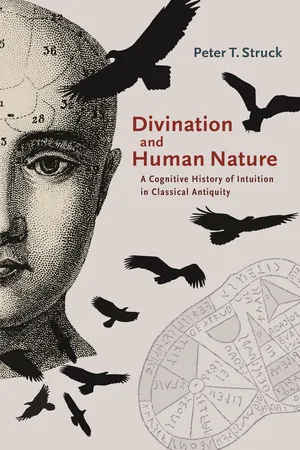
Divination and Human Nature
A Cognitive History of Intuition in Classical Antiquity
- 304 pages
- English
- ePUB (mobile friendly)
- Available on iOS & Android
eBook - ePub
About this book
Information
Publisher
Princeton University PressYear
2016Print ISBN
9780691183459
9780691169392
eBook ISBN
9781400881116
CHAPTER 1
Plato on Divination and Nondiscursive Knowing
In his most vivid narrative of his hero’s life story, Plato has Socrates center his autobiography on an act of divination. The Apology shows a man driven by a provocative pronouncement from the Delphic oracle to devote his life to solving its riddle. Pleading his own defense before an Athenian jury, Socrates presents a carefully constructed speech, rich in mythological allusions. He compares himself to Achilles (28c) and likens his life’s work to a Herculean labor (22a).1 A more subtle and also more powerful point of reference is another figure, the Theban hero Oedipus, whose life was as profoundly shaped by the oracle as he argues his own was. But while Oedipus spends his days trying to disprove the oracle, in an archetypal act of intellectual hubris, Plato reverses the main point of the traditional tale, making his story one of intellectual humility. He dramatizes his hero’s epistemological caution through counterpoint.
Plato consistently reaches back to myth, usually with an underlying purpose of supplanting a mythic archetype with one of his own more philosophical models—as when Er’s trip to the other world is said to supersede Odysseus’ narrative (“no tall tale to Alcinous” Rep. 614b).2 It is somewhat surprising, given its prominent place in the corpus, that this particular retelling has not received more attention.3 Socrates makes out his own life to be a kind of propitiation for the general sin of overconfidence in the ability to know (Apol. 21b–d, 23b–c), the offence for which Oedipus could well stand. He places the same culturally regnant form of divination, the oracle at Delphi, at the very center of his drama too. The stories of the two figures resonate in specific similarities and inversions. Like Oedipus, Socrates arrives as a foreigner (ξένος 17d) in the land of the courtroom. Both men have given over their lives to solving oracular riddles (αἰνίγματα 21b, 27a, 27d) in order to benefit their cities. Both lose out on wealth and political power because of their wrestling with the Delphic oracle (24a). Even in its staging, the Apology resembles the Oedipus Tyrannus. In both works, the main character stands in front of a body of citizens who are making judgments, the dicasts resembling the chorus, and defends against accusers from his position at center stage: Socrates’ accusers, Anytus, Lycon, and Meletus answering to Oedipus’ Creon, Teiresias, and the messengers.
They strongly contrast with each other, though, over their attitude toward the state of their own knowledge. Oedipus deals with the challenge of the Pythia by remaining convinced that the infallible oracle has in his case made a mistake. Since hearing that he would sleep with his mother and kill his father, he has tried to prove it wrong. Bolstered by his victory over the Sphinx, he defensively makes light of Apollo’s ability to know. When he gets the message that his Corinthian father is dead, whom he doesn’t know was an adoptive one, he goes so far as to vaunt against divinatory knowledge.
Ah ha!, why then would anyone look to
the Pythian seer’s hearth, or to the
screeching birds above, under whose guidance
I was supposed to have killed my very father? But he, now dead,
lies concealed down in the earth; and I, this man, right here,
am pure from the spear; unless somehow he died
by longing for me, and in this way he might have died on account of me.
But Polybus has taken with him the oracles at hand, worth nothing,
and lies in Hades.
φεῦ φεῦ, τί δῆτ’ ἄν, ὦ γύναι, σκοποῖτό τις
τὴν Πυθόμαντιν ἑστίαν, ἢ τοὺς ἄνω
κλάζοντας ὄρνεις, ὧν ὑφ’ ἡγητῶν ἐγὼ
κτανεῖν ἔμελλον πατέρα τὸν ἐμόν; ὁ δὲ θανὼν
κεύθει κάτω δὴ γῆς· ἐγὼ δ’ ὅδ’ ἐνθάδε
ἄψαυστος ἔγχους, εἴ τι μὴ τὠμῷ πόθῳ
κατέφθιθ’· οὕτω δ’ ἂν θανὼν εἴη ’ξ ἐμοῦ.
τὰ δ’ οὖν παρόντα συλλαβὼν θεσπίσματα
κεῖται παρ’ Ἅιδῃ Πόλυβος ἄξι’ οὐδενός.
(OT 964–72)
A certain kind of disagreeing with Apollo is of course authorized by a long tradition of debate with his oracle—famously depicted in Herodotus’ stories of powerful men talking back to the Pythia—but Oedipus’ challenge is less respectful. He stands outside the oracle’s rules by simply declaring it wrong, instead of trying to figure out how it might be right, in a sense that he could live with. When Herodotus’ Athenians don’t like a particularly dreary oracle they get, by contrast, they ask for a new one (7.140–41). Their query yields them the famous declaration that by taking refuge behind the “wooden wall” they might stand a slim chance against Xerxes’ onslaught. This gives them something they can work with, and they argue about the best way to interpret it. Successful interlocutors look for an accommodation. Socrates’ stance is much closer to that of Themistocles than it is to Oedipus’. When the oracle declares Socrates to be the wisest of men, he claims to have been incredulous. But he accepts its authority and sets out to see what it might have meant, and in what way it could be true (Apol. 21b). Eventually, he declares it is right, understanding his wisdom to consist in a recognition of profound human limitation (20d–e). It turns out to be an oracle itself about divinatory knowledge, in comparison to which the human ability to know functionally vanishes. Precisely reversing Oedipus, he declares in the end that it is human wisdom, not the divine oracle, that is “worth nothing:”
It’s likely, gentlemen, that the god really is wise, and in this oracle is saying this: that human wisdom is worth something very small, even nothing. Although he appears to say this of Socrates, he has just used my name, making me an example, as if he should say, “That man is wisest among you, humans, whoever just like Socrates knows that in regard to wisdom, in truth, he is worth nothing.”
τὸ δὲ κινδυνεύει, ὦ ἄνδρες, τῷ ὄντι ὁ θεὸς σοφὸς εἶναι, καὶ ἐν τῷ χρησμῷ τούτῳ τοῦτο λέγειν, ὅτι ἡ ἀνθρωπίνη σοφία ὀλίγου τινὸς ἀξία ἐστὶν καὶ οὐδενός. καὶ φαίνεται τοῦτον λέγειν τὸν Σωκράτη, προσκεχρῆσθαι δὲ τῷ ἐμῷ ὀνόματι, ἐμὲ παράδειγμα ποιούμενος, ὥσπερ ἂν <εἰ> εἴποι ὅτι “Οὗτος ὑμῶν, ὦ ἄνθρωποι, σοφώτατός ἐστιν, ὅστις ὥσπερ Σωκράτης ἔγνωκεν ὅτι οὐδενὸς ἄξιός ἐστι τῇ ἀληθείᾳ πρὸς σοφίαν.” (23a–b)
Socrates atones for Oedipus’ failing by his own change of attitude, but further he supplants failure with success. Although Oedipus cannot entirely solve his crucial Delphic riddle, Socrates can. Speaking to the Delphic maxim to “know yourself,” Plato makes of Socrates’ life a lesson grounded in a particular kind of self-knowledge. He is indeed the wisest of men because he at least knows that he doesn’t know anything at all.
With vertiginous ingenuity, Plato has made the panoptic knowledge that most of his peers thought resided at Delphi to occupy a position perfectly congruent to the kind of knowing Socrates is driven to pursue throughout his life: a grasp of the real truth of things, as opposed to tentative knowledge of the shifting surfaces of the shadow world of appearances in which we all sadly dwell. Further, the state of aporia that results from Socratic elenchus produces an intellectual humility with which he finds a parallel in that faced by those who tangle with the oracle. Socrates seems to claim here that he has learned his own most important lesson from the Pythia: appearances can be deceiving. And if one could ever achieve secure knowledge of the forms themselves, that person would be in a kind of higher state of knowing. Xenophon’s version of the story differs in instructive ways. The courtroom drama is also driven by an oracle, but it isn’t about human knowledge. Xenophon has the oracle claiming that no man is freer, more just, nor more temperate than Socrates (Xen. Apol. 14). Socrates then advocates on his own behalf, arguing for all the ways in which he indeed has more freedom, justice, and temperance than anyone else.4 Plato has made a deliberate choice in the Apology to cast Socrates’ life as a drama about epistemology, and by using the oracle as a fulcrum, he indicates divination’s power to speak to the human capacity to know. Taking this as an invitation to have another look at how divination appears in the corpus, one sees that it comes up more frequently than might be expected. Socrates finds it useful in developing his arguments and illustrating points of his philosophical program. His tone is sometimes ironic and playful, sometimes quite sincerely engaged, sometimes mocking, sometimes serious, and almost never exclusively one of these.
By way of introduction, I will attempt to lay out a general sense of how divination functions in Plato’s work. When scholars do take account of this topic, the question of skepticism tends to guide the treatment. We see attempts to determine some point, across a scale leading from negative to positive, corresponding to how Plato, Plato’s Socrates, or the historic Socrates might have valued divinatory knowledge.5 I will engage in a slightly different inquiry. I will not focus on how seriously Plato takes divination, but rather on how he takes it. Irrespective of any endorsement he may have hinted at toward the idea of knowledge arriving via traditional divinatory pathways, in what particular ways does he talk about it? I will proceed from a sense that Plato uses divination as an authoritative piece of his cultural context, to specify with greater precision his own ideas about ways of knowing; and as he is doing this, he helps us understand the nature of divination, as it is understood in his time.6
This approach also mirrors what is probably the standard mode in studies of the complex evidence Plato provides for another traditional, deeply authoritative discourse: poetry. We are used to the idea that even when he is being ironic or critical, we can gain powerful insights from Plato’s corpus about poetics and poetry itself. And just as one needn’t solve precisely how seriously Plato took poetry in some global sense to gain such insights, so also we can learn about divination from Plato without having first to pin him (or Socrates) down to a single view on the whole of the topic. And as one begins to look in this direction, one finds that his discussions of divination are nearly as frequent as those of poetry, and perhaps even more consequential. In addition to the Apology, the topic is woven rather deeply, after all, into the fabric of prominent dialogues, such as the Phaedrus, Phaedo, and Symposium, and shorter references to it pepper other works.
Like poetry, divination often provides a foil for comparison—usually as a point of contrast rather than a topic unto itself. Both discourses carry a background of authority that Plato is keen to co-opt. He measures each art according to the value of its claims to knowledge, and in each case stresses limitations, especially in comparison with philosophy. Both poetry and divination are built on shaky epistemological ground, and they operate via the medium of the phantom image (εἴδωλον)—which for Plato consistently means an imitation of an imitation.7
In general in his corpus, I will argue, Plato treats divination (in a rainbow of tones from irony to seriousness) as being based on a claim about a particular form of cognition, one marked especially for being nondiscursive. In his various modes of treating it, it comes to stand for a kind of knowledge that arrives unexpectedly or involuntarily, and stretches beyond our ability to account for it. By consistently highlighting these qualities, Plato attests to a broader view that divination is the locus of surplus knowledge. This aspect of the larger picture has mostly escaped us.
After this broader exploration of the corpus, I will use the view gained to reexamine Plato’s most concentrated commentary on the topic, in the fascinating anatomical discussion of human nature in the Timaeus. The text is undeniably strange. As we will see, Plato develops an elaborate discussion of the liver as a screen for divinatory images meant to frighten the appetitive soul into submission. But this section of the Timaeus, coming as it does at a pivotal inflection point of the dialogue, has provoked a more bemused kind of puzzlement among scholars than perhaps it should.8 It articulates a complex set of ideas that are embedded in important components of Platonic epistemology and psychology.9 And furthermore, in my view, it gives us our most illuminating insights into his ideas o...
Table of contents
- Cover Page
- Title Page
- Copyright Page
- Dedication Page
- Contents
- Acknowledgments
- Introduction: Divination and the History of Surplus Knowledge
- Chapter 1: Plato on Divination and Nondiscursive Knowing
- Chapter 2: Aristotle on Foresight through Dreams
- Chapter 3: Posidonius and Other Stoics on Extra-Sensory Knowledge
- Chapter 4: Iamblichus on Divine Divination and Human Intuition
- Conclusion: Reconsidering Penelope
- Bibliography
- Index Locorum
- Subject Index
Trusted by 375,005 students
Access to over 1.5 million titles for a fair monthly price.
Study more efficiently using our study tools.
Frequently asked questions
Yes, you can cancel anytime from the Subscription tab in your account settings on the Perlego website. Your subscription will stay active until the end of your current billing period. Learn how to cancel your subscription
No, books cannot be downloaded as external files, such as PDFs, for use outside of Perlego. However, you can download books within the Perlego app for offline reading on mobile or tablet. Learn how to download books offline
Perlego offers two plans: Essential and Complete
- Essential is ideal for learners and professionals who enjoy exploring a wide range of subjects. Access the Essential Library with 800,000+ trusted titles and best-sellers across business, personal growth, and the humanities. Includes unlimited reading time and Standard Read Aloud voice.
- Complete: Perfect for advanced learners and researchers needing full, unrestricted access. Unlock 1.5M+ books across hundreds of subjects, including academic and specialized titles. The Complete Plan also includes advanced features like Premium Read Aloud and Research Assistant.
We are an online textbook subscription service, where you can get access to an entire online library for less than the price of a single book per month. With over 1.5 million books across 990+ topics, we’ve got you covered! Learn about our mission
Look out for the read-aloud symbol on your next book to see if you can listen to it. The read-aloud tool reads text aloud for you, highlighting the text as it is being read. You can pause it, speed it up and slow it down. Learn more about Read Aloud
Yes! You can use the Perlego app on both iOS and Android devices to read anytime, anywhere — even offline. Perfect for commutes or when you’re on the go.
Please note we cannot support devices running on iOS 13 and Android 7 or earlier. Learn more about using the app
Please note we cannot support devices running on iOS 13 and Android 7 or earlier. Learn more about using the app
Yes, you can access Divination and Human Nature by Peter Struck in PDF and/or ePUB format, as well as other popular books in History & Ancient History. We have over 1.5 million books available in our catalogue for you to explore.