A definitive biography of the great French essayist and thinker
One of the most important writers and thinkers of the Renaissance, Michel de Montaigne (1533–92) helped invent a literary genre that seemed more modern than anything that had come before. But did he do it, as he suggests in his Essays, by retreating to his chateau, turning his back on the world, and stoically detaching himself from his violent times? In this definitive biography, Philippe Desan, one of the world's leading authorities on Montaigne, overturns this longstanding myth by showing that Montaigne was constantly concerned with realizing his political ambitions—and that the literary and philosophical character of the Essays largely depends on them. The most comprehensive and authoritative biography of Montaigne yet written, this sweeping narrative offers a fascinating new picture of his life and work.
As Desan shows, Montaigne always considered himself a political figure and he conceived of each edition of the Essays as an indispensable prerequisite to the next stage of his public career. He lived through eight civil wars, successfully lobbied to be raised to the nobility, and served as mayor of Bordeaux, special ambassador, and negotiator between Henry III and Henry of Navarre. It was only toward the very end of Montaigne's life, after his political failure, that he took refuge in literature. But, even then, it was his political experience that enabled him to find the right tone for his genre.
In this essential biography, we discover a new Montaigne—caught up in the events of his time, making no separation between private and public life, and guided by strategy first in his words and silences. Neither candid nor transparent, but also not yielding to the cynicism of his age, this Montaigne lends a new depth to the Montaigne of literary legend.
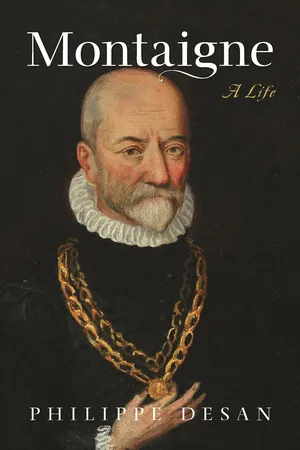
- 832 pages
- English
- ePUB (mobile friendly)
- Available on iOS & Android
eBook - ePub
About this book
Information
Publisher
Princeton University PressYear
2017Print ISBN
9780691183008
9780691167879
eBook ISBN
9781400883394
PART ONE

Ambitions
CHAPTER 1
The Eyquems’ Social Ascension
“And if I were to live a long time, I do not doubt that I would forget my own name.”1 Montaigne’s name constitutes the author’s memory and incarnates the history of a family and its social ascension, but we still need to know what name Montaigne is talking about. Is it Michel Eyquem, his patronymic, or Michel de Montaigne, the name of his estate and his seigneury? The answer to this question differs over time, and the passage from Eyquem to Montaigne is a textbook case for the study of the social history of the class of wealthy merchants and bourgeois who became gentlemen at the end of the fifteenth and throughout the sixteenth centuries. The author of the Essais was the first member of his family to give up the name of his ancestors and retain only the name of his seigneury. In fact, the biography of “Michel, seigneur Montaigne” begins long before his birth. To understand his familial milieu, we have to study the social ascension of the house of Montaigne that started in the middle of the fourteenth century. The economic transformations of the fifteenth and sixteenth centuries favored the emergence and domination of well-off merchant families who had settled in the great European cities.
Political power slowly but surely shifted toward centers of exchange and commerce, particularly cities built on navigable waterways or at the mouths of rivers. Bordeaux was ideally situated to become a hub serving most European ports. Its access to the ocean gave a major advantage to those whose main activity consisted in warehousing merchandise and sending it on by sea to new markets. In the fifteenth century, during the decline of the English presence in the region, Bordeaux was a land of opportunity, and a significant number of merchants emigrated there from other parts of France and also from Spain and Portugal. For example, an edict of 1464 authorized emigrants to settle in Bordeaux in houses they found empty and to obtain letters of naturalization. Very early on, the wheels of commerce and the administrative control of the city were concentrated in the hands of a few families that had been able to benefit from the commercial development of Guyenne after the departure of the English.
In the fourteenth century, the name Eyquem was quite common in the Bordeaux region. It was spelled “Ayquem” and “Aiquem” as well as “Eyquem” and is found in several localities, including Mérignac, Taillan, Pessac, Camblanes, Blanquefort, and Langon. The Eyquems of Blanquefort—from whom the Montaignes descended—settled in Bordeaux in the early fourteenth century and joined the juradei as early as 1358, a sign that they had already achieved a significant economic success. Wealthy Bordeaux families formed a bourgeoisie that was little inclined to discuss its origins. Focused on the future, they practiced endogamy to increase their status in the city and to favor their access to municipal political power. Their goal was to advance their social position by means of marriages with other great bourgeois families. In the city, a political void allowed these families to take control of the administration in order to manage the regulation of their economic and commercial activities. By the middle of the fifteenth century, English power had grown considerably weaker in Guyenne, and in 1453 the battle of Castillon put an end to three centuries of English domination in Aquitaine. A parlementii was established in 1462, and the city’s privileges were approved and confirmed by Charles VIII in 1483. The king was generous toward the bourgeois of Bordeaux, declaring them free and exempt from having to pay subsidies and land taxes or make compulsory loans. Troops could not be billeted in the city without the consent of the mayor and the magistrates, and the city’s guard as well as its police were entrusted to the citizens. However, after the English left, Guyenne’s share of the land tax to be collected in Aquitaine was doubled. In this context of European expansion and political reforms, the city of Bordeaux underwent an unprecedented economic growth at the end of the fifteenth and the beginning of the sixteenth centuries.
Under Francis I the Anciennes Coutumes de Guyenne (“ancient customary laws of Guyenne”) were reformed to take into account the local bourgeoisie’s demands. The three estates of the sénéchaussée of Guyenne assembled in February 1520 to modify the old Coutumier. Several articles were suppressed or changed and new ones were added. The work lasted five months and the reformed Coutumier went into effect toward the end of 1527. Its territory was extended to include the former sénéchaussée of Bordeaux. The new customary law of Guyenne, which heavily favored the bourgeoisie, consisted of 117 articles written in a rather disorderly fashion and without much equity. Questions of inheritance and testamentary succession strongly recentered customary law around the transmission of property, and the goal of the great majority of the articles was to provide better protection for private property and to favor bourgeois property owners over the feudal territorial rights of noble landlords.iii The first article sets the tone of this rewriting of customary law. It stipulates that every son of a merchant family engaged in commerce or other business (banking, brokerage, purchasing) “can make commitments without his father’s consent, in matters concerning merchandise or business.”2 For example, children had the right to do business under their own names without depending on the authority of their fathers. In the same spirit of liberalizing mercantile law, Article V reorganized the law governing the legacy of goods to descendants by specifying that lineal transmission henceforth always had priority over feudal law. Inheritances, successions, transmissions, and donations of buildings, as well as the regulation of rents and mortgages, were subjected to new interpretations favorable to the rising bourgeoisie and represented more than sixty articles in the Coutumes générales de la ville de Bordeaux et de la sénéchaussée de Guyenne between 1520 and 1527. The revision of customary law at the beginning of the sixteenth century was the end result of a long process of political redistribution in Bordeaux and in Guyenne.
The Eyquems were among the small number of families that very soon came to hold the reins of the city’s administration. Montaigne’s ancestors made a fortune selling woadiv and smoked herring. The Eyquems followed the social trajectory typical of wealthy merchant families and used their economic success to gain access to political power. No matter what Montaigne says about it, his family’s past in Guyenne is not of noble origin, but is instead associated with commerce and merchandise, which may explain why the historical periods mentioned in the Essais are mainly Antiquity and the immediate present. The last hundred years are not referred to anywhere in the text, because for obvious reasons Montaigne is not interested in retracing the history of his family. There are only vague remarks about his grandparents and great-grandparents, on both the paternal and maternal sides. Of course, Montaigne talks about his father and brothers, but he remains almost completely silent about his earlier ancestors. We are told only that he was born of “a race famous for integrity,”3 and that his nobility goes back “more than a hundred years before me.”4 The limit of one hundred years is not chosen by accident. In the sixteenth century, the rules governing membership in the nobility varied depending on the region.5 In his Traité des nobles et des vertus dont ils sont formés, François de L’Alouëte proposes that nobles be forced to produce “once in their lives a description and genealogy of the race from which they come and descend from father and from mother to the fourth degree, and beyond as far as they can go and extend themselves,”6 and to deposit these descriptions in the hands of the bailiffs or seneschals so that they could be consulted in case of need. In Aquitaine, custom required a person to have “lived nobly” for one hundred years on his land before he could claim to be noble “by prescription.”v Usually leaving aside this quantitative conception of nobility, Montaigne prefers a qualitative definition, reminding his reader repeatedly that he behaves as a lord and lives nobly on his lands.
Belonging to the nobility of the sword,vi the only noble race,7 also meant performing military service. Montaigne wholeheartedly adhered to what was called the “soldierly” spirit of the nobility,8 even if he did not wear the sword into combat as his father had done. This correspondence between the social order and the main activity of the members of the nobility is often foregrounded in the Essais. In contrast, the world of commerce and merchandise remains a taboo subject. For Montaigne, money distorts human relations, corrupts traditional values, and injures the spirit of the nobility. He prefers battlefields to markets. It suffices to see the way in which he talks about the Indians of the New World and projects onto them his idea of nobility to see that he fully adheres to the military and chivalric principles that defined the noble ideal. Marked by this idealization of military values and their transformation into virtues, Montaigne reminds us that his father participated in the military campaigns in Italy during Francis I’s conquest and then loss of Milan. He describes himself as a soldier even though he took part in no battles and witnessed only one military siege—perhaps two—as an observer and not as a knight in the service of the king. If Montaigne is proud to be a Gascon, that is partly because of the military reputation the young men of his region enjoyed at the time. He repeatedly emphasizes this origin that made him an excellent horseman and indirectly authorized him to assert his membership in the French nobility. In his Essais Montaigne always distinguishes himself from the mercantile class (mercadence) and the world of the bourgeoisie.
A Family Matter

Montaigne’s great-grandfather, Ramon Eyquem, was born in 1402; Ramon’s father was Martin (?) Eyquem and his mother was Jeanne de Gaujac, the daughter of a family that exported wine, salted fish, and woad in Bordeaux. Ramon took over the business of his uncle Guillart Eyquem, and around 1440 he married Isabeau de Ferraignes, the sister of Henri de Ferraignes, one of the first members of the Bordeaux parlement. The latter was connected, by his first marriage, to the noble Madeleine de La Mothe, the daughter of Jean de La Mothe, lord of Cambes, and by his second marriage, to the noble Jehanne du Puy, the daughter of Hélie du Puy, lord of La Jarthe. The marriage linking the Eyquems to the Ferraigneses marks the starting point of an alliance that was profitable for the Eyquems both financially and as a way of cultivating useful relationships. Thanks to her brother, Isabeau also offered her husband an opportunity to gain access to new power groups. From the middle of the fifteenth century on, the bourgeois family of the Eyquems signed its notarized documents with the title “honorable man Ramon Ayquem, merchant in the parish of Saint-Michel and bourgeois of Bordeaux.” He was among the city’s influential merchants and joined the jurade in 1472.
Ramon Eyquem’s everyday life was completely focused on pecuniary matters. Like many bourgeois who had grown rich, he invested his profits in real estate. In a logic of accumulating lands and houses, he reasoned and acted as a merchant would and was not yet cut out to be a noble. He left this concern about nobility to his children; his role was limited to preparing the terrain for the generations to come. Everything he did had as its aim to make his family’s name known and respected. Ramon was a prosperous merchant, and he rapidly made himself known as an “entrepreneur” in all sorts of commercial projects. He established his home on the Rue de la Rousselle in Bordeaux and began by exporting mainly salted fish, but he soon diversified his activities and began selling wine and woad, depending on the market opportunities. Like other big merchants of the time—the Carles, the Le Ferrons, the Pontacs, and the Makanams—Ramon Eyquem took an active part in the city’s political life, which greatly helped him in his personal affairs. At the end of the fifteenth century, the wine trade had supplanted that in woad and had become the main source of income for the bourgeois of Bordeaux and the region.9
In 1477, one year before his death, Ramon Eyquem bought the noble houses of Montaigne and Belbeys, in the barony of Montravel, along with their lands, vineyards, woods, and mills, from Guillaume Duboys, for 900 Bordeaux francs.10 This transaction made it possible to move from “Eyquem” to “Montaigne.” The estate of Montaigne is located on a hill between the Dordogne River and a stream called the Lidoire, and is now situated within the departments of Gironde and Dordogne, about forty-five kilometers due east of Bordeaux. The buildings and lands of Montaigne and Belbeys had first been sold to Thomas Pons, Lord of Clermont, for 300 gold royals and an annual income of thirty livres tournois. But Pons was unable to raise the sum asked and Guillaume Duboys had the sale canceled on October 10, 1477. The same day, he sold his lands to Ramon Eyquem and promised to transmit to him the list of the esporlesvii for the past six years. The payment of this fee was required when there was a change of owner. The amount of the esporle was generally modest, but this tax had an important symbolic function because it made it possible to anticipate the prescription of the landed seigneury and to assert the new lord’s right over the property in the event of a challenge. On November 30, 1477, Ramon Eyquem took possession of his land and the noble house of Montaigne, 103 years before the first publication of the Essais. In accord with the custom associated with the transmission of property, Ramon had traveled to his lands in the company of the former owner, who entered his former home in Ramon’s company and then left alone, witnessed by all the neighbors who had gathered there for the occasion. Ramon spoke a few words before a notary and then sat down to table, which allowed him to be officially recognized as the new master of the estate.11
Around 1450, two children had been born to Ramon and Isabeau Eyquem: Grimon, Montaigne’s grandfather, and Pey (Pierre), their second son. In documents notarized in the 1470s, Grimon and Pey are described as “honorable men … merchants of the parish of Saint-Michel.” Ramon also had two daughters, Pérégrina and Audeta. In a process of marriage and mixture between the rising bourgeoisie and a nobility in decline, Ramon married his daughters to Jean de Lansac and Bernard de Verteuilh, respectively; Lansac and Verteuilh were the heirs of noble families that had found it necessary, for financial reasons, to connect themselves with families from the bourgeoisie. In 1473, while he was getting ready to go on a pilgrimage to Saint James of Compostela, Ramon wrote a testament in which he left his wife a large number of buildings and lands, provided monetary dowries for his two daughters, and designated his two sons, Grimon and Pey, as universal heirs.viii He died in June 1478, less than a year after acquiring the seigneury of Montaigne. In 1488, after the death of his brother, who had no children, Grimon remained alone to turn the Eyquems’ affairs to good account. Thanks to his acute business sense, especially in exports, his fortune grew considerably. He specialized in the trade in wine and salted fish with England and Spain, which led Scaliger to say, not without irony, that Montaigne’s father was a fishmonger. A docum...
Table of contents
- Cover Page
- Title Page
- Copyright Page
- Contents
- Acknowledgments
- Prologue
- Introduction
- Part One—Ambitions
- Part Two—Practices
- Part Three—Post Mortem
- Epilogue
- Abbreviations
- Notes
- Bibliography
- Translations Cited
- Index
Trusted by 375,005 students
Access to over 1.5 million titles for a fair monthly price.
Study more efficiently using our study tools.
Frequently asked questions
Yes, you can cancel anytime from the Subscription tab in your account settings on the Perlego website. Your subscription will stay active until the end of your current billing period. Learn how to cancel your subscription
No, books cannot be downloaded as external files, such as PDFs, for use outside of Perlego. However, you can download books within the Perlego app for offline reading on mobile or tablet. Learn how to download books offline
Perlego offers two plans: Essential and Complete
- Essential is ideal for learners and professionals who enjoy exploring a wide range of subjects. Access the Essential Library with 800,000+ trusted titles and best-sellers across business, personal growth, and the humanities. Includes unlimited reading time and Standard Read Aloud voice.
- Complete: Perfect for advanced learners and researchers needing full, unrestricted access. Unlock 1.5M+ books across hundreds of subjects, including academic and specialized titles. The Complete Plan also includes advanced features like Premium Read Aloud and Research Assistant.
We are an online textbook subscription service, where you can get access to an entire online library for less than the price of a single book per month. With over 1.5 million books across 990+ topics, we’ve got you covered! Learn about our mission
Look out for the read-aloud symbol on your next book to see if you can listen to it. The read-aloud tool reads text aloud for you, highlighting the text as it is being read. You can pause it, speed it up and slow it down. Learn more about Read Aloud
Yes! You can use the Perlego app on both iOS and Android devices to read anytime, anywhere — even offline. Perfect for commutes or when you’re on the go.
Please note we cannot support devices running on iOS 13 and Android 7 or earlier. Learn more about using the app
Please note we cannot support devices running on iOS 13 and Android 7 or earlier. Learn more about using the app
Yes, you can access Montaigne by Philippe Desan, Steven Rendall, Lisa Neal, Steven Rendall,Lisa Neal in PDF and/or ePUB format, as well as other popular books in Politique et relations internationales & Biographies littéraires. We have over 1.5 million books available in our catalogue for you to explore.