How the creation of the Nobel Prize in Economics changed the economics profession, Sweden, and the world
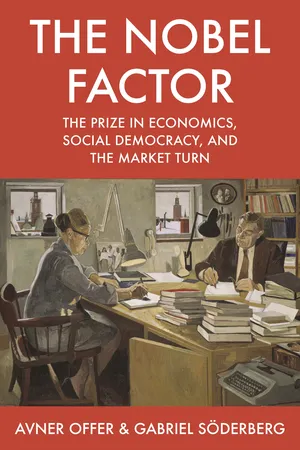
Economic theory may be speculative, but its impact is powerful and real. Since the 1970s, it has been closely associated with a sweeping change around the world—the "market turn." This is what Avner Offer and Gabriel Söderberg call the rise of market liberalism, a movement that, seeking to replace social democracy, holds up buying and selling as the norm for human relations and society. Our confidence in markets comes from economics, and our confidence in economics is underpinned by the Nobel Prize in Economics, which was first awarded in 1969. Was it a coincidence that the market turn and the prize began at the same time? The Nobel Factor, the first book to describe the origins and power of the most important prize in economics, explores this and related questions by examining the history of the prize, the history of economics since the prize began, and the simultaneous struggle between market liberals and social democrats in Sweden, Europe, and the United States.
The Nobel Factor tells how the prize, created by the Swedish central bank, emerged from a conflict between central bank orthodoxy and social democracy. The aim was to use the halo of the Nobel brand to enhance central bank authority and the prestige of market-friendly economics, in order to influence the future of Sweden and the rest of the developed world. And this strategy has worked, with sometimes disastrous results for societies striving to cope with the requirements of economic theory and deregulated markets.
Drawing on previously untapped Swedish national bank archives and providing a unique analysis of the sway of prizewinners, The Nobel Factor offers an unprecedented account of the real-world consequences of economics—and its greatest prize.
eBook - ePub
The Nobel Factor
The Prize in Economics, Social Democracy, and the Market Turn
- 344 pages
- English
- ePUB (mobile friendly)
- Available on iOS & Android
eBook - ePub
The Nobel Factor
The Prize in Economics, Social Democracy, and the Market Turn
About this book
Trusted by 375,005 students
Access to over 1.5 million titles for a fair monthly price.
Study more efficiently using our study tools.
Information
Publisher
Princeton University PressYear
2016Print ISBN
9780691196312
9780691166032
eBook ISBN
9781400883417
CHAPTER 1
IMAGINARY MACHINES
We think of economists as men of the world, but much of their Nobel Prize accomplishment is anything but worldly. ‘Economic literature is largely speculative, an apparently inconclusive exploration of possible worlds.’1 About half of the prize winners have engaged primarily in the building of intellectual constructs, imaginary machines, or simply ‘models’. This term should be understood as in ‘model aircraft’. Unlike model aircraft, economic models mostly remain on paper, usually in the form of mathematical equations, but mechanical analogues can be constructed: the Phillips MONIAC hydraulic computer simulated the circular flow of money in the economy by means of coloured water in glass pipes, with valves which permitted policy choices to be simulated.2
MODEL MAKING
The city of Oxford in England has a vast and beautiful open space called Port Meadow, only a short walk from the centre. It survives undeveloped because it is owned as common property, in defiance of market norms. On weekends, it sometimes attracts a band of model aviators, whose machines buzz overhead all day long. Economic models, however, are rarely taken out to Port Meadow, and are unlikely to fly. It is difficult to know (beyond the claims of their designers) how airworthy they really are.
The environs of Port Meadow also have a poignant memorial to a pair of real flyers, who crashed there in 1912 (figure 1.1). The memorial highlights the difference between models founded on the disciplines of science and of economics. Its grasshopper aircraft foreshadows real progress. The first powered flight in Britain took place only four years earlier. The innovation was tested by life-and-death risk-taking, not paper speculations. Motivated by more than money, it required co-operation as well as competition, was undertaken by government, and was embedded in a particular locality. But in the mainstream or orthodox neoclassical tradition, models do not exist in a particular time and place, and if they are rejected, it is not by practical experience, but by other theorists.3 That is rarely the end of the matter. In the words of Joan Robinson (who deserved the Nobel Prize but did not get it): ‘In a subject where there is no agreed procedure for knocking out errors, doctrines have a long life.’4

Figure 1.1. Aviation Memorial in Wolvercote, Oxford.
Source: Photo: Avner Offer.
An economic model is not easy to design. It needs to comply with a web of constraints. These include prior convictions (henceforth, ‘priors’), policy and political orientations, agreement with some larger theory, internal consistency, mathematical technique, stylized facts (for example, producers, consumers, taxes), and analogy with some real-world issue.5 And it needs to be validated by empirical observation: it needs to fly.6
Two particular priors are the core doctrines of economics, ‘methodological individualism’ and the ‘invisible hand’.7 Economic activity is driven exclusively by private self-interest, and it scales up to an efficient state (‘equilibrium’) in which supply matches demand, and all markets clear. Adam Smith mentioned the invisible hand only once in an economic context. He did not spell out how it worked, although he did provide an elegant example.8 But it remained a conjecture, just an article of faith.9 The quest to demonstrate the validity of equilibrium, that is, to prove its existence mathematically, has a long history.10 We skip over the century after Smith, and begin with Leon Walras in 1874. He described an economy in which all prices would be brought into equilibrium by an imaginary auction, at the end of which no goods were left unsold. Francis Edgeworth in 1881 and Vilfredo Pareto in 1906, between them, showed that when two traders exchanged one commodity each, they could strike a deal to share all the benefit available (the ‘Pareto optimum’ already mentioned in the introduction), in proportion to their respective bargaining power. Edgeworth gave reasons to think that with numerous traders, the equilibrium point became unique.11
A more encompassing version emerged in the 1930s as ‘welfare economics’, which specified the conditions for achieving ‘efficiency’ in market exchange, that is, that no goods should remain unsold. To simplify, these conditions specified an extensive uniformity: that when two inputs were combined in production (say, labour and machinery), all producers delivered the same output, which had a unique value. As prices fell, consumers bought more; as costs increased, producers raised prices, and demand and supply converged on an equilibrium. In other words, the price posted ‘at the margin’, that is, for the next purchase or sale, would be uniform for all sellers and buyers (as in the initial two-trader example), thus meeting the efficiency requirement that no output should remain unsold. This marginal pricing norm is sometimes regarded as a third core doctrine of economics. These restrictive assumptions of uniformity (and others not specified here) are at odds with any economy that has ever existed. Indeed, it is not clear how (with no price differences for uniform goods) sellers can even compete with each other.12 The real world falls short of this ideal, and invites economists to fix it.
In 1954, Kenneth Arrow (NPW, 1972), Gerard Debreu (NPW, 1983), and Lionel Mckenzie, separately showed that the unique equilibrium sought by Walras (and glimpsed by Edgeworth, Pareto, and others) was capable of a mathematical solution. This proof of the existence of ‘general equilibrium’ (abbreviated as ‘Arrow-Debreu’) was hailed as the holy grail of economics, which had uncovered the secret of market magic.13 But it required even more onerous conditions to work: that no single trader could affect prices (‘perfect competition’) and most importantly, complete markets, namely that every consumer and producer knows all prices of all goods for all time, in all possible states of nature (that is, rain and shine), and that all these goods can be traded now, once, and for all. There are no economies of scale: a worker on his own can produce as much as one in a factory. General equilibrium left out government, money, finance, monopoly, co-operation, expectations, and change over time, and had nothing to say about unemployment, distribution, and inequality. It did not say how to get there, or what happens next. This did not resemble any existing world either. The model showed that such an equilibrium was mathematically not impossible (it ‘existed’), and was in accord with the full use of available resources (‘Pareto efficiency’). But that such equilibria could persist, even in mathematical models (the attribute of ‘stability’), remains in doubt.14 Arrow’s co-author Frank Hahn wrote ‘the complete market hypothesis is completely falsified’, and Arrow added, ‘such a system could not exist’.15 Hahn went further, and said that the conditions for general equilibrium turned out to be so demanding, that Arrow-Debreu was mostly useful as a refutation of the ‘invisible hand’.16 Joseph Stiglitz (NPW, 2001) wrote that in the absence of perfect information and complete markets for all time (both impossible), equilibrium could not be Pareto efficient.17
A model aircraft in flight balances precariously between gravity and lift. When it falls to the ground, it achieves a more stable equilibrium. Likewise in economics, equilibrium is almost a truism. It seems to accord with the facts of experience, especially those of being better off. There is food on the table and money in the bank, the shops are full, and the car is in the driveway. Semesters follow in succession and lead into summer holidays and overseas conferences, as things get better all the time. Elsewhere there may be anxiety, unemployment, debt, illness, divorce, long days of dull work, pain, discrimination, mental disorder, prison, war, and death. But if these incentives are needed to make the magic work, then we don’t want it disturbed. And if you don’t like it, then take yourself off somewhere else. This conception of equilibrium, however, was less compelling to inter-war proletarians seeking for ways out of poverty and insecurity.
When applied in economic modelling, self-interest and equilibrium are priors: they take as given what actually needs to be established. Neither of them is a fact. When Edgeworth and Pareto demonstrated that exchange between two self-interested agents would leave no waste, it was an illuminating analysis of potential market efficiency.18 But over subsequent decades, the priors of self-interest and equilibrium hardened into rigid requirements, as if possessing some desirable virtue in themselves. Like the Soviet command economy, neoclassical models also embody the dreams and values of their designers. That self-interest is a virtue, as the models posit, is self-evident to the selfish. Within neoclassical models, property owners can gratify themselves with no consideration for those with lesser endowments. If this could be shown (or made) to align with reality by economists, so much the better. And if the model is true, then society is redundant.
HOW MODELS WORK
Economic models are extended to the real world by analogy. Chicago model-maker Robert Lucas (NPW, 1995) explained that the purpose of modelbuilding is to ‘argue by analogy from what we know about one situation to what we would like to know about another, quite different situation’.19 The real world is held up to the standard of perfection exemplified in the model. But the model is greatly simplified in comparison with reality. An analogy says that in some essential respect ‘x is like y’. It works in one of two ways: either ceteris paribus (all other things kept equal), or mutatis mutandis (with the necessary modifications). It is not a scale model of reality, but an alternative to it. In analogy, x is never the same as y. Hence, no appeal to reality, no observation or measurement, can show that an analogy is false. Lucas wrote that the analogy that one person finds persuasive, his neighbour might well dismiss,20 implying the absence of objective criteria for selection.
In economic discourse, a model is only required to demonstrate internal consistency. This theme recurs in Lucas, for example:
A ‘theory’ is not a collection of assertions about the behavior of the actual economy but rather an explicit set of instructions for building a parallel or analogue system—a mechanical, imitation economy. A ‘good’ model, from this point of view, will not be exactly more ‘real’ than a poor one, but will provide better imitations. Of course, what one means by a ‘better imitation’ will depend on the particular questions to which one wishes answers.21
In other words, the model does not work like reality, but seeks to mimic some particular aspect or outcome. This sounds plausible, but even if it works in this single dimension (which it often doesn’t), how can it be validated in the comp...
Table of contents
- Cover Page
- Title Page
- Copyright Page
- Epigraph
- Contents
- List of Figures and Table
- List of Abbreviations
- List of Nobel Prize Winners in Economics, 1969–2015
- Preface and Acknowledgments
- Introduction
- 1. Imaginary Machines
- 2. A Prize in ‘Economic Sciences’
- 3. Bitter Roots: Finance and Social Democracy between the Wars
- 4. The Riksbank Endows a Nobel Prize
- 5. Does Economics Have a Political Bias?
- 6. Individual Reputations (with Samuel Bjork)
- 7. Nobel Economics and Social Democracy
- 8. Models into Policy: Assar Lindbeck and Swedish Social Democracy
- 9. Swedosclerosis or Pseudosclerosis? Sweden in the 1980s
- 10. The Real Crisis: Not Work Incentives but Runaway Credit
- 11. Beyond Scandinavia: Washington Consensus to Market Corruption
- Conclusion: Like Physics or Like Literature?
- Bibliography
- Index
Frequently asked questions
Yes, you can cancel anytime from the Subscription tab in your account settings on the Perlego website. Your subscription will stay active until the end of your current billing period. Learn how to cancel your subscription
No, books cannot be downloaded as external files, such as PDFs, for use outside of Perlego. However, you can download books within the Perlego app for offline reading on mobile or tablet. Learn how to download books offline
We are an online textbook subscription service, where you can get access to an entire online library for less than the price of a single book per month. With over 1.5 million books across 990+ topics, we’ve got you covered! Learn about our mission
Look out for the read-aloud symbol on your next book to see if you can listen to it. The read-aloud tool reads text aloud for you, highlighting the text as it is being read. You can pause it, speed it up and slow it down. Learn more about Read Aloud
Yes! You can use the Perlego app on both iOS and Android devices to read anytime, anywhere — even offline. Perfect for commutes or when you’re on the go.
Please note we cannot support devices running on iOS 13 and Android 7 or earlier. Learn more about using the app
Please note we cannot support devices running on iOS 13 and Android 7 or earlier. Learn more about using the app
Yes, you can access The Nobel Factor by Avner Offer,Gabriel Söderberg in PDF and/or ePUB format, as well as other popular books in Economics & Economic History. We have over 1.5 million books available in our catalogue for you to explore.