How the science of ecology is changing to meet the daunting challenges of environmental sustainability
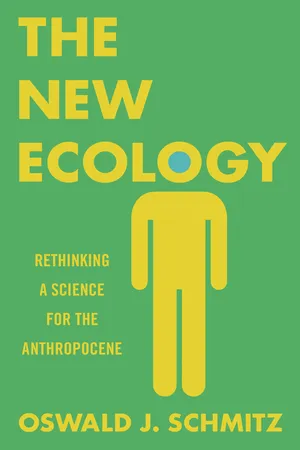
Our species has transitioned from being one among millions on Earth to the species that is single-handedly transforming the entire planet to suit its own needs. In order to meet the daunting challenges of environmental sustainability in this epoch of human domination—known as the Anthropocene—ecologists have begun to think differently about the interdependencies between humans and the natural world. This concise and accessible book provides the best available introduction to what this new ecology is all about—and why it matters more than ever before.
Oswald Schmitz describes how the science of ecology is evolving to provide a better understanding of how human agency is shaping the natural world, often in never-before-seen ways. The new ecology emphasizes the importance of conserving species diversity, because it can offer a portfolio of options to keep our ecosystems resilient in the face of environmental change. It envisions humans taking on new roles as thoughtful stewards of the environment to ensure that ecosystems have the enduring capacity to supply the environmental services on which our economic well-being—and our very existence—depend. It offers the ecological know-how to maintain and enhance our planet's environmental performance and ecosystem production for the benefit of current and future generations.
Informative and engaging, The New Ecology shows how today's ecology can provide the insights we need to appreciate the crucial role we play in this era of unprecedented global environmental transition.
- 256 pages
- English
- ePUB (mobile friendly)
- Available on iOS & Android
eBook - ePub
About this book
Information
Publisher
Princeton University PressYear
2016Print ISBN
9780691182827
9780691160566
eBook ISBN
9781400883462
CHAPTER 1
THE CHALLENGE OF SUSTAINABILITY
The word north has always allured me. Something about it connotes a distant, wild land with an arresting beauty that has persisted for time immemorial. Whenever I think of such a place, the Bristol Bay region of Alaska, with its breathtaking vistas of snow-capped mountains, crystal clear waters and lush, towering evergreens, immediately comes to mind. It is where large predators like bears, wolves, and wolverines still roam freely across the vast landscape, and where one can frequently see moose and caribou, bald eagles, and innumerable species of waterfowl. It is touted for having the greatest salmon run on the planet. Stocks of five species of salmon, that are among the last unthreatened stocks worldwide, use the region’s headwaters as their nurseries. Each year, upwards of 40 million salmon set the rivers here ablaze in red as they undertake a spectacular migration back from the ocean to spawn in the area’s headwaters. Along the way, the migrating salmon sustain ocean-dwelling killer whales, seals, and sea lions; and once in the rivers the dead and dying salmon provide key nutrients that sustain the many plant and animal species that make up the ecosystems within the region’s watersheds.
The Bristol Bay region is also known for its geological formations that hold a mother lode of gold and copper, and a highly heat resistant metal—molybdenum—that strengthens alloys of stainless steel. The deposits of these metals, which lie directly beneath the very head-water streams used by the salmon, are so enormous that if mined they could double the inventory of the United States’ copper and gold; and it would mean that the United States holds the world’s largest supply of molybdenum. These metals sustain the high-tech manufacturing sector of our global economy. Gold is a key element in modern electronics including computers and cell phones. Copper is used for conducting electricity in power-grid distribution systems, residential wiring and electronics, and in motors that run all sorts of machinery. Molybdenum is an irreplaceable component of stainless steel used in surgical and medical equipment, and chemical and pharmaceutical manufacturing.
The desire to mine this reserve has led to much anxiety and acrimony. The debate centers on the wisdom of exploiting such an iconic and mystical place. Arguments on the one side hold that using the mineral wealth could boost the technological economy, including the innovative products and jobs that come with it. Counterarguments express worry that the mining activity would rapidly transform this wilderness area into a large industrial complex. This creates the risk that it will become a toxic wasteland that could drive the salmon to extinction, along with the species of birds and mammals that depend heavily on salmon for food. The issue is complicated by the fact that it cannot be resolved locally. Even if we never see this remote place firsthand, virtually anyone who clamors for the latest cell phone or computer technology or desires world-class health care would unwittingly have a hand in determining its fate by encouraging the exploitation of its minerals. This is little appreciated or understood because the ill effects of the mining will never directly harm most people. But the effects of transforming or destroying large wilderness areas can come back to influence humankind in a circuitous way. By virtue of supporting species and ecosystem functions, these wilderness areas also play a key role in regulating important Earth systems processes such as the global carbon cycle and thereby the climate.
This issue is emblematic of the kinds of tugs-of-war over nature that humankind increasingly faces across the globe. It is representative of the kinds of issues that ecological science is increasingly being called upon to help adjudicate. But it becomes complicated because of clashes between human values. There are those who have strong compulsions to subdue or tame nature’s wildness and to exploit it, rationalizing that such a view benefits human economic health and well-being; there are others who revere its wildness for its pristine majesty and mystery, unspoiled by human presence. In either case, humankind typically does not view itself as being an intimate part of nature. Indeed, it has been difficult to imagine how humans could play a shared role in its inner workings alongside the other species that make up the natural world. To some, it would be uncivilized to do so. Wild animals and plants inhabit nature and so becoming a part of it would mean reverting to a seemingly primitive way of life. To others, it would be like intruding into a pristine and mystical place.
Either way, we have effectively created a human/nature divide. We are altering and controlling many natural areas expressly to suit our own purposes. In the interest of economics and commerce, we have transformed landscapes and ecosystems to enhance food supply, to extract ores and metals, to produce energy and building materials, and to reduce the danger from natural enemies like wild predators and disease. In the interest of conservation, we set aside some natural spaces as managed preserves and protected areas. But many of these spaces are mere fragments of their once vast size. Increasingly, there is less and less geography left on Earth that will not be influenced by one or another form of human agency. This can be reason for celebration or lament, depending on one’s view of nature. Nonetheless, history has taught us time and again that humans will continue to exercise their impulse to transform and control nature. This was true thousands of years ago when societies transitioned to agrarian lifestyles, whereby they transformed wilderness into cropland and built infrastructure to irrigate those crops. It was true hundreds of years ago during the industrial revolution when societies expanded global trade and commerce, whereby they exploited wilderness to supply raw materials such as coal, iron ore and timber. It remains true today with the rise in urban growth and technological advancement.
So going forward, the looming question is: How can humanity engage with nature more thoughtfully and sustainably? From an ecological standpoint, sustainability means that ecosystems have the enduring capacity to be productive. This means ensuring that nutrients and water are replenished—recycled—at rates the meet the physiological needs of plants and animals to enable them to remain productive. It further means ensuring that species within ecosystems—the mind-boggling variety of microbes and plants and animals—can exist and fulfill their functional roles as interdependent members of food chains. Of course, any decision about how to do this must reconcile conflicting human values about nature. But the fate of these countless species and their interrelationships will inevitably hang in the balance. While ecological science may be called upon to provide a supporting role to help adjudicate the conflicts, it cannot tell people what values they should hold toward nature, nor what decisions they should make. The New Ecology can, however, encourage thoughtfulness by illuminating with scientific evidence how different decision options, based on those values, stand to influence the species that make-up ecosystems and their functioning. It thereby helps to ensure that any decision about sustaining nature is scientifically defensible.
My goal in this book is to show how modern ecology has grown to become a science in support of sustainability in the twenty-first century—an epoch known as the Anthropocene, in which humankind’s actions will be the predominant forces shaping the world. This is not to say that, to keep pace, ecology has had to completely reinvent itself. I will show that it remains a science that remains true to its roots, fundamentally devoted to reveal nature’s awe-inspiring mystery and beauty as it strives to understand the complexities of nature’s inner workings. Indeed, an important discovery is how biological diversity—the variety and variability of life on Earth—is a central component of complexity that plays a key role in ecological functions that humans may draw upon to provide critical services in support of their livelihoods and well-being. But to remain relevant to the issues of today and tomorrow, it has become a science that also strives to re-imagine how human and nonhuman species can coexist and play a shared role in the workings of nature and the human built environment alike. As such, the New Ecology that I describe helps society overcome the human/nature divide by formulating scientific ways to integrate the study of humanity with the study of nature. I will discuss how these seemingly divided realms are in fact intertwined as socio-ecological systems—systems in which human political, cultural, religious, and economic institutions influence how nature works and how feedbacks from nature can instigate institutional change in a co-dependent way. This all means that we need to let go of traditional views that nature exists in some grand balance, and that humans have a persistent habit of disrupting that balance. Ecological science is revealing how nature is perpetually changeable, with or without human presence and, to borrow a turn of phrase from the environmental writer Emma Marris—it is sometimes rambunctiously so. I will explain how species have remarkable abilities to keep pace with change by continually evolving their physiological, morphological and behavioral capacities to cope. I discuss how preserving this evolutionary capacity is what is needed to keep ecosystems resilient, by which I mean that their functioning remains durable in the face of change. But the reader will also come to appreciate that human decisions that are made without any thought to nature’s inner workings can stretch these evolutionary capacities beyond their limits. I will discuss how, in a modern world that is becoming ever more interconnected by global trade and commerce, the loss of evolutionary capacity in one location can have far-reaching consequences. That said, I also highlight how ecological principles can be newly applied to enhance the sustainability of human-built environments, such as cities and industries, in ways that can lessen societal demands and impacts on nature.
The New Ecology came to this place in a roundabout way. After it coalesced as a formal science in the early twentieth century, it advanced as two major subfields. One subfield, known as community ecology, grew from Victorian era natural philosophy that described the diversity and beauty of living beings, and a Darwinian evolutionary worldview that explained how those living beings came to be. It was fundamentally devoted to explain why different species existed in different geographic locations across the globe based on adaptations that were shaped by their competitors or predators. Community ecologists were also eager to know why some locations supported an incredible diversity and abundance of species and other locations did not. The other subfield—known as ecosystem ecology—grew from the earth sciences and was largely devoted to studying how materials and nutrients were cycled in nature. Ecosystem ecologists tirelessly accounted for the exchanges and storage of nutrients and materials among terrestrial, freshwater and marine reservoirs and the atmosphere. Even though they differed in focus, both subfields sought to do their studies in wild places devoid of human influence, because it was held that ecological and evolutionary processes were not anthropogenic in origin. Both subfields shared the world view that the biota and the nutrient cycles reached a grand balance. It was anthropogenic—humanly generated—affects that caused imbalances.
But in doing this, ecologists ironically perpetuated the human/nature divide we see today. This divided way of looking at the world progressed despite Aldo Leopold’s plea, during that time, that ecologists should not only study how nature works but should also apply their knowledge so that humans could see themselves as a part of nature’s inner workings. Leopold was a professional ecologist, but he is best known as the father of modern environmental ethics. By integrating concepts from community ecology and from ecosystem ecology and relating to humanity, he was someone ahead of his time. He used his integrated view to articulate a basis for ethical engagement with nature in the interest of sustaining ecosystems and society. He also appreciated the conundrums ecologists always faced when reconciling the scientific study of nature with its conservation. The conundrum, which remains every bit as true today as it did then, is encapsulated in the following excerpt from his Round River (Oxford: Oxford University Press, 1953):
One of the penalties of an ecological education is that one lives alone in a world of wounds . . . . . . An ecologist must either harden [his or her] shell and make believe that the consequences of science are none of [his or her] business, or [he or she] must be the doctor who sees the marks of death in a community that believes itself well and does not want to be told otherwise.
One could take the latter part of this quotation to literally mean that an important role for ecological science is to diagnose how bad humanly caused damages are and to highlight the dire consequences of further damage. This could be taken a step further to mean that ecological science should be marshaled in support of arguments that society desist in its over-exploitation and leave nature alone. And many ecologists have taken this position, speaking up to decry human destruction of nature. But doing this doesn’t resonate with everyone. It may be highly appealing to those who behold nature with awe, simply because it exists in all its majesty and mystery. It can be less appealing to many others who may want to know what opportunities for human progress may be lost by protecting nature rather than exploiting it. Indeed, in some public circles, ecology has even become perceived to be a science in support of environmental activism against human progress, a science that perpetuates the human/nature divide.
The New Ecology I describe represents an effort to return to the kind of integrative worldview that Leopold had in mind. In fact, his use of a medical science and practice metaphor was meant to encourage the development of a parallel, integrated environmental science and practice. Such a science would, metaphorically, provide the means and capacity to diagnose how nature’s ailments—the decrease in, or outright loss of, species diversity and ecological functionality—arise, of course. But in undertaking scientific studies to diagnose the problems, one also builds the kind of understanding needed to restore nature back to health; and more importantly help society minimize the risk of inflicting damages as it strives for greater technological and economic advancement.
But to relate more directly to modern concerns about human economic well-being and health, I would like to offer two ways of framing how ecology can deepen understanding about how humankind could play a role within nature, rather than apart from it, in the interest of building a sustainable world. One way is to take a kind of systems perspective that draws parallels with market economies. Here, nature is imagined as another kind of economy that is sustained by the production, consumption and transfer of materials by species. The other way takes an individualistic perspective by borrowing from new thinking in public health and medicine where sustaining the health of the environment is seen as going hand-in-hand with sustaining personal health and well-being.
* * *
Like a market economy that is built from a variety of sectors that provide specialized and essential services (e.g., agriculture, forestry, mining, manufacturing), nature’s economy could be viewed as being built up from many kinds of species that together create another variety of sectors—called ecosystems—that also provide humans with essential services.
The variety of species that comprise different ecosystems is an important part of what is variously known as the diversity of life, biological diversity, or biodiversity. This diversity is what creates the opportunity for sustainability by ensuring that humans have ample clean and fresh water; deep and fertile soils; genetic variety to produce hardy crops; the means to pollinate those crops; and the capacity to mitigate impacts of gaseous emissions, among numerous other services. Together, the species and the bounty they produce could be viewed as a kind of capital: natural capital, nature’s money in the bank. Spending that money faster than it can be accrued, or worse yet squandering it, sets things on a pathway to loss of essential services and eventual bankruptcy. This is another way of conveying what ecologists mean by loss of sustainability.
Envisioning sustainability this way requires the fundamental appreciation that we live on a finite planet. The space on the planet must be shared with other species if we wish to feasibly retain levels of the many ecosystem functions that are essential to providing services for society. Using this fundamental appreciation about nature’s limitations, the New Ecology helps to envision how human dependency on ecosystem services connects to the functioning of those ecosystems. It can help to quantify and address trade-offs that inevitably arise because, in a finite world, expanded demand for any given service can lead to decreases in the ability of species within ecosystems to provide that or other services. Sustainability in the ecological sciences, as in other kinds of economics, is about finding appropriate trade-off balances, given limitations set by the scarcity of resources.
The management of biodiversity in nature’s economy can also be metaphorically thought of as being akin to stewardship of portfolios of securities within mutual funds or similar instruments in market economies. At the very least, investors try to maintain a diverse portfolio of securities in order to mitigate risk and loss of financial return. But they also adjust their portfolios to maintain a desired level of return by keeping those securities that perform well in prevailing market conditions and letting go those that perform poorly. As prevailing conditions change, portfolios can be re-adjusted by selling off securities that perform poorly and buying back securities that are performing better. It is an effective way of adapting, by making sure performance and return stay on track as market conditions change. But there are limitations to extending this metaphor to natural economies because there are different consequences of letting securities go within a market economy and within nature’s economy. In a market economy, a security that is excluded from a portfolio can be later included. That is, there is opportunity to adapt by making rapid reversals in investment choices by buying back those securities. In nature’s economy, letting securities—species—go effectively means that those species may be difficult to bring back. This means losing the opportunity to make adaptive adjustments, which can lead to loss of return from vital functions and services as environmental conditions change.
Therefore, maintaining species diversity provides the capacity for societies to be resilient in the face of the challenges and changes that they must confront as they develop. Biodiversity provides this capacity because different species are adapted to live and function within widely different environmental conditions. This in turn creates the needed variety of choi...
Table of contents
- Cover
- Title Page
- Copyright Page
- Contents
- Preface
- Chapter 1: The Challenge of Sustainability
- Chapter 2: Valuing Species and Ecosystems
- Chapter 3: Biological Diversity and Ecosystem Functions
- Chapter 4: Domesticated Nature
- Chapter 5: Socio-ecological Systems Thinking
- Chapter 6: Hubris to Humility
- Chapter 7: Ecologies by Humans for Humans
- Chapter 8: The Ecologist and the New Ecology
- Bibliography
- Index
Trusted by 375,005 students
Access to over 1.5 million titles for a fair monthly price.
Study more efficiently using our study tools.
Frequently asked questions
Yes, you can cancel anytime from the Subscription tab in your account settings on the Perlego website. Your subscription will stay active until the end of your current billing period. Learn how to cancel your subscription
No, books cannot be downloaded as external files, such as PDFs, for use outside of Perlego. However, you can download books within the Perlego app for offline reading on mobile or tablet. Learn how to download books offline
Perlego offers two plans: Essential and Complete
- Essential is ideal for learners and professionals who enjoy exploring a wide range of subjects. Access the Essential Library with 800,000+ trusted titles and best-sellers across business, personal growth, and the humanities. Includes unlimited reading time and Standard Read Aloud voice.
- Complete: Perfect for advanced learners and researchers needing full, unrestricted access. Unlock 1.5M+ books across hundreds of subjects, including academic and specialized titles. The Complete Plan also includes advanced features like Premium Read Aloud and Research Assistant.
We are an online textbook subscription service, where you can get access to an entire online library for less than the price of a single book per month. With over 1.5 million books across 990+ topics, we’ve got you covered! Learn about our mission
Look out for the read-aloud symbol on your next book to see if you can listen to it. The read-aloud tool reads text aloud for you, highlighting the text as it is being read. You can pause it, speed it up and slow it down. Learn more about Read Aloud
Yes! You can use the Perlego app on both iOS and Android devices to read anytime, anywhere — even offline. Perfect for commutes or when you’re on the go.
Please note we cannot support devices running on iOS 13 and Android 7 or earlier. Learn more about using the app
Please note we cannot support devices running on iOS 13 and Android 7 or earlier. Learn more about using the app
Yes, you can access The New Ecology by Oswald J. Schmitz in PDF and/or ePUB format, as well as other popular books in Biological Sciences & Ecology. We have over 1.5 million books available in our catalogue for you to explore.