A richly textured account of what it means to be poor in America
Baltimore was once a vibrant manufacturing town, but today, with factory closings and steady job loss since the 1970s, it is home to some of the most impoverished neighborhoods in America. The Hero's Fight provides an intimate look at the effects of deindustrialization on the lives of Baltimore's urban poor, and sheds critical light on the unintended consequences of welfare policy on our most vulnerable communities.
Drawing on her own uniquely immersive brand of fieldwork, conducted over the course of a decade in the neighborhoods of West Baltimore, Patricia Fernández-Kelly tells the stories of people like D. B. Wilson, Big Floyd, Towanda, and others whom the American welfare state treats with a mixture of contempt and pity—what Fernández-Kelly calls "ambivalent benevolence." She shows how growing up poor in the richest nation in the world involves daily interactions with agents of the state, an experience that differs significantly from that of more affluent populations. While ordinary Americans are treated as citizens and consumers, deprived and racially segregated populations are seen as objects of surveillance, containment, and punishment. Fernández-Kelly provides new insights into such topics as globalization and its effects on industrial decline and employment, the changing meanings of masculinity and femininity among the poor, social and cultural capital in poor neighborhoods, and the unique roles played by religion and entrepreneurship in destitute communities.
Blending compelling portraits with in-depth scholarly analysis, The Hero's Fight explores how the welfare state contributes to the perpetuation of urban poverty in America.
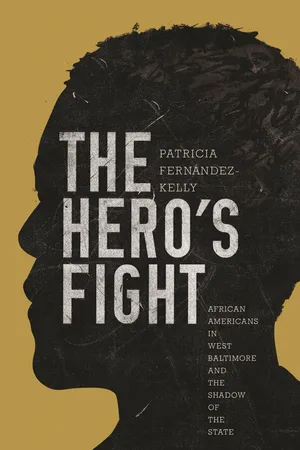
eBook - ePub
The Hero's Fight
African Americans in West Baltimore and the Shadow of the State
- 440 pages
- English
- ePUB (mobile friendly)
- Available on iOS & Android
eBook - ePub
The Hero's Fight
African Americans in West Baltimore and the Shadow of the State
About this book
Information
Publisher
Princeton University PressYear
2016Print ISBN
9780691173054
9780691162843
eBook ISBN
9781400883561
1 | D. B. WILSON |
DONALD BRADLEY WILSON WAS ONLY NINETEEN WHEN HE ARRIVED in the promising city of Baltimore, Maryland, in the summer of 1959. The winds of history were blowing strong in the aftermath of school desegregation and the first inklings of the civil rights movement, but the young man from Mayesville, South Carolina, had other things on his mind, like endurance and high hope. Not that he was unaware of the troubles caused by racial friction or that he didn’t welcome progress, but in his view, discrimination was just part of human nature. Either you learned to live with it or it hammered you down. Years later he told me, “If you can’t change it, don’t let it bother you. Peoples blame discrimination for everything; they make excuses, but really it’s their own fault if they can’t make it.” In this, Mr. Wilson held a truly American outlook.
I cannot remember exactly when we met, so gradually did our paths converge. It must have been in 1987, at the beginning of my decade in Baltimore. By then he was driving a Yellow Cab that I often boarded on my way to the airport, rushing south along Martin Luther King Jr. Boulevard, past the odious skyscrapers that formed the now defunct George Murphy Homes. Never at a loss for words, Mr. Wilson treated me to detailed critiques of the welfare state. The government, he thought, pampered the idle at the expense of the taxpayer. Harboring opposing views, we argued in earnest, eventually finding nicknames for each other. He called me Doc; I called him D. B.
Our early encounters invariably concluded with one of his business cards clasped between my fingers as he reminded me that I could call him directly, bypassing the Yellow Cab dispatcher. Donald Wilson carried a portable telephone long before such a practice became popular among the members of the executive class, and his motives were far from showy—he wanted to keep downtime to a minimum, the same principle he had observed throughout his working life. Not for Mr. Wilson the long waits in line at the Pennsylvania train station, hoping for the infrequent but lucrative ride to Pikesville or DC. Not for him the complaints about low fares in a city that could hardly afford them. He had a bevy of “regulars” to fill most of his day. They relied on him because, to tell the truth, you could set your watch by Mr. Wilson’s movements. He seldom missed a call, and he was never late. If he was not available, the rasp of his voice, poured out in rhyme, greeted his patrons in a recorded message:
You know my name, you are getting closer and closer, but you haven’t found me yet. If you want to reach me, I’ll give you a clue: leave your telephone number; that’s all you have to do. Thank you and have a nice day.
In addition to integrity, Mr. Wilson had humor.
When he was a boy growing up with seven brothers and sisters in rural South Carolina, D. B. always knew where authority and comfort resided. His father was a strict man who showed no hesitation in using the occasional lashing. Such measures were seldom necessary because, according to D. B., “a single look of him was enough to freeze you on the spot.” His approach to discipline was premodern: it was not enough, or even necessary, that his children love him; more important was that they stand in awe before their father, as the Good Book says. There was, in his mind, a key distinction between adults and youngsters: the former should tower over the latter. And the older Mr. Wilson had no doubt that a disregard for the differences between children and grownups would signify the collapse of civilization.
Decades later, as we traversed the streets of West Baltimore with their rows of abandoned houses and their climate of defeat, Donald Wilson would reflect on the enigmatic outcomes of resettlement. The people who had first arrived in those neighborhoods were not all that different from him or, for that matter, his own father. As part of the Great Black Migration, they had arrived seeking opportunity, willing to work hard and sacrifice for their children.1 Legal segregation was still in effect during the 1940s and early 1950s, and maybe just for that reason, families shared a feeling of unity, a need to stand together against leveling pressures. That was especially true with respect to the young. D. B. remembered that
Families looked out for other peoples’ childrens, and if you was a child, you knew that. You could go to the house next door or across the street like it was your own. But if you got into trouble, look out! You mama would find out before you got home. You saw her standing at the door with the strap in her hand, and you didn’t have to ask no questions—you knew what was comin’.
Now the young people wandered about without surveillance or fear of their elders, and the neighborhoods looked like war zones. Apparently, the older Mr. Wilson had been right all along.
And it wasn’t only the way parents related to children that had changed. West Baltimore had once been inhabited by distinguished personalities, like Thurgood Marshall who litigated before the U.S. Supreme Court and prevailed against all odds, bringing about the legislative agenda that demolished segregation and ushered in the civil rights movement. Donald Wilson could recall the names of celebrities and businessmen, some of them very wealthy, who had lived in close proximity to ordinary folks, the sons and daughters of sharecroppers like him.
Long before Pennsylvania Avenue had become an open market of illicit pleasures, it had been a fashionable strip lined with nightclubs, dance halls, and theaters, including the famous Royal, and the Senator. All the great entertainers of the era had performed in those gilded places; from Lena Horne to Louis Armstrong and James Brown. They were remembered as part of a period marked by greater confidence and civility. In the 1970s, things had started to shift: “It was the drugs and the welfare that finished the city,” Mr. Wilson told me. “Peoples just got lazy.”
Throughout the 1960s, Blacks living in West Baltimore held modest jobs, and they struggled to make ends meet. But on Sundays, when they went to church, partly to pray and partly to see and be seen by others, they donned the symbols of self-affirmation and optimism. Families walked down the streets on their way to Old Bethel AME or First Baptist clothed as beautifully as their means would allow. The men in double-breasted suits, vivid neckties, and their indispensable Stetsons embellished with a discreet feather on the hatband. Girls in tight, shiny braids overlaid with multicolored baubles, the cuffs of their socks peeking above immaculate patent leather shoes. Boys in trousers and white shirts, hair pressed hard against their heads. But in that radiant display of human pride, no other group shone more brightly than the women in their plumed or bejeweled hats, dressed in silk or lace, gloves covering their hands, their throats encircled in pearl strings. The garments and trinkets were cheap but the effect was stylish.
Collective symbols and deportment were different in the 1990s. The new generations had no way of knowing what the past had been like and how bright the days ahead had seemed. They gazed upon the “old heads” and their quaint ways with contempt.2 Church was not among their frequent destinations. Instead of formal wear, they favored clothes that were casual, costly, and subversive: jeans with a leg rolled up below the knee or trousers baggy enough to show their underpants; T-shirts sporting loud, insolent slogans; climbing boots, running shoes, and sneakers, all with the laces undone.
The young people bought the footgear at high prices from firms like Nike, K-Swiss, New Balance, and Timberland. The shirts and pants bore labels from Tommy Hilfiger, Apollo, and Nautica. Especially among older adolescents, but even in the prepubescent set, off-brand dressing was a mark of inadequacy that could attract heaps of abuse from friends and foes alike. Youngsters would rather stay home than go to school in the wrong threads. Their grandmothers and grandfathers had been satisfied to scrimp for garments that said, “I am respectable.” The children went hungry and sometimes stole or killed for clothes that screamed “I don’t give a fuck!”
Some of the old migrants from the South were still living in West Baltimore in the last decade of the twentieth century. They stayed, driven by a sense of continuity and also because they couldn’t afford to move elsewhere. They had watched their neighborhoods change in ways they never did. Age had bent their backs and weakened their knees, but they still looked elegant heading for church. I loved to watch them on Sundays, moving deliberately or standing gravely at their places of worship, the gentlemen still wearing those fine hats with the diminutive feathers, the ladies still in their fancy dresses and bonnets. Out of step with the times, their numbers had dwindled together with those of the holy buildings where they found refuge.
Once the center of community life and cultural dignity, many churches were now shells, mere pieces of real estate with little appeal or monetary value. Some had been altered to serve secular purposes. Others had been boarded up and thrust into permanent disrepair. Desperate addicts searching for easy dollars had eventually stolen their copper pipes and wrought-iron frames to sell for a pittance at the junkyards. At least one church had been turned into a shooting gallery. Then again, as D. B. liked to say, “When the churches go, Doc, the whole community goes.”
The ravages of urban decline had been far in the distant future when Donald B. Wilson was still growing up on the farm in South Carolina. He had been born into a modest but upright family. His father, Henry, and his granddaddy, Johnny Wilson, had been sharecroppers. Although there wasn’t much to go around, D. B. had fond memories of his childhood. It was a first-rate experience to be a youngster in the rural South when kin surrounded you. He told me:
I can go back to when I was six, seven years old. Every morning we went about five miles to school ’cause it was all country and there was no transportation. It was cousins and other relatives, about thirty of them, and we used to walk, run really, to school. But first we had to do our chores. Sometime we had to go in the field and haul cotton; sometime we picked the cotton or plow the land. We did a lot of things people does in the farm. After school, we come back home and study a little, and later we worked till the sun goes down and you can’t see. Those were the good old days.
School began at 9:00 a.m. at the Mayesville Institute, a large barn-like structure with a cement floor and small desks lined up in the front. The teacher, Miss Bella Ward, had down-to-earth goals: to ensure that her pupils knew the basics and that they became good citizens. Every afternoon, during the winter months, the students, Donald included, went out to play and collect wood. They had to make sure it was warm inside the building the next day. “The federal government,” said D. B., “provided food, like apples, so the childrens could have good nutrition, and they also gave us stamps to buy flour and gasoline.” Families did wonders with the little they had, and the young people, for the most part, didn’t realize they were poor. When you know those around you and they know you, it’s hard to engage in invidious comparisons or yearn for things you don’t know exist.
Henry Wilson, Donald’s father, was in his early twenties when he married fifteen-year-old Geneva Radisson. Their union lasted almost forty-six years and was only interrupted by Geneva’s death in 1988. Through thick and thin, the couple went on, in due course buying fourteen acres of arable land that is still owned by the family. D. B. attributes his success and that of his siblings to his elders’ strong principles. All they wanted was for their children to have an education and do well in life. Their loyalty to family and community were unwavering:
My parents wasn’t nothing like the parents today that let the children do whatever they want. When my mother went and cook, you either ate or, when she cleaned up, if you hadn’t touched the food, it went right back into the kitchen. That was it! My father too was firm about that.
In addition, the elder Mr. Wilson was a stickler about punctuality:
It was ten o’clock, say, on a Saturday morning and he tell you, “See, boy, see the sun behind the tree? If you go to town, you gotta get back by the time the sun is on the tree top.” And he meant what he said; if you wasn’t back when you was supposed to, you had somethin’ coming.
Although he was a dependable provider and a devoted husband, Henry Wilson was not a saint; temptation could derail his good intentions. Said D. B. many years later:
My daddy, he was a religious man but he had his ups and downs like everyone else: he cussed, he said wild things, and he liked to gamble a lot. So when you’re out there rolling dice and playing cards, anything can happen, like womens; he loved the womens, yes, he did! But come Sunday morning: holy man! He din’t do no wrong!
Henry and Geneva Wilson had eight children—six boys and two girls, all of whom fared well as adults. First came Henry Jr., who volunteered for the Marine Corps when he was seventeen but who, in D. B.’s droll account, “cried to get out.” Although he wasn’t a marine for long, he learned a trade: how to lay bricks. Later he worked as a mason. With his wife, Alice, he had four children. D. B.’s eldest sister, Sandra, became a schoolteacher. Like Henry Jr., she never left the South, and even today, she looks after the family farm. When she was younger, she worked on it with her husband; after he died, she leased out the land. By the 1990s, neither cotton nor corn was cultivated on that farm—soybeans had become the crop of choice.
After Sandra came Buford, who grew up to be a crew officer in the army and held his post until retirement. He put two of his children through the Marine Corps. Dorothy, the Wilson’s second daughter, left Mayesville for New York in 1960, when she was twenty-five, in search of a better life leaving behind her first husband and children. When she remarried and could afford to, she sent for her three children and had two more with her new husband.
Robert, the next born, was the first to head for Baltimore, and Albert and Donald followed. Robert worked in construction and ultimately was hired by the Koppers Company, one of Baltimore’s large industrial firms. Albert found a job at the local A&P supermarket in Dundalk, which later became part of the Super Fresh franchise. He retired in 1993 after many years of faithful service. Donald’s younger brother, Leroy eventually married and went to live in New York.
Although tossed asunder by migration and resettlement, the Wilson siblings maintained strong, lasting ties. They found jobs for one another, depended on shared assets, met regularly to play and gossip, and periodically converged in Mayesville for a family reunion. They cultivated a sense of shared history because, as D. B. explained, “You need to know where you coming from if you’re gonna make something of youself.”
As a youngster on the farm, and from time to time, Donald visited Mary, his father’s sister, who had lived in Baltimore since the 1940s. When he grew older and became concerned about his future, he went looking for a job in that city and stayed with Mary. First he worked setting and waiting tables at the Chartreuse, a restaurant situated at the corner of Eagle and Charles. After a year, he moved on to the Tower Engineering Company, where he was a construction worker. Even later, he became a mechanic at Jerrysville Chevrolet. He also began supplementing his income by driving a taxi. Baltimore was expanding, and it wasn’t hard to make a living in those days.
When he was twenty-one, D. B. went back to Mayesville to marry his childhood sweetheart. He was “crazy in love with her,” but after he and his young wife returned to Baltimore, things didn’t work out as planned. He wasn’t ready to slow down. Smoking, drinking, and carousing were part of his routine:
I had a little street in my life, staying out, partying; my wife never knew when I was coming home. We had a daughter but the marriage didn’t last. After that I had to search my soul because I was the one who caused the trouble.
Magnified by the contrast with his parents’ unbreakable union, Donald’s failure was all the more painful; he was forced to take a hard look at his priorities.
In 1963 his cousin Jill, who was also living in Baltimore, introduced him to Beverly Elaine Jeter, who would become his second wife. Bev, as she was known by her family, was still striking in her fifties. Like Donald, she had been married before. When they first met, she was working as a seamstress in a factory to support her two children, seven-year-old Robert and five-year-old Teresa. According to D. B., it was love at first sight: “You know how it is when you see someone in the street and something just clicks? That’s the way it was with me.” The couple married in 1967.
This time it was a charm. Together they had another child, Donald Jr. In the summer...
Table of contents
- Cover Page
- Title Page
- Copyright Page
- Dedication Page
- Contents
- Preface
- Acknowledgments
- Introduction
- 1. D. B. Wilson
- 2. Baltimore: From Factory Town to City in Decline
- 3. Big Floyd
- 4. Intersections of Poverty, Race, and Gender in the American Ghetto
- 5. Shaping the Inner City: Urban Development and the American State
- 6. Distorted Engagement and Liminal Institutions: Ruling against the Poor
- 7. Little Floyd
- 8. Down the Rabbit Hole: Childhood Agency and the Problem of Liminality
- 9. Clarise
- 10. Paradoxes of Social Capital: Constructing Meaning, Recasting Culture
- 11. Towanda
- 12. Cultural Capital and the Transition to Adulthood in the Urban Ghetto
- 13. Lydia
- 14. Faith and Circumstance in West Baltimore
- 15 Manny Man
- 16. Divided Entrepreneurship and Neighborhood Effects
- Conclusion: Distorted Engagement and the Great Ideological Divide
- Appendix
- Notes
- Bibliography
- Index
Trusted by 375,005 students
Access to over 1.5 million titles for a fair monthly price.
Study more efficiently using our study tools.
Frequently asked questions
Yes, you can cancel anytime from the Subscription tab in your account settings on the Perlego website. Your subscription will stay active until the end of your current billing period. Learn how to cancel your subscription
No, books cannot be downloaded as external files, such as PDFs, for use outside of Perlego. However, you can download books within the Perlego app for offline reading on mobile or tablet. Learn how to download books offline
Perlego offers two plans: Essential and Complete
- Essential is ideal for learners and professionals who enjoy exploring a wide range of subjects. Access the Essential Library with 800,000+ trusted titles and best-sellers across business, personal growth, and the humanities. Includes unlimited reading time and Standard Read Aloud voice.
- Complete: Perfect for advanced learners and researchers needing full, unrestricted access. Unlock 1.5M+ books across hundreds of subjects, including academic and specialized titles. The Complete Plan also includes advanced features like Premium Read Aloud and Research Assistant.
We are an online textbook subscription service, where you can get access to an entire online library for less than the price of a single book per month. With over 1.5 million books across 990+ topics, we’ve got you covered! Learn about our mission
Look out for the read-aloud symbol on your next book to see if you can listen to it. The read-aloud tool reads text aloud for you, highlighting the text as it is being read. You can pause it, speed it up and slow it down. Learn more about Read Aloud
Yes! You can use the Perlego app on both iOS and Android devices to read anytime, anywhere — even offline. Perfect for commutes or when you’re on the go.
Please note we cannot support devices running on iOS 13 and Android 7 or earlier. Learn more about using the app
Please note we cannot support devices running on iOS 13 and Android 7 or earlier. Learn more about using the app
Yes, you can access The Hero's Fight by Patricia Fernández-Kelly in PDF and/or ePUB format, as well as other popular books in Social Sciences & North American History. We have over 1.5 million books available in our catalogue for you to explore.