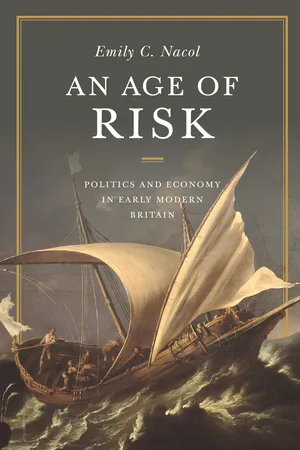
In An Age of Risk, Emily Nacol shows that risk, now treated as a permanent feature of our lives, did not always govern understandings of the future. Focusing on the epistemological, political, and economic writings of Thomas Hobbes, John Locke, David Hume, and Adam Smith, Nacol explains that in seventeenth- and eighteenth-century Britain, political and economic thinkers reimagined the future as a terrain of risk, characterized by probabilistic calculation, prediction, and control.
In these early modern sources, Nacol contends, we see three crucial developments in thought on risk and politics. While early modern thinkers differentiated uncertainty about the future from probabilistic calculations of risk, they remained attentive to the ways uncertainty and risk remained in a conceptual tangle, a problem that constrained good decision making. They developed sophisticated theories of trust and credit as crucial background conditions for prudent risk-taking, and offered complex depictions of the relationships and behaviors that would make risk-taking more palatable. They also developed two narratives that persist in subsequent accounts of risk—risk as a threat to security, and risk as an opportunity for profit. Looking at how these narratives are entwined in early modern thought, Nacol locates the origins of our own ambivalence about risk-taking. By the end of the eighteenth century, she argues, a new type of political actor would emerge from this ambivalence, one who approached risk with fear rather than hope.
By placing a fresh lens on early modern writing, An Age of Risk demonstrates how new and evolving orientations toward risk influenced approaches to politics and commerce that continue to this day.
- 184 pages
- English
- ePUB (mobile friendly)
- Available on iOS & Android
eBook - ePub
About this book
Information
Topic
PhilosophySubtopic
British History— CHAPTER ONE —
INTRODUCTION
How should we cope with risk? How do we confront a future that is, by definition, uncertain but still likely to contain some kind of peril or promise? Risk is an integral—and frequently uncomfortable—part of our daily experiences, an inevitable consequence of living in the world. As French philosopher and historian François Ewald explains, contemporary life is defined by risk; it is “in human beings, in their conduct, in their liberty, in the relations between them, in the fact of their association, in society.”1 The ubiquity and permanence of risk in our contemporary relations with each other and with nature make it hard to imagine that anyone has ever lived without it. But human beings once did, and thus the idea of risk has an origin and a history.2
Risk emerged in specific times and places as a new way of understanding the future and what harms or possibilities it might hold. In this book, I explore one site of emergence, to establish that risk developed as a new idea in seventeenth- and eighteenth-century British political and economic discourse. I interpret political theory and political economy from this period and place to show that risk became a meaningful concept for people trying to cope with the unknown, particularly in their political and commercial endeavors.3 Accordingly, early modern British political thinkers developed critical accounts of the struggle to think about risk and to act on it, and they started to evaluate how its appearance transformed the forms and meanings of thought and action in politics and commerce. By the end of the eighteenth century, I argue, Ewald’s diagnosis of the contemporary condition already held in Britain: political and commercial actors understood their conduct, relations, and associations in terms of risk. By then, risk was, to use his language, “in human beings,” and thus a new age of risk had begun.
“Risk” and Risk in Early Modern Britain
“Risk” entered the English lexicon much as it did that of other European languages—as part of a technical, professional vocabulary belonging to traders and other commercial actors.4 In the English language, the first known appearance of the word “risk” was in 1661, when it was defined, according to the Oxford English Dictionary, as a noun meaning “peril, jeopardy, danger, hazard, chance,” reflecting an early and persistent association between risk and harm or loss. But it is worth noting that this early definition also included “chance,” establishing an important link between risk and probability.5
As risk became a way for people in early modern Britain to describe what could lie ahead, a corresponding development in epistemology started to take hold. No longer a realm of fate, fortune, or providence, the future was conceived as a terrain of calculable risk.6 In particular, probabilistic calculation—the basis of risk—began to gain traction in contentious epistemological debates about how human beings could best determine what an unknowable future might bring and how to respond.7 The seventeenth century saw the production of the earliest probability theory texts, and philosophers and political thinkers also started to focus on probabilistic reasoning and the possibility (or impossibility) of acquiring certain knowledge that could guide decision making and action.8 During this period, new forms of political and economic organization—centralized trading states, central banks, and insurance markets—also developed and consolidated. These institutions were designed expressly for coping with the uncertainties of politics and commerce as well as for managing a contingent future by conceptualizing it in terms of probability, prediction, and shared risk.
One of my major contentions in this book is that seventeenth- and eighteenth-century British political thought reflected these transformations and contended openly with the problem of risk.9 In the following chapters, I concentrate on the contributions of four thinkers who offered particularly robust considerations of what risk means for political communities being transformed by new modes of knowledge production and by new institutions meant to cope with risk: Thomas Hobbes, John Locke, David Hume, and Adam Smith. I concentrate on Hobbes, Locke, Hume, and Smith because each of them produced a body of work that engaged deeply with different components essential to a rich account of risk. Although they were certainly not the first writers or thinkers to understand that the future was unknown and full of contingency, the aim of my study is to establish them as distinctive voices in advancing an idea of the future as a realm of risk. To do this, I take advantage of their polymathic proclivities and bring together their writings on epistemology, politics, sociability, and political economy to identify three important insights on risk and politics that should resonate with contemporary readers as well.
Scope and Summary
In chapter 2, I begin with Hobbes’s intertwined theories of knowledge and politics, as they emerged from his experience of a violent civil war and fierce struggles over epistemological and political authority. As I argue, he provokes an early modern engagement with the concept of risk in politics by positing uncertainty as the main problem that political theory and political order are meant to solve. In Leviathan, Hobbes’s construction of a unified sovereign power that quashes conflict is motivated by an epistemological obsession with the problem of uncertainty, and the primary aim of his civil science is to displace the conflicts created by limited knowledge of an unknown political future. For Hobbes, uncertainty is the root cause of violence and insecurity, and thus it becomes a target for elimination when he begins to think about how to construct a safe political community. In this chapter, I reconstruct Hobbes’s commitment to a science of politics modeled on geometry, emphasizing its certain character by contrasting it with other ways of knowing about politics that are more experiential, such as prudence.
As I argue, despite his best efforts to construct a unified regime of certain knowledge production and absolutist political power, Hobbes’s civil science is not capacious enough to cope with everything the future might bring. His heroic attempt to displace uncertainty from political life is especially important because of this failure, however. His thwarted efforts raise a valuable question, which sets an agenda for the thinkers who follow him: Can risk, suffering, and fear ever be truly overcome by political planning and more certain forms of scientific knowledge about collective life? Although Hobbes identifies epistemological and political uncertainty as a major source of political insecurity and suffering, his work leaves readers with the conclusion that uncertainty can never be displaced altogether. The thinkers after him turn to probability and judgment rather than certain knowledge as a resource for securing the future. This shift prepares them to think about the future in terms of calculable risk.
In chapter 3, I explain how Locke’s work on epistemology, politics, and economy can be read as a sustained meditation on the relationship of risk and trust. The extensive literature on trust and authority in Locke’s work establishes that he thinks citizens’ trust in the state helps them organize and survive in the face of uncertainty, as well as manage the risks they might find in the future. In this chapter, I argue that Lockean political trust is actually more closely related to risk than it appears at first glance. Political trust, Locke theorizes, is actually underwritten by the perpetual work of risk calculation and probabilistic reasoning by citizens. His work shows that if a strong central state is the institution that manages political and economic risk for subjects, then those subjects still must scrutinize the state as a new risk, using whatever cognitive tools they have at their disposal. Locke’s relative comfort with the permanence of uncertainty and his acceptance of risk as a part of common life lead him to theorize very powerful political authority and institutions as well as equally robust forms of citizen power, coupled in relations of trust.
To advance this interpretation, I analyze three particular episodes in Locke’s corpus—two from his political theory and one from his economic writings: his concession to prerogative power as a necessary tool for the state; his reservation of the powers of political judgment and revolution for citizens; and finally, his engagement with the coinage controversies of the late 1690s. The first two cases in particular emphasize Locke’s insight that profound uncertainty is the background condition of politics and commerce, as well as his insistence that probability and judgment are the best cognitive tools people have for cutting through radical uncertainty to perceive a more manageable set of risks. Locke’s work also offers trust as a mode of confronting risks in politics and commerce, while remaining attentive to how risk underwrites trusting relationships, a point that the coinage controversy particularly highlights.
Chapter 4 offers an interpretation of David Hume’s body of work as simultaneously sensitive to how uncertainty and risk can enervate commercial actors and committed to emboldening these actors to take more risks. I find in Hume’s writings on passion, cognition, politics, and commerce an apt representation of how risk and uncertainty are entangled in the minds of subjects, as well as a robust explanation for why so many people are made anxious by risks, even ones that promise a good outcome. Hume’s expressions of philosophical skepticism and his treatment of probability establish his view that deep uncertainty is the background condition for commerce and for the politics of commercial societies, and show that he is unusually mindful of the disconcerting experience of living with uncertainty. Although individuals can use probabilistic reasoning to formulate better understandings of the risks of an unknown future, Hume thinks this taxes them psychologically. Whereas thinking about the future can trigger hope and fear in individuals, he argues that in practice, it seems to generate mostly fear, even when people have stable probable beliefs about the future and well-founded expectations that joy rather than grief awaits them there.
After explaining how Hume reaches this conclusion, I explore the idea that his popular writings for a general reading public were meant as a resource for those who might wish to shake off the paralysis of uncertainty and the anxieties provoked by probabilistic thinking, at least to a degree sufficient to confront risk in commerce. Hume anticipates that members of a commercial public will fixate on both the probable and the improbable misfortunes introduced by complex and increasingly international economic exchanges. In his moral, political, and economic essays, Hume draws on his notions of philosophical proof as well as on familiar metaphors of stable natural phenomena to introduce the idea of a balanced system, in which risk taking in overseas commercial ventures produces profits in the long term and for the whole nation-state, while it sometimes hurts primary actors in the immediate term. Hume uses the conversational essay form to coax his readers into an attitudinal shift regarding risk taking, by reorienting them toward a measure of hope and optimism.
Finally, in chapter 5, I argue that Smith’s moral theory and political economy confront human ambivalence about risk, by now a permanent feature of the human condition. Smith’s analysis of individuals, groups, institutions, and policies leads him to find that human beings have a risk-loving side, which drives them to take chances to pursue gain, but that they also clamor to secure themselves against possible loss. How well they balance these two impulses can, Smith argues, issue in productive or dangerous approaches to risk taking. The Wealth of Nations records instances of a more pathological approach to risk, as Smith describes traders’ corrupt manipulation of institutions, political networks, and policy to displace the responsibilities and losses that risk taking may incur. Smith’s critique of monopolies and mercantile policies depends very much, I argue, on his view that traders exploit risk badly, by redistributing or jettisoning loss. Smith argues that those who pursue highly uncertain profits by taking risks in the political economy must also be willing to brook loss.
In his 1790 revisions to The Theory of Moral Sentiments, Smith draws a portrait of the prudent and trustworthy merchant, whose observable practices and character cultivate a climate of trust and predictability, which offsets the risks of trade without eschewing responsibility for losses. The prudent merchant’s ambivalence toward risk tips him toward caution, and he supports his security-seeking endeavors with practical knowledge, reliable partners, and networks of trust and credit. Smith’s call here for prudential approaches to risk taking at the level of individual actors may have been in response to an intervention from Jeremy Bentham, who counters Smith’s pessimism about risk taking in The Wealth of Nations with the suggestion that progress is inextricably linked to risky endeavors pursued by bold individuals. Bentham’s more sanguine views on risk may have invited further reflection by Smith on how commercial actors should approach risk, resulting in Smith’s own modest but quite powerful intervention—a defense of the prudent man as the right kind of risk taker.
In each of these chapters, I reinterpret texts that are familiar to political theorists by arguing that we should look at them anew as significant contributions to emerging discourses of risk. At the same time, the thinkers I engage are distinctive, and their arguments are impossible to weave into a coherent whole or a progressive narrative about how human beings come to know more about risk and to improve their efforts at managing it. If anything, reading these texts together underscores how fraught and multifaceted early modern efforts to calculate and confront risk were. Yet, I argue, it is possible to identify continuities alongside important innovations in early modern British political thought on risk.
Dimensions of Risk in Early Modern British Thought
My interpretation of seventeenth- and eighteenth-century epistemological, political, and economic texts generates three insights into early modern British engagement with risk. First, we can spot a distinct conceptual refinement in late seventeenth-century sources, a development that carried over into the next century. Seventeenth-century epistemology and political thought was animated by the problem of uncertainty about the future, but by the eighteenth century, attention was more clearly focused on the problem of risk, as a matter of knowledge about the future that is rooted in conceptions of time, probability, and action. Curiously, however, even as we can identify this change, uncertainty and risk remained in something of a conceptual muddle throughout the eighteenth century—a confusion that we have inherited and that shapes our own efforts to confront an unknown future. While risk is conceptually distinct from blind uncertainty about the world and the future, it remains an uncertain form of knowledge.10 Even though we can often be quite precise in our risk calculations, just the act of making these calculations may heighten the realization that we have to live with uncertainty. As such, we struggle to parse uncertainty and risk, and we even use the terms interchangeably at times, which strains our ability to make decisions for the future and to evaluate critically the efforts of authorities and experts to manage risk.11
The second insight this book draws out is the tight relationship between risk and trust in seventeenth- and eighteenth-century political thought and political economy. As risk is foregrounded as a problem for politics and commerce, the meaning and limits of trust in political authority and creditworthiness in political economy are thrown into sharp relief. Because the probable judgments of political and commercial actors are necessarily partial, and the future does not yet exist, these actors frequently need support in their endeavors. Networks and relationships of trust and credit frequently ease the way, emboldening actors to take more risks and perhaps even cushioning their fall if they choose badly. Conversely, trust and credit acquire meaning and value from the risks that underpin them.
Third and finally, the character of the political subject is worked out in the early modern engagement with risk, and the fearful subject emerges from this fraught process. At the beginning of the eighteenth century, the question of whether risk taking is exhilarating or threatening was still open. By the end, it had been established that even risks promising profit and benefit are painful to think about and to take, probably because the struggle to parse risk and uncertainty is such a persistent problem for individuals. This affective response to risk again underscores why trust and credit are so important for risk takers, as two of the few resources that help steel humans against the downsides of risk.
Beyond these three observations, I also argue that early modern British engagement with risk offers two narratives, views of risk that persist in our own time and shape our orientation toward an unknown future. First, I focus on accounts of risk as a threat to security; indeed, this is probably the prominent narrative of this book and of the risk literature in general. Negative readings of risk assert that marshaling our partial knowledge of the future will enable us to hold back from taking unnecessary risks or to displace the risks of politics and commerce as much as we possibly can. Second, I explore depictions of risk as an opportunity to be exploited for profit or gain. In these accounts, risk taking is figured as exhilarating or pleasurable, a chance to exercise freedom and choice in the interest of some gain. Even a cursory glance at the ...
Table of contents
- Cover Page
- Title Page
- Copyright Page
- Dedication Page
- Contents
- Acknowledgments
- Chapter One: Introduction
- Chapter Two: “Experience Concludeth Nothing Universally”: Hobbes and the Groundwork for a Political Theory of Risk
- Chapter Three: The Risks of Political Authority: Trust, Knowledge, and Political Agency in Locke’s Politics and Economy
- Chapter Four: Hume’s Fine Balance: On Probability, Fear, and the Risks of Trade
- Chapter Five: Adventurous Spirits and Clamoring Sophists: Smith on the Problem of Risk in Political Economy
- Chapter Six: An Age of Risk, a Liberalism of Anxiety
- Notes
- References
- Index
Trusted by 375,005 students
Access to over 1.5 million titles for a fair monthly price.
Study more efficiently using our study tools.
Frequently asked questions
Yes, you can cancel anytime from the Subscription tab in your account settings on the Perlego website. Your subscription will stay active until the end of your current billing period. Learn how to cancel your subscription
No, books cannot be downloaded as external files, such as PDFs, for use outside of Perlego. However, you can download books within the Perlego app for offline reading on mobile or tablet. Learn how to download books offline
Perlego offers two plans: Essential and Complete
- Essential is ideal for learners and professionals who enjoy exploring a wide range of subjects. Access the Essential Library with 800,000+ trusted titles and best-sellers across business, personal growth, and the humanities. Includes unlimited reading time and Standard Read Aloud voice.
- Complete: Perfect for advanced learners and researchers needing full, unrestricted access. Unlock 1.5M+ books across hundreds of subjects, including academic and specialized titles. The Complete Plan also includes advanced features like Premium Read Aloud and Research Assistant.
We are an online textbook subscription service, where you can get access to an entire online library for less than the price of a single book per month. With over 1.5 million books across 990+ topics, we’ve got you covered! Learn about our mission
Look out for the read-aloud symbol on your next book to see if you can listen to it. The read-aloud tool reads text aloud for you, highlighting the text as it is being read. You can pause it, speed it up and slow it down. Learn more about Read Aloud
Yes! You can use the Perlego app on both iOS and Android devices to read anytime, anywhere — even offline. Perfect for commutes or when you’re on the go.
Please note we cannot support devices running on iOS 13 and Android 7 or earlier. Learn more about using the app
Please note we cannot support devices running on iOS 13 and Android 7 or earlier. Learn more about using the app
Yes, you can access An Age of Risk by Emily C. Nacol in PDF and/or ePUB format, as well as other popular books in Philosophy & British History. We have over 1.5 million books available in our catalogue for you to explore.