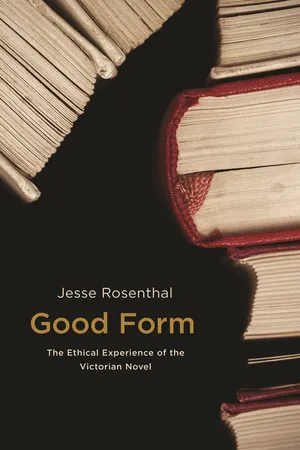
What do we mean when we say that a novel's conclusion "feels right"? How did feeling, form, and the sense of right and wrong get mixed up, during the nineteenth century, in the experience of reading a novel? Good Form argues that Victorian readers associated the feeling of narrative form—of being pulled forward to a satisfying conclusion—with inner moral experience. Reclaiming the work of a generation of Victorian "intuitionist" philosophers who insisted that true morality consisted in being able to feel or intuit the morally good, Jesse Rosenthal shows that when Victorians discussed the moral dimensions of reading novels, they were also subtly discussing the genre's formal properties.
For most, Victorian moralizing is one of the period's least attractive and interesting qualities. But Good Form argues that the moral interpretation of novel experience was essential in the development of the novel form—and that this moral approach is still a fundamental, if unrecognized, part of how we understand novels. Bringing together ideas from philosophy, literary history, and narrative theory, Rosenthal shows that we cannot understand the formal principles of the novel that we have inherited from the nineteenth century without also understanding the moral principles that have come with them. Good Form helps us to understand the way Victorians read, but it also helps us to understand the way we read now.
- 272 pages
- English
- ePUB (mobile friendly)
- Available on iOS & Android
eBook - ePub
About this book
Trusted by 375,005 students
Access to over 1.5 million titles for a fair monthly price.
Study more efficiently using our study tools.
Information
Publisher
Princeton University PressYear
2016Print ISBN
9780691196640
9780691171708
eBook ISBN
9781400883738
CHAPTER 1
WHAT FEELS RIGHT: ETHICS, INTUITION, AND THE EXPERIENCE OF NARRATIVE
Georg Lukács, in a 1935 essay on Balzac’s Lost Illusions, offers a defense of the “old-fashioned … methods of plot-building” against naturalist accusations of clumsy contrivance.1 Realist novelists like Balzac and Dickens, Lukács claims, produce such “subtle and multiple interconnections” in their novels that the events in their narratives take on a “poetic necessity,” which is more important than the plausibility of any individual event:
Introduce an accident, however well-founded causally, into any tragic conflict and it is merely grotesque; no chain of cause and effect could ever turn such accident into a necessity. The most thorough and accurate description of the state of the ground which would cause Achilles to sprain his ankle while pursuing Hector or the most brilliant medico-pathological explanation of why Antony lost his voice through a throat infection just before he was due to make his great speech over Caesar’s body in the forum could never make such things appear as anything but grotesque accidents; on the other hand, in the catastrophe of Romeo and Juliet the rough-hewn, scarcely motivated accidents do not appear as mere chance. (56)
Here Lukács makes archly explicit something that lies implicit in most discussions of narrative. Not all events are created equal; some seem right and some seem wrong, even if it is difficult to say precisely why or how. Still, Lukács claims, with what might seem like an almost naive insistence, there is really no alternative: “Romeo and Juliet’s love must end in tragedy” and “Lucien must perish in Paris.” These outcomes represent the “true necessity” that inheres in Shakespeare’s tragedy or Balzac’s novel.
But, of course, this “true necessity” is not truly necessary. There is no logical reason to assume that Lost Illusions could not have ended with Lucien staying in the country. What Lukács means is that, if such a novel were to exist, its conclusion would “appear grotesque.” Is this just hindsight bias—the belief that because something happened, it had to happen—or an overreliance on teleology? While Lukács might be willing to subscribe to the latter, I would argue that it points to something far more basic in the way that critics discuss, write about, and read novel narrative. Novel theory in the twentieth and twenty-first centuries, for all its sophistication of critical metalanguage, has long rested on an important but largely unexamined premise: that certain directions in novel narrative will seem—or “appear,” or “feel”—right, and others will seem wrong. The language that critics use to make these claims will usually involve some metaphor of vision, or physical sensation, or nonrational intuition. After all, there is no logical or rational reason Achilles could not have sprained his ankle. At the base of narrative theory has been a largely tacit agreement not only that narrative is a system of representation that we respond to in some nonrational way but also that we ratify narrative as either successful or unsuccessful at this nonrational level. If narrative “works,” it does so because of how it makes us feel—and, so the story seems to go, there is no way to tell just how it will make us feel without actually engaging in the experience.
In this chapter, I will attempt to sketch out the history and consequences of this connection between novel narrative and a felt, intuitive experience over time. What I hope to show is that this hard-to-define quality of narrative—its ability to engage a reader and mobilize expectation toward a certain state of affairs—is intimately connected with the moral concerns of the nineteenth century. This is not only an issue for understanding individual narratives; since literary studies depends on distinguishing a few model texts for close study, the question of how we recognize a successful or well-formed narrative has a great impact on the discipline as a whole. This will be a theme in later chapters in this book: how these concerns helped to form the novelistic tradition into its recognizable shape by conflating certain morally inflected experiences with what we have come to see as satisfying narrative structure. First, though, it will be useful to reflect on how our own understanding of narrative form has been shaped, through and through, by a reliance on intuition—and just how much implicit morality that intuition has brought along with it.
NOVEL INTUITIONS
If we wish to look for the root of this reliance on intuition, a good place to start would be the principal metalanguage of narrative theory over the last half-century or so: linguistics.2 Linguistics depends, in large part, on the unreflective judgment of the competent speaker as its court of highest appeal. As Chomsky puts it, “linguistics as a discipline is characterized by attention to certain kinds of evidence that are … readily accessible and informative: largely, the judgments of native speakers.”3 These judgments are not based on a consciously held set of rules. Instead, as one popular linguistics textbook claims, “all the linguist has to go by … is the native speaker’s intuitions.”4 While it is true that literary studies have been a good deal more influenced by a Saussurean social model than a Chomskyan model of deep grammar, the field still makes use of the idea of the native speaker. In fact, at the heart of a good deal of twentieth-century literary study is Chomsky’s reformulation of the Saussurean distinction between langue and parole as competence and performance.5 “Performance,” as Jonathan Culler explains it, would allow a speaker to utter an ungrammatical statement through distraction or to make an effect of some sort; “competence” is based more on a “judgment”: “Competence is reflected in the judgment passed on an utterance or in the fact that the rule violated is partly responsible for the effect achieved.”6 Culler’s choice of emphasis here makes clear that a central inheritance that literary study takes from linguistics is the idea that we can understand the “rules” by imagining a judge—native or competent—who can tell when those rules are broken. More to the point, we can understand rules by imagining the “effects” they will have on the reader when they are broken.
This method is, by Culler’s account, an essential element of literary study. As he puts it, “One cannot … emphasize too strongly that every critic, whatever his persuasion, encounters the problems of literary competence as soon as he begins to speak or write about literary works, and that he takes for granted notions of acceptability and common ways of reading” (124). We speak of a langue underwriting the narrative parole, in other words, but we prove it through the intuitive judgment that a competent reader passes on a literary performance. Obviously, Lukács is not claiming that all readers, everywhere, will react with disgust to the examples he offers. It may well be possible for someone to view Antony’s sore throat with pleasure, but it would be someone lacking in competence and therefore not worth analyzing.
The problem that arises when this procedure of intuitive judgment is applied to literature, though, is that while most of us can easily imagine how to construct a sentence that we could intuit to be faulty—a glaring subject-verb disagreement would probably suffice—it is quite a bit harder to say what an “incorrect” narrative might be. Take, for example, Seymour Chatman’s suggestion that all of the elements of a narrative must eventually be shown to be “relevant”: “otherwise we object that the narrative is ‘ill-formed.’”7 The way Chatman proceeds here is through a standard method of argument in narrative theory: argument by contradiction, or reductio ad absurdum. Assume something to be the case, and then claim that this would lead to an unsuccessful narrative. And yet we note that, in order to classify the narrative as unsuccessful, Chatman has to imagine readers—“we” competent readers—“objecting” to it. The problem with this approach is one that I imagine many of Chatman’s actual readers faced, if they paused over this: allowing he had a point, working through a few possible counterexamples, and ultimately concluding, “I’d have to read it and see.” It is quite difficult to judge a narrative ill-formed, in other words, absent the intuition that only comes with the experience of reading it.
Novel theory generally tries to explain away its reliance on intuition and experience by reference to an underlying constraint based in a theoretical metalanguage. Thus, for example, Barthes will claim, in S/Z, that the narrative is propelled onward “by the discourse’s instinct for preservation.”8 Barthes is here referring to a point in the Balzac story “Sarrasine,” when the protagonist receives a mysterious warning, instructing him not to visit the castrato Zambinella. He chooses to disregard this warning, and the story continues. But, as Barthes tells us, there really never was a choice. For if Sarrasine does not make the right decision, “there would be no story.” Again, “I’d have to read it and see,” but it seems that there could very well be a story; this moment could produce something no more significant than a suspenseful delay. Counterfactual, to be sure, but what I have been suggesting is that discussions of narrative consistently turn to the counterfactual and then suggest that this course could not have been taken. Yet whatever their choice of metalanguage may be—Marxism, linguistics, psychoanalysis, history—narrative theorists do not actually mean that an underlying structure made a certain outcome necessary. What they mean is that, had another outcome come about, it would have somehow felt wrong.
My intention here is not to say whether these critics are right or wrong about the specific plot points that they analyze. Rather, what I wish to point out is that, for all their differences in theoretical approach, each implicitly assumes that given a traditional (realist, old-fashioned, readerly) narrative and a competent reader, that reader will feel that the narrative exerts some sort of compulsion, which necessitates that something “must” happen, or which “constrains” the direction of the story to one goal. But at the same time, they all are forced to allow that this compulsion, this felt necessity, only exists as a feeling that readers will intuit. What “should” happen in novel narrative, in other words, becomes a question of what feels right.
The idea persists in the language used—Lukács’s sight metaphor, Barthes’s reference to constraint—that there is something essentially physical in this feeling. Perhaps the most familiar physicalization of the experience of reading, in the twentieth century, is Peter Brooks’s drive-based description of the experience as “narrative desire”: the “desire that carries us forward, onward, through the text.”9 The idea of being somehow carried, though, stretches back to the nineteenth century. Thackeray, as we have seen, describes Dickens’s “power” in similar terms of compulsion: the “reader at once becomes his captive, and must follow him.”10 Desire offers one way of describing an experience that seems almost physical; Thackeray takes the more direct approach of suggesting that the writer has simply taken the reader in hand.
Indeed, nineteenth-century England probably offered the most serious attempts to describe the seemingly physical nature of narrative experience. Nicholas Dames argues that “physiology was the metalanguage of nineteenth-century novel theory, as perhaps linguistics is of twentieth-century novel theory.”11 The philosopher and physiologist Alexander Bain, to take one example, offers the classification of the “mental attitude under a gradually approaching end, a condition of suspense” as either “Pursuit” or “Plot-interest.”12 As the first term suggests, Bain understands this to encompass all sorts of movements toward a desired goal, in animals as well as humans. As the second term suggests, though, the engagement with narrative is the example par excellence of this sensation. After a discussion of the various physical and mental effects of this phenomenon, Bain offers the following: “the composer of fiction and romance studies how to work up the interest to the highest pitch. The entire narration in an epic poem, or romance, is conceived to an agreeable end, which is suspended by intermediate actions, and thrown into pleasing uncertainty” (273). The fact that Bain feels comfortable using the engagement with narrative to encapsulate a wide array of physical phenomena with only a minimum of explanation suggests that there was some contemporary agreement on the idea that narrative mechanics such as suspense and delay could have a physical effect on a novel’s readers.
The idea of the nonrational draw of narrative thus has a long—and, I think, familiar—connection with the reading experience. Yet this experience, call it what you will, has rarely received much consideration in the twentieth century as more than a guilty or, at best, empty pleasure. While novels’ formal techniques could produce the sensation of being led or compelled, and make their readers intuit some sort of necessity, this was just the spoonful of sugar that made the more important work of the novel—intersubjective character studies, and examinations of relations with other intelligences—go down.
For, come the twentieth century, it was this relation to the lives of others that would be the central ethical lens through which the novel would be viewed. As Dorothy Hale has convincingly shown, post-Jamesian theories of the novel, despite their varied differences, largely agree that “the novel’s primary ideological work [is] the promotion of sympathy.”13 Such theories are “committed to a moral belief in the intrinsic good of alterity—that humans are most fulfilled when they come to know sympathetically persons who are substantially different from themselves” (8). Novel reading, then, becomes an ethical act insofar as it becomes about the reader’s relation with another person. Or, to be more precise, it becomes an ethical act when it induces the reader to respond to trope and convention in a way that resembles—and hopefully educates the reader in preparation for—encountering flesh-and-blood humans. In fact, some have gone so far as to suggest that this “ideological work” is not only the ethical dimension of novels but the novelistic domain of ethics. Martha Nussbaum, for example, argues that “the narrative styles of writers such as James and Proust” are at least as well suited as, if not better suited than, “abstract philosophical style” for exposing the reader to “the truths about human life.”14 Richard Rorty, meanwhile, goes even further, stating that narrative expression, especially that offered by novels, is the superior vehicle for expressing these truths:
This process of coming to see other human beings as “one of us” rather than as “them” … is a task not for theory but for genres such as ethnography, the journalist’s report, the comic book, the docudrama, and, especially, the novel. Fiction like that of Dickens, Olive Schreiner, and Richard Wright gives us details about kinds of suffering being endured by people to whom we had not previously attended.15
For Rorty, the central ethical categories of novel narrative are “us” and “them”: our relation to others beside ourselves. Though not quite as explicit, Nussbaum suggests as much as well, by her reference to “human life”—presumably, exposure to lives other than our own offer us the potential for improvement. The ethical dimension of narrative methods, and particularly novel narrative methods, is at its base a social one.
Though Rorty lists a number of different genres, he accords pride of place (“especially”) to the novel. This fits in well with the tradition that Hale describes. This “ideological work” is specific to the novel, according to the theorists that Hale discusses, because its effect der...
Table of contents
- Cover Page
- Title Page
- Copyright Page
- Dedication Page
- Epigraph Page
- Contents
- Acknowledgments
- Introduction: “Moralised Fables”
- Chapter 1: What Feels Right: Ethics, Intuition, and the Experience of Narrative
- Chapter 2: The Subject of the Newgate Novel: Crime, Interest, What Novels Are About
- Chapter 3: Getting David Copperfield: Humor, Sensus Communis, and Moral Agreement
- Chapter 4: Back in Time: The Bildungsroman and the Source of Moral Agency
- Chapter 5: The Large Novel and the Law of Large Numbers: Daniel Deronda and the Counterintuitive
- Afterword
- Notes
- Bibliography
- Index
Frequently asked questions
Yes, you can cancel anytime from the Subscription tab in your account settings on the Perlego website. Your subscription will stay active until the end of your current billing period. Learn how to cancel your subscription
No, books cannot be downloaded as external files, such as PDFs, for use outside of Perlego. However, you can download books within the Perlego app for offline reading on mobile or tablet. Learn how to download books offline
Perlego offers two plans: Essential and Complete
- Essential is ideal for learners and professionals who enjoy exploring a wide range of subjects. Access the Essential Library with 800,000+ trusted titles and best-sellers across business, personal growth, and the humanities. Includes unlimited reading time and Standard Read Aloud voice.
- Complete: Perfect for advanced learners and researchers needing full, unrestricted access. Unlock 1.5M+ books across hundreds of subjects, including academic and specialized titles. The Complete Plan also includes advanced features like Premium Read Aloud and Research Assistant.
We are an online textbook subscription service, where you can get access to an entire online library for less than the price of a single book per month. With over 1.5 million books across 990+ topics, we’ve got you covered! Learn about our mission
Look out for the read-aloud symbol on your next book to see if you can listen to it. The read-aloud tool reads text aloud for you, highlighting the text as it is being read. You can pause it, speed it up and slow it down. Learn more about Read Aloud
Yes! You can use the Perlego app on both iOS and Android devices to read anytime, anywhere — even offline. Perfect for commutes or when you’re on the go.
Please note we cannot support devices running on iOS 13 and Android 7 or earlier. Learn more about using the app
Please note we cannot support devices running on iOS 13 and Android 7 or earlier. Learn more about using the app
Yes, you can access Good Form by Jesse Rosenthal in PDF and/or ePUB format, as well as other popular books in Literature & English Literary Criticism. We have over 1.5 million books available in our catalogue for you to explore.