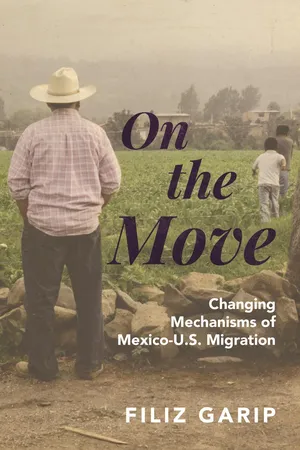
Why do Mexicans migrate to the United States? Is there a typical Mexican migrant? Beginning in the 1970s, survey data indicated that the average migrant was a young, unmarried man who was poor, undereducated, and in search of better employment opportunities. This is the general view that most Americans still hold of immigrants from Mexico. On the Move argues that not only does this view of Mexican migrants reinforce the stereotype of their undesirability, but it also fails to capture the true diversity of migrants from Mexico and their evolving migration patterns over time.
Using survey data from over 145,000 Mexicans and in-depth interviews with nearly 140 Mexicans, Filiz Garip reveals a more accurate picture of Mexico-U.S migration. In the last fifty years there have been four primary waves: a male-dominated migration from rural areas in the 1960s and '70s, a second migration of young men from socioeconomically more well-off families during the 1980s, a migration of women joining spouses already in the United States in the late 1980s and '90s, and a generation of more educated, urban migrants in the late 1990s and early 2000s. For each of these four stages, Garip examines the changing variety of reasons for why people migrate and migrants' perceptions of their opportunities in Mexico and the United States.
Looking at Mexico-U.S. migration during the last half century, On the Move uncovers the vast mechanisms underlying the flow of people moving between nations.
- 312 pages
- English
- ePUB (mobile friendly)
- Available on iOS & Android
eBook - ePub
About this book
Information
Publisher
Princeton University PressYear
2016Print ISBN
9780691191881
9780691161068
eBook ISBN
9781400883769
Table of contents
- Cover Page
- Title Page
- Copyright Page
- Dedication Page
- Contents
- List of Illustrations
- List of Tables
- Acknowledgments
- Introduction
- 1. Why Do People Migrate?: Identifying Diverse Mechanisms of Migration
- 2. “Go Work Over There and Come Do Something Here”: Circular Migrants
- 3. “We Leave to Help Our Parents Economically”: Crisis Migrants
- 4. “Your Place Is Where Your Family Is”: Family Migrants
- 5. “Putting Down Roots”: Urban Migrants
- 6. Where Do We Go from Here?: Conditional Theories and Diverse Policies
- Appendixes
- Notes
- References
- Index
Trusted by 375,005 students
Access to over 1.5 million titles for a fair monthly price.
Study more efficiently using our study tools.
Frequently asked questions
Yes, you can cancel anytime from the Subscription tab in your account settings on the Perlego website. Your subscription will stay active until the end of your current billing period. Learn how to cancel your subscription
No, books cannot be downloaded as external files, such as PDFs, for use outside of Perlego. However, you can download books within the Perlego app for offline reading on mobile or tablet. Learn how to download books offline
We are an online textbook subscription service, where you can get access to an entire online library for less than the price of a single book per month. With over 1.5 million books across 990+ topics, we’ve got you covered! Learn about our mission
Look out for the read-aloud symbol on your next book to see if you can listen to it. The read-aloud tool reads text aloud for you, highlighting the text as it is being read. You can pause it, speed it up and slow it down. Learn more about Read Aloud
Yes! You can use the Perlego app on both iOS and Android devices to read anytime, anywhere — even offline. Perfect for commutes or when you’re on the go.
Please note we cannot support devices running on iOS 13 and Android 7 or earlier. Learn more about using the app
Please note we cannot support devices running on iOS 13 and Android 7 or earlier. Learn more about using the app
Yes, you can access On the Move by Filiz Garip in PDF and/or ePUB format, as well as other popular books in Social Sciences & Social Policy. We have over 1.5 million books available in our catalogue for you to explore.