A plethora of different theories, models, and concepts make up the field of community ecology. Amid this vast body of work, is it possible to build one general theory of ecological communities? What other scientific areas might serve as a guiding framework? As it turns out, the core focus of community ecology—understanding patterns of diversity and composition of biological variants across space and time—is shared by evolutionary biology and its very coherent conceptual framework, population genetics theory. The Theory of Ecological Communities takes this as a starting point to pull together community ecology's various perspectives into a more unified whole.
Mark Vellend builds a theory of ecological communities based on four overarching processes: selection among species, drift, dispersal, and speciation. These are analogues of the four central processes in population genetics theory—selection within species, drift, gene flow, and mutation—and together they subsume almost all of the many dozens of more specific models built to describe the dynamics of communities of interacting species. The result is a theory that allows the effects of many low-level processes, such as competition, facilitation, predation, disturbance, stress, succession, colonization, and local extinction to be understood as the underpinnings of high-level processes with widely applicable consequences for ecological communities.
Reframing the numerous existing ideas in community ecology, The Theory of Ecological Communities provides a new way for thinking about biological composition and diversity.
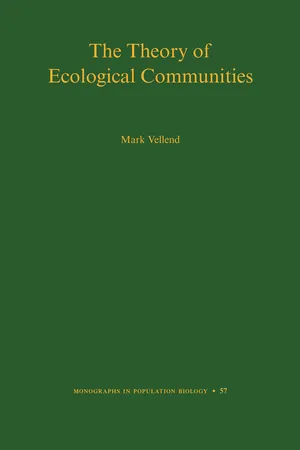
- 248 pages
- English
- ePUB (mobile friendly)
- Available on iOS & Android
eBook - ePub
The Theory of Ecological Communities
About this book
Information
Publisher
Princeton University PressYear
2016Print ISBN
9780691208992
9780691164847
eBook ISBN
9781400883790
Table of contents
- Cover Page
- Title Page
- Copyright Page
- Contents
- Acknowledgments
- 1. Introduction
- Part I: Approaches, Ideas, and Theories in Community Ecology
- Part II: The Theory of Ecological Communities
- Part III: Empirical Evidence
- Part IV: Conclusions, Reflections, and Future Directions
- References
- Index
Trusted by 375,005 students
Access to over 1.5 million titles for a fair monthly price.
Study more efficiently using our study tools.
Frequently asked questions
Yes, you can cancel anytime from the Subscription tab in your account settings on the Perlego website. Your subscription will stay active until the end of your current billing period. Learn how to cancel your subscription
No, books cannot be downloaded as external files, such as PDFs, for use outside of Perlego. However, you can download books within the Perlego app for offline reading on mobile or tablet. Learn how to download books offline
Perlego offers two plans: Essential and Complete
- Essential is ideal for learners and professionals who enjoy exploring a wide range of subjects. Access the Essential Library with 800,000+ trusted titles and best-sellers across business, personal growth, and the humanities. Includes unlimited reading time and Standard Read Aloud voice.
- Complete: Perfect for advanced learners and researchers needing full, unrestricted access. Unlock 1.5M+ books across hundreds of subjects, including academic and specialized titles. The Complete Plan also includes advanced features like Premium Read Aloud and Research Assistant.
We are an online textbook subscription service, where you can get access to an entire online library for less than the price of a single book per month. With over 1.5 million books across 990+ topics, we’ve got you covered! Learn about our mission
Look out for the read-aloud symbol on your next book to see if you can listen to it. The read-aloud tool reads text aloud for you, highlighting the text as it is being read. You can pause it, speed it up and slow it down. Learn more about Read Aloud
Yes! You can use the Perlego app on both iOS and Android devices to read anytime, anywhere — even offline. Perfect for commutes or when you’re on the go.
Please note we cannot support devices running on iOS 13 and Android 7 or earlier. Learn more about using the app
Please note we cannot support devices running on iOS 13 and Android 7 or earlier. Learn more about using the app
Yes, you can access The Theory of Ecological Communities by Mark Vellend in PDF and/or ePUB format, as well as other popular books in Biological Sciences & Ecology. We have over 1.5 million books available in our catalogue for you to explore.