A unique primer on how to think intelligently about the thorniest public issues confronting us today
Let's be honest, we've all expressed opinions about difficult hot-button issues without always thinking them through. With so much media spin, political polarization, and mistrust of institutions, it's hard to know how to think about these tough challenges, much less what to do about them. One Nation Undecided takes on some of today's thorniest issues and walks you through each one step-by-step, explaining what makes it so difficult to grapple with and enabling you to think smartly about it.
In this unique what-to-do book, Peter Schuck tackles poverty, immigration, affirmative action, campaign finance, and religious objections to gay marriage and transgender rights. For each issue, he provides essential context; defines key concepts and values; presents the relevant empirical evidence; describes and assesses the programs that now seek to address it; and considers many plausible solutions. Schuck looks at all sides with scrupulous fairness while analyzing them rigorously and factually. Each chapter is self-contained so that readers may pick and choose among the issues that interest and concern them most. His objective is to educate rather than proselytize you—the very nature of these five issues is that they resist clear answers; reasonable people can differ about where they come out on them.
No other book provides such a comprehensive, balanced, and accessible analysis of these urgent social controversies. One Nation Undecided gives you the facts and competing values, makes your thinking about them more sophisticated, and encourages you to draw your own conclusions.
eBook - ePub
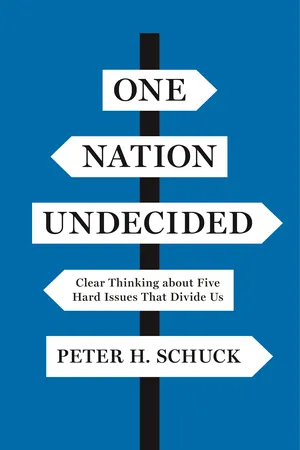
One Nation Undecided
Clear Thinking about Five Hard Issues That Divide Us
- 440 pages
- English
- ePUB (mobile friendly)
- Available on iOS & Android
eBook - ePub
About this book
Information
Publisher
Princeton University PressYear
2017Print ISBN
9780691191584
9780691167435
eBook ISBN
9781400884728
CHAPTER 1
INTRODUCTION
YOU ARE A SERIOUS, well-educated voter. You read print and online media, listen to the views of opinion leaders and organizations that you trust, discuss current events informally with interested friends, and generally try to keep up with current events. You want to participate responsibly in the democratic process through which the policies that govern us are formed, but you find this difficult. Busy with your family, work, and other private commitments, you don’t have much spare time to navigate the daunting complexity of the substantive policy issues. Social groups and peer pressure urge you to take clear positions on these issues. You might feel more comfortable if you could conscientiously do so. But you feel uneasy in taking firm positions on these important issues because, in all honesty, you know that you haven’t given them all that much thought or done your homework. So what is a conscientious but understandably distracted citizen like you to do?
I wrote this book for you. It is about hard public issues and how Americans should think about them before deciding where they stand. The success of our deliberative democracy—in which We the People and our representatives really do decide how such issues are resolved—depends on citizens’ knowing what they are talking and voting about.
What makes an issue hard? Why are some issues getting even harder, while others seem to become easier?* Is more public debate on hard issues needed? What do I mean by clear thinking about issues? What is the quality of today’s debates? How much must citizens know about the issues in order to think clearly about them, and how realistic is this? What can this book hope to contribute to these debates?
This chapter answers these questions in general, and the chapters that follow get down to specifics. But which ones? The list of domestic policy† decisions on which Americans sharply disagree with one another—in the voting booth and in conversations—is very long. No single person could explicate most of them. To do so would require far more knowledge, technical skill, time, and patience than any individual (certainly this one) possesses.
The reader’s patience is short, so I focus my analysis on five domestic policy issues: poverty; immigration; campaign finance; affirmative action; and conflicts between religious and secular values. Why these? Reasonable people will disagree about the most important issues facing the nation. The first—poverty—is an enduring challenge to the American dream. The next two—immigration and campaign finance—are perennially controversial, especially during election campaigns. The debate over affirmative action remains as robust as ever, even after the U.S. Supreme Court upheld its constitutionality in 2016. (The Court did not endorse its policy merits and the decision was a narrow one, limited—as the majority emphasized—to Texas’s “sui generis” plan.) The final issue, which I shall call “religious accommodation” as a shorthand, has always been controversial in our public life, and its prominence today is especially high in light of two recent Supreme Court decisions, discussed in chapter 6.
Each of the five is a very hard issue according to the criteria I present immediately below—although some of them are more hotly debated, affect more people, are more politically sensitive, and raise more basic constitutional issues than others. And some issues that I do not analyze here are even harder and arguably more consequential—for example, climate change and the financing and delivery of health care—are more complicated. But trying to compare the hardness of different public issues (rather than of, say, different minerals) is a fool’s errand. Each of the five vitally affects our democracy and society. We have argued about all of them for so long that their contours are relatively well defined and thus amenable to the kind of close analysis presented in this book. And the analytical structure that I use to dissect each of them invites the reader to apply it to other issues not considered here.
WHAT MAKES AN ISSUE HARD?
In my usage, an issue is hard to the extent that the following characteristics are inherent to it: Hard issues also have external or contingent aspects (e.g., political conditions, timing, leadership, unexpected events, international developments).
• It is a public and federal issue. Government institutions, especially at the federal level, play an important role in resolving it through the political process and in embodying it in public law. In contrast, most issues never make it on to the public agenda at all.1
• It is highly salient to a large number of people. This means that they care deeply, passionately, and perhaps even militantly about it. People tend to have at least provisional opinions or intuitions about where they stand on it when it enters their world.
• It constitutes an ensemble of interrelated disputed questions. We may try to treat the issue as if it were analytically discrete or self-contained, but in reality its knot of questions interact in complicated, opaque, and hard-to-disentangle ways.
• It is historically inflected, bearing the strong imprint of earlier struggles that continue to haunt current debates, affect the terms of discussion, and perhaps limit the menu of future options.
• It consists in part of complex empirical disputes that our existing knowledge cannot authoritatively resolve and on which even the experts are usually divided. Hard issues, moreover, often are subject to a “meta” empirical issue—i.e., whether the empirical disputes have in fact been settled or are instead still open to dispute. Efforts to persuade the public that a given issue is or is not still open to serious, responsible debate is a high-stakes game played by competing interests. Climate change is probably the clearest current example.* Reformers typically cite a looming crisis that must be addressed immediately, while those who favor the status quo or emphasize our ignorance or uncertainty usually favor delay, urging more deliberation, better information, and thus a more durable public consensus.
• It is embedded in normative disputes. The contested values are usually widely held and deeply felt by their proponents. Depending on the nature and content of these values, they may be more or less sensitive or tractable to empirical facts that might (or might not) seem relevant to them. Thus, people who employ a utilitarian framework that values a particular policy according to its consequences (often measured by its costs and benefits) will want to know which conditions cause which effects (among other empirical facts) before they choose a preferred policy or action. In contrast, others may assess the desirability of a policy or action deontologically—i.e., in light of whether it conforms to preexisting rules or precepts while according less (or no) significance to such empirical contingencies.
The complexity and passion surrounding normative disputes often make them seem intractable. In a democratic society, they can be resolved, if at all, only through compromise in which the competing values are traded off against one another, or by decentralizing disputes so that different jurisdictions may reach different results without the need for any overarching national solution. Values may compete with one another in at least two ways. Most commonly, pursuing goal A in fact entails some sacrifice of goal B (and vice versa). Such value conflicts, moreover, often reflect quite different worldviews so that those who hold them will tend to disagree about many other important issues, including the factual claims that underlie the values.
Occasionally, however, a normative dispute is so basic that it essentially forecloses any reasoned debate on empirical issues or even on value trade-offs. Abortion, I believe, is an example, which is one reason why I do not include it here. If one strongly believes that life begins at conception (or alternatively, that a woman’s control of her body and right to choose how it is used are absolute), then abortion is murder (or alternatively, a basic right of personal autonomy), and there really isn’t much more to talk about, except perhaps at the edges of the issue-space (e.g., narrow exceptions, or differentiating among trimesters). Similarly, many if not most opponents of capital punishment believe that it is simply immoral for the state to take life, although many opponents also object on other, more empirical grounds (e.g., uncertainty and arbitrariness).
Issues of this kind often implicate not merely differences in perspective but competing worldviews. Those who hold them may be especially unwilling, or even epistemologically unable, to yield or compromise on them because too much of their sense of reality or morality seems to be at stake. Indeed, such issues cause such people to perceive and interpret factual evidence in ways that conform to or reinforce that worldview. Scholars have approached this interpretive phenomenon in different ways.*
Some issues are normatively divisive for a particular reason that makes them even harder to resolve. This occurs when people harbor strong views but either conceal or sanitize them out of fear that they will be stigmatized as socially abhorrent. People with racist or homophobic views, for example, are often reluctant to acknowledge them. Opponents of affirmative action often fear being accused of racism by its advocates. Conservatives may depict critics of aggressive foreign policies as unpatriotic, critics of Israel as anti-Semitic, and critics of tough police practices as soft-on-crime apologists for social disorder. Such tactics are part and parcel of robust, sharp-elbowed debate in a society deeply committed to free speech. There really is no good remedy for this other than greater self-restraint and tolerance.2 But when such fears cause the timorous (who probably include all of us at times) to pull their punches, retreat from public fora, or misrepresent their views when asked for them, the public debate is deformed and people’s true positions on issues become more difficult to gauge.
• Analyzing a hard issue requires drawing relatively fine distinctions, which the general public may find difficult to understand or accept. As we shall see, legal doctrine tends to multiply such distinctions over time in response to new, often unanticipated factual situations that arise. These new situations might be covered by existing rule A but might (as some will plausibly argue) be covered better by existing or new rule B. Policy makers and judges, like other people, must decide which distinctions to make and how to formulate them. In the policy process, new distinctions are often added to earlier ones, which makes the policy ever more technical and complex but also, hopefully, more responsive to emerging social needs.
• Institutional density makes it harder to both understand and solve issues.* By this, I mean the number of agencies, levels of government, civil society groups, and private markets interacting in a particular issue-space.
• Hard issues confront particularly severe constraints on policy solutions. Any genuine solutions (not mere patches or temporary fixes) are likely to be very costly. Sometimes, these costs are not only large (for example, Medicare and Social Security reforms) but cannot be easily concealed from the likely cost-bearers, hard as politicians may try.† Knowing who will ultimately pay affects political conflict, particularly where the conflict seems zero-sum. Budgetary issues are often of this type, but so are policies that may trigger status conflicts that cause one group to feel diminished in social esteem by the rise of another. Immigration, affirmative action, and demands for religious accommodation can trigger feelings of this kind. But for most hard issues, the constraints are not only fiscal or even political. Sometimes they are moral (as with antipoverty policies). Legal rules, including constitutional ones, may foreclose certain solutions, as we shall see in several of the chapters that follow—especially campaign finance, religious accommodation, and affirmative action.
WHY ARE SOME HARD ISSUES GETTING EVEN HARDER?
Public policy disputes seem to be getting more protracted, more impervious to reasoned debate, and their solutions more elusive. This impression is difficult to prove definitively because we lack clear gauges: The characteristics that make issues hard are largely qualitative and resist measurement. We must also bridle our tendency to imagine a past “golden age” of consensus and high-toned debate, just as we should not assume that today’s policy struggles are nastier, more politicized, more irrational, and more polarized than in earlier times. The belief in such a harmonious past betrays more ignorance about our history than insight about our current challenges. The sharp, sometimes violent divisions documented by American historians throughout our history belie such a fantasy.3 Abraham Lincoln, long sainted in our collective national memory, was in his own time vilified in the most intemperate, despicable terms.4 Although the period between World War II and the Vietnam War now seems unusually harmonious (except for the McCarthy era), that was abnormal. Arguably, the 1800 presidential election was uglier than 2016’s.5
Still, some features of our contemporary policy-making context do make many issues harder to understand and resolve. In one sense, today’s hard issues are harder almost by definition: We have already picked some of the lower-hanging fruit—policy changes that over time came to be widely seen as morally compelled—leaving us twenty-first-century Americans to debate issues that have not yet achieved that consensus (if they ever will). My point, emphatically, is not that universal suffrage, safety net entitlements, antidiscrimination laws, environmental and consumer protection programs, and labor rights came easily. Far from it; they were extraordinarily hard issues at the time, resolved only after protracted political and cultural struggle—and, in some cases, widespread violence. Even today when these policies’ basic parameters seem fairly well settled, bitter conflict continues over their precise contours. Efforts to roll them back continue, albeit nonviolently.
Perhaps as time passes, many of the hard issues that roil today’s Americans will seem more tractable than now appears possible—for example, the cultural conflicts over same-sex marriage and transgender rights, discussed in chapter 6—but powerful arguments exist on all sides of hard issues. By some measures, our politics really is more polarized than at any time since the post–Civil War era, at least in the U.S. Congress.6 Even issues not now on the political agenda seem more contested today than since World War II.7 Even though today’s policy makers can access much better social data and an...
Table of contents
- Cover Page
- Title Page
- Copyright Page
- Dedication Page
- Contents
- Acknowledgments
- 1: Introduction
- 2: Poverty
- 3: Immigration
- 4: Campaign Finance
- 5: Affirmative Action
- 6: Religious Exemptions from Secular Public Policies
- 7: Conclusion
- Notes
- Index
Trusted by 375,005 students
Access to over 1.5 million titles for a fair monthly price.
Study more efficiently using our study tools.
Frequently asked questions
Yes, you can cancel anytime from the Subscription tab in your account settings on the Perlego website. Your subscription will stay active until the end of your current billing period. Learn how to cancel your subscription
No, books cannot be downloaded as external files, such as PDFs, for use outside of Perlego. However, you can download books within the Perlego app for offline reading on mobile or tablet. Learn how to download books offline
Perlego offers two plans: Essential and Complete
- Essential is ideal for learners and professionals who enjoy exploring a wide range of subjects. Access the Essential Library with 800,000+ trusted titles and best-sellers across business, personal growth, and the humanities. Includes unlimited reading time and Standard Read Aloud voice.
- Complete: Perfect for advanced learners and researchers needing full, unrestricted access. Unlock 1.5M+ books across hundreds of subjects, including academic and specialized titles. The Complete Plan also includes advanced features like Premium Read Aloud and Research Assistant.
We are an online textbook subscription service, where you can get access to an entire online library for less than the price of a single book per month. With over 1.5 million books across 990+ topics, we’ve got you covered! Learn about our mission
Look out for the read-aloud symbol on your next book to see if you can listen to it. The read-aloud tool reads text aloud for you, highlighting the text as it is being read. You can pause it, speed it up and slow it down. Learn more about Read Aloud
Yes! You can use the Perlego app on both iOS and Android devices to read anytime, anywhere — even offline. Perfect for commutes or when you’re on the go.
Please note we cannot support devices running on iOS 13 and Android 7 or earlier. Learn more about using the app
Please note we cannot support devices running on iOS 13 and Android 7 or earlier. Learn more about using the app
Yes, you can access One Nation Undecided by Peter H. Schuck in PDF and/or ePUB format, as well as other popular books in Politics & International Relations & Public Law. We have over 1.5 million books available in our catalogue for you to explore.