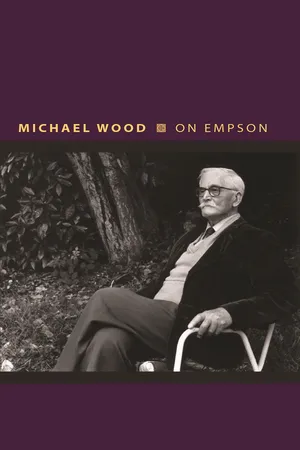
From one of today's most distinguished critics, a beautifully written exploration of one of the twentieth century's most important literary critics
Are literary critics writers? As Michael Wood says, "Not all critics are writers—perhaps most of them are not—and some of them are better when they don't try to be." The British critic and poet William Empson (1906–84), one of the most important and influential critics of the twentieth century, was an exception—a critic who was not only a writer but also a great one. In this brief book, Wood, himself one of the most gifted writers among contemporary critics, explores Empson as a writer, a distinguished poet whose criticism is a brilliant literary performance—and proof that the act of reading can be an unforgettable adventure.
Drawing out the singularity and strength of Empson's writing, including its unfailing wit, Wood traces the connections between Empson's poetry and criticism from his first and best-known critical works, Seven Types of Ambiguity and Some Versions of Pastoral, to later books such as Milton's God and The Structure of Complex Words. Wood shows why this pioneer of close reading was both more and less than the inventor of New Criticism—more because he was the greatest English critic since Coleridge, and didn't belong to any school; and less because he had severe differences with many contemporary critics, especially those who dismissed the importance of an author's intentions.
Beautifully written and rich with insight, On Empson is an elegant introduction to a unique writer for whom literature was a nonstop form of living.
eBook - ePub
On Empson
About this book
Information
Topic
LiteraturaSubtopic
Crítica literaria inglesaFIVE
All in Flight
“I wanted control over the broadcasting of any ambiguities.”
Gillian Rose, Love’s Work
I
Empson wrote that his later poems were largely focused on the historical theme that also engaged other, apparently more political poets, namely “the gradual sinister confusing approach to the Second World War.” Of his second book of verse, The Gathering Storm (1940), he wrote that “nearly all the poems really are considering this prospect.” He also said, partly in jest, that the title means “just what Winston Churchill did when he stole it” [CP 127]. Churchill’s The Gathering Storm is the first book in his six-volume history of the war.
The theme is certainly present in the remarkable poem “Aubade,” written in 1933 or 1934, but it arrives very late in the poem and can’t fully be disentangled from personal matters. The story involves two lovers woken by an earthquake in Japan, and the initial question is whether they should stay in the speaker’s house or leave. It is on a cliff, we are told, and the weather “could take / Bookloads off shelves, break bottles in a row.”
Then the long pause and then the bigger shake.
It seemed the best thing to be up and go. [CP 69]
“Up” can mean out of bed or fully awake; and “up and off” hovers behind “up and go.” “The best thing” may refer to immediate physical action, or to a longer-term view of the relationship. The second stanza is a little hard to read.
And far too large for my feet to step by.
I hoped that various building were brought low.
The heart of standing is you cannot fly. [CP 69]
What’s “far too large” seems to be the tremor continuing after a pause (“and then the bigger shake”), but “cannot fly” surely represents what the speaker wants to think rather than any actual impossibility.
It seemed quite safe till she got up and dressed.
The guarded tourist makes the guide the test.
Then I said The Garden? Laughing she said No.
Taxi for her and for me healthy rest.
It seemed the best thing to be up and go. [CP 69]
The last line here seems to be a form of indirect speech, a paraphrase of the speaker’s nervous understanding of what the woman says. To a question about safety, she answers with a laugh and a thought about transport. The speaker is rueful.
The language problem but you have to try
Some solid ground for lying could she show?
The heart of standing is you cannot fly. [CP 69]
He wonders why she wants to leave, and since he’s a poet (or since he is a version of Empson), he does his wondering with a pun. The language problem may not be the obvious one, the tourist’s poor or nonexistent grasp of Japanese. It may also involve the English mania for suspicion in words and of words: is the woman lying to him or telling him why she can’t lie with him any longer? But both meanings of lying turn out to be irrelevant.
None of these deaths were her point at all.
The thing was that being woken he would bawl
And finding her not in earshot he would know.
I tried saying Half an Hour to pay this call.
It seemed the best thing to be up and go. [CP 69]
These deaths: the deaths that have occurred in the earthquake and the further deaths that may occur if people venture outdoors too soon. She needs to get home because someone—a husband or a child—will cry or complain as soon as he discovers she is not there.
The speaker sleeps for a bit, and the topic of the poem begins to shift.
I slept, and blank as that I would yet lie.
Till you have seen what a threat holds below,
The heart of standing is you cannot fly. [CP 69]
The speaker is not ready to let go of his pun. He hints that he would be lying if he said that sleep solved any sort of problem, but also says he wished he could continue in that blankness, a condition where at least he doesn’t have to worry so rationally about staying or leaving. His logic is about seeing “what a threat holds below” is strange, but also convincing: perhaps we can’t (or shouldn’t) fly until we’ve looked the danger in the face
And now suddenly the shift is completed. The question no longer concerns the earthquake and the couple, although the comic tourist and guide are still within reach. The speaker wonders whether it may be time to leave Japan, and not just this house.
Tell me again about Europe and her pains,
Who’s tortured by the drought, who by the rains.
Glut me with floods where only the swine can row
Who cuts his throat and let him count his gains.
It seemed the best thing to be up and go. [CP 69]
On second thought, the refrain seems to say, perhaps I’d better go and find out for myself. Or does he mean he should get up and go to work today—as long as he is so far from Europe, he should be doing the job he’s paid for in Japan. The next stanza takes him towards Japan rather than away from it.
A bedshift flight to a Far Eastern sky.
Only the same war on a stronger toe.
The heart of standing is you cannot fly. [CP 70]
“Bedshift” is quite wonderful in its unruly meanings: it reminds us of the lovers being woken by the earthquake, evokes a night journey by plane, and suggests something makeshift about the whole situation. The Gardners engagingly associate the word with magic carpets [Gardner 166]. Perhaps our man is not thinking of leaving but remembering his arrival, recalling the uncertain political climate of Europe, the war already in the air. War is present in the East too, “the same war on a stronger toe.” If it really is the same war, then of course the question of standing or flying becomes in many ways moot. Empson tells us the poem “was written in Tokyo during the Manchurian Incident,” and brings the international question back to the couple: “It was thought unwise for visiting Englishmen to marry Japanese ladies, because the two countries would clearly soon be at war” [CP 316].
The next stanzas don’t clarify anything, yet they have an unmistakable urgency about them, as if the real question were not about staying or leaving, standing or flying, but how one should feel about any such action, whichever one does. ‘Tell me more quickly what I lost by this,” the speaker says. Almost everything is unmoored in this sentence. Whom is he asking? More quickly than what? What is “this”? Let’s say he is asking anyone who will reply to him, in reality or in imagination. And “this” could be the love affair, the change in it that may follow the earthquake, the whole relation between the guide and the tourist, the tourist’s awareness that he is never going to be a native here. It could be whatever decision he arrives at. The poem, as if sensing that we are not going to be much help, offers an alternative:
Or tell me with less drama what they miss
Who call no die a god for a good throw,
Who say after two aliens had one kiss
It seemed the best thing to be up and go. [CP 70]
“With less drama” parallels “more quickly”—there is a real worry about taking things too grandly, turning affective molehills into international mountains. But the “I” has interestingly turned into a “they”; a notional type takes over from a person. The line about the gambling is truly opaque and awkward, I think, but weirdly haunting. I take it we are meant to imagine types who miss something important because they pride themselves on their calm, on their lack of extreme behavior—they are not going to worship chance just because they might be lucky. And then this rather “English” common sense slips into an equally “English” habit of not taking foreigners (or each other perhaps) too seriously. “One kiss,” and it’s time to be off. Thank God for the reminder the earthquake provided. “It seemed the best thing” in this light is cruelly comic: can’t be too careful when it comes to aliens.
The poem reaches its conclusion with a repetition of the word “tell”—the speaker is going to tell us what we can’t tell him—and another pun.
But as to risings, I can tell you why.
It is on contradiction that they grow.
It seemed the best thing to be up and go.
Up was the heartening and the strong reply.
The heart of standing is we cannot fly. [CP 70]
“Risings” evokes the war situation in the East and the West, but in this context must also call up the manifestations of sexual desire, as well as the notion of getting up and going. What does the speaker have to say about these things? That “it is on contradiction that they grow.” This seems obvious in the political context, less so in the personal one. But we have to believe the speaker has found something he wants to say to himself. The repetition of the first refrain—“It seemed the best thing to be up and go”—which appears to be a conclusion drawn from the theory of risings growing out of contradictions, might be thought to settle things. Since contradiction is at the heart of these matters, rising itself means leaving, taking action, even if the sexual meaning of the word implies that one has to linger in one place, with one person, now and then. “Up and go” is a rather brutally witty description of a one-night stand.
But the refrain doesn’t settle things, since the apparent agreement in the next line holds only for a second. “Up was the heartening and the strong reply.” “Up” without “go” might mean a lot more risings in the same place, and this is where the refrain leaves us: “The heart of standing is we cannot fly.” In a quiet but significant substitution, Empson has replaced “you” with “we.” “Heartening” and “heart” create a troubling echo, almost an irony. How heartening is it to be told you cannot fly? Not quite the right question perhaps. When and for whom would it be heartening to be told this? And how do we read “heart”? Are there other kinds of standing—heartless kinds?
Empson doesn’t explicitly connect “Aubade” to the Fool’s song in King Lear about staying and flying, but the two lyrics do illuminate each other beautifully. The Earl of Kent, banished from Britain by the angry king, has returned in disguise to go on serving his master. He is now in the stocks for his trouble, and asks the king’s Fool what has happened to all the knights who were supposed to be part of the king’s retinue. (They are in the process of being dispersed by the king’s daughters, who th...
Table of contents
- Cover Page
- Series Page
- Title Page
- Copyright Page
- Dedication Page
- Contents
- One: Empson’s Intentions
- Two: The Strangeness of the World
- Three: Large Dreams
- Four: The Other Case
- Five: All in Flight
- Six: Sibylline Leaves
- Seven: The Smoke of Hell
- Acknowledgments
- Abbreviations
- Bibliography
Trusted by 375,005 students
Access to over 1.5 million titles for a fair monthly price.
Study more efficiently using our study tools.
Frequently asked questions
Yes, you can cancel anytime from the Subscription tab in your account settings on the Perlego website. Your subscription will stay active until the end of your current billing period. Learn how to cancel your subscription
No, books cannot be downloaded as external files, such as PDFs, for use outside of Perlego. However, you can download books within the Perlego app for offline reading on mobile or tablet. Learn how to download books offline
Perlego offers two plans: Essential and Complete
- Essential is ideal for learners and professionals who enjoy exploring a wide range of subjects. Access the Essential Library with 800,000+ trusted titles and best-sellers across business, personal growth, and the humanities. Includes unlimited reading time and Standard Read Aloud voice.
- Complete: Perfect for advanced learners and researchers needing full, unrestricted access. Unlock 1.5M+ books across hundreds of subjects, including academic and specialized titles. The Complete Plan also includes advanced features like Premium Read Aloud and Research Assistant.
We are an online textbook subscription service, where you can get access to an entire online library for less than the price of a single book per month. With over 1.5 million books across 990+ topics, we’ve got you covered! Learn about our mission
Look out for the read-aloud symbol on your next book to see if you can listen to it. The read-aloud tool reads text aloud for you, highlighting the text as it is being read. You can pause it, speed it up and slow it down. Learn more about Read Aloud
Yes! You can use the Perlego app on both iOS and Android devices to read anytime, anywhere — even offline. Perfect for commutes or when you’re on the go.
Please note we cannot support devices running on iOS 13 and Android 7 or earlier. Learn more about using the app
Please note we cannot support devices running on iOS 13 and Android 7 or earlier. Learn more about using the app
Yes, you can access On Empson by Michael Wood in PDF and/or ePUB format, as well as other popular books in Literatura & Crítica literaria inglesa. We have over 1.5 million books available in our catalogue for you to explore.