The information age owes its existence to a little-known but crucial development, the theoretical study of logic and the foundations of mathematics. The Great Formal Machinery Works draws on original sources and rare archival materials to trace the history of the theories of deduction and computation that laid the logical foundations for the digital revolution.
Jan von Plato examines the contributions of figures such as Aristotle; the nineteenth-century German polymath Hermann Grassmann; George Boole, whose Boolean logic would prove essential to programming languages and computing; Ernst Schröder, best known for his work on algebraic logic; and Giuseppe Peano, cofounder of mathematical logic. Von Plato shows how the idea of a formal proof in mathematics emerged gradually in the second half of the nineteenth century, hand in hand with the notion of a formal process of computation. A turning point was reached by 1930, when Kurt Gödel conceived his celebrated incompleteness theorems. They were an enormous boost to the study of formal languages and computability, which were brought to perfection by the end of the 1930s with precise theories of formal languages and formal deduction and parallel theories of algorithmic computability. Von Plato describes how the first theoretical ideas of a computer soon emerged in the work of Alan Turing in 1936 and John von Neumann some years later.
Shedding new light on this crucial chapter in the history of science, The Great Formal Machinery Works is essential reading for students and researchers in logic, mathematics, and computer science.
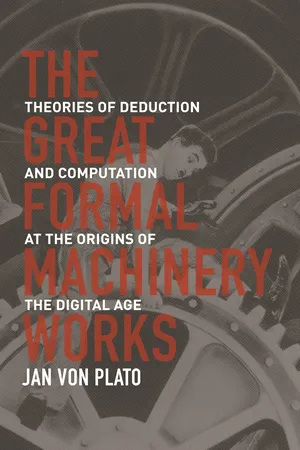
eBook - PDF
The Great Formal Machinery Works
Theories of Deduction and Computation at the Origins of the Digital Age
- 391 pages
- English
- PDF
- Available on iOS & Android
eBook - PDF
The Great Formal Machinery Works
Theories of Deduction and Computation at the Origins of the Digital Age
About this book
Information
Topic
StoriaSubtopic
Informatica generaleTable of contents
- Cover
- Title
- Copyright
- CONTENTS
- Preface
- Prologue: Logical Roots of the Digital Age
- 1. An Ancient Tradition
- 2. The Emergence of Foundational Study
- 3. The Algebraic Tradition of Logic
- 4. Frege’s Discovery of Formal Reasoning
- 5. Russell: Adding Quantifiers to Peano’s Logic
- 6. The Point of Constructivity
- 7. The Göttingers
- 8. Gödel’s Theorem: An End and a Beginning
- 9. The Perfection of Pure Logic
- 10. The Problem of Consistency
- References
- Index
Trusted by 375,005 students
Access to over 1.5 million titles for a fair monthly price.
Study more efficiently using our study tools.
Frequently asked questions
Yes, you can cancel anytime from the Subscription tab in your account settings on the Perlego website. Your subscription will stay active until the end of your current billing period. Learn how to cancel your subscription
No, books cannot be downloaded as external files, such as PDFs, for use outside of Perlego. However, you can download books within the Perlego app for offline reading on mobile or tablet. Learn how to download books offline
Perlego offers two plans: Essential and Complete
- Essential is ideal for learners and professionals who enjoy exploring a wide range of subjects. Access the Essential Library with 800,000+ trusted titles and best-sellers across business, personal growth, and the humanities. Includes unlimited reading time and Standard Read Aloud voice.
- Complete: Perfect for advanced learners and researchers needing full, unrestricted access. Unlock 1.5M+ books across hundreds of subjects, including academic and specialized titles. The Complete Plan also includes advanced features like Premium Read Aloud and Research Assistant.
We are an online textbook subscription service, where you can get access to an entire online library for less than the price of a single book per month. With over 1.5 million books across 990+ topics, we’ve got you covered! Learn about our mission
Look out for the read-aloud symbol on your next book to see if you can listen to it. The read-aloud tool reads text aloud for you, highlighting the text as it is being read. You can pause it, speed it up and slow it down. Learn more about Read Aloud
Yes! You can use the Perlego app on both iOS and Android devices to read anytime, anywhere — even offline. Perfect for commutes or when you’re on the go.
Please note we cannot support devices running on iOS 13 and Android 7 or earlier. Learn more about using the app
Please note we cannot support devices running on iOS 13 and Android 7 or earlier. Learn more about using the app
Yes, you can access The Great Formal Machinery Works by Jan von Plato in PDF and/or ePUB format, as well as other popular books in Storia & Informatica generale. We have over 1.5 million books available in our catalogue for you to explore.