An insightful reflection on the mathematical soul
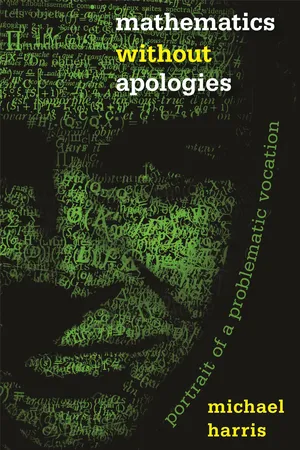
What do pure mathematicians do, and why do they do it? Looking beyond the conventional answers—for the sake of truth, beauty, and practical applications—this book offers an eclectic panorama of the lives and values and hopes and fears of mathematicians in the twenty-first century, assembling material from a startlingly diverse assortment of scholarly, journalistic, and pop culture sources.
Drawing on his personal experiences and obsessions as well as the thoughts and opinions of mathematicians from Archimedes and Omar Khayyám to such contemporary giants as Alexander Grothendieck and Robert Langlands, Michael Harris reveals the charisma and romance of mathematics as well as its darker side. In this portrait of mathematics as a community united around a set of common intellectual, ethical, and existential challenges, he touches on a wide variety of questions, such as: Are mathematicians to blame for the 2008 financial crisis? How can we talk about the ideas we were born too soon to understand? And how should you react if you are asked to explain number theory at a dinner party?
Disarmingly candid, relentlessly intelligent, and richly entertaining, Mathematics without Apologies takes readers on an unapologetic guided tour of the mathematical life, from the philosophy and sociology of mathematics to its reflections in film and popular music, with detours through the mathematical and mystical traditions of Russia, India, medieval Islam, the Bronx, and beyond.
- 464 pages
- English
- ePUB (mobile friendly)
- Available on iOS & Android
eBook - ePub
About this book
Information
Publisher
Princeton University PressYear
2017Print ISBN
9780691175836
9780691154237
eBook ISBN
9781400885527
Topic
MatemáticasSubtopic
Biografías de ciencias socialeschapter 1
Introduction: The Veil
Who of us would not be glad to lift the veil behind which the future lies hidden; to cast a glance at the next advances of our science and at the secrets of its development during future centuries? What particular goals will there be toward which the leading mathematical spirits of coming generations will strive? What new methods and new facts in the wide and rich field of mathematical thought will the new centuries disclose?
—David Hilbert, Paris 1900
The next sentence of Hilbert’s famous lecture at the Paris International Congress of Mathematicians (ICM), in which he proposed twenty-three problems to guide research in the dawning century, claims that “History teaches the continuity of the development of science.”1 We would still be glad to lift the veil, but we no longer believe in continuity. And we may no longer be sure that it’s enough to lift a veil to make our goals clear to ourselves, much less to outsiders.
The standard wisdom is now that sciences undergo periodic ruptures so thorough that the generations of scientists on either side of the break express themselves in mutually incomprehensible languages. In the most familiar version of this thesis, outlined in T. S. Kuhn’s Structure of Scientific Revolutions, the languages are called paradigms. Historians of science have puzzled over the relevance of Kuhn’s framework to mathematics.2 It’s not as though mathematicians were unfamiliar with change. Kuhn had already pointed out that “Even in the mathematical sciences there are also theoretical problems of paradigm articulation.”3 Writing in 1891, shortly before the paradoxes in Cantor’s set theory provoked a Foundations Crisis that took several decades to sort out, Leopold Kronecker insisted that “with the richer development of a science the need arises to alter its underlying concepts and principles. In this respect mathematics is no different from the natural sciences: new phenomena [neue Erscheinungen] overturn the old hypotheses and put others in their place.”4 And the new concepts often meet with resistance: the great Carl Ludwig Siegel thought he saw “a pig broken into a beautiful garden and rooting up all flowers and trees”5 when a subject he had done so much to create in the 1920s was reworked in the 1960s.
Nevertheless, one might suppose pure mathematics to be relatively immune to revolutionary paradigm shift because, unlike the natural sciences, mathematics is not about anything and, therefore, does not really have to adjust to accommodate new discoveries. Kronecker’s neue Erscheinungen are the unforeseen implications of our hypotheses, and if we don’t like them, we are free to alter either our hypotheses or our sense of the acceptable. This is one way to understand Cantor’s famous dictum that “the essence of mathematics lies in its freedom.”
It’s a matter of personal philosophy whether one sees the result of this freedom as evolution or revolution. For historian Jeremy Gray, it’s part of the professional autonomy that characterizes what he calls modernism in mathematics; the imaginations of premodern mathematicians were constrained by preconceptions about the relations between mathematics and philosophy or the physical sciences:
Without … professional autonomy the modernist shift could not have taken place. Modernism in mathematics is the appropriate ideology, the appropriate rationalization or overview of the enterprise…. it became the mainstream view because it articulated very well the new situation that mathematicians found themselves in.6
This “new situation” involved both the incorporation of mathematics within the structure of the modern research university—the creation of an international community of professional mathematicians—and new attitudes to the subject matter and objectives of mathematics. The new form and the new content appeared at roughly the same time and have persisted with little change, in spite of the dramatic expansion of mathematics and of universities in general in the second half of the twentieth century.
Insofar as the present book is about anything, it is about how it feels to live a mathematician’s double life: one life within this framework of professional autonomy, answerable only to our colleagues, and the other life in the world at large. It’s so hard to explain what we do—as David Mumford, one of my former teachers, put it, “I am accustomed, as a professional mathematician, to living in a sort of vacuum, surrounded by people who declare with an odd sort of pride that they are mathematically illiterate”7—that when, on rare occasions, we make the attempt, we wind up so frustrated at having left our interlocutor unconvinced, or at the gross misrepresentations to which we have resorted, or usually both at once, that we leave the next questions unasked: What are our goals? Why do we do it?
But sometimes we do get to the “why” question, and the reasons we usually advance are of three sorts. Two of them are obviously wrong. Mathematics is routinely justified either because of its fruitfulness for practical applications or because of its unique capacity to demonstrate truths not subject to doubt, apodictically certain (to revive a word Kant borrowed from Aristotle). Whatever the merits of these arguments, they are not credible as motivations for what’s called pure mathematics—mathematics, that is, not designed to solve a specific range of practical problems—since the motivations come from outside mathematics and the justifications proposed imply that (pure) mathematicians are either failed engineers or failed philosophers. Instead, the motivation usually acknowledged is aesthetic, that mathematicians are seekers of beauty, that mathematics is in fact art as much as science, or that it is even more art than science. The classic statement of this motivation, due to G. H. Hardy, will be reviewed in the final chapter. Mathematics defended in this way is obviously open to the charge of sterility and self-indulgence, tolerated only because of those practical applications (such as radar, electronic computing, cryptography for e-commerce, and image compression, not to mention control of guided missiles, data mining, or options pricing) and because, for the time being at least, universities still need mathematicians to train authentically useful citizens.
There are new strains on this situation of tolerance. The economic crisis that began in 2008 arrived against the background of a global trend of importing methods of corporate governance into university administration and of attempting to foster an “entreprenurial mindset” among researchers in all potentially useful academic fields. The markets for apodictically certain truths or for inputs to the so-called knowledge economy may some day be saturated by products of inexpensive mechanical surrogate mathematicians; the entrepreneurial mindset may find mathematics a less secure investment than the more traditional arts. All this leaves a big question mark over the future of mathematics as a human activity. My original aim in writing this book was to suggest new and more plausible answers to the “why” question; but since it’s pointless to say why one does something without saying what that something is, much of the book is devoted to the “what” question. Since the book is written for readers without specialized training, this means it is primarily an account of mathematics as a way of life. Technical material is introduced only when it serves to illustrate a point and, as far as possible, only at the level of dinner-party conversation. But the “why” will never be far off, nor will reminders of the pressures on professional autonomy that make justification of our way of life, as we understand it, increasingly urgent.
The reader is warned at the outset that my objective in this book is not to arrive at definitive conclusions but rather to elaborate on what Herbert Mehrtens calls “the usual answer to the question of what mathematics is,” namely, by pointing: “This is how one does mathematics.”* And before I return to the “why” question, I had better start pointing.
* Ich gebe damit auch die übliche Antwort auf die Frage, was Mathematik sei So macht man Mathematik (Mehrtens 1990, p. 18).
chapter 2
How I Acquired Charisma
J’ai glissé dans cette moitié du monde. pour laquelle l’autre n’est qu’un décor.
—Annie Ernaux
My mathematical socialization began during the prodigious summer of 1968. While my future colleagues chanted in the Paris streets by day and ran the printing presses by night, helping to prepare the transition from structuralism to poststructuralism; while headlines screamed of upheavals—The Tet offensive! The Prague spring! Student demonstrations in Mexico City!—too varied and too numerous for my teenage imagination to put into any meaningful order; while cities across America burst into flames in reaction to the assassination of Martin Luther King and continued to smolder, I was enrolled in the Temple University summer program in mathematics for high school students at the suggestion of Mr. Nicholas Grant, who had just guided my class through a two-year experimental course in vector geometry. It was the summer between tenth and eleventh grades and between the presidential primaries and the unforgettable Democratic National Convention in Chicago. Like many of my classmates, I was already a veteran of partisan politics. Over the course of the summer, the certainty of the religious, patriotic, and familial narratives that had accompanied the first fourteen years of my own life were shaken, in some cases to the breaking point. How convenient, then, that a new and timeless certainty was ready and waiting to take their place.1
At Temple that summer, I discovered the Men of Modern Mathematics poster that I subsequently rediscovered in nearly every mathematics department I visited around the world: at Swarthmore, where the marvelous Mr. Grant drove me during my senior year to hear a lecture by Philadelphia native L. J. Mordell, an alumnus of my high school and G. H. Hardy’s successor at Cambridge to the Sadleirian Chair of Pure Mathematics; near the University of Pennsylvania mathematics library, where I did research for a high school project; and through all the steps of my undergraduate and graduate education. The poster was ubiquitous and certainly seemed timeless to my adolescent mind but had, in fact, been created only two years earlier by IBM. Its title alludes to Eric Temple Bell’s Men of Mathematics, the lively but unreliable collection of biographies that served as motivational reading that summer at Temple. You will have noticed at least one problem with the title, and it’s not only that one of the “men” in Bell’s book and (a different) one on the IBM poster are, in fact, women. Whole books can a...
Table of contents
- Cover Page
- Title Page
- Copyright Page
- Dedication
- Contents
- preface to the paperback edition
- preface
- acknowledgments
- Part I
- Part II
- Part III
- notes
- bibliography
- index of mathematicians
- subject index
Trusted by 375,005 students
Access to over 1.5 million titles for a fair monthly price.
Study more efficiently using our study tools.
Frequently asked questions
Yes, you can cancel anytime from the Subscription tab in your account settings on the Perlego website. Your subscription will stay active until the end of your current billing period. Learn how to cancel your subscription
No, books cannot be downloaded as external files, such as PDFs, for use outside of Perlego. However, you can download books within the Perlego app for offline reading on mobile or tablet. Learn how to download books offline
Perlego offers two plans: Essential and Complete
- Essential is ideal for learners and professionals who enjoy exploring a wide range of subjects. Access the Essential Library with 800,000+ trusted titles and best-sellers across business, personal growth, and the humanities. Includes unlimited reading time and Standard Read Aloud voice.
- Complete: Perfect for advanced learners and researchers needing full, unrestricted access. Unlock 1.5M+ books across hundreds of subjects, including academic and specialized titles. The Complete Plan also includes advanced features like Premium Read Aloud and Research Assistant.
We are an online textbook subscription service, where you can get access to an entire online library for less than the price of a single book per month. With over 1.5 million books across 990+ topics, we’ve got you covered! Learn about our mission
Look out for the read-aloud symbol on your next book to see if you can listen to it. The read-aloud tool reads text aloud for you, highlighting the text as it is being read. You can pause it, speed it up and slow it down. Learn more about Read Aloud
Yes! You can use the Perlego app on both iOS and Android devices to read anytime, anywhere — even offline. Perfect for commutes or when you’re on the go.
Please note we cannot support devices running on iOS 13 and Android 7 or earlier. Learn more about using the app
Please note we cannot support devices running on iOS 13 and Android 7 or earlier. Learn more about using the app
Yes, you can access Mathematics without Apologies by Michael Harris in PDF and/or ePUB format, as well as other popular books in Matemáticas & Biografías de ciencias sociales. We have over 1.5 million books available in our catalogue for you to explore.