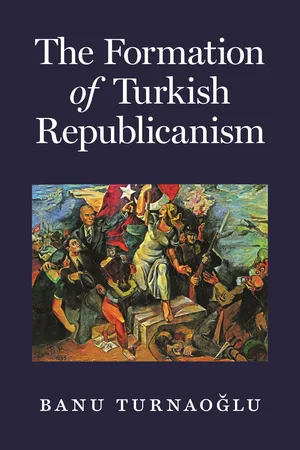
Turkish republicanism is commonly thought to have originated with Mustafa Kemal Atatürk and the founding of modern Turkey in 1923, and understood exclusively in terms of Kemalist ideals, characterized by the principles of secularism, nationalism, statism, and populism. Banu Turnao?lu challenges this view, showing how Turkish republicanism represents the outcome of centuries of intellectual dispute in Turkey over Islamic and liberal conceptions of republicanism, culminating in the victory of Kemalism in the republic's formative period.
Drawing on a wealth of rare archival material, Turnao?lu presents the first complete history of republican thinking in Turkey from the birth of the Ottoman state to the founding of the modern republic. She shows how the Kemalists wrote Turkish history from their own perspective, presenting their own version of republicanism as inevitable while disregarding the contributions of competing visions. Turnao?lu demonstrates how republicanism has roots outside the Western political experience, broadening our understanding of intellectual history. She reveals how the current crises in Turkish politics—including the Kurdish Question, democratic instability, the rise of radical Islam, and right-wing Turkish nationalism—arise from intellectual tensions left unresolved by Kemalist ideology.
A breathtaking work of scholarship, The Formation of Turkish Republicanism offers a strikingly new narrative of the evolution and shaping of modern Turkey.
- 320 pages
- English
- ePUB (mobile friendly)
- Available on iOS & Android
eBook - ePub
The Formation of Turkish Republicanism
About this book
Information
Publisher
Princeton University PressYear
2017Print ISBN
9780691210131
9780691172743
eBook ISBN
9781400885220
CHAPTER ONE
Shaping the Empire
THE MEDIEVAL MEDITERRANEAN WORLD had inherited a long tradition of government, beginning with the magistracies of the ancient citystates and culminating in the monarchies of the Roman and Byzantine Empires. A second tradition came from the Arabs, who spread the Islamic type of government from the Arab Peninsula to North Africa, the Iberian Peninsula, Central Asia, and northern India. From the eleventh century onward, these lands were invaded by the akıncıs (raids) of the Turks from Central Asia, Berbers from the Sahara and the High Atlas, and Arabs from the Libyan Desert, who brought with them their own nomadic cultures, which transformed Mediterranean societies and forged new states. The most dramatic outcome of the process was the formation of the Ottoman state, which successfully combined and blended the three traditions of Mediterranean monarchy, Arabo-Islamic governance, and Turco-Asian nomadic culture in its government.1 Although Ottoman state philosophy had little in common with its Western counterparts during its formative years and the classical imperial period (1453–1789), it shared many similarities with Eastern (for example, Indian, Persian, and Chinese) governments and with the political, social, and moral thought of the East, at least until the nineteenth century.
European Renaissance and Reformation observers often described the Ottoman regime as an atrocious tyranny where the people stood relative to the sultan as slaves to a master.2 François de La Noue wrote that “[T]he Turkish kingdome [is] a terrible tyranny, whose subjects were wonderfully enthralled: their wars destitute of all good foundation: their politique government being well examined to be but a basenesse: their ecclesiastical regiment to be none.”3 Similarly, Paul Rycaut portrayed Ottoman sultans as spreading the “cruelty of the sword in the most rigorous way of execution, by killing, consuming and laying desolate the countries.”4 The impact of this experience shaped the conception of “Oriental despotism.” In his The Spirit of the Laws, Montesquieu described despotism as an Oriental regime exclusively to be encountered in Asia. Ottoman society epitomized a typical Oriental society and political system, bound to be ruled by a despot because of its peculiar manners, customs and the warmth of its climate, which enervated the people, rendering them slaves.5
This way of viewing the Ottoman state persisted in Europe for centuries.6 Ernest Gellner saw the Ottoman Empire as a “slave soldier” state, whose protection and security depended on the sultan’s slaves.7 For Max Weber, this dependency, in contrast to Western European states, was an aspect of the way in which power was exercised in the Ottoman state. The state was the personal property of the sultan, evolving out of patriarchalism into patrimonialism as its personnel expanded beyond the monarch, his kinsmen, and household to encompass a professional army of secretaries and soldiers.8 Until recently, this Eurocentric view of Ottoman politics dominated Western and even Turkish academia.9
This conception of the Ottoman state, however, is neither accurate nor coherent. Classical Ottoman political thought rejected tyranny and acknowledged checks on the sultan’s conduct and limitations on his rights. It saw legitimacy as resting on the provision of justice and the maintenance of order. This deeply conservative vision began to alter with the advent of Westernization during the eighteenth century. Although the state philosophy had carried elements of a republican government since its foundation, Ottoman thinkers of the classical period did not see this as an alternative to monarchy. The word “republic” (cumhuriyet) appeared as a political category, but little attention was paid to republic as a type of government until the French Revolution, and there was certainly nothing that could be mistake for a republican tradition.
Early Stages of Ottoman State Formation
The emergence of the Ottoman state from a small principality (beylik) to a world-leading empire is still very poorly understood not least because of the scarcity and inadequacy of early written sources. Until the twentieth century, historical studies relied heavily on borrowings from legendary accounts, including fifteenth-century frontier narratives such as that of Âşıkpaşazâde,10 histories by Oruç Bey11 and Neşrî,12 and anonymous folktales. Herbert A. Gibbons’s controversial book The Foundation of the Ottoman Empire initiated the modern debate over the rise of Ottoman power, presenting the religious conversion of the Christian populations in Byzantine Bithynia to Islam as the major reason for the demographic, cultural, and institutional origins of the Ottoman state.13 In response, Paul Wittek argued that early Ottoman society inherited the traditions of the Islamic military frontier organization, and the Islamic tradition of gaza, an ideology of holy war in the name of Islam (jihad), which provided a dynamic spur for conquest and innovation.14 Until recently, Wittek’s gaza thesis continued to be the most prominent account of the foundation of the Ottoman state, among both Anglophone and Turkish historians.15
In the 1980s, a revisionist historiography has criticized the Wittek thesis for downplaying much of the relational and cultural dynamism of the region, and offering a simplistic account of the rise of the Ottomans, their ethnic and religious force and ability to overwhelm through gaza. The Ottomans did not see the defense and extension of Islam as their primary purpose, but implemented strategic and tactical ways to exert their power. Heath Lowry and Colin Heywood insisted that gaza/gazi in Turkish language meant at the time akın/akıncı (“flow”/”those who flow”), and that the process of state-building cannot be reduced to a gaza movement.16 Rather, it must be understood as a series of moments when contenders for power had at hand minimal organizational structures but numerous social relations and ties, which they could deploy to influence, control, and increase their social and cultural resources. State-building and the consolidation of power were the results of complex activities, combining the formation of strategic alliances with different groups, intermarriage, and religious conversion.17 The centralized state was an accumulation of these networks.
Ottoman Political Thought in the Classical Age
The conquest of Constantinople in 1453 by Mehmed II (r. 1451–81) was a key event in the Ottoman transition from a state into an empire (Devlet-i Âliyye; Sublime State), a robust political entity with a centralized administrative system, strong army, and ruling elite.18 During the reign of Sultan Süleyman the Magnificent (r. 1520–66), the Empire developed across Western Asia, reaching as far as the Danube in the North, the Euphrates in the East, and the Balkans in the West, and experienced its “Golden Age.” It became a formidable war machine. The sixteenth and early seventieth centuries saw the Mediterranean and Black Seas encircled, the Safavid Empire pushed back, and the Arab world added to the Empire together with the Maghrib as far as Morocco. This expansion generated a sophisticated political, philosophical, social, and cultural synthesis.
NİZAM AS THE BASIS FOR STATE POWER, SOCIETY, AND MORALITY
Central to Ottoman classical thought was the conception of nizam (“order”). It denoted the conservation of custom, tradition, and law, and referred to a category of ethics, politics, and morality. Its origins lay in neo-Aristotelian theory, taken up by medieval Islamic theorists and later transmitted to the Eastern world. Like its Indian counterpart dharma, nizam contained a caution or warning against the consequence of the disturbance of tradition.19 All things—human beings, society, politics, and the cosmos—had an internal and ideal nizam, which must be in harmony with the metaphysical or spiritual order.
The preservation of the nizam was the primary duty of the state. This notion of the state was inherited from Plato and Aristotle, transmitted through the works of al-Farabi, al-Miskawayh, Ibn Sina, and Ibn Rushd and in Sassanid-Persian views on statecraft and Islamic legal precepts.20 Through the Ottoman genius for government and administration, these different elements were blended into a new dispensation with a distinctive character.21 The state apparatus was constituted as the outcome of the contract between the rulers and the ruled. As in the Turko-Islamic states, the simultaneous separation and harmony between the rulers and the ruled in Ottoman society was essential to the effective functioning of the state. The society was seen essentially as a political and moral entity, divided into four segments (warriors, bureaucrats, agriculturalists, and merchant-guild members), and grouped into two components. The first group, the askeri or the ruling class, included officers of the court and the army, civil servants and ulema, while the second, the reaya, comprised Muslim and non-Muslim taxpayers—that is, agriculturalists and merchant-guild members.22 To maintain nizam, both the reaya and askeri had to perform the duties and obligations assigned to one another: the reaya’s duty was to produce wealth, while the askeri’s duty was to protect them. A sharp separation between these groups was necessary for the operation of politics and successful functioning of society. If trader...
Table of contents
- Cover Page
- Title Page
- Copyright Page
- Dedication Page
- Contents
- Acknowledgments
- Dramatis Personae
- Introduction
- Chapter 1: Shaping the Empire
- Chapter 2: The Age of Transformation in Ottoman Political Thought: The Reigns of Selim III (r. 1789–1808) and Mahmud II (r. 1808–39)
- Chapter 3: The Tanzimat Era and the Republicanism of the Young Ottomans
- Chapter 4: The Positivist Universalism and Republicanism of the Young Turks
- Chapter 5: The Political Thought of the Young Turk Revolution
- Chapter 6: Political Thought in the Balkan Wars: The Rise of Authoritarianism, Militarism, and Nationalism
- Chapter 7: Ottoman Political Thought during World War I
- Chapter 8: The War of Independence (1919–22): Road to the Independent Turkish Republic
- Chapter 9: The Victory of Radical Republicanism
- Conclusion The Ideology of the Early Republic
- Bibliography
- Index
Trusted by 375,005 students
Access to over 1.5 million titles for a fair monthly price.
Study more efficiently using our study tools.
Frequently asked questions
Yes, you can cancel anytime from the Subscription tab in your account settings on the Perlego website. Your subscription will stay active until the end of your current billing period. Learn how to cancel your subscription
No, books cannot be downloaded as external files, such as PDFs, for use outside of Perlego. However, you can download books within the Perlego app for offline reading on mobile or tablet. Learn how to download books offline
We are an online textbook subscription service, where you can get access to an entire online library for less than the price of a single book per month. With over 1.5 million books across 990+ topics, we’ve got you covered! Learn about our mission
Look out for the read-aloud symbol on your next book to see if you can listen to it. The read-aloud tool reads text aloud for you, highlighting the text as it is being read. You can pause it, speed it up and slow it down. Learn more about Read Aloud
Yes! You can use the Perlego app on both iOS and Android devices to read anytime, anywhere — even offline. Perfect for commutes or when you’re on the go.
Please note we cannot support devices running on iOS 13 and Android 7 or earlier. Learn more about using the app
Please note we cannot support devices running on iOS 13 and Android 7 or earlier. Learn more about using the app
Yes, you can access The Formation of Turkish Republicanism by Banu Turnaoğlu,Banu Turnaoğlu in PDF and/or ePUB format, as well as other popular books in History & 20th Century History. We have over 1.5 million books available in our catalogue for you to explore.