For more than half a century, the celebrated historian Arthur Schlesinger, Jr., has been the guiding force of American liberalism, both intellectually and in practice. The author of many critically acclaimed books, Schlesinger vigorously defended FDR's New Deal policies in his earliest writings and later served as a close advisor to President John F. Kennedy. In this volume, twenty of today's most eminent historians join forces to explore Schlesinger's unique brand of liberalism--one that has steered clear of ideological extremism and social fragmentation, favoring instead pluralism and the pragmatic use of state power. By engaging the reader in various aspects of his career and intellectual pursuits, these essays offer an exhilarating journey through American political history, from the Jackson era to multiculturalism, while demonstrating historical writing at its best. The volume opens with essays on Schlesinger as a historian and a political participant, contributed by William E. Leuchtenburg, Hugh Thomas, George Kennan, John Kenneth Galbraith, and John Morton Blum. The influence of the Jackson era is explored by Robert Remini, Sean Wilentz, and Jean V. Matthews. In a section on modern liberalism and governance, such topics as the New Deal, the Great Society, and the fate of liberalism under the Carter administration are discussed by Alan Brinkley, Kathleen D. McCarthy, Fred Siegel, Leo P. Ribuffo, and Richard C. Wade. Betty Miller Unterberger and Ronald Steel comment on liberalism and the Cold War. Louis Menand and Eugene D. Genovese explore ideological controversies within liberalism, including pragmatic liberalism and relativism and multiculturalism. In the final section, George Cotkin, Neil Jumonville, and Sir Isaiah Berlin write on three figures whom Schlesinger greatly admired: William James, Henry Steel Commager, and Edmund Wilson.
Originally published in 1997.
The Princeton Legacy Library uses the latest print-on-demand technology to again make available previously out-of-print books from the distinguished backlist of Princeton University Press. These editions preserve the original texts of these important books while presenting them in durable paperback and hardcover editions. The goal of the Princeton Legacy Library is to vastly increase access to the rich scholarly heritage found in the thousands of books published by Princeton University Press since its founding in 1905.
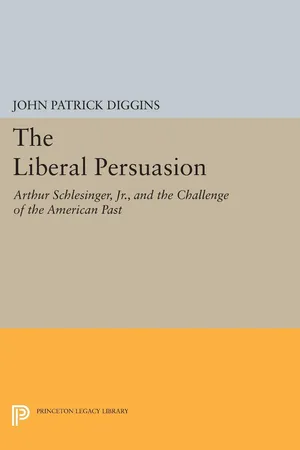
eBook - PDF
The Liberal Persuasion
Arthur Schlesinger, Jr., and the Challenge of the American Past
- 333 pages
- English
- PDF
- Available on iOS & Android
eBook - PDF
The Liberal Persuasion
Arthur Schlesinger, Jr., and the Challenge of the American Past
About this book
Information
Publisher
Princeton University PressYear
2017Print ISBN
9780691608617
9780691048291
eBook ISBN
9781400887491
Table of contents
- Cover
- Contents
- Introduction
- The Vital Historian by John Patrick Diggins and Michael Lind
- Part 1: History as a Vocation
- Part 2: The Era of Andrew Jackson
- Part 3: Modern Liberalism and the Challenge of Governance
- Part 4: America and the World
- Part 5: Ideological Controversies
- Part 6: Intellectual Heroes
- Selected Bibliography of Works by Schlesinger
- Contributors
- Acknowledgments
- Index
Trusted by 375,005 students
Access to over 1.5 million titles for a fair monthly price.
Study more efficiently using our study tools.
Frequently asked questions
Yes, you can cancel anytime from the Subscription tab in your account settings on the Perlego website. Your subscription will stay active until the end of your current billing period. Learn how to cancel your subscription
No, books cannot be downloaded as external files, such as PDFs, for use outside of Perlego. However, you can download books within the Perlego app for offline reading on mobile or tablet. Learn how to download books offline
Perlego offers two plans: Essential and Complete
- Essential is ideal for learners and professionals who enjoy exploring a wide range of subjects. Access the Essential Library with 800,000+ trusted titles and best-sellers across business, personal growth, and the humanities. Includes unlimited reading time and Standard Read Aloud voice.
- Complete: Perfect for advanced learners and researchers needing full, unrestricted access. Unlock 1.5M+ books across hundreds of subjects, including academic and specialized titles. The Complete Plan also includes advanced features like Premium Read Aloud and Research Assistant.
We are an online textbook subscription service, where you can get access to an entire online library for less than the price of a single book per month. With over 1.5 million books across 990+ topics, we’ve got you covered! Learn about our mission
Look out for the read-aloud symbol on your next book to see if you can listen to it. The read-aloud tool reads text aloud for you, highlighting the text as it is being read. You can pause it, speed it up and slow it down. Learn more about Read Aloud
Yes! You can use the Perlego app on both iOS and Android devices to read anytime, anywhere — even offline. Perfect for commutes or when you’re on the go.
Please note we cannot support devices running on iOS 13 and Android 7 or earlier. Learn more about using the app
Please note we cannot support devices running on iOS 13 and Android 7 or earlier. Learn more about using the app
Yes, you can access The Liberal Persuasion by John Patrick Diggins, John Diggins in PDF and/or ePUB format, as well as other popular books in History & North American History. We have over 1.5 million books available in our catalogue for you to explore.