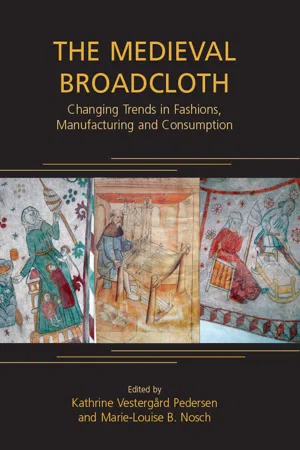
eBook - ePub
The Medieval Broadcloth
Changing Trends in Fashions, Manufacturing and Consumption
- 160 pages
- English
- ePUB (mobile friendly)
- Available on iOS & Android
eBook - ePub
The Medieval Broadcloth
Changing Trends in Fashions, Manufacturing and Consumption
About this book
The eight papers presented here provide a useful introduction to medieval broadcloth, and an up-to-date synthesis of current research. The word broadcloth is nowadays used as an overall term for the woven textiles mass-produced and exported all over Europe. It was first produced in Flanders as a luxurious cloth from the 11th century and throughout the medieval period. Broadcloth is the English term, Laken in Flemish, Tuch in German, Drap in French, Klæde in the Scandinavian languages and Verka in Finish. As the concept of broadcloth has deriving from the written sources it cannot directly be identified in the archaeological textiles and therefore the topic of medieval broadcloth is very suitable as an interdisciplinary theme. The first chapter (John Munro) presents an introduction to the subject and takes the reader through the manufacturing and economic importance of the medieval broadcloth as a luxury item. Chapter two (Carsten Jahnke) describes trade in the Baltic Sea area, detailing production standards, shipping and prices. Chapters three, four and five (Heini Kirjavainen, Riina Rammo and Jerzy Maik) deal with archaeological textiles excavated in the Baltic, Finland and Poland. Chapters six and seven (Camilla Luise Dahl and Kathrine Vestergård Pedersen) concern the problems of combining the terminology from the written sources with archaeological textiles. The last chapter reports on an ongoing reconstruction project; at the open air museum in Eindhoven, Holland, Anton Reurink has tried to recreate a medieval broadcloth based on written and historical sources. During the last few years he has reconstructed the tool for preparing and spinning wool, and a group of spinners has produced a yarn of the right quality. He subsequently wove approximately 20 metres of cloth and conducted the first experiment with foot-fulling.
Information
Subtopic
Fashion & Textile IndustryIndex
HistoryChapter 1
Three Centuries of Luxury Textile Consumption in the Low Countries and England, 1330–1570: Trends and Comparisons of Real Values of Woollen Broadcloths (Then and Now)
LUXURY TEXTILES: AN OVERVIEW OF LATE-MEDIEVAL CLOTH PRODUCTION, TRADE, AND CONSUMPTION
If mankind’s three basic necessities have always been food, clothing, and shelter, whose production, trade, and consumption have rightly been a primary focus of economists and historians for many generations, we may ask this vital question: how do we distinguish between necessities and luxury products? Indeed, any examination of later-medieval and early-modern commodity prices reveals that for all three of these basic categories there was a seamless continuum from the very cheapest to the most expensive goods sold on the market, so that making clear cut divisions becomes virtually impossible. How and why was the consumption of food and drink, for example, transformed from a basic necessity to ensure survival to become a luxury that enhances and enriches the quality of life?1
Obviously the very same considerations apply to clothing as well. For many people, if only for a much smaller segment of the population, chiefly to be found in the aristocracy, the higher clergy and wealthy bourgeoisie, clothing has also served and still serves other wants, in terms of luxury consumption: for decoration and for the assertion of personal values, and especially of one’s social status. Indeed, for such people, luxury textiles may have been and still are deemed as personal ‘necessities’.
For later-medieval and early-modern Europe, one may cite the wide variety of sumptuary legislation, by which royalty and the aristocracy sought to prevent the lower classes – the lower bourgeoisie and working classes – from seeking to emulate their ‘betters’ in the modes of dress that they were permitted to wear.2 Not only the very detailed sumptuary legislation, but also a remarkable series of annual textile prices, a wide variety of other commodity prices and urban industrial wages in the late-medieval and early-modern Low Countries and England, together allow us to measure changes in real values of various textiles in these two regions for almost three centuries, from the 14th to the 16th, and to make comparisons with modern-day consumption patterns.3
THE RELATIVE SHIFT TO LUXURY TEXTILES IN LATE-MEDIEVAL INTERNATIONAL TRADE
In the late-medieval European economy, for a variety of other reasons, costly luxury textiles gained an even more important role in both manufacturing and international trade than they had enjoyed before the 14th century.4 As I have contended in other publications, the spreading stain of warfare – international, regional, and local or regional civil wars – beginning in the 1290s and continuing into the Hundred Years’ War (1337–1453), brought about drastic alterations in the structure of international trade that directly or indirectly favoured the production of luxury textiles. In essence, both the economic and political consequences of such chronic, widespread warfare, combined with a drastic fall in population after the Black Death, raised the transaction costs of long-distance trade, in terms of transportation, protection, and marketing costs, while also raising the taxation of trade, to often prohibitive levels. Indeed, those rising transportation and transaction costs virtually eliminated the long-distance commerce in the cheaper textiles from north-west Europe to the far distant Mediterranean basin, all the more so since transaction costs are a fundamentally a function of both security and scale-economies, both of which were greatly reduced by the post-Plague demographic decline and chronic warfare.5 That was all the more true for those who produced cheap textiles that lacked any distinguishing features, and were indeed undistinguishable from almost identical cheaper products produced in the Mediterranean basin itself. Necessarily acting as ‘price takers’, these northern producers thus were unable to raise prices to compensate for rising transaction costs.
The chief beneficiaries of these structural changes in the late-medieval international trade in textiles were evidently those producing luxury products: not just those producing very costly silks,6 but even more so, those manufacturing heavy-weight, expensively dyed woollen broadcloths, all made from the very finest wools and dyestuffs. For only such luxury textiles were able to sustain these rising marketing and other transaction costs, especially to and in the Mediterranean basin, which remained by far the most important market zone for the European economy. Furthermore, producers of luxury woollens had always striven to differentiate their products by distinguishing superior quality over those of their competitors. Thus acting as ‘price-makers’ in the context of ‘monopolistic competition’, they were better able to raise their prices, for a much smaller, wealthier market. In any event, rising transaction costs were a far smaller proportion of final retail prices for luxury goods. Consequently, the late-medieval Low Countries, northern France, England, and even Italy, experienced a major reorientation in textile production and trade away from the sayetteries (worsted industries, in England) to an overwhelming concentration on heavy-weight luxury woollens, whose chief markets came to be those in the Baltic and northern Europe.7
Since the single most important component of luxury woollens was fine English wool, the Low Countries’ draperies had no choice but to accept, from the 1330s, an increasingly extortionate taxation of English wool exports, which further and very substantially raised their costs and prices all the more.8 Nevertheless, so long as this region’s luxury woollen industries continued to prove successful in convincing their customers in the widely diverse European and also Islamic (chiefly Ottoman) markets of the distinctively superior quality of their cloths, they were then able to set prices that would continue to maintain profits in international trade, even with a smaller sales volume and despite rising raw material and transaction costs.9
THE 16TH CENTURY REVIVAL OF LONG DISTANCES TRADE IN CHEAPER TEXTILES: INDUSTRIAL CHANGES
By the early 16th century, however, a combination of macro-economic and micro-economic factors combined to lower transportation and transaction costs in international trade, with significant consequences for the European textile industries. The most important factors in these cost reductions were: a relative diminution in warfare, and thus an increase in relative security; renewed demographic growth, especially with a dramatic and disproportionate growth in urban populations that led to superior scale economies in international trade; and major innovations in marketing, and in both sea-borne and land transportation.10 Those much more propitious economic circumstances thereby acted to promote a recovery and renewed expansion in the international trade in relatively less expensive, chiefly lighter textiles, whose chief markets were again found mainly in the Mediterranean basin, and, this time, also in the Spanish New World – in warmer climate zones that provided better markets for lighter textiles.11
The chief beneficiary of these structural changes in international trade in textiles during the early to mid-16th century were the worsted-type sayetteries of the southern Low Countries, led by the Flemish town of Hondschoote, whose light-weight, relatively inexpensive textiles were exported chiefly to this region, especially to Italy and Spain. By the 1530s, they had become the predominant sector of the Low Countries’ textile industries.12 Furthermore, even before the 1530s, this region’s luxury woollen cloth industries had largely succumbed, though never entirely, to the overwhelming competition in most European textile markets from the much lower-cost (because woven from tax-free wools), more cheaply-priced, but still luxury-quality English woollen broadcloths. These once renowned and very prominent luxury woollen draperies, as represented here, from both Ghent (Flanders) and Mechelen (Brabant), had managed to survive into the 16th century, though almost as shadows of their former selves, by serving a very narrow market niche of the ultra-rich in European society.13
Fortunately, a list of comparative textile prices and ‘real’ values in the southern Low Countries in the decade from the mid 1530s to the mid 1540s illustrates the very major differences be...
Table of contents
- Cover
- Title Page
- Copyright
- Contents
- List of contributors
- Introduction
- Chpater 1: Three Centuries of Luxury Textile Consumption in the Low Countries and England, 1330–1570: Trends and Comparisons of Real Values of Woollen Broadcloths (Then and Now)
- Chpater 2: Some Aspects of Medieval Cloth Trade in the Baltic Sea Area
- Chpater 3: A Finnish Archaeological Perspective on Medieval Broadcloth
- Chpater 4: Searching for Broadcloth in Tartu (14th–15th century)
- Chpater 5: The Influence of Hanseatic Trade on Textile Production in Medieval Poland
- Chpater 6: Mengiað klæthe and tweskifte klædher. Marbled, Patterned and Parti-coloured Clothing in Medieval Scandinavia
- Chpater 7: Archaeological Evidence of Multi-coloured Cloth and Clothing
- Chpater 8: Reconstructing 15th century Laken
Trusted by 375,005 students
Access to over 1.5 million titles for a fair monthly price.
Study more efficiently using our study tools.
Frequently asked questions
Yes, you can cancel anytime from the Subscription tab in your account settings on the Perlego website. Your subscription will stay active until the end of your current billing period. Learn how to cancel your subscription
No, books cannot be downloaded as external files, such as PDFs, for use outside of Perlego. However, you can download books within the Perlego app for offline reading on mobile or tablet. Learn how to download books offline
We are an online textbook subscription service, where you can get access to an entire online library for less than the price of a single book per month. With over 1.5 million books across 990+ topics, we’ve got you covered! Learn about our mission
Look out for the read-aloud symbol on your next book to see if you can listen to it. The read-aloud tool reads text aloud for you, highlighting the text as it is being read. You can pause it, speed it up and slow it down. Learn more about Read Aloud
Yes! You can use the Perlego app on both iOS and Android devices to read anytime, anywhere — even offline. Perfect for commutes or when you’re on the go.
Please note we cannot support devices running on iOS 13 and Android 7 or earlier. Learn more about using the app
Please note we cannot support devices running on iOS 13 and Android 7 or earlier. Learn more about using the app
Yes, you can access The Medieval Broadcloth by Kathrine Vestergard Pedersen,Marie-Louise Nosch, Marie-Louise Nosch in PDF and/or ePUB format, as well as other popular books in History & Fashion & Textile Industry. We have over 1.5 million books available in our catalogue for you to explore.