How Maoism captured the imagination of French intellectuals during the 1960s
Michel Foucault, Jean-Paul Sartre, Julia Kristeva, Phillipe Sollers, and Jean-Luc Godard. During the 1960s, a who's who of French thinkers, writers, and artists, spurred by China's Cultural Revolution, were seized with a fascination for Maoism. Combining a merciless exposé of left-wing political folly and cross-cultural misunderstanding with a spirited defense of the 1960s, The Wind from the East tells the colorful story of this legendary period in France. Richard Wolin shows how French students and intellectuals, inspired by their perceptions of the Cultural Revolution, and motivated by utopian hopes, incited grassroots social movements and reinvigorated French civic and cultural life.
Wolin's riveting narrative reveals that Maoism's allure among France's best and brightest actually had little to do with a real understanding of Chinese politics. Instead, it paradoxically served as a vehicle for an emancipatory transformation of French society. Recounting the cultural and political odyssey of French students and intellectuals in the 1960s, The Wind from the East illustrates how the Maoist phenomenon unexpectedly sparked a democratic political sea change in France.
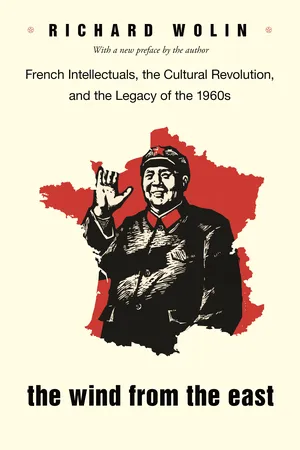
eBook - ePub
The Wind From the East
French Intellectuals, the Cultural Revolution, and the Legacy of the 1960s - Second Edition
- 464 pages
- English
- ePUB (mobile friendly)
- Available on iOS & Android
eBook - ePub
The Wind From the East
French Intellectuals, the Cultural Revolution, and the Legacy of the 1960s - Second Edition
About this book
Information
Publisher
Princeton University PressYear
2017Print ISBN
9780691154343
9780691129983
Edition
2eBook ISBN
9781400888443
CHAPTER 1
Showdown at Bruay-en-Artois
We made war and revolution in our imaginations. We
pretended to believe. It was like birth pangs without
giving birth, without passing over to the act. The suffering
was internal. It was all theatrical. And that permitted us
to remain outside the gates of hell—that is, murder.
pretended to believe. It was like birth pangs without
giving birth, without passing over to the act. The suffering
was internal. It was all theatrical. And that permitted us
to remain outside the gates of hell—that is, murder.
—Roland Castro, Maoist student leader
April 6, 1972. The scene was a mining town in provincial Normandy, Bruay-en-Artois. A young working-class girl, Brigitte Dewevre, had been sadistically murdered, her mutilated, unclothed corpse left in a vacant field. The crime scene bespoke a level of brutality to which France was entirely unaccustomed. Adding to the event’s macabre nature was the fact that Brigitte’s body was discovered the next day by her younger brother in the course of a pickup soccer match.
Within a fortnight of the murder, the police had arrested a local notable, Pierre Leroy. Leroy was a notary public who specialized in real estate transactions and was a prominent member of the local Rotary Club. There was considerable circumstantial evidence linking the suspect to the crime. Earlier in the day, Leroy’s white Peugeot had been observed near the crime scene. Brigitte’s body had been found in a field adjacent to the villa of Leroy’s fiancée, Monique Mayeur. Shortly before her disappearance, Brigitte had been seen talking to a man in a turtleneck sweater. Leroy had been sporting a turtleneck that day. That night, Leroy’s mother had washed his clothes by hand with ammonia instead of taking them to the dry cleaners as usual. There was also a telltale fifteen-minute gap in the suspect’s alibi. Moreover, there were rumors that Leroy had been a prodigious consumer of pornography. Recently, he had been involved in a number of shady real estate transactions.
Nevertheless, in lieu of more concrete findings explicitly linking Leroy to the victim or the murder scene, the examining magistrate realized he had a relatively weak case. Thus, shortly after he was arrested, Leroy was released. Once again he walked the streets of Bruay-en-Artois a free man.
The Maoists wished to spare Brigitte a second death—this time, at the hands of a class-based judiciary system—by ensuring that her murderer was brought to justice. To the brain trust of the pro-Chinese Gauche prolétarienne, Leroy’s guilt was never in doubt. His release was a typical instance of the fecklessness of bourgeois justice. The plotline was simple, one that the Maoists had observed time and again: a bourgeois kills a member of the working class, and no charges are pressed. The culprit is released with impunity. For the Maoists, although there were some dissenting voices, Leroy’s guilt was a foregone conclusion. As a bourgeois, he was objectively guilty. His crime was merely a logical extension of the everyday injustice members of the working classes endured at the hands of their bourgeois tormentors. (“First they kill us at the bottom of the mines; now they kill and mutilate our children,” lamented the miners upon learning of Brigitte’s death.)1 Adding to the Maoists’ outrage was the fact that in recent years several women in the same region—all of humble origin—had been murdered in similar fashion. In each case, although the women had not been raped, their torsos had been mutilated. The police felt seemingly little pressure to apprehend the culprit. In each instance, insinuations surfaced implying that the victims were “loose women”—a widespread assumption in the region about miners’ daughters—hence, intrinsically blameworthy. Ironically, the Maoists themselves were nearly all normaliens—students of the elite Parisian Ecole normale supérieure. As such, their backgrounds were preponderantly upper middle class. Were they, then, seeking to expiate their own guilt as sons and daughters of the bourgeoisie? Who could doubt it?
The Maoist daily La Cause du Peuple, with Jean-Paul Sartre as its titular editor, sprang into action to defend Brigitte’s honor as well as that of her class. The inflammatory headline of the May 1 issue screamed: “Bruay: And Now They Are Massacring Our Children!” The Maoists sought to transpose the discussion from the plane of criminality to that of class struggle. They lambasted Leroy’s and Mayeur’s alleged prurient sexual exploits, as well as (somewhat laughably) their purported culinary extravagances: “Who in Bruay-en-Artois buys lobster, under the proviso that both antennae remain attached? Price is no object; one must have quality, even if it costs 300 to 400 francs a week. . . . Who ate 800 grams of meat the night of the crime? Leroy! A daughter of the working class who has just peaceably visited her grandmother is beaten to shreds: it’s an act of cannibalism.”
A sidebar proclaimed: “Only a bourgeois could have done this!” The youthful gauchistes, or leftists, remained wedded to a Manichaean opposition between “bourgeois” and “proletarian” that bore only a vague resemblance to the realities of contemporary French society. In postwar France, the working class, whose revolutionary potential Marx had glorified, had ceased to be a dominant political and economic force. It had been largely replaced by “salaried employees” (salariés), composed of white-collar workers and middle managers (cadres). The Maoists’ conception of the proletariat was a highly idealized image inspired in part by Louis Althusser’s books and seminars.
At one point, the court inexplicably issued a search warrant for the Dewevre family home. A group of irate miners promptly invaded Leroy’s garden, demanding justice and fulminating verbal threats. They intemperately suggested that only a death equal in brutality to the one Brigitte had endured would be suitable. Rocks were hurled at the Mayeur estate adjacent to the crime scene. A few days later, a group of miners’ wives directly petitioned the examining magistrate, Henri Pascal: “We speak from the bottom of our hearts as mothers. Brigitte was our child. The bourgeoisie treat our children like chattel. If they want to have a good time, they do with our children what they want.”2 Ultimately, the French Supreme Court of Appeal (Cour de cassation) found Judge Pascal biased against Leroy and, to the outrage of local residents, removed him from the case.
A commemorative plaque was placed near the empty lot where Brigitte’s body had been found. Beside it lay an appeal to the townspeople to form an independent committee for truth and justice. A brainchild of the Maoists, the committee was intended to keep pressure on the examining magistrate and to ensure that Brigitte’s murderer was brought to justice. The GP activists acted as catalysts. In keeping with the Maoist doctrine of the “mass line,” according to which truth resides with the people, they shunned an active leadership role. Town elders, siding with Leroy, with whom many had business dealings, actively sought to disrupt the committee’s activities. One miner’s daughter told of being taken into custody while distributing leaflets and detained for two hours at a local police station. “They threatened to send us to the District Court in Béthune [a neighboring town],” she explained. “The police commissioner told us that we did not have the right to distribute such literature.”3
The Maoists had already planted several militants in the area, who jockeyed with the pro-Communist trade union, the CGT (Confédération générale du travail), to win over working-class loyalties. In the Maoists’ view, manifestations of working-class rage were an unequivocally positive development. It meant that the miners had surmounted their normal state of inert passivity—or, to employ the terminology of Sartre’s Critique of Dialectical Reason, their “serialization”—and had found the courage to openly denounce class injustice.
The issue of “people’s tribunals” had first surfaced in the aftermath of a February 1970 mining disaster near Lens, in which, following a methane gas explosion, sixteen miners had perished. Predictably, the local judiciary dragged its heels when it came to prosecuting mining officials for numerous safety violations, although it did see fit to indict six working-class militants who had thrown a Molotov cocktail at the mining company’s offices. In December Sartre arrived to convene a popular tribunal in order to apply public pressure with an eye toward bringing those responsible for the explosion to justice. Medical experts testified concerning the condition of advanced silicosis, or black lung disease, affecting the deceased.
The Lens tribunal found the state-owned mining company, Houllières, guilty of murder for having placed profits ahead of worker safety. Sartre, employing the idiom of Hegelian-Marxism, argued that the Houllières directorship “intentionally chose output over safety, which is to say, the production of things over people’s lives.”4 The French judiciary remained unmoved, and no one was ever indicted for the catastrophe. At Lens, Sartre’s one modest achievement was to secure the acquittal of the six activists who had been charged with arson.
Two months earlier, Michel Foucault and Gauche prolétarienne leader Pierre Victor (nom de guerre of the Egyptian-born Jew Benny Lévy), smitten with the ethos of revolutionary third worldism, debated the merits of popular justice in Sartre’s Les temps modernes. For the student generation, Che, Mao, and Ho Chi Minh had become the new political idols. Che’s slogan “One, two, many Vietnams,” was a litany recited by left-wing youth worldwide. Who could doubt that the Vietnamese struggle against American imperialism was intrinsically just? Student radicals hoped that third-world radicalism would inject meaning and substance into an otherwise moribund global revolutionary project. A casual glance at the Kremlin’s ossified, septuagenarian leader ship helped explain this desperate political wager.
In the debate with Foucault, Victor argued that because of the existing court system’s manifest class biases, the Left needed to establish its own revolutionary people’s tribunals. He had fully imbibed the “populist” spirit of China’s Cultural Revolution: its mistrust of experts and bureaucrats (“better Red, than expert” had been a popular slogan), its Rousseauian veneration of the popular will. Victor excelled at pushing radicalism to its absolute limits. It was this capacity that had won him acclaim among his fellow gauchistes.
Yet, in this particular instance, it was Foucault who outdid Victor in revolutionary zeal. Foucault placed little trust in the existing legal system, or in any future “proletarian” legal system, for that matter. After all, Stalin’s purge trials during the 1930s, in which an estimated one million people lost their lives, had become a permanent blot on the record of Soviet communism. Thus, on the one hand, like Victor, Foucault favored the summary elimination of bourgeois legality. On the other hand, he argued vigorously against the creation of the people’s tribunals favored by Victor, Sartre, and other GP activists. Such organs, he believed, represented too much of a formal constraint on the spontaneity of popular will. To employ the jargon of the times, such tribunals risked congealing into an “ideological state apparatus” (one of Althusser’s pet terms). Thereby they threatened to create a needless divide between the masses and the official repositories of power.
The model of justice Foucault proposed harked back to the halcyon days of the French Revolution: the September massacres of 1792, when hundreds of helpless prisoners were put to death for fear that, with counterrevolutionary armies amassing on France’s eastern frontier, the criminals might threaten the Revolution’s integrity. Foucault’s logic was antiseptic and chilling:
Now my hypothesis is not so much that the court is the natural expression of popular justice, but rather that its historical function is to ensnare it, to control it and to strangle it, by re-inscribing it within Institutions which are typical of a state apparatus. For example, in 1792, when war with neighboring countries broke out and the Parisian workers were called on to go and get themselves killed, they replied: “We’re not going to go before we’ve brought our enemies within our own country to court. While we will be out there exposed to danger they’ll be protected by the prisons they’re locked up in. They’re only waiting for us...
Table of contents
- Cover
- Title
- Copyright
- Dedication
- Contents
- Preface to the Second Edition
- Prologue
- Introduction: The Maoist Temptation
- Part I — The Hour of Rebellion
- Part II — The Hour of the Intellectuals
- Bibliography
- Index
Trusted by 375,005 students
Access to over 1.5 million titles for a fair monthly price.
Study more efficiently using our study tools.
Frequently asked questions
Yes, you can cancel anytime from the Subscription tab in your account settings on the Perlego website. Your subscription will stay active until the end of your current billing period. Learn how to cancel your subscription
No, books cannot be downloaded as external files, such as PDFs, for use outside of Perlego. However, you can download books within the Perlego app for offline reading on mobile or tablet. Learn how to download books offline
Perlego offers two plans: Essential and Complete
- Essential is ideal for learners and professionals who enjoy exploring a wide range of subjects. Access the Essential Library with 800,000+ trusted titles and best-sellers across business, personal growth, and the humanities. Includes unlimited reading time and Standard Read Aloud voice.
- Complete: Perfect for advanced learners and researchers needing full, unrestricted access. Unlock 1.5M+ books across hundreds of subjects, including academic and specialized titles. The Complete Plan also includes advanced features like Premium Read Aloud and Research Assistant.
We are an online textbook subscription service, where you can get access to an entire online library for less than the price of a single book per month. With over 1.5 million books across 990+ topics, we’ve got you covered! Learn about our mission
Look out for the read-aloud symbol on your next book to see if you can listen to it. The read-aloud tool reads text aloud for you, highlighting the text as it is being read. You can pause it, speed it up and slow it down. Learn more about Read Aloud
Yes! You can use the Perlego app on both iOS and Android devices to read anytime, anywhere — even offline. Perfect for commutes or when you’re on the go.
Please note we cannot support devices running on iOS 13 and Android 7 or earlier. Learn more about using the app
Please note we cannot support devices running on iOS 13 and Android 7 or earlier. Learn more about using the app
Yes, you can access The Wind From the East by Richard Wolin in PDF and/or ePUB format, as well as other popular books in History & 20th Century History. We have over 1.5 million books available in our catalogue for you to explore.