The first in-depth look at how postwar thinkers in Egypt mapped the intersections between Islamic discourses and psychoanalytic thought
In 1945, psychologist Yusuf Murad introduced an Arabic term borrowed from the medieval Sufi philosopher and mystic Ibn 'Arabi—al-la-shu'ur—as a translation for Sigmund Freud's concept of the unconscious. By the late 1950s, Freud's Interpretation of Dreams had been translated into Arabic for an eager Egyptian public. In The Arabic Freud, Omnia El Shakry challenges the notion of a strict divide between psychoanalysis and Islam by tracing how postwar thinkers in Egypt blended psychoanalytic theories with concepts from classical Islamic thought in a creative encounter of ethical engagement.
Drawing on scholarly writings as well as popular literature on self-healing, El Shakry provides the first in-depth examination of psychoanalysis in Egypt and reveals how a new science of psychology—or "science of the soul," as it came to be called—was inextricably linked to Islam and mysticism. She explores how Freudian ideas of the unconscious were crucial to the formation of modern discourses of subjectivity in areas as diverse as psychology, Islamic philosophy, and the law. Founding figures of Egyptian psychoanalysis, she shows, debated the temporality of the psyche, mystical states, the sexual drive, and the Oedipus complex, while offering startling insights into the nature of psychic life, ethics, and eros.
This provocative and insightful book invites us to rethink the relationship between psychoanalysis and religion in the modern era. Mapping the points of intersection between Islamic discourses and psychoanalytic thought, it illustrates how the Arabic Freud, like psychoanalysis itself, was elaborated across the space of human difference.
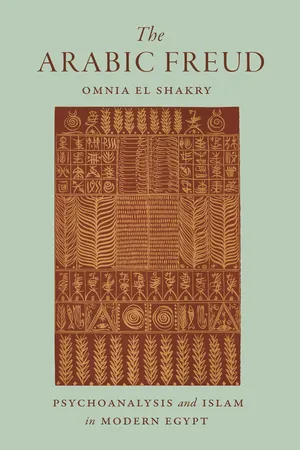
- 224 pages
- English
- ePUB (mobile friendly)
- Available on iOS & Android
eBook - ePub
About this book
Information
Publisher
Princeton University PressYear
2017Print ISBN
9780691203102
9780691174792
eBook ISBN
9781400888030
PART I
The Unconscious and the Modern Subject

CHAPTER ONE
Psychoanalysis and the Psyche
Well now, this year I am proposing not simply to be faithful to the text of Freud and to be its exegete, as if it were the source of an unchanging truth that was the model, mold and dress code to be imposed on all our experience.
—JACQUES LACAN, ETHICS OF PSYCHOANALYSIS
ON FRIDAY MORNINGS in Cairo in the mid- to late 1940s and 1950s, scholars and students of all disciplines would assemble at the house of psychology professor Yusuf Murad.1 Gathered to discuss the latest intellectual trends in psychology and philosophy, at those meetings, we are told, the attendees’ concerns revolved around two central questions: how can the scholar be a philosopher and how can the teacher be a mentor?2 Through a capacious body of work that touched on subjects as diverse as the epistemology of psychoanalysis and the analytic structure, and Abu Bakr al-Razi’s medieval treatise on spiritual medicine, Murad developed what he termed an integrative (takamuli) psychology based on the fundamental philosophical unity of the self. Presenting Freud’s discovery of the unconscious as a “Copernican revolution” to his audience, Murad identified psychoanalysis as the dialectical synthesis of philosophical introspection, positivism, and phenomenology.
Responsible in large part for the formalization of an Arabic language lexicon of psychology and psychoanalysis, Murad introduced the Arabic term “al-la-shuʿur,” a mystical term taken from the medieval Sufi philosopher Ibn ʿArabi, as “the unconscious” into scholarly vocabularies.3 Translating and blending key concepts from psychoanalysis and the French tradition of philosophical psychology with classical Islamic concepts, Murad put forth a dynamic and dialectical approach to selfhood that emphasized the unity of the self, while often insisting on an epistemological and ethical heterogeneity from European psychological and psychoanalytic thought.
The coterie of students in attendance at Yusuf Murad’s Friday morning salon were born sometime between 1920 and 1930, making them the generation that would later become instrumental in transforming the role of the intellectual and of knowledge production within Arab postcolonial polities.4 Among the regular attendees were several scholars training in philosophy: Mahmud Amin al-ʿAlim, who was to play a decisive part in the fierce debates over existentialism and the role and purpose of literary production for decolonizing political action; Yusuf al-Sharuni, the meticulous and socially conscious short story writer and literary critic who was active in the avant-garde post–World War II literary groups that formed in Egypt; and Murad Wahba, the author of philosophical commentaries on Averroës, Kant, and Bergson, and of a large body of work on philosophy, civilization, and secularism. Other attendees included Mustafa Suwayf, later a well-known psychology professor at Cairo University (and father to novelist Ahdaf Soueif); Sami al-Durubi, the Syrian translator and diplomat, who wrote on psychology and literature and translated Henri Bergson’s Mind-Energy and Laughter, as well as Frantz Fanon’s Wretched of the Earth and numerous Russian novels, such as Fyodor Dostoevsky’s Brothers Karamazov and Mikhail Lermontov’s A Hero of Our Time; and Salih al-Shammaʿ, the author of texts on childhood language and on the semantics of Qurʾanic ethics, later a professor of psychology and head of the philosophy department at the University of Baghdad.5
Translating the Unconscious
Yusuf Murad (1902–1966) founded a school of thought within the psychological and human sciences in Egypt and the Arab world, best thought of as part of a shared Arab intellectual heritage of blending traditions, of which Murad represented an exemplary “philosopher of integration.”6 Training a generation of thinkers who then went on to become literary critics, translators, university professors, and mental health professionals in Egypt, Syria, and Iraq, he left a wide imprint on psychology, philosophy, and the wider academic field of the humanities and the social sciences. As one of his former students, Farag ʿAbd al-Qadir Taha, noted, Murad’s mark on psychology in Egypt was thought to be so great that the majority of Egyptian professors of psychology had studied under him either directly or indirectly through his textbook, a popular handbook of psychology published in 1948 that went through at least seven editions.7
Murad was himself well versed in the traditions of experimental psychology as well as in European psychoanalytic and neo-psychoanalytic approaches. Born in Cairo, he studied philosophy at Fuʾad I University (later Cairo University), graduating in 1930 and traveling to France where he received his doctorate in psychology in 1940 from the Sorbonne.8 Upon his return, he taught psychology in the philosophy department at Cairo University, and was the first to do so in Arabic, eventually becoming chair of the philosophy department between 1953 and 1957.9 Murad, along with his colleague Mustafa Ziywar, a psychoanalyst who had trained in philosophy, psychology, and medicine in France in the 1930s, founded the Jamaʿat ʿIlm al-Nafs al-Takamuli (Society of Integrative Psychology) and the Egyptian Majallat ʿIlm al-Nafs (Journal of Psychology) in 1945, and supervised the translation and publication of numerous works of psychology.10 Majallat ʿIlm al-Nafs, the first psychology journal published in the Arab world, was illustrative of the emerging disciplinary space of psychology in Egypt in the 1940s; it was understood as a science of selfhood and the soul (ʿilm al-nafs) rather than delimited as the empirical study of mental processes.11 The journal, which ran from 1945 to 1953, served as a wide-ranging platform for academic psychology and was meant to serve as a bridge between the psychological sciences and philosophy, while introducing its audience to the major concepts of psychoanalysis and psychology.
In the inaugural issue of Majallat ʿIlm al-Nafs, Yusuf Murad introduced a dictionary that provided the Arabic equivalents to English, French, and German terms in the fields of psychology and psychoanalysis.12 Murad was himself a member of the Academy of Language for the committee on psychological terms and was therefore crucial in the creation and standardization of an Arabic lexicon of psychology. Emphasizing the difficulty and importance of precise terminology, he remarked that in some instances multiple terms were needed to convey the meaning of a single word and to adumbrate the different interpretations of terms by different schools of thought in psychology.13 Murad’s dictionary was likely partly inspired by his former university professor André Lalande, and his Vocabulaire technique et critique de la philosophie, a text known for its analytical rigor.14 Notably, Murad observed that he often returned to classical Arabic texts in order to create new translations for words and clear, precise, and capacious meanings.15 Murad’s felicitous translations were oftentimes closer to the German spirit of Freud’s terms than the standard English translations, as for example in his choice of Arabic terms for psyche (nafs), ego (al-ana), and superego (al-ana al-a ʿla).16
Majallat ʿIlm al-Nafs presented to its academic readers a rich and scholarly understanding of psychoanalysis, drawing on the entire corpus of Freud’s work, which many had read in English, and to a lesser extent in French. Beyond that, authors integrated a multitude of diverse conduits of psychoanalytic thought, from the United Kingdom (John Flügel, Ian Suttie, James Wisdom); France and Switzerland (Daniel Lagache, Henri Wallon, Charles Odier); and Hungary (Sándor Ferenczi, Franz Alexander). Yet, in so doing, psychoanalysis in Egypt emerged not simply as an importation or “a derivative exercise” but rather “a reflexive process of appropriation.”17
This chapter explores the work of Yusuf Murad, the founder of a school of thought within the psychological and human sciences, and provides a close study of the journal he coedited from 1945 to 1953, Majallat ʿIlm al-Nafs. I offer not a literal history of Freud in Egypt but rather a history of ideas and debates spawned by Freudianism as a multivalent tradition. I analyze the dense interdiscursive web that constituted the field of psychological inquiry in postwar Egypt, tracing historical interactions and hybridizations between and within traditions of psychological inquiry. Moving away from models of selfhood as either modern or traditional, Western or non-Western, I examine the points of condensation, divergence, and the epistemological resonances that psychoanalytic writings had in postwar Egypt.
More specifically, I explore the coproduction of psychoanalytic knowledge, across Egyptian and European knowledge formations, through the concept of the point de capiton. For Jacques Lacan quilting points are signifiers around which dense webs of meanings converge, thereby providing ideological cohesion to discursive formations.18 In what follows, I draw attention to a number of quilting points that sutured the discursive field of psychology and psychoanalysis in midcentury Egypt. Such points de capiton were, quite tellingly, terms or concepts that were pregnant with epistemological resonances drawn from pre-psychoanalytic discursive formations, such as from Ibn ʿArabi’s metaphysics or Aristotelian philosophy. I focus on a number of concepts: integration and unity as central both to the self and to knowledge formations (wahdat al-nafs, wahdat ʿilm al-nafs, or ʿilm al-nafs al-takamuli); insight and intuition (firasa and kashf) as a mode of knowledge production distinct from positivist or empirical epistemology; and the socius or community of/in the other (al-nahnu, al-akhir).
The Integrative Subject
Yusuf Murad’s corpus embodied an approach he termed integrative psychology, which presented the self not solely as a body, or a psyche, or even a psyche added to a body, but rather as “wahda nafsiyya, jismiyya, ijtima ʿiyya,” the unity of psychic, bodily, and societal aspects.19 Murad’s integrative psychology both constituted and was constituted by the larger sociopolitical context within which it was embedded, namely, Egypt’s emergent postcoloniality. If, as Jan Goldstein has demonstrated, Victor Cousin provided a postrevolutionary psychology and pedagogy that enabled the production and reproduction of bourgeois subjectivity in nineteenth-century France, then Murad provided the contours for what we might term a postcolonial subjectivity for twentieth-century Egypt.20
Murad’s integrative curriculum was part of a larger intellectual context that spanned French philosophical and empirical psychology, psychoanalysis, Aristotelian philosophy, and medieval and modern Arabic thought. Murad’s integrative subject was not equivalent to the split subject of postwar Lacanian psychoanalysis, but nor was it the instrumentalist subject of American egopsychology.21 In fact, rather than the ego, the key term of reference for Murad and his cohort was the Arabic term nafs (soul, spirit, âme), a term etymologically imbued with a primordial divinity.22 In particular, the emphasis on integration can be seen, at least partly, as a response to the events of Wor...
Table of contents
- Cover Page
- Title Page
- Copyright Page
- Dedication Page
- Contents
- Acknowledgments
- Note on Transliteration and Translation
- Introduction: Psychoanalysis and Islam
- Part I: The Unconscious and the Modern Subject
- Part II: Spaces of Interiority
- Epilogue
- Notes
- Glossary
- References
- Index
- A Note on the Type
Trusted by 375,005 students
Access to over 1.5 million titles for a fair monthly price.
Study more efficiently using our study tools.
Frequently asked questions
Yes, you can cancel anytime from the Subscription tab in your account settings on the Perlego website. Your subscription will stay active until the end of your current billing period. Learn how to cancel your subscription
No, books cannot be downloaded as external files, such as PDFs, for use outside of Perlego. However, you can download books within the Perlego app for offline reading on mobile or tablet. Learn how to download books offline
Perlego offers two plans: Essential and Complete
- Essential is ideal for learners and professionals who enjoy exploring a wide range of subjects. Access the Essential Library with 800,000+ trusted titles and best-sellers across business, personal growth, and the humanities. Includes unlimited reading time and Standard Read Aloud voice.
- Complete: Perfect for advanced learners and researchers needing full, unrestricted access. Unlock 1.5M+ books across hundreds of subjects, including academic and specialized titles. The Complete Plan also includes advanced features like Premium Read Aloud and Research Assistant.
We are an online textbook subscription service, where you can get access to an entire online library for less than the price of a single book per month. With over 1.5 million books across 990+ topics, we’ve got you covered! Learn about our mission
Look out for the read-aloud symbol on your next book to see if you can listen to it. The read-aloud tool reads text aloud for you, highlighting the text as it is being read. You can pause it, speed it up and slow it down. Learn more about Read Aloud
Yes! You can use the Perlego app on both iOS and Android devices to read anytime, anywhere — even offline. Perfect for commutes or when you’re on the go.
Please note we cannot support devices running on iOS 13 and Android 7 or earlier. Learn more about using the app
Please note we cannot support devices running on iOS 13 and Android 7 or earlier. Learn more about using the app
Yes, you can access The Arabic Freud by Omnia El Shakry in PDF and/or ePUB format, as well as other popular books in History & Middle Eastern History. We have over 1.5 million books available in our catalogue for you to explore.