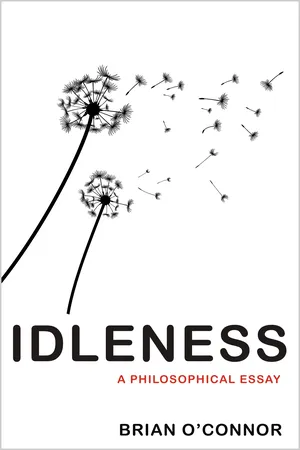
The first book to challenge modern philosophy's case against idleness, revealing why the idle state is one of true freedom
For millennia, idleness and laziness have been regarded as vices. We're all expected to work to survive and get ahead, and devoting energy to anything but labor and self-improvement can seem like a luxury or a moral failure. Far from questioning this conventional wisdom, modern philosophers have worked hard to develop new reasons to denigrate idleness. In Idleness, the first book to challenge modern philosophy's portrayal of inactivity, Brian O'Connor argues that the case against an indifference to work and effort is flawed--and that idle aimlessness may instead allow for the highest form of freedom.
Idleness explores how some of the most influential modern philosophers drew a direct connection between making the most of our humanity and avoiding laziness. Idleness was dismissed as contrary to the need people have to become autonomous and make whole, integrated beings of themselves (Kant); to be useful (Kant and Hegel); to accept communal norms (Hegel); to contribute to the social good by working (Marx); and to avoid boredom (Schopenhauer and de Beauvoir).
O'Connor throws doubt on all these arguments, presenting a sympathetic vision of the inactive and unserious that draws on more productive ideas about idleness, from ancient Greece through Robert Burton's Anatomy of Melancholy, Schiller and Marcuse's thoughts about the importance of play, and recent critiques of the cult of work. A thought-provoking reconsideration of productivity for the twenty-first century, Idleness shows that, from now on, no theory of what it means to have a free mind can exclude idleness from the conversation.
- 216 pages
- English
- ePUB (mobile friendly)
- Available on iOS & Android
eBook - ePub
About this book
Information
Publisher
Princeton University PressYear
2018Print ISBN
9780691204505
9780691167527
eBook ISBN
9781400889617
Topic
PhilosophySubtopic
Ethics & Moral PhilosophyCHAPTER 1
OUR WORTHINESS FOR FREEDOM

Circumstances force most of us to take our lives seriously. We have to work hard in order to gain what we think we need and to protect the things that are important to us. In the context of pressing needs, idleness is a fantastic luxury. Our work, though, is not confined to basic security. General opinion about what counts as a proper life motivates, shapes, and justifies much of what we also do. The force of that opinion is difficult to resist. All sorts of labors are undertaken in the name of winning what only others can give us: standing, perhaps even prestige. Anyone who cannot acquire those “goods” is placed at a relative disadvantage to others. These kinds of life-consuming efforts have been neutrally framed as the attempt to acquire an “identity” through a “social role,” that is, to become a person with a recognizable and socially effective character.
These days it is regarded as virtuous when we can be “pluralistic” about the different ways that people try to establish their identities as they pursue their preferred version of the good life. Each version has its own range of what is supposed to qualify as an impressive achievement. From outside their contexts, however, those very same achievements may appear trivial. Wealth, honors, cultivation, the right look might be everything to those who chase after them, whereas to others they are vainglorious or vacuous. Just occasionally we are jolted by the worry that those insults rightly apply to our very own personal passions. Humorous mockery of pretension and clumsy efforts at social elevation are found across Western literature. We laugh along, yet as one of its sharpest exponents discomfortingly observes, “Satire is a sort of glass, wherein beholders do generally discover everybody’s face but their own” (Jonathan Swift, Battle of the Books). It is probably only those without a care for what they are who are safe from some satirical perspective. If there is absurdity in the human condition, it may not be down to some mismatch between our hopes and an indifferent universe. It is just as likely to be a matter of the comedy our lives provide for others.
One way or another, however, very few people are in any doubt about the challenges of managing the social pressures that hang over their lives. Even the occasional worry that there is nothing very valuable about our objectives does little to knock us off our stride. Yet in spite of all that, obvious though it is, there are philosophers who tell us that we do not take ourselves seriously enough. They blame all kinds of viciousness—usually a cocktail of idleness and cowardice—for distracting us from the task of living in the right way. The right way involves some new and extreme manner of taking possession of ourselves. Philosophers with this message do not accept that we can either decently or intelligibly reject what they have to say to us.
Take the famous lecture that Jean-Paul Sartre gave in Paris on the theme of “existentialism as humanism” barely six months after the nightmarish war in Europe had concluded. He forcefully and repeatedly charged his audience, if not the world, with the offense of under-using and thereby misusing freedom. People were allowing others—political parties, religious institutions, social convention—to determine their values, choosing in that way to let others choose for them. They entered freely into these arrangements, but they were not acting freely enough. Human beings had to realize that what they choose, even when choosing indirectly, is always a matter for which they are answerable. And deciding one way or another could not, by its very nature, be easy. There are no codes or systems that exist independently of human action. Every choice creates an ethical principle. We must therefore approach each situation in anguish, unsure as to whether what we prefer to do is “the better,” that is, what is best for humanity as a whole. Considerations of “the better” weigh heavily because each choice affects everyone else in bringing into existence a value that should, in principle, hold good for all: “In fashioning myself I fashion man.”1
Was Sartre, as is commonly thought, attempting to reinvigorate European morality in the wake of its near extinction? Perhaps he himself saw it that way. But what is also interesting is that the core of his message had already been enunciated at least 150 years earlier, as we shall see in this chapter, under very different historical circumstances. It is essentially a thesis of the Enlightenment, and it continues to sustain the remarkable idea that we must build and perfect the self as an autonomous moral entity if we are to become properly human. In the current century, the same message has been adopted in a philosophical circle far from war and without a sense of the perilous state of Western values. Christine Korsgaard—whose views will be revisited in the concluding chapter of this book—believes that this work of making something of ourselves can be opposed only by some sort of pathology: “Timidity, idleness, and depression will exert their claims in turn” and prevent us from achieving what we supposedly know we must do.2
The line of thinking we find in Sartre and Korsgaard, among others, rests on a myth. Let us call it the worthiness myth. It is an uplifting story about how we human beings can overcome those human tendencies we take to be based in nature: the greater the effort, the more impressive and worthy the result. And it is this myth, perhaps more than any other assumed by philosophers, that has been used to deprive idleness of merit. How, those philosophers think, could we be so irresponsible as to turn away from the painful effort of elevating ourselves by preferring to idle? This question goes beyond condemnation of laziness or sloth. It rests on the relatively new idea of the obligation to become worthy of one’s humanity through carefully chosen acts of self-realization.
The worthiness myth originates in this demanding form in Kant’s efforts to articulate the hopes of the Enlightenment for his age. Nothing near to it is found among earlier theories of how we ought to live or, more significantly for this study, in accompanying accounts of the implications of refusing to do so. The novelty of this idea might be easier to appreciate if we take a contrasting look at Robert Burton’s monumental The Anatomy of Melancholy, a work of the early seventeenth century. That book is unsparingly condemnatory of idleness, though not on the basis that it interferes with the pursuit of worthiness. Burton’s worry relates to the consequences of idleness, and it is motivated by the view that human beings have a marked tendency to degenerate when idle. Once we have examined Burton we can, hopefully with sharper eyes, see what is distinctive about the Enlightenment criticism of idleness.
THE ANATOMY OF IDLENESS
Burton concludes his massive study with this advice for those who wish to avoid the torments of melancholy: “Be not solitary, be not idle.”3 Early in the work, though, he is clear that, of the two states, there “is no greater cause of Melancholy then idlenesse.”4 At times idleness and solitariness are treated by him as part of a single phenomenon: they mutually imply one another. At other times they are independent causes of melancholy. A considerable amount of the book, in fact, teases out the exact nature of idleness’s relation to melancholy. Burton’s treatment of idleness can hardly be said to be either orderly or systematic, or directed even by a single line of thought, but it is certainly an effort to take a comprehensive view of the topic. From among his wide range of contentions, two enable us to gain a perspective on the historical shift in hostile views of idleness. The first—(1) below—lies in what Burton thinks of as the damaging consequences of idleness. The second—(2) below—focuses on the kind of idleness that he believes to be peculiar to the aristocratic classes. The first of these contentions will provide us with a vantage point from which to consider contrastively Enlightenment claims about the inherently unworthy character of idleness. And Burton’s criticisms of aristocratic idleness show us that there are accounts of what it means to be vigorously active, yet viciously idle. The vice does not amount to a lack of productivity, but to the lack of a directed effort. Burton, in fact, has a great deal to say in support of productivity, but he does not think of its absence as equivalent to idleness.
(1) Burton divides his analysis between physical and mental forms of idleness. Although physical idleness, he holds, tends to cause unenviable digestive disorders, its effects are not limited to the body. It is, he writes, “the nurse of naughtinesse, stepmother of discipline, the chiefe author of all mischiefe, one of the seaven deadly sinnes, & a sole cause of this and many other maladies, the Divels cushion.”5 Burton is following conventional moral teaching when thinking of idleness as a space within which wickedness can take hold. Even the very difficult notion that idleness actually causes mischief is a commonplace among those contemporaries and predecessors of Burton whose moral beliefs were marked by the Christian tradition.6 That thought rests on the view that human beings are prone to degeneracy. Little effort is required to lapse into that vicious state. Idleness clearly offers no resistance to that propensity.
Burton, though, has a more ambitious theory to add to the received wisdom. Namely, that idleness produces damaging mental disturbances. The idle mind, he writes,
macerates and vexeth it selfe with cares, griefes, false-feares, discontents, and suspicions, it tortures and preyes upon his owne bowels, and is never at rest. This much I dare boldly say; he or shee that is idle, be they of what condition they will, never so rich, so well allied, fortunate, happy, let them have all things in abundance, all felicity that heart can wish and desire: all contentment, so long as he or she, or they are idle, they shall never be pleased, never well in body and minde, but weary still, sickly still, vexed still, loathing still, weeping, sighing, grieving, suspecting, offended with the world, with every object, wishing themselves gone or dead, or else carried away with some foolish phantasie or other.7
The mind, it seems, has a way of attacking the happiness of those with the tendency to ruminate and who are also without distraction from troubling, and eventually, self-perpetuating negativity. This latent capacity for self-destruction from within also allows us to understand how solitariness, as Burton and others have thought, could contribute to melancholy. Isolated from others, a person is more inclined to become absorbed in lonely and troubling thoughts. It is notable, though, as we shall see through Kant, that Enlightenment philosophy has the quite different worry that idleness is a far too enjoyable way of living, and it threatens not so much our organic existence or happiness but our higher selves.
(2) A recurrent theme in Burton’s account of idleness is that it is a distinctive luxury for those included among the nobility. Indeed he sees physical idleness as “the badge of gentry.”8 He does not at the same time think of the aristocratic class as slothful, that is, physically inactive. Their idleness appears to consist in their liberty to avoid real work. And they use their time, instead, with a concerted commitment to play. Their dedication to “sports, recreations, and pastimes,” physically demanding though they might well be, can be counted as idleness. What separates these exertions from the more acceptable ones is that they are not stimulated by a “vocation.” Because it is without vocation, play is somehow pointless and, on that basis, idle. This distinction is hardly watertight when applied to the two spheres. Burton tries to help us by stipulating that activity of a vocational kind involves taking “paines” in pursuit of some meaningful ends.9 But this does not really separate it from the riotous though skilled pleasures of “hawking, hunting, &c. & such like disports and recreations.” Burton is left simply with an asserted and conventional exclusion of those pleasures from the category of “honest labour.”10
More significant, though, is that what counts as honest labor, in fact, is not equivalent to productivity. Among Burton’s recommendations “to expell Idlenesse and Melancholy” is intensive study. Clearly, this reflects the preference of a bookish man like Burton. He cites, with agreement, a well-known line from Seneca’s eighty-second epistle: “To be at leasure without bookes is another hell, and to be buried alive.”11 He does not seem to follow the view Seneca puts forward in De otio that studious contemplation, and a leisurely withdrawal from civic life, can lead to an enhancement of the republic. In that essay, Seneca posits the idea of a republic that is not reducible to the existing arrangements of the state. He is speaking about the kinds of ideal political actor that we may sometimes be able to become only when we have the freedom to spend our time in philosophical reflection. We can be theorists when we no longer have to compromise our principles to meet the needs of everyday politics. Seneca writes that this “greater commonwealth [res publica] we are able to serve even in leisure [in otio] … so that we may enquire what virtue is.…” For that reason he rejects the charge that he is recommending contemplation for its own sake: “[W]hen virtue is banished to leisure without action it is an imperfect and spiritless good, that never brings what it has learned into the open.”12 Withdrawing from the demands of everyday life and turning toward leisurely contemplation turns out to be of eventual benefit to the political actor. Seneca’s clarification that contemplation is “spiritless” if it does not inform the way we live makes a claim that might have been of service to Burton. It could have provided him with a decisive way of distinguishing between intensive study and intensive leisure. The “vocation” of the former in Seneca’s text is its contribution to a better state. Instead, Burton leaves his own preference for studiousness without a secure principle with which to distinguish it from concerted leisure.
Burton’s recommendation, in contrast with Seneca’s, appears mainly to be that we use study to occupy the mind and keep it disciplined by undertaking difficult tasks. Those tasks, it seems, may indeed bring us closer to the divine, but their main objective is to preserve us from melancholy. Burton warns us that “overmuch study” can also be destructive. Taken to excess, study becomes a form of solitariness that, again, induces melancholy. Women, Burton thinks, must protect themselves from melancholy by different means: they should undertake “insteed of laborious studies … curious Needle-workes, Cut-workes, spinning, bone-lace, and many pretty devises of their owne making, to adorne their houses, Cushions, Carpets, Chaires, Stooles … confections, conserves, distillations, &c. which they shew to strangers.…” A final point to draw from Burton’s conception of the non-idle occupations is that neither study nor the decorative arts are productive in the economic sense. What is produced through them is confined either to the scholar’s mind or to the home: the community at large does not stand to gain, at least in Burton’s account. What is valuable in these activities is primarily that they demand dedication, give those who undertake them an inner repose, distracting them from self-destructive thoughts. Idleness induced melancholy and mischief are kept at bay. Burton, though, takes that last idea to an extreme. At one point—and not obviously ironically—he effectively suggests that it may be beneficial for idlers to have tasks imposed upon them. He offers the case of the Israelites who, apparently, were so little burdened by the Egyptians that they could idly contemplate rebellion. By heaping more work upon his slaves the Pharaoh, Burton says, cured them of their idleness and extinguished the mental space within which discontent could foment a demand for liberation.13
From Burton’s view of idleness we can abstract the implicit but philosophically archaic conception of the human being that supports it. Our human existence seems to be shaped both by the force of an original tendency to destroy ourselves and our best efforts to fight against that tendency. In this context, the idler is effectively allowing that latent destructiveness to take hold. This process is conceived to accord with the doctrine of original sin: “that generall corruption of mankinde,” Burton calls it.14 Idleness means succumbing to sin. This, in fact, echoes a point earlier asserted by Calvin. He thinks of the virtuous life as one of strict discipline, and the absence of discipline as the descent into moral decay. H...
Table of contents
- Cover Page
- Title Page
- Copyright Page
- Dedication Page
- Contents
- Acknowledgments
- Introduction: Philosophy and Idleness
- Chapter 1. Our Worthiness for Freedom
- Chapter 2. Work, Idleness, and Respect
- Chapter 3. The Challenges of Boredom
- Chapter 4. Play as Idleness
- Chapter 5. Idleness as Freedom
- Notes
- Index
Trusted by 375,005 students
Access to over 1.5 million titles for a fair monthly price.
Study more efficiently using our study tools.
Frequently asked questions
Yes, you can cancel anytime from the Subscription tab in your account settings on the Perlego website. Your subscription will stay active until the end of your current billing period. Learn how to cancel your subscription
No, books cannot be downloaded as external files, such as PDFs, for use outside of Perlego. However, you can download books within the Perlego app for offline reading on mobile or tablet. Learn how to download books offline
Perlego offers two plans: Essential and Complete
- Essential is ideal for learners and professionals who enjoy exploring a wide range of subjects. Access the Essential Library with 800,000+ trusted titles and best-sellers across business, personal growth, and the humanities. Includes unlimited reading time and Standard Read Aloud voice.
- Complete: Perfect for advanced learners and researchers needing full, unrestricted access. Unlock 1.5M+ books across hundreds of subjects, including academic and specialized titles. The Complete Plan also includes advanced features like Premium Read Aloud and Research Assistant.
We are an online textbook subscription service, where you can get access to an entire online library for less than the price of a single book per month. With over 1.5 million books across 990+ topics, we’ve got you covered! Learn about our mission
Look out for the read-aloud symbol on your next book to see if you can listen to it. The read-aloud tool reads text aloud for you, highlighting the text as it is being read. You can pause it, speed it up and slow it down. Learn more about Read Aloud
Yes! You can use the Perlego app on both iOS and Android devices to read anytime, anywhere — even offline. Perfect for commutes or when you’re on the go.
Please note we cannot support devices running on iOS 13 and Android 7 or earlier. Learn more about using the app
Please note we cannot support devices running on iOS 13 and Android 7 or earlier. Learn more about using the app
Yes, you can access Idleness by Brian O'Connor in PDF and/or ePUB format, as well as other popular books in Philosophy & Ethics & Moral Philosophy. We have over 1.5 million books available in our catalogue for you to explore.