How racism and discrimination have been central to democracies from the classical period to today
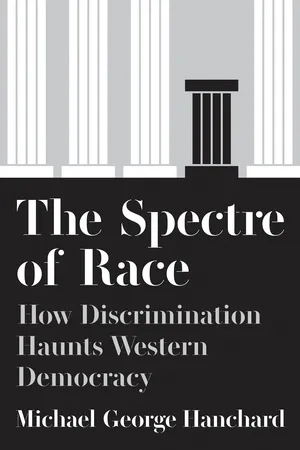
As right-wing nationalism and authoritarian populism gain momentum across the world, liberals, and even some conservatives, worry that democratic principles are under threat. In The Spectre of Race, Michael Hanchard argues that the current rise in xenophobia and racist rhetoric is nothing new and that exclusionary policies have always been central to democratic practices since their beginnings in classical times. Contending that democracy has never been for all people, Hanchard discusses how marginalization is reinforced in modern politics, and why these contradictions need to be fully examined if the dynamics of democracy are to be truly understood.
Hanchard identifies continuities of discriminatory citizenship from classical Athens to the present and looks at how democratic institutions have promoted undemocratic ideas and practices. The longest-standing modern democracies--France, Britain, and the United States—profited from slave labor, empire, and colonialism, much like their Athenian predecessor. Hanchard follows these patterns through the Enlightenment and to the states and political thinkers of the late nineteenth and early twentieth centuries, and he examines how early political scientists, including Woodrow Wilson and his contemporaries, devised what Hanchard has characterized as "racial regimes" to maintain the political and economic privileges of dominant groups at the expense of subordinated ones. Exploring how democracies reconcile political inequality and equality, Hanchard debates the thorny question of the conditions under which democracies have created and maintained barriers to political membership.
Showing the ways that race, gender, nationality, and other criteria have determined a person's status in political life, The Spectre ofRace offers important historical context for how democracy generates political difference and inequality.
- 272 pages
- English
- ePUB (mobile friendly)
- Available on iOS & Android
eBook - ePub
About this book
Information
Publisher
Princeton University PressYear
2018Print ISBN
9780691203676
9780691177137
eBook ISBN
9781400889570
Table of contents
- Cover Page
- Title Page
- Copyright Page
- Dedication Page
- Contents
- Acknowledgements
- Introduction: How Discrimination Haunts Western Democracy
- 1: Edward Augustus Freeman and the Dawn of Comparative Politics
- 2: Race Development, Political Development
- 3: Society and Polity, Difference and Inequality
- 4: Racial and Ethno-National Regimes in Liberal Polities
- 5: Conclusion: Reconfiguring Comparative Politics and Democracy
- Postscript: From Athens to Charlottesville
- Appendix
- Notes
- Bibliography
- Index
Trusted by 375,005 students
Access to over 1.5 million titles for a fair monthly price.
Study more efficiently using our study tools.
Frequently asked questions
Yes, you can cancel anytime from the Subscription tab in your account settings on the Perlego website. Your subscription will stay active until the end of your current billing period. Learn how to cancel your subscription
No, books cannot be downloaded as external files, such as PDFs, for use outside of Perlego. However, you can download books within the Perlego app for offline reading on mobile or tablet. Learn how to download books offline
Perlego offers two plans: Essential and Complete
- Essential is ideal for learners and professionals who enjoy exploring a wide range of subjects. Access the Essential Library with 800,000+ trusted titles and best-sellers across business, personal growth, and the humanities. Includes unlimited reading time and Standard Read Aloud voice.
- Complete: Perfect for advanced learners and researchers needing full, unrestricted access. Unlock 1.5M+ books across hundreds of subjects, including academic and specialized titles. The Complete Plan also includes advanced features like Premium Read Aloud and Research Assistant.
We are an online textbook subscription service, where you can get access to an entire online library for less than the price of a single book per month. With over 1.5 million books across 990+ topics, we’ve got you covered! Learn about our mission
Look out for the read-aloud symbol on your next book to see if you can listen to it. The read-aloud tool reads text aloud for you, highlighting the text as it is being read. You can pause it, speed it up and slow it down. Learn more about Read Aloud
Yes! You can use the Perlego app on both iOS and Android devices to read anytime, anywhere — even offline. Perfect for commutes or when you’re on the go.
Please note we cannot support devices running on iOS 13 and Android 7 or earlier. Learn more about using the app
Please note we cannot support devices running on iOS 13 and Android 7 or earlier. Learn more about using the app
Yes, you can access The Spectre of Race by Michael G. Hanchard in PDF and/or ePUB format, as well as other popular books in Politics & International Relations & Civics & Citizenship. We have over 1.5 million books available in our catalogue for you to explore.