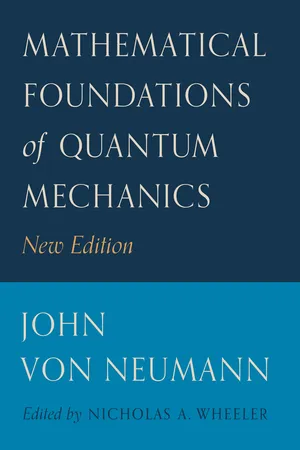
Quantum mechanics was still in its infancy in 1932 when the young John von Neumann, who would go on to become one of the greatest mathematicians of the twentieth century, published Mathematical Foundations of Quantum Mechanics--a revolutionary book that for the first time provided a rigorous mathematical framework for the new science. Robert Beyer's 1955 English translation, which von Neumann reviewed and approved, is cited more frequently today than ever before. But its many treasures and insights were too often obscured by the limitations of the way the text and equations were set on the page. In this new edition of this classic work, mathematical physicist Nicholas Wheeler has completely reset the book in TeX, making the text and equations far easier to read. He has also corrected a handful of typographic errors, revised some sentences for clarity and readability, provided an index for the first time, and added prefatory remarks drawn from the writings of Léon Van Hove and Freeman Dyson. The result brings new life to an essential work in theoretical physics and mathematics.
eBook - PDF
Mathematical Foundations of Quantum Mechanics
New Edition
- 325 pages
- English
- PDF
- Available on iOS & Android
eBook - PDF
Mathematical Foundations of Quantum Mechanics
New Edition
About this book
Information
Publisher
Princeton University PressYear
2018Print ISBN
9780691178578
9780691178561
eBook ISBN
9781400889921
Table of contents
- Cover
- Title
- Copyright
- CONTENTS
- Translator’s Preface
- Preface to This New Edition
- Foreword
- Introduction
- CHAPTER I Introductory Considerations
- CHAPTER II Abstract Hilbert Space
- CHAPTER III The Quantum Statistics
- CHAPTER IV Deductive Development of the Theory
- CHAPTER V General Considerations
- CHAPTER VI The Measuring Process
- Name Index
- Subject Index
- Locations of Flagged Propositions
- Articles Cited: Details
- Locations of the Footnotes
Trusted by 375,005 students
Access to over 1.5 million titles for a fair monthly price.
Study more efficiently using our study tools.
Frequently asked questions
Yes, you can cancel anytime from the Subscription tab in your account settings on the Perlego website. Your subscription will stay active until the end of your current billing period. Learn how to cancel your subscription
No, books cannot be downloaded as external files, such as PDFs, for use outside of Perlego. However, you can download books within the Perlego app for offline reading on mobile or tablet. Learn how to download books offline
We are an online textbook subscription service, where you can get access to an entire online library for less than the price of a single book per month. With over 1.5 million books across 990+ topics, we’ve got you covered! Learn about our mission
Look out for the read-aloud symbol on your next book to see if you can listen to it. The read-aloud tool reads text aloud for you, highlighting the text as it is being read. You can pause it, speed it up and slow it down. Learn more about Read Aloud
Yes! You can use the Perlego app on both iOS and Android devices to read anytime, anywhere — even offline. Perfect for commutes or when you’re on the go.
Please note we cannot support devices running on iOS 13 and Android 7 or earlier. Learn more about using the app
Please note we cannot support devices running on iOS 13 and Android 7 or earlier. Learn more about using the app
Yes, you can access Mathematical Foundations of Quantum Mechanics by John von Neumann, Nicholas A. Wheeler, Robert T. Beyer in PDF and/or ePUB format, as well as other popular books in Physical Sciences & Mathematical & Computational Physics. We have over 1.5 million books available in our catalogue for you to explore.