How gender and generation shape perceptions of place and time as told through the voices of Mexican teenage girls
This book examines the lived experiences of Mexican teenage girls raised in transnational families and the varied ways they make meaning of their lives. Under the Bracero Program and similar recruitment programs, Mexican men have for decades been recruited for temporary work in the U.S., leaving their families for long periods of time to labor in the fields, factories, and service industry before returning home again. While the conditions for these adults who cross the border for work has been extensively documented, very little attention has been paid to the lives of those left behind. Over a six-year period, Lilia Soto interviewed more than sixty teenage girls in Napa, California and Zinapécuaro, Michoacán to reveal the ruptures and continuities felt for the girls surrounded by the movement of families, ideas, and social practices across borders.
As they develop their subjective selves, these Mexican teens find commonality in their fathers’ absence and the historical, structural, and economic conditions that led to their movement. Tied to the ways U.S. immigration policies dictate the migrant experiences of fathers and the traditional structure of their families, many girls develop a sense of time-lag, where they struggle to plan for a present or a future. In Girlhood in the Borderlands, Soto highlights the “structure of feeling” that girls from Zinapécuaro and Napa share, offering insight into the affective consequences of growing up at these social and geographic intersections.
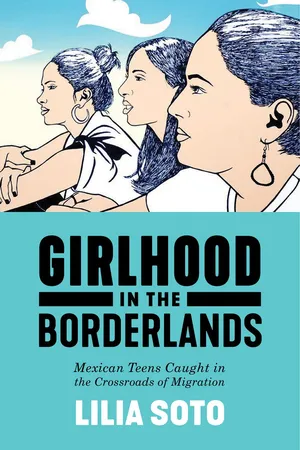
eBook - ePub
Girlhood in the Borderlands
Mexican Teens Caught in the Crossroads of Migration
- 272 pages
- English
- ePUB (mobile friendly)
- Available on iOS & Android
eBook - ePub
About this book
Information
1
The Why of Transnational Familial Formations
la suerte viene, la suerte se va por la frontera, la suerte viene, la suerte se va,
el hambre viene, el hombre se va, sin más razón, el hambre viene, el hombre se va,
cuando volvera,
por la carretera, por la carretera, por la carretera
[luck comes, luck goes through the border, luck comes, luck goes,
hunger comes, man leaves without a doubt, hunger comes, man leaves,
when will he return,
on the road, on the road, on the road]
—Manu Chao, “El Viento” Clandestino (Paris: Virgin Records, 1998)
El hielo anda suelto por esas calles
Nunca se sabe cuando nos va a tocar
Lloran, los niños lloran a la salida
Lloran al ver que no llegará mamá
Uno se queda aquí
Otro se queda alla
Eso pasa por salir a trabajar.
[ICE is on the loose out on the streets
You never know when your number’s up
Cry, children cry when they get out
They cry when mom’s not coming to pick them up
Some of us stay here
Others stay there
That happens for going out to find work.”
—La Santa Cecilia, “Ice el Hielo” Treinta Dias (Universal Latino, 2013)
Seventeen-year-old Marbe and her sisters—fifteen-year-old Emilia and thirteen-year-old Toñita—live in the town of Zinapécuaro in the state of Michoacán, Mexico. Since birth, they have lived in a father-away transnational family. Their father Sixto also grew up in a transnational family. As a son of a former bracero, he came to understand migration as cyclical and family life as something stretched across international borders. Sixto began helping his family through hard labor at the age of eleven, having only completed the sixth grade. According to Emilia, her father is a brilliant man. While in elementary school, his hard work was rewarded with high grades in math and penmanship. Grammar and spelling were also strengths of his, which makes Marbe, the oldest, feel self-conscious whenever she shares her writing with him. He is the motivation behind Emilia and her sisters’ success in school. “Had he had the opportunity to go to school,” said Toñita, “he would have done great things, but poverty pushed him to drop out.” When he was younger, his family used to produce and sell the ceramic items they made in their backyard kilns. As the family grew, space was needed to build extra rooms, so the kilns were demolished. This forced the family to purchase the merchandise they once produced to make ends meet.
Sixto’s father, a U.S. resident, assisted him in getting his papeles. Following in his father’s footsteps, Sixto began his commutes to the U.S. in the 1980s. These continued after his marriage to Poncia and the birth of his six children—four daughters and two boys. As a legal resident turned citizen, Sixto spends six months of the year in the U.S., usually in Chicago, Portland, or Alaska, and the rest of the year in Zinapécuaro. With six children, one en route to college, ailing parents, and a sister under his care, money is always in short supply. He has plenty of contacts that inform him which city he should try on his next trip to the U.S. Sixto leaves in June, after Holy Week and Saint John the Baptist’s Day (June 24), and returns by November just in time for the Christmas holidays.
Seventeen year-old Elena arrived in Napa in 2002 at the age of thirteen to live with her father Silvio. Like Sixto, Silvio began commuting to Napa for work as a young man. Once he married, his cyclical commutes continued until 2002. Living in Oaxaca, Elena always knew her father lived in Napa. Events such as Father’s Day or school-related activities provided painful reminders of her father’s absence, of his geographic location and distance from family and home. Because her father always returned in April, July, and December of each year, Elena always knew when to expect him. As a U.S. resident, his commutes were regular and relatively easy as the border did not serve as deterrent. When he was away, he called every week. Elena’s household did not have a phone then, so each Sunday, wearing their Sunday best, they walked to the phone booth down the street to await his call. During his visits, outings to fairs, restaurants, and belated birthday celebrations were common. For Elena, his departures meant feeling empty and lonely. She recalled one particular departure: “On one occasion, my mom and dad told me that, when my dad was about to leave [back to Napa], he told us he was leaving, but—I was little, I don’t know, I must have been four, I don’t know, I think, I’m not sure, and my mom says that—I grabbed my lunch box and I went to get a bag of chips and some frutsis (Mexican juice drinks) and when my dad was about to leave, I grabbed his hand and told him ‘all right, let’s go!’” Elena became emotional as she shared this particular story, but insists she never felt abandoned by her father. At home, her mother always made his presence felt by speaking about him and consulting with him on any decisions she made about the children’s schooling and household matters. Her extended family, including grandparents, also lived nearby. They cared for and looked after Elena and the family. She found comfort in knowing her father cared for her and loved her very much.
The stories of the three sisters and of Elena represent two examples of transnational families. The first concerns girls still living in this familial arrangement while the second is an example of a family that once lived transnationally but later experienced what Zavella describes as family reunification.1 Reunification may be a kind of misnomer since, for some families, it may actually mean unification for the first time, as some children may grow up without ever living with their father or mother. When they dwell in the same household in the U.S. or Mexico, it may be the first time that all members of the family live together. In both examples, the girls were raised in a transnational family from birth with a migrant father whose commutes to the U.S. began in the 1980s.
The majority of girls that I interviewed in Zinapécuaro and in Napa came from this transnational familial arrangement. Sixto and Silvio left their families for work in the U.S. in order to provide them with better living conditions and opportunities. Sixto’s ability to provide for his family from the U.S. is reflected in Marbe, Emilia, and Toñita’s enrollments in school. In 2012, Marbe was in her third year as a nursing student at La Michoacana; Emilia was completing her last year of high school and preparing to take the entrance exam to enroll in La Normal, with hopes of earning a degree in childhood education; and Toñita’s high marks in high school were being rewarded with scholarships.2 The family owns their home and manages to get by economically. Similarly, while Elena lived in Mexico, her father Silvio was able to pay tuition for her and her brothers at a private Catholic school—a luxury in rural towns. Silvio also sent enough money in remittances for his family to enable them to own their own home and a couple of businesses: a minimart and a bakery. For these girls, their fathers’ departures materially improved their lives. Silvio decided to bring Elena, her mother, and her siblings to Napa while Sixto has emphatically refused to take his family to Chicago, Alaska, or Portland.
There is something seemingly traditional in these girls’ stories that revolve around a man leaving to the U.S. in search of a better future for his family. As Rhacel Salazar Parreñas (2005) explains, for many families in migrants’ countries of origin, a father’s departure is expected and celebrated—it becomes a logical part extension of his role as the breadwinner.3 This chapter examines the formation of transnational families with a focus on father-away families. This familial formation is the product of twentieth-century U.S. immigration policy, of failed neoliberal economic policies in Mexico, and of the global restructuring witnessed from the late 1970s onward that has placed men and women on the migrant path.
The Production of Transnational Families: An Overview
When I began to conduct interviews in Napa in 2006 and subsequently in Zinapécuaro in 2010, I noted a pattern. Most of the girls were born into an already existing father-away transnational family. Their fathers began migrating to the U.S. during the 1980s and 1990s. This period saw devaluation of the Mexican peso and an end to government subsidies guaranteeing low prices for food and fuel, creating an economic crisis. The resulting increase in migration to the U.S. led to the passage of the Immigration Reform and Control Act (IRCA) of 1986 by the U.S. Congress, which in turn led to the militarization of the border on the U.S. side. These seemingly distant events registered themselves indirectly in the lives of the girls I interviewed, in the form of migration and family fragmentation.
A long prior history of labor control and recruitment paved the way for the creation of transnational families in the 1980s and 1990s. They followed a pattern of movement north from Mexico established by U.S. employers over decades seeking cheap and willing labor.4 This labor recruitment was shaped by draconian U.S. immigration policies that excluded and restricted entry by racialized and ethnic groups deemed unassimilable. During the first half of the twentieth century, nativists claimed racialized and ethnic groups were a threat to the racial composition of the nation and, thus, to its very being. While U.S. law and custom resisted granting citizenship and full social membership to Mexican immigrants, U.S. employers welcomed the profits made from the exploitation of low wage immigrant labor. Immigration control functioned as labor control, not reducing the number of immigrants arriving in the U.S. but making sure that their legal vulnerabilities prevented them from bargaining freely over wages and working conditions. Three immigration acts in particular—in 1917, 1921, and 1924—were passed to control entrance into the U.S. and preclude future generations of citizens. Mexicans were exempted from the restrictionist policies directed at other immigrants, not because they were deemed assimilable within the nation, but because of the cheap and disposable labor they could provide.5 During the second half of the twentieth century, the militarization of the U.S.-Mexico border disguised labor exploitation as border defense.
Following DeGenova’s arguments about how migration produces subordinate inclusion for Mexican migrant workers, the section below provides an overview of the production of transnational families.6 Central to this chapter is how and why fathers left for the U.S. and the varied ways in which their daughters’ lives became entangled within these migratory practices.
Immigration Policies in the Twentieth-Century U.S.
Transnational families where the father is the migrant emerged in concert with twentieth-century U.S. immigration policy and labor recruitment. During the nineteenth century, between the end of the Mexican-American War and the 1900s, estimates indicate that fewer than 50,000 migrants arrived in the U.S. from Mexico.7 By the 1860s, however, men from northern Mexico were already commuting to California for work.8 Though small in numbers, cohorts of Mexican men migrated to the U.S. and formed transnational families.9
Mexican migration and the formation of transnational families continued into the early years of the twenty-first century. Although there has been a recent decrease in U.S.-bound Mexican migration that should not be overlooked, processes of migration are so rooted in Mexican families—such as the ones in this study—that a complete cessation seems unlikely.10 When debates over immigration arise in the U.S., proposals for visas for low-skilled workers continue to be one of the solutions. These proposals are reminiscent of previous guest worker programs such as those during the bracero years that targeted mostly single men to labor in low-skilled jobs, and the laws governing special agricultural workers (SAW) under IRCA that continue to address the demand for cheap labor to sustain agricultural production and the service sector in the U.S. economy.11
Drawing on the generative scholarship of Sassen, DeGenova argues that migration is produced and patterned systemically.12 In the case of Mexico, this production began in the early 1900s, during a time of heavy recruitment of Mexican workers known as the era of the Enganche (1900–1929). Enganchadores would travel into Mexico to hire men as railroad laborers and bring them to the U.S.13 The Immigration Acts of 1917, 1921, and 1924 had practically eliminated all other sources of cheap labor as the U.S. practiced a closed-door immigration policy. These acts targeted Asian migrants not included in the Chinese Exclusion Act of 1882 or the Gentlemen’s Agreement of 1907, as well as Southern and Eastern European migrants who possessed allegedly undesirable religious and political views purported to threaten the ontology of the U.S. nation. The Immigration Act of 1917 enforced literacy tests, but exempted Mexicans. The Immigration Act of 1921 barred the “Asiatic zone that ran from Afghanistan to the Pacific.”14 The architects of this 1921 act also “restricted immigration to 355,000 a year” and “set a quota for each European country at 3 percent of the number of foreign-born of that nationality residing in the United States in 1910,” targeting Southern and Eastern Europeans deemed to be the “wrong kind of migrants.”15 By 1924, the new immigr...
Table of contents
- Cover
- Title Page
- Copyright Page
- Dedication
- Contents
- Introduction
- 1. The Why of Transnational Familial Formations
- 2. Growing Up Transnational: Mexican Teenage Girls and Their Transnational Familial Arrangements
- 3. Muchachas Michoacanas: Portraits of Teenage Girls in a Migratory Town
- 4. Migration Marks: Time, Waiting, and Desires for Migration
- 5. The Telling Moment: Pre-Crossings of Mexican Teenage Girls and Their Journeys to the Border
- 6. Imaginaries and Realities: Encountering the Napa Valley
- Conclusion
- Acknowledgments
- Notes
- Bibliography
- Index
- About the Author
Trusted by 375,005 students
Access to over 1.5 million titles for a fair monthly price.
Study more efficiently using our study tools.
Frequently asked questions
Yes, you can cancel anytime from the Subscription tab in your account settings on the Perlego website. Your subscription will stay active until the end of your current billing period. Learn how to cancel your subscription
No, books cannot be downloaded as external files, such as PDFs, for use outside of Perlego. However, you can download books within the Perlego app for offline reading on mobile or tablet. Learn how to download books offline
Perlego offers two plans: Essential and Complete
- Essential is ideal for learners and professionals who enjoy exploring a wide range of subjects. Access the Essential Library with 800,000+ trusted titles and best-sellers across business, personal growth, and the humanities. Includes unlimited reading time and Standard Read Aloud voice.
- Complete: Perfect for advanced learners and researchers needing full, unrestricted access. Unlock 1.5M+ books across hundreds of subjects, including academic and specialized titles. The Complete Plan also includes advanced features like Premium Read Aloud and Research Assistant.
We are an online textbook subscription service, where you can get access to an entire online library for less than the price of a single book per month. With over 1.5 million books across 990+ topics, we’ve got you covered! Learn about our mission
Look out for the read-aloud symbol on your next book to see if you can listen to it. The read-aloud tool reads text aloud for you, highlighting the text as it is being read. You can pause it, speed it up and slow it down. Learn more about Read Aloud
Yes! You can use the Perlego app on both iOS and Android devices to read anytime, anywhere — even offline. Perfect for commutes or when you’re on the go.
Please note we cannot support devices running on iOS 13 and Android 7 or earlier. Learn more about using the app
Please note we cannot support devices running on iOS 13 and Android 7 or earlier. Learn more about using the app
Yes, you can access Girlhood in the Borderlands by Lilia Soto in PDF and/or ePUB format, as well as other popular books in Social Sciences & Emigration & Immigration. We have over 1.5 million books available in our catalogue for you to explore.