eBook - ePub
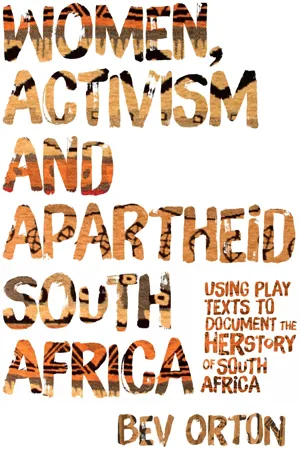
Women, Activism and Apartheid South Africa
Using Play Texts to Document the Herstory of South Africa
- 220 pages
- English
- ePUB (mobile friendly)
- Available on iOS & Android
eBook - ePub
Women, Activism and Apartheid South Africa
Using Play Texts to Document the Herstory of South Africa
About this book
This book investigates women's political activism and conflict in the struggle against apartheid in South Africa, examining issues around domestic violence, racial abuse and women in detention without trial. It builds on the theatrical analysis within play texts such as 'You Strike the Woman, You Strike the Rock', 'Glass House', 'Born in the RSA', 'Has Anyone Seen Zandile?' and 'So What's New?' to chart participation in the struggle against apartheid between 1975 and 1993, providing a political, economic and social herstory of South African women's activism. Further, the focus on play texts addresses the dearth of knowledge of pertinent herstorical moments, women's fight for political agency and equality, how apartheid laws affected women's role in theatre and provides a feminist lens and insight into how these laws affected the herstory of South Africa. The inclusion of a critical perspective from women who wrote plays and worked in theatre takes the book beyond a purely theatrical analysis. It seeks to explore how theatre as a form can help write a 'herstory' of apartheid, not only to document the reality of women's experiences but also as a means to imagine different realities.
Information
Chapter 1
A Brief Overview of the Dynamic Herstory of South Africa 1912–1993
This chapter provides a brief overview of the dynamic herstory of South Africa and includes political and social contexts during the period 1912–1993 with particular reference to apartheid laws and the lives of African women. As Marks argues, ‘If, for most of the past in most parts of the world, most women have been “hidden from history” ’ (1987, p. 1) black women in South Africa have been doubly hidden, both as women and because they are black. Women, although involved in political change remained relegated to the sidelines – oppressed by apartheid laws, customary laws and patriarchal society. The neglect of gender issues will become apparent, as will the need to remedy ‘the short shrift’ (Bhatia, 2006, p. 7) that is accorded to women in recording the herstory of South Africa (Bhatia, 2006). Although women’s defiant campaigns contributed to important dates in the herstory of South Africa – such as protests against the pass, The Women’s March and Sharpeville – their contribution to the struggle is largely unacknowledged in South African history.
Throughout the struggle against apartheid, women were regarded as being the ‘silent strength’ (Britton, 2005, p. 6). Yet they were at the forefront of mass action, voluntarily setting aside their fight for gender equality in their fight for racial equality, whilst maintaining their identity as mothers and wives (Britton, 2005, p. 6). Since 1913, African women had been protesting against apartheid and pass laws, yet nationalist leaders did not acknowledge women’s oppression nor their political mobilisation under either colonialism or patriarchy (Giesler, 2004, p. 64).
I consider the following dates from 1912 to 1993 to be important in the herstory of South Africa: in 1912, the African National Congress (ANC) was formed; in 1913, Charlotte Maxeke led a march against pass laws for African women; The Natives Land Act of 1913 stated that natives were no longer able to buy, sell or lease outside the stipulated reserves. This Act could be seen as the first structure of apartheid policy (Feinberg, 1993, p. 68). The influx control and The Natives Urban Act of 1923 and amendments to the Act in 1937 had devastating consequences for African women as it severely restricted their movements from rural to urban areas. The year 1930 is important because this was when white South African women acquired the vote which gave political activists, such as Helen Joseph and Helen Suzman, a political voice. In 1948, the ANC Women’s League (ANCWL) was formed, and the National Party adopted the policy of apartheid. The Group Areas Act, Act No. 41 of 1950, the Blacks (Abolition of Passes and Co-ordination of Documents), Act No. 67 of 1952 and the Reservation of Separate Amenities Act, Act No. 49 of 1953 were introduced. The 1950s was also the decade when the Women’s League became stronger, playing a more dominant role against apartheid. In 1954, the Congress Alliance – which brought together the ANC and the South African Indian Congress – was formed. It was also the year that the Federated Union of South African Women was formed. In 1955, the Freedom Charter was adopted; in 1956, women marched on Pretoria in defiance of pass laws; 1960 was a year of the Sharpeville massacre, resulting in a State of Emergency and international outrage against the apartheid government. In 1961, the Republic of South Africa was formed; the period of the 1970s and 1980s was a time of intense civil unrest and political violence. In 1990, Nelson Mandela was released from prison, and in 1991, de Klerk repealed the apartheid laws in full. In 1993, an interim constitution was drafted to being an end to apartheid legal rule and which became the Constitution of the Republic of South Africa, Act 200 of 1993. In 1994, South Africa held its first non-racial elections, voting in Nelson Mandela as the first black president of South Africa. This was an historic moment in the lives of all South Africans, and it is here that I end the period of my study. In 1994, South Africa moved from a state of turmoil and chaos into a state of ‘rainbow people’ (Dickow & Moller, 2002, p. 176) who experienced pride and happiness in being South African, and these feelings may have contributed to the reason for South Africa’s peaceful transition into a democracy and the relative lack of alienation felt by ‘the losers of the new dispensation’ (Moller et al., 1999, p. 245).
The ANC
The South African Native National Congress (SANNC) was renamed the ANC in 1912 with its main aim being to work for African unity (Kotze, 1975, p. 4). Its founding members were Saul Msane (Esq.), Josiah Gumede, John Dube, Pixley ka Isaka Seme and Sol Plaatje, who were supported by chiefs, people’s representatives and church organisations with the responsibility of enabling all black South Africans the right to defend their freedoms and emphasised passive and legal forms of protest using non-violent direct action campaigns in the early 1950s. It was an ‘organisational vehicle through which black South Africans could pursue their rights’ (Zunes, 1999, p. 139).
Initially, the ANC was not a political party in that it was a ‘parliament of the African people’ (Ottaway, 1991, p. 68) and a coalition of people from various political affiliations. The ANC was committed to a non-racial democracy, and this goal was set out in the 1955 Freedom Charter that stated that:
all people shall be entitled to take part in the administration of the country and that the rights of all people shall be the same, regardless of race, colour or sex. (Johannesburg, May, I990, p. 56 cited in Ottaway, 1991, p. 67)
‘The A.N.C.’s success as spokesman for oppressed South Africans made its transformation into a democratic party much more difficult’ (Ottaway, 1991, p. 69); however, the decision was made for the ANC to be the ‘the mouthpieces of the people’ (Ottaway, 1991, p. 69) in order to preserve unity and to speak as one voice (Ottaway, 1991, p. 69). Policy documents such as the African Claims in 1943, the intensification of trade union activity and the formation of the radical Congress Youth League helped to transform the ANC into a popular movement.
After realising that the passive resistance was not working, the ANC became more militant and began advocating violent resistance, along with the Pan Africanist Congress (PAC), which was founded in 1959. After the Sharpeville massacre in 1960, the ANC was banned as was the PAC. Both resorted to armed resistance, and this led to the formation of the ANC’s armed wing, Umkonto We Sizwe (Spear of the Nation) which many believed would play a major role in the liberation from apartheid (Zunes, 1999, p. 140). Strikes and boycotts continued as the main strategy for liberation with sabotage and small-scale guerrilla attacks being used as propaganda (Zunes, 1999, p. 147).
The ANC was considered to be an organisation of men in which women’s participation would be limited to their stereotypical ‘traditional’ domestic roles. The prevailing patriarchal notions of women’s roles in society were written in the constitutional provision. For women, their duties tended to be that of the category of ‘auxiliary’ members, who were automatically enrolled without fee and therefore did not have a vote.
All the wives of the members of any affiliated branch or branches and other distinguished African ladies where the Congress or Committee therefore shall be holding its sessions shall ipso facto become auxiliary members of the Congress during the period of such session. …. It shall be the duty of all auxiliary members to provide suitable shelter and entertainment for delegates to the Congress. (Ginwala, 1990, p. 80)
For the first 30 years, women were excluded from obtaining full membership and denied leadership roles despite participating in discussions, decision making and campaigns of the organisation. ‘This apparent contradiction arose from the actuality of African women’s involvement in resistance and the peculiar structure of the ANC, which allowed for ways in which women could participate’ (Ginwala, 1990, p. 77). Women were admitted as affiliate members from 1931 and as full members in 1943.
Missionaries
On arrival in South Africa in the 1700s, missionaries introduced Christianity to members of the African tribes. Mission schools were set up to help introduce and spread the evangelisation process. Reverend Father Bernard Huss, who was one of the first missionaries to realise the pedagogical value of theatre, arrived in South Africa in 1895 as a member of the Trappist order of monks. He was based at St Francis College, Marianhill, for 17 years. Whilst there, he established a reputation for drama performances. There were three main types of drama that were performed – medieval morality plays, secular English comedies and dramatisation of Zulu oral narratives. The pedagogic value of theatre was that it could be used to transmit Christian and civilised values such as repentance, obedience, thrift and diligence. The scripture syllabus taught honesty, justice, chastity and truthfulness. The pedagogic appeal of theatre for the missionaries was that they could use theatre to project their social and political agendas. Huss used theatre as a way of attempting to convert Africans to Christianity and as a form of social control and organised recreation. He maintained that if children should be taught to ‘… put their whole soul into the role they played at school’ (Peterson, 1994, pp. 349–350).
Theatre was used not only to challenge the perceived backwardness and limited intelligence of the Africans, but also to enforce progress. Black graduates of mission schools represented the new intellectuals and were known as the educated black elite. For them, the acquisition of western cultural forms was the best strategy, and they became ambivalent towards African traditions. There was a strong move to become Westernised and to acquire Western clothing, convert to Christianity and to realise the social advantages of English and Afrikaans and white civilisation (Coplan, 1986, p. 158). These mission-educated elite sought entry into colonial society by denouncing their traditional society (Ginwala, 2000, p. 3). In the Witwatersrand, theatre was promoted by whites and the African elite as being entertainment that was ‘healthy and morally improving’ (Peterson, 1990, p. 230) unlike entertainment such as bioscopes and dance halls.
Charlotte Maxeke (1874–1939) – ‘Mother of Black Freedom in South Africa’
Charlotte Maxeke, who became one of the leading women political activists, received a missionary education at Edwards Memorial School in the Eastern Cape in the early 1880s. It was her academic prowess which enabled her to co-ordinate and to encourage women to become actively involved in issues that directly affected them, issues such as pass laws (Walker, 1991). After moving to Kimberley with her family, Charlotte became a schoolteacher. Whilst on a trip with the choir from the Institute of African Methodist Episcopal Church (AME) to America, she was offered a scholarship to study at Wilberforce University, a segregated Negro college in Cleveland, in order to continue her studies in America. There she studied under the Pan-Africanist W.E.B. Du Bois and in 1905, she became the first black South African woman to receive a BSc degree. On her return to South Africa, she became involved in organising campaigns against pass laws, supporting trade union movements (Walker, 1991) as well as establishing the Wilberforce Institute in Evaton in Vereeniging. Her husband, Rev M.M. Maxeke, a minister in the AME, was also a graduate of Wilberforce College, and he had joined the ANC with whom he developed strong links (Walker, 1982, p. 37). In 1912, the ANC was formed, an organisation which united around the common cause of liberation, and which ‘[embodied] the central demands and aspirations of the national liberation movement’ (Maharaj, 2008, pp. 6–7) set out the Freedom Charter adopted in 1955. Through her husband, she established strong links with the ANC (Walker, 1991).
In 1912, SANNC passed a resolution to block a new requirement by the Orange Free State which made it compulsory for black South African and Coloured women to carry passes (Chiwengo, 2007, p. 186). The protest against women carrying passes was led by Charlotte Maxeke and spread throughout the Free State. A total of 5,000 signatures were collected on petitions, and the women prepared to go to Cape Town to present their concerns to Prime Minister Louis Botha and the authorities (Daymond et al., 2003, p. 159). This proposed action by the women made the white authorities anxious and the Minister of Native Affairs requested John Dube, then president of SANNC, to stop the women’s deputation as it would make whites nervous and hinder any representations made by other political organisations (Chiwengo, 2007, p. 187). However, the women would not be dissuaded by the argument presented by John Dube, and they persisted in presenting their petition to officials in Cape Town (Chiwengo, 2007, p. 187).
This act of defiance was followed by the first anti-pass campaign, when on 23 September 1913, Charlotte Maxeke led the women’s resistance against the imposition by the government of pass laws on women by ‘deciding to stop carrying passes or buying permits’ (Chiwengo, 2007, p. 187). About 600 women handed in their passes to the Mayor of Bloemfontein. Similar demonstrations took place in Jagersfontein, Fauresmith and Winburg. The women refused to carry passes in spite of being arrested and given sentences of imprisonment and hard labour. These acts of defiance underpinned the formation of the Bantu Women’s League in the SANNC in 1918 which was led by Charlotte Maxeke. She was described as ‘the mother of African freedom in South Africa’ by Dr Xuma, president of the ANC at the All-African Convention in 1935 (Walker, 1991, p. 36). The aim of the Bantu Women’s League was to speak up on behalf of women and to defend their rights ‘to be treated with propriety, [and] worthy of respect’ (Kimble & Unterhalter, 1982, p. 19). The alteration of the members of wives to women in the constitution illustrated the acknowledgement of women being ‘entitled to organise politically’ (Ginwala, 1990, p. 85).
‘Despite the privations they suffered during their stay in prison, they declared they would never buy passes even if they had to return to prison’ (Plaatje, 1916, pp. 95–96 cited in Kimble & Unterhalter, 1982, p. 18). These actions of defiance spread across the provinces resulting in confrontations with police when women tried to rescue those women taken prisoner (Ginwala, 1990, p. 82). Sol Plaatjie, the General Secretary of the SANNC, visited those imprisoned and expressed his admiration for their determination (Chiwengo, 2007, p. 187; Ginwala, 1990, p. 83). However, there were reports of women who refused to produce a pass, who were forced to go to the charge office and there some women were ‘taken by force and outraged’ (Petition, 1914 cited in Ginwala, 1990, p. 83). Petition 14 cites an example of a case of a young girl who refused to show a pass being taken by force and assaulted by a white Superintendent of the Location (Petition, 1914 cited in Ginwala, 1990, p. 83).
As the first president of the Bantu Women’s League, Charlotte Maxeke was not only a leader of national standing but was also able to have direct dealings with officials and legislators (Ginwala, 1990, p. 85). Charlotte Maxeke, who became one of the leading women political activists, received her education at a mission school, and it was her academic prowess which enabled her to co-ordinate and to encourage women to become actively involved in issues that directly affected them, issues such as pass laws (Walker, 1991).
The League had branches throughout the country and dealt with issues and grievances such as those of women farm workers who were forced to do heavy physical work despite being in the later stages of pregnancy, who were punished for complaining about working conditions (by being forced to stand in a pool of cold water for half a day) and who were made to work till midnight without a break for meals (Ginwala, 1990, p. 85). In 1918, Maxeke gave evidence before the Moffat Commission1 on ‘the indignities women suffered because they had to carry night passes’ (Kimble & Unterhalter, 1982, p. 19). Charlotte, writing in Xhosa on the social and political situations of women, addressed the ‘woman question’ in Umteteli wa Bantu (Mouthpiece of the People).
Not only is Maxeke regarded as one of the great modernisers but also as one of the founders of feminism in South Africa. She approached political activities through developing a dialectical relationship between political activism and oppression. Her work, both in political and social areas, provides an insight into intersecting oppressions in the subjugation and control of African women which is explicitly demonstrated in the restrictions imposed on women migrants.
The Black (or Natives) Land Act, Act No. 27 of 1913 – One of the First Segregation Laws
‘Awakening on Friday morning, June 20, 1913, the South African native found himself, not actually a slave, but a pariah in the land of his birth’ (Plaatje, 1995, p. 13). The Act was the result of paternal racism, capitalism and fear that promoted territorial segregation to an overwhelmingly white electorate (Braun, 2015, p. 356). The Act represented ‘the first key piece of territorial segregationist legislation’ (Glaser, 2001, p. 93) and was, according to Feinberg (1993), ‘one of the most important segregation laws of the century’ (p. 65) as it was the first time that territorial racial segregation was introduced into legislation since the Union in 1910. In 1910, the S...
Table of contents
- Cover
- Title
- Introduction
- Chapter 1. A Brief Overview of the Dynamic Herstory of South Africa 1912–1993
- Chapter 2. ‘Wathint Abafazi’Wathint’ – You Strike the Woman, You Strike the Rock
- Chapter 3. Glass House: A Clash of Two Cultures, Detention and Aggression
- Chapter 4. Born in the RSA: Lies, Manipulation, Violence and Solitary Confinement
- Chapter 5. Have You Seen Zandile? Gogo and her Granddaughter
- Chapter 6. ‘So What’s New?’ The Bold and the Beautiful
- Chapter 7. Women, Protest and Theatre
- Chapter 8. Twenty Years On and ‘So, What’s New?’
- References
- Index
Trusted by 375,005 students
Access to over 1.5 million titles for a fair monthly price.
Study more efficiently using our study tools.
Frequently asked questions
Yes, you can cancel anytime from the Subscription tab in your account settings on the Perlego website. Your subscription will stay active until the end of your current billing period. Learn how to cancel your subscription
No, books cannot be downloaded as external files, such as PDFs, for use outside of Perlego. However, you can download books within the Perlego app for offline reading on mobile or tablet. Learn how to download books offline
Perlego offers two plans: Essential and Complete
- Essential is ideal for learners and professionals who enjoy exploring a wide range of subjects. Access the Essential Library with 800,000+ trusted titles and best-sellers across business, personal growth, and the humanities. Includes unlimited reading time and Standard Read Aloud voice.
- Complete: Perfect for advanced learners and researchers needing full, unrestricted access. Unlock 1.5M+ books across hundreds of subjects, including academic and specialized titles. The Complete Plan also includes advanced features like Premium Read Aloud and Research Assistant.
We are an online textbook subscription service, where you can get access to an entire online library for less than the price of a single book per month. With over 1.5 million books across 990+ topics, we’ve got you covered! Learn about our mission
Look out for the read-aloud symbol on your next book to see if you can listen to it. The read-aloud tool reads text aloud for you, highlighting the text as it is being read. You can pause it, speed it up and slow it down. Learn more about Read Aloud
Yes! You can use the Perlego app on both iOS and Android devices to read anytime, anywhere — even offline. Perfect for commutes or when you’re on the go.
Please note we cannot support devices running on iOS 13 and Android 7 or earlier. Learn more about using the app
Please note we cannot support devices running on iOS 13 and Android 7 or earlier. Learn more about using the app
Yes, you can access Women, Activism and Apartheid South Africa by Bev Orton in PDF and/or ePUB format, as well as other popular books in Social Sciences & Civil Rights in Politics. We have over 1.5 million books available in our catalogue for you to explore.