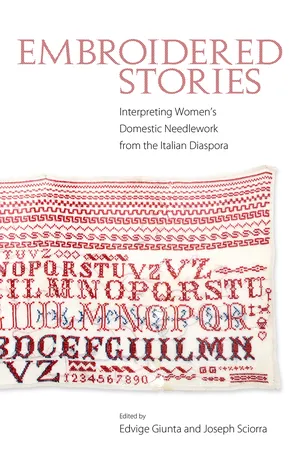
For Italian immigrants and their descendants, needlework represents a marker of identity, a cultural touchstone as powerful as pasta and Neapolitan music. Out of the artifacts of their memory and imagination, Italian immigrants and their descendants used embroidering, sewing, knitting, and crocheting to help define who they were and who they have become. This book is an interdisciplinary collection of creative work by authors of Italian origin and academic essays. The creative works from thirty-seven contributors include memoir, poetry, and visual arts while the collection as a whole explores a multitude of experiences about and approaches to needlework and immigration from a transnational perspective, spanning the late nineteenth century to the late twentieth century. At the center of the book, over thirty illustrations represent Italian immigrant women's needlework. The text reveals the many processes by which a simple object, or even the memory of that object, becomes something else through literary, visual, performance, ethnographic, or critical reimagining. While primarily concerned with interpretations of needlework rather than the needlework itself, the editors and contributors to Embroidered Stories remain mindful of its history and its associated cultural values, which Italian immigrants brought with them to the United States, Canada, Australia, and Argentina and passed on to their descendants.
eBook - ePub
Embroidered Stories
Interpreting Women's Domestic Needlework from the Italian Diaspora
- 394 pages
- English
- ePUB (mobile friendly)
- Available on iOS & Android
eBook - ePub
Embroidered Stories
Interpreting Women's Domestic Needlework from the Italian Diaspora
About this book
Information
Bachelor, Lace, Butch, Trousseau
“Stai zeet? Stai zeet? Perchè no maritt?” is a line of questioning that greeted me in my grandmother’s town, Acquaviva delle Fonti, upon every visit in my twenties and thirties. Getting assailed in this way by Zia Filumena was my least favorite part of being there and the reason I had to leave, every time.
“Are you engaged? Are you engaged? Why aren’t you married?” my Sicilian editor Edvige Giunta e-mails me the translation.
“No,” I protest. “Are you married? Are you married? Why no husband?” I know what my Zia Filumena was telling me, and what she was implying—why are you traveling around the world without a man by your side. Why no husband—a woman alone is no good.”
“It doesn’t say all that,” Giunta writes back, “the word zita is interesting. It means engaged, while zitella means spinster. Also maritarsi has its root in marito: husband.”
“Barese is twisted,” I write Giunta. And of course, the hands fill in where the words leave off. The meaning is made in between words and hands. I can still see Zia Filumena’s fingers kneading the air while she poked me about the reason behind my marital status. Now I had two arguments in my head, one with my Barese aunt about my relationship to men, and one with my Sicilian editor about dialect and meaning, and what really transpired between my aunt and me, Acquaviva and me.
I had one other unmarried female cousin in the town, not just unmarried, but somehow beyond being with a man. Giusy was my age and lived with her parents in a three-story marble building built by her father and grandfather. Her brother lived upstairs with his wife and kids. I thought she might be a lesbian, but I couldn’t decipher her sexuality or the tragedy, perceived by her family, that she was clearly on her way to becoming one of the barren old spinsters in Acquaviva, still a role the town despised.
My first trip to Acquaviva was in 1986: I had a Silence = Death Act-Up T-shirt, black with a large pink triangle, but I wouldn’t wear it in Acquaviva, not for meeting my aunts and uncles and cousins whom my family had been separated from by the Atlantic Ocean since 1919. I wasn’t going to march into town with my gay flag raised. I didn’t feel my life mattered. I aimed on reuniting our family. Over the years I traveled with various lesbian lovers to Acquaviva; but I was never out in Acquaviva. That was an ocean I wasn’t ready to cross.
Giusy had a deep laugh barbed with a manic darkness that kept me at a distance. Her laugh had spikes in it. It reminded me of my insane relatives this side of the Atlantic. For the last decade of his life, my father had been in a mental home in Babylon, New York, with PTSD and paranoid schizophrenia. His sister was a paranoid schizophrenic who practically lived at the Port Authority Bus Terminal; that’s where I would go to visit her: my aunt Apollonia, the Donut Visionary. At the end of my father’s life, he said to me, “Look what kind of woman you’ve become, you’re just like your aunt Bella.” Bella is what they called Apollonia. What I know of her denouement into mental illness is a scant list of plot points. Apollonia was the family beauty. She carried her cup of coffee in the street when everyone else stayed home to drink their coffee. According to my mother, carrying your coffee in the street was a radical act for a Bronx Italian woman in the post–World War II years. “I carry my coffee, baby, I carry my coffee. In the street where it’s sweet,” is the lyric that swims in my head when I sing of Apollonia. She didn’t say those words. I sing them.
Apollonia had a vision: She opened Johnny’s Donuts, named after her adopted son, in the Morris Park train station at 180th Street. Johnny’s Donuts preceded Dunkin’ Donuts. My mother reports that everyone in the family said this would never catch on, that people had their morning coffee a casa, but Aunt Apollonia insisted that New Yorkers would learn to grab a coffee and donut on their way to work. She believed it would catch on. “Unheard of back then,” my mother reports. Her husband, Uncle Tony, a war hero who had seen hard combat in World War II and suffered from PTSD, hung himself by a strap from a pipe in the kitchen of the donut shop.
Every time I drink a coffee in a Dunkin’ Donuts I think—this could have been Johnny’s Donuts—Aunt Apollonia’s ambitious groundbreaking vision, and my stomach tightens with all the lost potential of my aunt’s American dream. I think of Cat Stevens’s lyric, “for you may still be here tomorrow but your dreams may not,” and I hammer away at my artistic visions and manifest as many as possible, for me, and for the collective lost dreams of my paesane.
Apollonia reinvented herself, getting a job as a crossing guard with the 42nd Police Precinct in the Bronx. She became obsessed with taking photos of cops, patrolling and reporting their activities.
Nights, my cousin Giusy would don high heels, tight dark pants, and dark shirts with iridescent patterns for the evening passeggiata. She invited me on these walks in the town square, where the local kids our age would lean against a stone wall, smoke cigarettes, laugh, and flirt. On these walks, I met the youth my cousins, except for Giusy, had intimate interests in. My other cousins, younger and older, met their mates this way, on the local streets. Years later, when various cousins mailed me wedding photos, I was glad that I’d met, when we were young, the cute ponytailed boy Fabrizio who pulled up on a Vespa, or the shy girl with the black-cherry eyes, Lucia, whom my cousin pursued outside the church on the murge. They would become my cousins-in-law, and their children’s names are now the names I pass on to my nieces and nephews on Facebook.
Me, I didn’t procreate.
Procreation was something I grew up thinking God would take care of, almost without me knowing about it, and I left it in his, yes, his hands. One day in my late forties I realized I was going through menopause and realized this part of life was now, all of a sudden, on its hinges, slamming shut and sealed behind me. In menopause I looked back over the lifespan of my eggs and my early idea of who I would grow to become: When I was eighteen, my ovaries had been “laterally transposed”—stapled off to the side, out of the field of external beam radiation, to protect them during my first cancer. From the time I was three or four, I had been very aware of older bachelors, men who would visit our house alone, sit at our table, eat with our family, talk of their travels and their nieces and nephews. They clearly floated from house to house, paesan to paesan, visiting and staying for dinner, bringing gifts and entertaining stories of adventure. They did philanthropic volunteer work. I felt a kinship with their freedom and unattachedness. I knew in my gut by the time I was twelve that I would become one of these bachelor troubadours, sitting at the tables of extended family, regaling everyone with stories and songs of international adventures, doing favors to help people, and never having a table of my own filled with my children to come home to. I would have lovers. I would have protégés. Would have dogs. I would never give my dogs people’s names.
Acquaviva delle Fonti, Bari Province, 1986
On my first venture to Acquaviva, I felt a compulsion to buy a lace tablecloth for every member of my family back in the States. At the time, lace was made by hand by the women in the town who crocheted endless circles and webbing with tiny metal hooks and connected the circles into large patterns that dazzled me. The message was clear: Life itself had some grand design. I knew I’d never have the patience or presence of mind or dexterity of fingers to create what they did. The place in my brain to hook white cotton had deteriorated—I was sure of it. I am American and lucky to get up off the couch. A paesana of mine, Gina, has lain on her couch for three years straight; an aide comes twice a day to lift her to the bath. Another brilliant paesana, Amelia, who first introduced me to the writings of Flannery O’Connor, spent the better part of her last twenty years on a day-bed sofa. “If I only had a balcone, like in Italy,” she used to say. I am determined to resist the gravity and isolation of my body to the couch, though with the passing years I realize the sickbed and the couch have claimed my body for far too many hours. I am determined to wake up every day, take my blue pill, and create my visions. Damn all else. This particular blue pill is Thyroxin. Without a thyroid gland, taken after my second bout with cancer, if I don’t take the blue pill, I will slowly come to a complete halt, like a wind-up toy. The blue pill is my morning wind-up.
Lace called to me. I stood at the outdoor market, squeezing my brain to picture the dinner table of my sister, and my mother, back in New York. My mother’s maple table was a large oval; my sister had a rectangular table. I closed my eyes and counted how many people could fit around each with the leaves inserted to approximate the sizes of lace I needed. The vendor opened many lace tablecloths for me under the Saturday morning sun and my Zia Filumena quickly separated the handmade from machine-made lace and sternly haggled the prices. She quickly threw some aside with a rejecting swipe of the hand. I couldn’t tell the difference between the handmade and machine-made lace. Zia Filumena brought it closer to my eye, turned it upside down, and showed me the difference. I still couldn’t see it, but I knew inside that if she knew I was a lesbian, I too would be swept to the side like a piece of machine-made lace.
Zia Filumena was a quick talker. I couldn’t keep up with her commentary. She wanted me to make up my mind and not buy too much. When I reached into my Caucasian-colored money belt for my greenback dollars, she told me to put them away. She wanted to pay in lire, and get a better price. For myself, I found a round lace. I had no table, but found comfort in round. One day I would have a table, and the lace from my grandmother’s town would hold us—whoever us would be. My dogs would sit on chairs at the table, if need be. The lace from grandma’s town would weave all our tables into one big web. The pattern I chose for myself began with one central rosette and built out concentrically, eight petals surrounding the rosette, then twenty-one rosettes forming a perimeter of the circle, and variations on and on, with thousands of interstitial stitches. I could see that this work could have been built in an infinite radial pattern outward, if there were only enough hands to collaborate. But this tablecloth stayed in a human proportion. It is finished in a scalloped edge to fall over the thighs around the table.
On my way back to New York, I stopped in Firenze, where I bought a giant lace, nine yards, with heart shapes. “Auguri,” the man at the market shouted in a congratulatory tone. As I walked away, I realized the lace vendor had concluded that I was getting married. Why else buy all this heart-patterned lace? His intonation was surprising. It was the exact opposite of the biting, “Stai zeet! Stai zeet! Perchè no maritt!” I didn’t know what I would do with the giant lace, or if I would ever have the heart to cut it to make into something functional, but I was sure of one thing: No one had ever been so happy for me in all my life as the lace vendor who thought I was engaged to be married.
Brooklyn, New York, 1996
Trash nights were Fridays in my Park Slope neighborhood. One Friday night on a dog walk with my mutts, Scaramooch and Cherub, I found a discarded heavy wood round tabletop on 6th Avenue off 1st Street. The trash gods were good to us. I lived with my lover, Audrey Kindred. We were proud to have furnished our three-room railroad apartment with great throwaways: butcher-block cabinets on wheels, a wooden bureau of Madonna-robe blue with gold stars like a painting of The Annunciation. The treasures of the streets in the Friday-night flow of trash were endless. I made bookshelves out of two hardwood staircases I paid guys to drag up the three flights of steps into our apartment. These I turned upside-down and finished with one-inch moldings serving as railings to hold my books on the perfect slant so that I could read the titles on the spines. Down 6th Avenue and up the Carroll Street hill I rolled the round tabletop home like a giant wheel, wearing my black motorcycle gloves that I used on trash-hunting expeditions. The edge of the table had grooves, like a quarter. It rolled through dog feces on the sidewalk. I kept walking. That’s what life was about—walking through the shit, then purifying yourself when you got home. I scrubbed the tabletop with bleach, then gave the entire slab three coats of white paint, making it clean and sterile. As I whitewashed the table, I thought back to a job I...
Table of contents
- Cover
- Title
- Copyright
- Contents
- Acknowledgments
- Introduction
- Daguerreotype: Lace Maker
- Threads of Women
- Skills and Artistry
- Factory Girls
- Environmental Sites
- Lost, Discarded, Reclaimed
- Afterword
- Notes on Contributors and Editors
- Credits
- Index
Trusted by 375,005 students
Access to over 1.5 million titles for a fair monthly price.
Study more efficiently using our study tools.
Frequently asked questions
Yes, you can cancel anytime from the Subscription tab in your account settings on the Perlego website. Your subscription will stay active until the end of your current billing period. Learn how to cancel your subscription
No, books cannot be downloaded as external files, such as PDFs, for use outside of Perlego. However, you can download books within the Perlego app for offline reading on mobile or tablet. Learn how to download books offline
Perlego offers two plans: Essential and Complete
- Essential is ideal for learners and professionals who enjoy exploring a wide range of subjects. Access the Essential Library with 800,000+ trusted titles and best-sellers across business, personal growth, and the humanities. Includes unlimited reading time and Standard Read Aloud voice.
- Complete: Perfect for advanced learners and researchers needing full, unrestricted access. Unlock 1.5M+ books across hundreds of subjects, including academic and specialized titles. The Complete Plan also includes advanced features like Premium Read Aloud and Research Assistant.
We are an online textbook subscription service, where you can get access to an entire online library for less than the price of a single book per month. With over 1.5 million books across 990+ topics, we’ve got you covered! Learn about our mission
Look out for the read-aloud symbol on your next book to see if you can listen to it. The read-aloud tool reads text aloud for you, highlighting the text as it is being read. You can pause it, speed it up and slow it down. Learn more about Read Aloud
Yes! You can use the Perlego app on both iOS and Android devices to read anytime, anywhere — even offline. Perfect for commutes or when you’re on the go.
Please note we cannot support devices running on iOS 13 and Android 7 or earlier. Learn more about using the app
Please note we cannot support devices running on iOS 13 and Android 7 or earlier. Learn more about using the app
Yes, you can access Embroidered Stories by Edvige Giunta,Joseph Sciorra in PDF and/or ePUB format, as well as other popular books in History & Art General. We have over 1.5 million books available in our catalogue for you to explore.