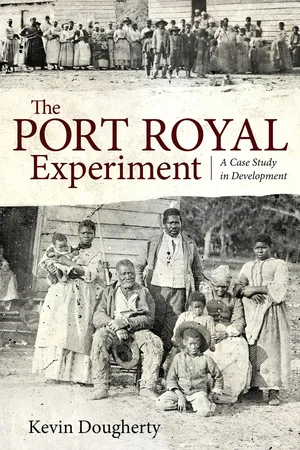
The Port Royal Experiment builds on classic scholarship to present not a historical narrative but a study of what is now called development and nation-building. The Port Royal Experiment was a joint governmental and private effort begun during the Civil War to transition former slaves to freedom and self-sufficiency. Port Royal Harbor and the Sea Islands off the coast of South Carolina were liberated by Union Troops in 1861. As the Federal advance began, the white plantation owners and residents fled, abandoning approximately 10,000 black slaves. Several private Northern charity organizations stepped in to help the former slaves become self-sufficient. Nonetheless, the Point Royal Experiment was only a mixed success and was contested by efforts to restore the status quo of white dominance. Return to home rule then undid much of what the experiment accomplished.
While the concept of development is subject to a range of interpretations, in this context it means positive, continuously improving, and sustained change across a variety of human social conditions. Clearly such an effort was at the heart of the Port Royal Experiment. While the term "nation-building" may seem misplaced given that no "nation" was the beneficiary of these efforts, the requirement to build institutions critical to nation-building operations was certainly a large part of the Port Royal Experiment and offers many lessons for modern efforts at nation building.
The Port Royal Experiment divides into ten chapters, each of which is designed to treat a particular aspect of the experience. Topics include planning considerations, philanthropic society activity, civil society, economic development, political development, and resistance. Each chapter presents the case study in the context of more recent developmental and nation-building efforts in such places as Bosnia, Somalia, Kosovo, Iraq, and Afghanistan and incorporates recent scholarship in the field. Modern readers will see that the challenges that faced the Port Royal Experiment remain relevant, even as their solutions remain elusive.