Women Pioneers of the Louisiana Environmental Movement provides a window into the passion and significance of thirty-eight committed individuals who led a grassroots movement in a socially conservative state. The book is comprised of oral history narratives in which women activists share their motivation, struggles, accomplishments, and hard-won wisdom. Additionally, interviews with eight men, all leaders who worked with or against the women, provide more insight into this rich—and also gendered—history. The book sheds light on Louisiana and America's social and political history, as well as the national environmental movement in which women often emerged to speak for human rights, decent health care, and environmental protection. By illuminating a crucial period in Louisiana history, the women tell how "environmentalism" emerged within a state already struggling with the dual challenges of adjusting to the civil rights movement and the growing oil boom. Peggy Frankland, an environmental activist herself since 1982, worked with a team of interviewers, especially those trained at Louisiana State University's T. Harry Williams Center for Oral History. Together they interviewed forty women pioneers of the state environmental movement. Frankland's work also was aided by a grant from the Louisiana Endowment for the Humanities. In this compilation, she allows the women's voices to provide a clear picture of how their smallest actions impacted their communities, their families, and their way of life. Some experiences were frightening, some were demeaning, and many women were deeply affected by the individual persecution, ridicule, and scorn their activities brought. But their shared victories reveal the positive influence their activism had on the lives of loved ones and fellow citizens.
- 286 pages
- English
- ePUB (mobile friendly)
- Available on iOS & Android
eBook - ePub
Women Pioneers of the Louisiana Environmental Movement
About this book
Information
Chapter One
“HOW COULD I STAND BY?”
Protecting One Place, Protecting Many
In 1997, Marine Shale agreed to pay more than $10 million to settle federal and state allegations that it incinerated hazardous waste without a permit and planned to sell the contaminated ash as fill material to the public. Sally Herman, Fernell Cryar, Catherine Holcomb, Barbara LeLeux, and Monica Mancuso were the 1995 recipients of an Environmental Protection Agency (EPA) award for their role in ensuring the safety of their community in the closing of Marine Shale’s waste operations in Morgan City.
We begin with a group of seven women, united in one place, Morgan City in Saint Mary Parish, Louisiana. Their stories may seem familiar: like so many others, these women made a leap from the household and schoolroom to public arenas, passing petitions, writing press releases, and testifying at permit hearings. Their work united caretaking for children with caretaking for the environment. We start with them since they tell not only of horrors but also of appreciation, a garnering of strength that rested primarily on education and values located in their families, churches, and, indeed, Louisiana itself. Their stories are those of great sorrows redeemed through action. Their stories are an awakening to the tragedies within their own families and beyond, to others of excluded groups, to even finding themselves among these excluded groups, and, of course, too, to deadly serious issues in the industrial pollution of their hometown.
Morgan City is not a large place. With only some twelve thousand residents, their parish (“county” elsewhere) is also small, with only some fifty-four thousand people. The city sits on the banks of the Atchafalaya River, and its people’s livelihoods have always been tied to this river, as well as to the land itself, the trees, and the nearby Gulf of Mexico.
In some ways, it is a typical Louisiana community, known for its annual blessing of the fleet that comes within the festive Shrimp and Petroleum Festival. The combination of these two products in an annual celebration, complete with a ritualistic ceremony of thanksgiving and prayer for safety, calls forth the richness of natural resources. Salt, water, oil, and natural gas are celebrated in good food, booths of handicrafts, decorated boats, music, and dancing. The women in this chapter, as elsewhere in the book, value this honoring and its foundation upon jobs based on seafood and oil. Many in the community shape their lives around such products.
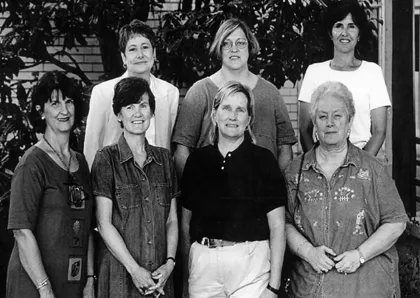
Morgan City women: Front row, from left, Helen Solar, Barbara LeLeux, Monica Laughlin Mancuso, and Miriam Price; and, second row, from left, Fernell Cryar, Sally Herman, and Catherine Holcomb
Residents are generally proud of the state’s natural resources and grateful for industrial growth. A government website lists seventeen industries for the state, and first on this list is the fact that “Louisiana has the greatest concentration of crude oil refineries, natural gas processing plants and petrochemical production facilities in the Western Hemisphere.” Second, Louisiana is “America’s third largest producer of petroleum and the third leading state in petroleum refining … [pioneering] offshore oil and gas exploration and drilling.” Third, the state also holds the distinction of hosting “the first [oil] well ever drilled out of sight of land.” These are the categories the residents associate with prosperity. Tenth out of seventeen industries contributing to this feeling of plenty is shrimping.1 Enriched earlier with the timber business, Morgan City has at times, then, been among the centerpieces of the state’s industrial growth.
In other ways, Morgan City has been somewhat different, somewhat unique. Even in the late eighteenth and early nineteenth centuries, its population was more in flux than most other communities in the state. English-speaking migrants from the Carolinas were the first fishermen here; later came the Acadians, Creoles, and others who followed the dredging of the Atchafalaya to allow for ocean-going vessels. Still later, in the 1930s through the 1970s, came those from within Louisiana and from across the United States who participated in the drilling of the first successful offshore oil well. In the early 1980s a downturn in this work occurred. Then the city looked to another employer, Marine Shale Processors, which had established an incinerator to process non-hazardous oilfield wastes coming from other places.
Waste—the very word, unknown at first except domestically to these women—began literally to destroy lives. Was this waste truly without hazard? That was the question these women grew to ask as the many by-products of “modern life” entered their community and, especially, their families’ homes. What was later learned was that Marine Shale started out burning non-hazardous oilfield waste but could not make enough money. Thus, it started taking creosote and other waste from Southern Wood Piedmont Company (1923–1985), which had manufactured railroad ties and telephone poles. The women eventually learned that the combination of materials was very different than the original permit had allowed.2
SALLY HERMAN
In the 1980s, Sally Herman and her husband had an oilfield equipment rental business, where her children often came after school. Their place of work was located across the street from Marine Shale’s industrial incinerator. On days the company was burning creosote, employees and children alike would be made sick. Sally became, then, one of the first women to connect illness to waste being burned. She became one of the first to challenge Marine Shale. Her story is a telling one of courage, but also of the context of Louisiana: Like Sally, many of the women had family members who worked in businesses connected to the petrochemical industries. Seven of the thirty-eight women mention direct ties via husbands, fathers, and brothers, and four of these are in the Morgan City area. Many more mention neighbors and friends who worked for petrochemical concerns. Though Marine Shale had a different focus, it was part of the web of conducting business without much oversight.
Sally’s narrative also sets the tone in other ways for those women’s voices that follow. Notice that she does not begin, or even end, thinking of herself as an activist, but rather, she draws from lessons of religion and citizenry and considers her actions as “right” and logical.
Narrative from Sally Herman (b. Morgan City, Louisiana, 1947)
My mother worked for the Morgan City Daily Review, which was called King Hanford’s then.3 My dad worked for Texaco. I have two sisters and one brother. Growing up, my mother tried to shelter me, and I remember her saying, “Don’t try. You might fail, and then you will be upset. It was meant to protect me, but I was a rebellious child, so it didn’t work. I learned as I got older that if you didn’t try—you didn’t win either.
I grew up in Morgan City and went to Morgan City High School. I was editor of the school newspaper, and I was in the foreign language club. My first job was at L&H Printing Company in Morgan City, where I did a little bit of bookkeeping and waited on customers.
I got married in 1972, and our first child was born in 1975 and our second child was born in 1977. My husband is a business owner. We rent oilfield equipment, so wherever the oilfield is doing well we just move where the rentals are. We moved to Lafayette, Metairie, Luling, Morgan City, and now we are back in Lafayette.
After our two children were born we really got strongly back into the church. We were living in Luling, and with the help of a friend we started a babysitting co-op and a mother’s group. I was president of the Methodist women in Luling, and I also taught several bible studies. We became more and more involved in the church, and my husband eventually went into the ministry, but not full time.
Not only were we active in the church, but when we moved to Morgan City, my husband started the first soccer league because they didn’t have one in the area. Our children were involved in both soccer and baseball.
I am not an environmental activist. I do care about the environment, but I would not go out of my way to be involved in a cause [such as joining a group organized around one cause]. That is not my reason for doing what I did. I am a person with strong convictions, and I guess I have something in me that likes to make what is wrong right, and Marine Shale was such a horrendous situation that I felt I could not keep quiet about it.
Our oilfield rental business in Morgan City was directly across the street from Marine Shale. When they would burn creosote for fuel we would have to close down and send our employees home because tears were running out of their eyes. Our children would have rashes and we would have sore throats. I had strangers calling me at night that were deathly ill, that were working there [Marine Shale] and they were begging us to help. We decided not to take it lying down. In 1985, we started looking into what we could do to stop it. Linda King [also featured in this book] helped to find an environmental doctor because the company employees were only allowed to see the company doctor.
We also learned that Marine Shale was taking waste they weren’t supposed to take and had sworn they didn’t take. We would follow them [trucks] to the gates of Marine Shale as they went in. We would scrape things off barrels and there would be skull and crossbones. We did this because we wanted to know as much as we could firsthand about what was going on. We had people calling us saying they were taking in fetuses from abortion clinics. We had three or four eyewitnesses. I don’t know if that is illegal or not, but to me that was horrendous. Babies being incinerated with hazardous waste was just more than I could bear to think about.
When we started fighting Marine Shale, it was a fairly small group: Melanie O’Neill, Kim Folse, and me. We were the main thorn in their flesh for probably five years. Then in 1987, right after the floating garbage barge incident, where they were trying to find a place to bring the [New York] garbage, we learned that the owners of Marine Shale thought they had the perfect solution and that was to bring it [garbage] to their facility for incineration. It was like the last resort. We said, “No, this is enough.” The Citizens’ Clearinghouse for Hazardous Wastes (CCHW) gave us an award for stopping the barge.
We were attending a parish council meeting [in reference to the barge], and we were trying to think of a name to call our group because they just kept calling us those “crazy people.” One of the ladies said, “Let’s be South Louisiana against pollution—SLAP.” We said, “Yes, that is it—SLAP.” The name was so distasteful to Marine Shale that we just loved it. I was the president of SLAP when it was founded.
SLAP was the sole group for probably five years. We had no funding so we joined with the Hazardous Waste Council [HWC] out of Washington, D.C. A lot of people felt we were joining the enemy because they were basically a consortium of hazardous waste treatment plants that wanted to knock out one of the competitors. I didn’t care what their motives were. They were going to help us get rid of Marine Shale. They used us and we used them, but it worked. Industry had an unlimited amount of money, lawyers, and politicians. We had nothing except our voices. We basically had no clout and they had it all. This is one of the reasons we joined [HWC] in order to level the playing field.
From [Governor] Edwin Edwards on down, every time we turned, there was a politician involved in some kind of way with Marine Shale. There were many things that we couldn’t prove, but in my opinion, Edwards had a financial interest in Marine Shale. We were told he was also a friend of Jack Kent, the owner of the company. Edwards made it impossible for us to do anything about closing the company down or getting any laws enforced, or even letting the LADEQ [the Louisiana Department of Environmental Quality, most often called DEQ] do their job.
We have contacted public officials on several occasions to ask what they could do to help us. When Mike Foster was a senator, I had numerous phone calls and conversations with him. Unfortunately, he never kept his word. He would tell us what he thought we wanted to hear and then would do what he wanted to do.
Senator John Breaux and Congressman Billy Tauzin were almost as bad.
We fought mostly at the parish level, and they, too, pretty much ignored the issue. We begged them not to give Marine Shale a permit, but they kept saying their hands were tied, which was not true because we had lawyers that said so. They just didn’t want to take a stand or hurt the economy in the community. Of course, this was 1985, and the economy was already bad in the oilfield business.
I remember Linda King telling me that when they couldn’t refute my facts they would attack me, so it was very difficult in the first five years because so many people would say, “You are going to run Marine Shale out of town and there aren’t going to be any jobs.” A lot of people thought we were doing it for the glory. If they only knew, there was no glory involved. It was hard work and a lot of tears. In the long run it cost me a lot more than I got out of it. I would never let them see me cry in public, but I would go home and cry a lot of times.
I spent a lot of time away from home [fighting Marine Shale], so years later I wrote a letter to my children and I said, “I’m so sorry for all the times you had to order pizza, or I couldn’t be at a baseball game, or I couldn’t be here or there.” Both of them were so sweet and said they felt like I gave them a lot and they realized they could speak out for what they believed in. I think it has made little crusaders out of them.
If I had not been at the point in my spiritual life that I was, I could not have done it. It was only after a lot of prayer with my husband that we decided that I should go ahead because it was the right thing to do. Most of the people being hurt were poor or less-educated people, and a lot of them were Vietnamese, and if somebody didn’t speak for them what was going to happen? It’s important to realize that what we are doing is for the good of everybody, not just one social group or one racial group. The environment is an area where the rich and poor will all suffer the same consequences—if we lose.
Afterword
There were times when I felt we had lost, and probably a year or two went by with them [Marine Shale] operating business as usual. But the bottom line is that in federal court they lost and they were closed down and they paid all these fines.
FERNELL CRYAR
As Sally Herman points out, battling an industry as powerful as Marine Shale could be overwhelming. Fernell Cryar, who now lives in Mandeville, Louisiana, expresses similar sentiments. Marine Shale had the support of the town’s mayor, its city council, then-Governor Edwards, as well as many residents worried about keeping their jobs.
Narrative from Fernell Cryar (b. Ville Platte, Louisiana, 1948)
I grew up in Bunkie, Louisiana.4 I have two sisters and one brother. My parents were good, hardworking people. My father was a farmer and my mother was a homemaker. Mom always helped at school as room mother and things like that. And I don’t think I have met anybody more honest than my father. He was always helping somebody. He taught us to do the right thing. Until the day dad died he had a garden. It was huge and he was always bringing stuff to people. We ate all kinds of fish. We would eat venison. Whatever they hunted we always ate, ducks and things like that. At times we had chickens and lambs and pigs.
Even though my dad did not graduate from high school, it was important to him that his kids went to college. I went to Bunkie High School and then to college at Louisiana Tech in Ruston. I have a bachelor’s degree in business. I did research papers and that taught me how to do research. Even though Tech was a small school, it had a lot of foreign students because of the engineering program, so I met a lot of different people. It expanded my horizons.
My husband and I got married in 1968, our last year of college. We lived in Ruston for the first year until my husband was drafted, and then we ended up living in Texas the whole time he was in the military. We also lived in New Orleans for seven years. Then we moved here to Morgan City. We have three children.
My first job was right here at Morgan City High School. I was an assistant to the librarian for three years. When I moved here, most of my volunteer work was in the schools. I would substitute teach. I would help in the office and that kind of thing. I also worked in my church, the Holy Cross Catholic Church, and I was on the school board. I have always been a good government type of person, so I belong and am the secretary of the Alliance for Good Government of the Saint Tammany chapter. I am in the League of Women Voters and I belong to the Sierra Club.
I was very aware of social issues. I am a product of the 1960s, when they were protesting the Vietnam War. I am an avid newspaper reader. So in 1987, when I really got started, I had been reading about Marine Shale and what was going on when Barbara LeLeux [also featured in this chapter] called and asked if I would speak at a hearing. I think it was a water hearing, but we have been to so many of them that they kind of run together sometimes. And so I said yes. It was like I was ready to do something and she was the catalyst. Well, I think she dropped the phone when I said yes because, later on, I found that it is very difficult to get people to speak at hearings for various and sundry reasons.
And that was my start. The more I got involved, the more I learned. I would go to the library and look through documents and read and write stuff down and send it to Wilma Subra [also featured in this book] about all the tests they were supposed to be doing. I didn’t know much about chemistry. Wilma taught me a lot. She was my professor. I learned by on-the-job training.
Wilma taught me how to speak to the newspapers and how to get out there because the bad guys always had their public relations people there. One time, after I had been on television for an interview, some lady at the bank went on and on about what a great job we were doing, but to my knowledge she had never been to a hearing. Usually you did not get negative responses. Most people would just avoid you. I didn’t have any direct pressure, however, because my husband was fully supportive of what I did [he is a financial advisor], although there were people that backed off because they owned businesses.
At tim...
Table of contents
- Cover Page
- Title Page
- Copyright Page
- Preface and Acknowledgments
- Introduction
- Chapter One. “How Could I Stand By?”: Protecting One Place, Protecting Many
- Chapter Two. “We are Black and White, Rich and Poor”: Crossing Boundaries, Remaking Louisiana
- Chapter Three. “I Know that it was a Revelation from God”: Religion and Environmental Action
- Chapter Four. “What a Few People can Do”: Learning to Advocate for Others
- Chapter Five. “You are not Somebody Pretending to be a Man”: Success, Politics, and Gender
- Chapter Six. “When Something is not Right, You Have to do Something about it”: Career Activists Build Bridges
- Chapter Seven. “We as a People are Better than Our Politics”: Allies, Experts, and Adversaries
- Chapter Eight. “There was Never a Question of Data”: Perspectives from Ten Years Out
- Notes
- Index
Trusted by 375,005 students
Access to over 1.5 million titles for a fair monthly price.
Study more efficiently using our study tools.
Frequently asked questions
Yes, you can cancel anytime from the Subscription tab in your account settings on the Perlego website. Your subscription will stay active until the end of your current billing period. Learn how to cancel your subscription
No, books cannot be downloaded as external files, such as PDFs, for use outside of Perlego. However, you can download books within the Perlego app for offline reading on mobile or tablet. Learn how to download books offline
Perlego offers two plans: Essential and Complete
- Essential is ideal for learners and professionals who enjoy exploring a wide range of subjects. Access the Essential Library with 800,000+ trusted titles and best-sellers across business, personal growth, and the humanities. Includes unlimited reading time and Standard Read Aloud voice.
- Complete: Perfect for advanced learners and researchers needing full, unrestricted access. Unlock 1.5M+ books across hundreds of subjects, including academic and specialized titles. The Complete Plan also includes advanced features like Premium Read Aloud and Research Assistant.
We are an online textbook subscription service, where you can get access to an entire online library for less than the price of a single book per month. With over 1.5 million books across 990+ topics, we’ve got you covered! Learn about our mission
Look out for the read-aloud symbol on your next book to see if you can listen to it. The read-aloud tool reads text aloud for you, highlighting the text as it is being read. You can pause it, speed it up and slow it down. Learn more about Read Aloud
Yes! You can use the Perlego app on both iOS and Android devices to read anytime, anywhere — even offline. Perfect for commutes or when you’re on the go.
Please note we cannot support devices running on iOS 13 and Android 7 or earlier. Learn more about using the app
Please note we cannot support devices running on iOS 13 and Android 7 or earlier. Learn more about using the app
Yes, you can access Women Pioneers of the Louisiana Environmental Movement by Peggy Frankland,Susan Tucker in PDF and/or ePUB format, as well as other popular books in Social Sciences & North American History. We have over 1.5 million books available in our catalogue for you to explore.