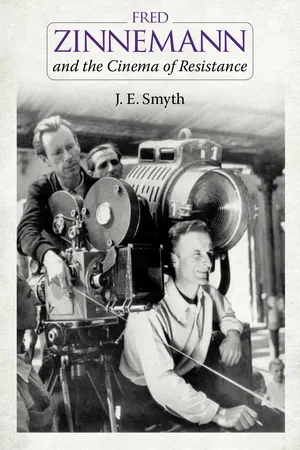
Fred Zinnemann directed some of the most acclaimed and controversial films of the twentieth century, yet he has been a shadowy presence in Hollywood history. In Fred Zinnemann and the Cinema of Resistance, J. E. Smyth reveals the intellectual passion behind some of the most powerful films ever made about the rise and resistance to fascism and the legacy of the Second World War, from The Seventh Cross and The Search to High Noon, From Here to Eternity, and Julia. Smyth's book is the first to draw upon Zinnemann's extensive papers at the Academy of Motion Picture Arts and Sciences and brings Fred Zinnemann's vision, voice, and film practice to life. In his engagement with the defining historical struggles of the twentieth century, Zinnemann fought his own battles with the Hollywood studio system, the critics, and a public bent on forgetting. Zinnemann's films explore the role of women and communists in the antifascist resistance, the West's support of Franco after the Spanish Civil War, and the darker side of America's national heritage. Smyth reconstructs a complex and conflicted portrait of Zinnemann's cinema of resistance, examining his sketches, script annotations, editing and production notes, and personal letters. Illustrated with seventy black-and-white images from Zinnemann's collection, Fred Zinnemann and the Cinema of Resistance discusses the director's professional and personal relationships with Spencer Tracy, Montgomery Clift, Audrey Hepburn, Vanessa Redgrave, and Gary Cooper; the critical reaction to his revisionist Western, High Noon; his battles over the censorship of From Here to Eternity, The Nun's Story, and Behold a Pale Horse; his unrealized history of the Communist Revolution in China, Man's Fate; and the controversial study of political assassination, The Day of the Jacka l. In this intense, richly textured narrative, Smyth enters the mind of one of Hollywood's master directors, redefining our knowledge of his artistic vision and practice.
- 330 pages
- English
- ePUB (mobile friendly)
- Available on iOS & Android
eBook - ePub
Fred Zinnemann and the Cinema of Resistance
About this book
Information
Publisher
University Press of MississippiYear
2014Print ISBN
9781617039645
9781617039645
eBook ISBN
9781626742345
Subtopic
Film & VideoCHAPTER ONE
From Germany to Algeria, and Other Historiographies of Resistance
“Just because you were German didn’t mean automatically that you were a monster.”
—Fred Zinnemann, 19761
“The weakness of all dictatorships is that they are vast bureaucracies.”
—Frederick Forsyth, The Day of the Jackal (1971), underlined by Fred Zinnemann in his personal copy
Fred Zinnemann was one of many filmmakers to leave an increasingly fascist Europe for Hollywood. He sailed to New York in the autumn of 1929, following close friend and documentary filmmaker Günther von Fritsch, who had settled in New York City. But, as he recalled, “two weeks in New York convinced me that hardly any ‘real’ movies were made there; Hollywood, a totally separate world … seemed to be the only answer.”2 He headed west, scouting the Hollywood landscape for a job. Trained as a cameraman at Paris’s new Technical School of Cinema, one of his first moves was to apply for membership in the Hollywood cameraman’s union. Even with the legendary Billy Bitzer (The Birth of a Nation, 1915; Intolerance, 1916) as his sponsor, he was refused admission. Despite forming friendships with European expatriates Berthold and Salka Viertel, and cameramen Joseph Ruttenberg, Gregg Toland, and Floyd Crosby, Zinnemann found it difficult to adjust to Hollywood in the 1930s. He disliked the production system’s inefficiency and lack of attention to historical detail, and was fired from the set of All Quiet on the Western Front for arguing with one of the assistant directors. He told Sam Goldwyn point blank that Hollywood pictures were “too slick.”3 Goldwyn was speechless for once. A few years and several mediocre jobs later, while working as an assistant to William Wyler on Dodsworth (1935), he disagreed with the director’s camera set-up.4 Wyler was one of the few to find the young upstart’s mixture of youthful enthusiasm and artistic distain amusing.
Zinnemann’s rebellion against the Hollywood system and a career of anonymity led him to accept a job in Mexico as the director of Paul Strand’s new government-funded film. Redes (The Wave, 1934–36) is the story of a fishing community on the Gulf Coast of Mexico which has been exploited for generations by wealthy oligarchs. When one man attempts to organize a strike and is assassinated, the people unite, cutting the “nets” of capitalism. Zinnemann spent seven months in Alvarado with Strand, writer Henwar Rodakiewicz, and Günther von Fritsch, who edited the film. They used local non-professionals in the roles, and cast university student Silvio Hernandez as the heroic strike leader. Though Strand’s interest in making a film about the development of working-class resistance among a group of fishermen was certainly imbued with the aims of Carlos Chavez and Mexico’s new socialist government,5 his tendency to shoot the film as a series of static images infuriated Zinnemann, who, like Sergei Eisenstein, saw cinematic movement as key to embodying revolutionary change. Despite being a staunch defender of photographic objectivity and its ability to engage with social change, Strand’s fascination with beautiful images often decontextualized them both in front of and behind the camera, and as art historian James Krippner has argued, betrayed his lack of sensitivity to issues of class, ethnicity, and gender.6 Zinnemann would later smooth over their ideological differences, remembering only that he and Strand “did not get on too well.” But the young director studied the left-wing photographer and his way of maintaining artistic control over the production. Zinnemann had little control over the final cut of Redes, but would remain proud of his involvement with the film. Late in life he was fond of pointing out that a few years after its release, “the Nazis found the negative and burned it.”7 It was the first but not the last time that one of his films attracted the wrath of a fascist political regime.
When he returned to Hollywood in late December 1934, Zinnemann was still looking for steady work. His resumé must have worried the conservative studio company men: he was associated with the socialist regime in Mexico and was a close friend of one of Hollywood’s biggest critics, Robert Flaherty. While working for Sam Goldwyn and Sidney Franklin on The Dark Angel (1935), he met Lillian Hellman and Dashiell Hammett, Hollywood writers who maintained their political radicalism while remaining on a studio payroll. Greta Garbo and Salka Viertel pulled strings to get him on the set of George Cukor’s Camille, but after directing Redes, he was in no mood to be anyone’s assistant again. But a mutual friend of his and Flaherty’s, cinematographer Floyd Crosby, got him an introduction to Jack Chertok of the MGM short department in 1937. Chertok admired Redes, which had just opened to good art-house reviews. He had an eye for training directors; Jules Dassin, Jacques Tourneur, and George Sidney all learned their craft in Chertok’s department. For several years, Zinnemann mastered the shorts system, even winning an Academy Award for That Mothers Might Live (1938), the story of an Austrian doctor’s cure for childbed fever obviously inspired by Zinnemann’s background as the son of a Viennese physician. He made several shorts that tapped into the current industrial trend in history films, such as The Story of Dr. Carver (1938) and The Old South (1940),8 but what he really wanted to do was a feature film about Mexican revolutionary Emiliano Zapata. MGM had recently promoted him to direct Van Heflin and Marsha Hunt in Kid Glove Killer (1942), but Zinnemann, while praising the talents of Heflin and Hunt, saw the contemporary thriller genre’s obvious limitations.9 Combining his familiarity with Mexico and fluent Spanish, expertise in producing economical historical films, and desire to make an anti-fascist film in keeping with Hollywood’s wartime aims, he wrote to Jack Chertok: “Up till now, the film industry has made a few feeble, though costly efforts in behalf of Pan-American solidarity and friendship. We all know how those efforts have failed, how they were booed off screens down there. More than ever, they made the Latin Americans feel that we have no respect for them, that we know nothing about their way of life, and that we care less. No wonder those pictures backfired. Meanwhile, the Germans keep releasing smoothly made films, successfully flattering the Latin American ego.”10 Zinnemann argued that a film about Zapata’s life “would be a gesture of respect, provided it is done with dignity and attention to historical truth.” According to Zinnemann, Zapata was a greater hero than the macho military icon Pancho Villa, who had been parodied by Wallace Beery in MGM’s Viva Villa! (1934). Zinnemann would never get to make the Zapata biopic, but his cinematic discovery, Marlon Brando, would star in Elia Kazan’s production several years later (Viva Zapata!, 1952). Instead, MGM producer Pandro S. Berman offered Zinnemann another project which tested his knowledge of Europe, anti-fascism, and heroism. It also connected with the young director’s interest in historical filmmaking and Hollywood’s war genre.
But the adaptation of Anna Seghers’s The Seventh Cross was unique as both a historical film and as an anti-Nazi war picture. Arguably, Hollywood’s films about American variants of fascism date back to Black Legion and They Won’t Forget (both 1937), while the studios’ early anti-Nazi films, an adaptation of Erich Maria Remarque’s Three Comrades (MGM, 1938) and Confessions of a Nazi Spy (Warner Bros., 1939), followed many months later.11 With the Nazi occupation of Belgium and Holland, and the French government’s collaboration with Nazi Germany in 1940, Hollywood’s denunciation of fascist Germany became clearer (Escape, MGM, 1940). Yet most Hollywood films about European resistance to fascism focused on the French Resistance (Joan of Paris, Casablanca, Reunion in France, all 1942; Passage to Marseille, 1943). Germans were cast as menacing military types, from Helmut Dantine’s fanatical young pilot (Mrs. Miniver, 1942) to Conrad Veidt’s menacing Major Strasser (Casablanca), who, acknowledging the myth of romantic Paris, slyly asks Rick Blaine (Humphrey Bogart), “Are you one of those people who can’t imagine the Germans in their beloved Paris?” Pan Berman wanted a different approach to the emerging war cycle, and was simultaneously exploring the theme of Eastern anti-fascist resistance histories with old RKO friend Katharine Hepburn, who played the anti-Japanese activist Jade in MGM’s adaptation of Pearl Buck’s historical novel, Dragon Seed (1944).12 But The Seventh Cross was an unusual choice for this production cycle since it was set in Germany, had a prewar historical setting, and its principal Resistance hero was, like Seghers herself, a communist political activist fleeing Nazi internment.13 Spencer Tracy, fresh from his work on The Keeper of the Flame (1943), an adaptation of Conrad Richter’s bestseller about hidden fascism in America, saw Seghers’s work as a way of building on his image as an anti-fascist hero in wartime. Intrigued by Berman’s description of Zinnemann, he asked to meet the young director. Their professional chemistry was immediate, and the men became good friends.
Zinnemann, thrilled with the prospect of working with MGM’s most revered star, read Helen Deutsch’s script with interest.14 Seghers had employed several recurring first-person voices throughout the novel. Anonymous Westhofen camp prisoners narrate German history and contextualize the escape, George thinks or mutters to himself throughout the massive manhunt, and the voice of Resistance leader Ernst Wallau, who is tortured to death after being recaptured, urges George to persevere in his escape.15 But for Deutsch and later Zinnemann, Wallau’s voice-over, heard even from the grave, became the central feature accompanying George’s escape and his political reawakening in the final scenes. Berman, Zinnemann, and Deutsch worried about introducing American audiences to the idea of German resistance to fascism in the 1930s, and were consequently preoccupied with the opening, explanatory voice-over. Deutsch’s early scripts expand and contract Wallau’s narration; at one point, the script contained multiple versions of the first sixteen pages of narration, and later the narration was considered important enough to merit a separate script composed entirely of the voice-over excerpts.16 Seghers would later write to Zinnemann saying that she felt Wallau’s voice-overs intruded too much in the narrative and were excessive,17 yet for Deutsch and for Zinnemann, this excess served a historical purpose. Wallau functioned as a crucial historical voice for a vanished group of Germans. George’s tendency to be silent in the opening sequences contrasts with both Wallau’s voice and George’s growing articulateness and political awareness in the second half.
The voice-over developed from the 1930s when it was occasionally used in lieu of a superimposed text foreword in historical films. Both the historical gangster smash-hit The Roaring Twenties (1939) and the George M. Cohan biopic Yankee Doodle Dandy (1942) used this form of narration in different ways: to link the subject matter to contemporary reportage and to personalize histories with the voice of the protagonist.18 A few years later, film noir would also tend toward voice-over narration, learning from Hitchcock’s Rebecca (1940). Voice-over narration would briefly dominate production of noir, from Double Indemnity, Murder, My Sweet, and Laura (all 1944) to The Locket (1946), Dark Passage (1947), Out of the Past (1947), and Sunset Boulevard (1950). All of these noirs were focused on the protagonists’ harrowing past lives and complicated the genre’s allegedly contemporary contexts. The association between voice-over narration, fraught histories, and claustrophobic personal disaster also links these later noirs with the motifs of The Seventh Cross.19 Yet The Seventh Cross’s reliance upon voice-over instead of the more conventional text superimpositions embodied the anti-fascist/anti-Nazi movement’s own vulnerability and marginality in a world where official histories and documents were easily corrupted for the purposes of political propaganda. As historian Margaret Collins Weitz has pointed out, “Underground movements do not leave written records.”20 Documents found by Nazis or fascist militia were a death sentence. In The Seventh Cross, oral history recovers the narrative of early anti-fascist resistance in Germany—a narrative that, like its protagonists, is all but extinct.
The film begins with what Deutsch described as Wallau’s “calm, deliberate, dispassionate” voice, narrating a story almost unknown to the historical records but crucial to remember: “When all the stories have been told, the great stories and the little ones—the tragedies and the melodramas—when all the stories of what happened in Europe have been told, as of course they never can be, the seventh cross will be remembered as the story of a few little people who proved there is something in the human soul which sets men above the animals and beyond them.” Wallau also provides the necessary historical background: “It happened in Germany in the fall of the year 1936 … the wars and aggressions had not yet begun, but the concentration camps were filled—the Germans were still purging their own country of rebels—purging their nation of the last traces of human decency.”21 Many of Seghers’s prisoners were incarcerated members of the once flourishing Communist Party (the KPD), the Nazi Party’s main radical opponent in the late 1920s and 1930s (as opposed to the more established German Socialist Party, the SPD). In March 1933, the Nazis began arresting party members, sending thousands of them to torture and death in the newly created Dachau concentration camp. Until his arrest, George Heisler was one of the party’s strongest adherents, and was widely known as a trained demonstrator and agitator. Wallau was his teacher. Yet Seghers was careful not to make her communist persuasions and those of her hero too apparent.22 There were references to former party officials and demonstrations in the novel, b...
Table of contents
- Cover Page
- Title Page
- Copyright Page
- Dedication
- Contents
- Acknowledgments
- Introduction
- Chapter One: From Germany to Algeria, and Other Historiographies of Resistance
- Chapter Two: Surviving Voices and the Search for Europe
- Chapter Three: The Un-American Western
- Chapter Four: American Fascists
- Chapter Five: Breaking the Silence of Women in the Resistance
- Chapter Six: Aging Revolutionaries and the Loss of History
- Chapter Seven: Resistant Women in Contested Frames
- Notes
- Bibliography
- Index
Trusted by 375,005 students
Access to over 1.5 million titles for a fair monthly price.
Study more efficiently using our study tools.
Frequently asked questions
Yes, you can cancel anytime from the Subscription tab in your account settings on the Perlego website. Your subscription will stay active until the end of your current billing period. Learn how to cancel your subscription
No, books cannot be downloaded as external files, such as PDFs, for use outside of Perlego. However, you can download books within the Perlego app for offline reading on mobile or tablet. Learn how to download books offline
Perlego offers two plans: Essential and Complete
- Essential is ideal for learners and professionals who enjoy exploring a wide range of subjects. Access the Essential Library with 800,000+ trusted titles and best-sellers across business, personal growth, and the humanities. Includes unlimited reading time and Standard Read Aloud voice.
- Complete: Perfect for advanced learners and researchers needing full, unrestricted access. Unlock 1.5M+ books across hundreds of subjects, including academic and specialized titles. The Complete Plan also includes advanced features like Premium Read Aloud and Research Assistant.
We are an online textbook subscription service, where you can get access to an entire online library for less than the price of a single book per month. With over 1.5 million books across 990+ topics, we’ve got you covered! Learn about our mission
Look out for the read-aloud symbol on your next book to see if you can listen to it. The read-aloud tool reads text aloud for you, highlighting the text as it is being read. You can pause it, speed it up and slow it down. Learn more about Read Aloud
Yes! You can use the Perlego app on both iOS and Android devices to read anytime, anywhere — even offline. Perfect for commutes or when you’re on the go.
Please note we cannot support devices running on iOS 13 and Android 7 or earlier. Learn more about using the app
Please note we cannot support devices running on iOS 13 and Android 7 or earlier. Learn more about using the app
Yes, you can access Fred Zinnemann and the Cinema of Resistance by J. E. Smyth in PDF and/or ePUB format, as well as other popular books in Media & Performing Arts & Film & Video. We have over 1.5 million books available in our catalogue for you to explore.