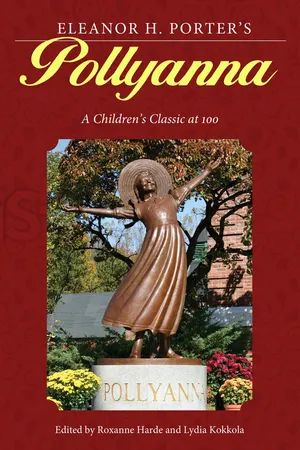
Appearing first as a weekly serial in The Christian Herald, Eleanor H. Porter's Pollyanna was first published in book form in 1913. This popular story of an impoverished orphan girl who travels from America's western frontier to live with her wealthy maternal Aunt Polly in the fictional east coast town of Beldingsville went through forty-seven printings in seven years and remains in print today in its original version, as well as in various translations and adaptations. The story's enduring appeal lies in Pollyanna's sunny personality and in her glad game, her playful attempt to accentuate the positive in every situation. In celebration of its centenary, this collection of thirteen original essays examines a wide variety of the novel's themes and concerns, as well as adaptations in film, manga, and translation. In this edited collection on Pollyanna, internationally respected and emerging scholars of children's literature consider Porter's work from modern critical perspectives. Contributors focus primarily on the novel itself but also examine Porter's sequel, Pollyanna Grows Up, and the various film versions and translations of the novel. With backgrounds in children's literature, cultural and film studies, philosophy, and religious studies, these scholars extend critical thinking about Porter's work beyond the thematic readings that have dominated previous scholarship. In doing so, the authors approach the novel from theoretical perspectives that examine what happens when Pollyanna engages with the world around her—her community and the natural environment—exposing the implicit philosophical, religious, and nationalist ideologies of the era in which Pollyanna was written. The final section is devoted to studies of adaptations of Porter's protagonist.
- 272 pages
- English
- ePUB (mobile friendly)
- Available on iOS & Android
eBook - ePub
About this book
Information
Part 1
POLLYANNA’S WORLD
1
“Then just being glad isn’t pro-fi-ta-ble?”: Mourning, Class, and Benevolence in Pollyanna
ROXANNE HARDE
As early as the tenth short chapter of Eleanor H. Porter’s Pollyanna, the novel’s eponymous hero has moved from profound loneliness to being so thoroughly contented that she “often told her aunt, joyously, how very happy [her days] were” (86). Pollyanna’s joy has come, in the main, from the effort she has put into her new community, from her benevolent actions on behalf of its less fortunate members, an effort born of the work of mourning. Even at this early stage of the novel, her glad game has made a difference to several people, and playing it has helped Pollyanna work through her grief over the recent death of her father and the earlier death of her mother. Aunt Polly—for whom benevolence is merely a duty and who has responded to her many losses with bitterness and isolation—replies to Pollyanna’s declaration that her days were happy: “I am gratified, of course, that they are happy; but I trust that they are profitable as well . . . otherwise I should have failed signally in my duty” (86). Pollyanna, who already knows that she might come to hate the word duty, finally asks if it would not be enough that her days were happy, “They must be pro-fi-table as well? . . . Then just being glad isn’t pro-fi-ta-ble?” (87). She seems to reach an intuitive understanding that both duty and profit are about personal investment and benefit, and are, at least from Aunt Polly’s example, conjoined to class. Duty and benevolence, to Aunt Polly, both represent and entrench one’s social standing. For Pollyanna, duty and benevolence require a wholehearted engagement with life that enables her to work through her mourning and come to terms with her orphanhood.
Considered alongside theoretical discourse that analyzes the operations of mourning and responses to absence, Pollyanna offers far more than the usual Progressive-era commentary on Christianity or sentimentalism or social institutions with which it is regularly credited. In Writing History, Writing Trauma, Dominick LaCapra cautions that because of personal loss or general empathy, people may invest death with value to which they remain “dedicated or at least bound,” which is both intolerable and no solution to loss (23). LaCapra argues that to work through mourning means articulating affect and representation in a way that precludes transcendence or withdrawal.1 In The Work of Mourning, a collection of eulogies written on the deaths of his friends, Jacques Derrida suggests that recognizing death and working through grief is a supremely verbal act. Even as he notes the impossibility of speaking at times of mourning, Derrida considers silence “another wound, another insult” (50). Refusing to make of death, and therefore mourning, an allegory or even a metaphor, Derrida models mourning as a movement toward life, a kind of ongoing work: “In and of itself. Even when it has the power to give birth, even and especially when it plans to bring something to light” (142–43). For both LaCapra and Derrida, the work of mourning allows an engagement with loss and insists on a reinvestment in life.
As a novel in which nearly every character suffers from loss, mainly of loved ones who have died or moved on, Pollyanna enacts a response to loss and mourning that reconsiders Progressive-era benevolence and posits Pollyanna’s “gladness,” in the form of her engagement with life, as an appropriate means to work through mourning. In its discussion of mourning and class in Pollyanna, this chapter engages with turn-of-the-century debates about benevolence and the orphan. While Porter offers pointed commentary on private and public altruism—even as she lamentably reinstates the socio-economic status quo, by attaching philanthropic social action to the act of mourning—her novel enacts an outlook as hopeful as Pollyanna herself.
“Practically nothing”: Mourning and an Orphan’s Worth
In its comments on the social movement toward the institutionalization of benevolence, Pollyanna offers some insight into changing representations of the orphan in children’s literature through the late nineteenth and early twentieth centuries. As Claudia Nelson points out, “the orphan’s undeniable symbolic qualities change over time” (65). Where antebellum orphans adapt to their new circumstances rather than changing the adults around them, Reconstruction-era orphans, “like the ideal immigrant, are often represented as infinitely flexible, upwardly mobile, and potentially useful” (Nelson 65). After the turn of the twentieth century, Nelson argues, the dependent child is used “to illustrate and endorse important new approaches toward children as a group, especially the redefining of the child’s value as emotional rather than practical. . . . Orphan fiction recapitulates the late-nineteenth-century debate about what to do with the dependent child, a debate in which the impulse to nurture the parentless slowly vanquished the impulse to hire them” (55). Even so, Pollyanna offers both sides of this debate about the value of a dependent child: Pollyanna’s value is clearly emotional, but before Porter introduces her, she introduces her readers to Nancy, whose value is practical.
Miss Polly’s new servant has been with her two months; this young woman, “had never ‘worked out’ before; but a sick mother, suddenly widowed and left with three younger children besides Nancy herself, had forced the girl into doing something towards their support in the kitchen of the great house on the hill” (2). Nancy’s, and possibly Pollyanna’s, worth may be practical to the adults in the novel, but it is emotional to Pollyanna. When Nancy expresses joy that a little girl, like “the sunshine her own little sisters made,” will brighten up Miss Polly’s home and life, Miss Polly replies: “Nice? Well, that isn’t exactly the word I should use. . . . However, I intend to make the best of it, of course. I am a good woman, I hope; and I know my duty” (3). Nancy’s ensuing sense that “somehow she must prepare a welcome for this lonely little stranger” demonstrates the emotional value she will hold for Pollyanna (3). A dependent child forced by the death of her father into independence, Nancy also functions as a mirror and model for Pollyanna as she adumbrates Pollyanna’s benevolent actions.
Both girls have recently lost their fathers, and while Pollyanna’s father has taught her the glad game that will enable her to work through her mourning, Nancy draws on her own experience of loss to understand that Pollyanna needs her. Shortly after they meet, Nancy develops an “aching sympathy for the poor little forlornness beside her” (19). By the end of the first chapter, she declares to Timothy, “You couldn’t hire me ter leave! . . . she’ll be aneedin’ some rock to fly to for refuge. Well, I’m a-goin’ ter be that rock” (22). The grieving and compassionate Nancy thus sets the stage for Pollyanna and her glad game. LaCapra suggests that converting absence (an infinite site of pain) into loss (which ends with the thing or person lost and mourned), allows a “crucial distinction between then and now wherein one is able to remember what happened to one in the past but realizes one is living in the here and now with future possibilities” (46–47). Forced into service by her family’s need, Nancy must grieve her father’s death with the same efficiency she brings to cooking and cleaning for Miss Polly. The novel may blithely accept the assignments and distinctions of class—one mourning girl moves into the domestic labor force while the other moves into privilege and a new wardrobe—but it also champions Nancy’s active engagement with her present and future, particularly her growing friendship with Timothy. Nancy’s practical approach to loss and change, to use LaCapra’s terms, “opens up empowering possibilities . . . in the creation of a more desirable, perhaps significantly different . . . life in the here and now” (58).
Porter brings Nancy’s liveliness, and her compassion for Pollyanna, into sharp contrast with Aunt Polly’s view of the little girl. The language of worth and class-based duty surrounds Polly’s view of her niece, and lacks the compassion Nancy expresses, which would mitigate Polly’s focus on social standing and wealth. The letter that requests she take her niece invokes questions surrounding the value of an orphan: “I regret to inform you that the Rev. John Whittier died two weeks ago, leaving one child, a girl eleven years old. He left practically nothing else save a few books; for, as you doubtless know, he was the pastor of this small mission church, and had a very meagre salary” (4). Where the letter suggests that this child has emotional value, in that it suggests Pollyanna’s belonging “among her own people,” and that Polly might actually desire to raise the penniless orphan for her “sister’s sake,” Polly’s response, “She hoped she knew her duty . . . disagreeable as the task would be,” makes clear she sees the child as only a burden she is obliged by her social position to undertake (5). To her aunt, Pollyanna has no emotional or economic value. Even as Polly expresses her frustration at this unwelcome burden, she ruminates on the loss of her sister, “when Jennie, as a girl of twenty, had insisted upon marrying the young minister, in spite of her family’s remonstrances. There had been a man of wealth who had wanted her—and the family had much preferred him to the minister but Jennie had not. . . . The break had come then” (5). The Harrington family’s preference for the man of wealth and standing over the impoverished minister speaks to their place within the constrictions of class and social standing, in the same way that Polly meets social expectations about her duty as Pollyanna’s last living relative. The early perspective of her, through Nancy’s eyes, as an impossible-to-please, “stern, severe-faced woman . . . who never thought to smile,” places Polly in an antagonistic position. She clearly sees the worth of the dependent child as only practical and tied to her class.
However, Porter also adds enough detail about Polly’s past—the deaths of her parents and both sisters, and the loss of her lover—that readers should understand Polly as a figure who has retreated into absence and pain. In LaCapra’s terms, she is bound to death and the past. Her focus on her money and possessions can be read as a focus on all that has been left to her, and her retreat into her house and solitude is complete: “For years now, she had been sole mistress of the house and of the thousands left her by her father. There were people who had openly pitied her lonely life, and who had urged her to have some friend or companion to live with her; but she had not welcomed either their sympathy or their advice. She was not lonely, she said” (6). If choosing solitude and a retreat into her wealth, absenting herself from the fullness of life, is Polly’s response to loss, a response that offers safety and the means to defer the pain of mourning, then Pollyanna’s presence understandably causes her aunt a good deal of anxiety. By simply living under the same roof, Pollyanna threatens Polly’s comfortable retreat into absence and stagnation.
“The little attic room”: The Site of Mourning
However, Pollyanna does more than simply live. As she explains to her aunt, living involves much more than breathing and should include a combination of playing, reading, climbing, talking, and finding things out (51). Living, to Pollyanna, means going out and engaging fully with her community, her surroundings, and her life. In so doing, she moves past absence and undertakes the work of mourning that, LaCapra contends, “brings the possibility of achieving a reinvestment in, or recathexis of, life, which allows one to begin again” (66). From their first meeting, Pollyanna’s concentration of emotional energy defines her value as emotional and negates Polly’s practical view of the child. When they meet, Polly does not consider it her duty to rise to greet her niece, so the child flings herself into “her aunt’s scandalized, unyielding lap,” just as she will fling herself into her new life (23). As in this scene, the narrative often stands clearly in judgment of Polly, particularly through Nancy. Nancy feels Polly should be ashamed for not meeting the child’s train and for putting her in a room that is “like an oven for heat” (12). Nancy’s rant, as she prepares the attic room for Pollyanna’s arrival, initially suggests that she thinks Polly miserly with possessions, space, and affection: “The idea of stickin’ that blessed child ’way off up here in this hot little room—with no fire in the winter, too; and all this big house ter pick and choose from! Unnecessary children indeed!” (7). Later, as Nancy helps Pollyanna move into the room, the younger girl fears that she may have taken Nancy’s room, which then reduces Nancy to tears and emphasizes the connection between the two recent bereavements. When Nancy defines the attic room as “a pretty place this is ter put a homesick, lonesome child into!” she displays both empathy for the newly orphaned little girl and the crux of her criticism of Polly and the attic room: this is an inappropriate place for a child to undertake the work of mourning (8).
The narrative validates Nancy’s conclusion as she brings Pollyanna home from the station, and the child mentions her father for the first time: “‘What a pretty street! I knew ’twas going to be pretty; Father told me—’ She stopped with a little choking breath. Nancy, looking at her apprehensively, saw that her small chin was quivering and that her eyes were full of tears” (17). Where Nancy sympathizes with the grieving girl, Aunt Polly expects her to ignore her loss, just as she has refused to acknowledge her own. When Pollyanna meets her aunt and mentions her father twice, Aunt Polly interrupts her both times, saying sharply “there is one thing that might just as well be understood right away at once; and this is, I do not care to have you keep talking of your father to me” (24). Forbidden to speak of her loss, to engage in the discourse of mourning Derrida posits as vital in the work of grieving around her aunt, Pollyanna must turn to her little attic room as the site of her mourning, a room where she can continue to play the glad game only when she looks outside through the window.
How, then, does this discourse of mourning function? In The Work of Mourning, Derrida contends that, ultimately, the living can only give the dead something in us: our memory. One must speak of the dead, in Derrida’s terms, “to combat all the forces that work to efface or conceal not just the names on the tombstones but the apostrophe of mourning” (30). This apostrophe, the address to the living, the eulogy, meets a number of needs, as Derrida asks, “What are we doing when we exchange these discourses? Over what are we keeping watch? Are we trying to negate death or retain it? Are we trying to put things in order, make amends, or settle our accounts, to finish unfinished business?” (50). In mourning her father, Pollyanna keeps watch over his memory and negates death by keeping him with her through language. As his child, she is her father’s unfinished business; only by living fully and through the example he has set, the glad game he taught her, will she perform the functions of mourning.
In denying Pollyanna discourse about her father, Aunt Polly effectively takes away one of the child’s few remaining connections to her past, to the things and people that were hers. As they go up to the attic room, Pollyanna’s “big blue eyes tried to look in all directions at once, that no thing of beauty or interest in this wonderful house might be passed unseen. Most eagerly of all her mind turned to the wondrously exciting problem about to be solved; behind which of all these fascinating doors was waiting now her room—the dear, beautiful room, full of curtains, rugs, and pictures, that was to be her very own?” (26). Lori Ginzberg suggests that nineteenth-century benevolence laid the groundwork for the emergence of early-twentieth-century middle-class, conservative reform movements that placed more emphasis on social control (206–8). Aunt Polly blurs any distinctions between duty, benevolence, and acceptable behavior as she undertakes Pollyanna’s training, one form of social control, but completely ignores Pollyanna’s grief and misreads the child’s need to have a home and family to call her own. Admiring the beauty around her, her aunt’s luxurious black silk skirt, a soft green carpet, gilt picture-frames, and lace curtains as her aunt takes her upstairs to her new room, Pollyanna declares “what a perfectly lovely, lovely house! How awfully glad you must be you’re so rich!” (25). Aunt Polly corrects her harshly: “I hope I could not so far forget myself as to be sinfully proud of any gift the Lord has seen fit to bestow upon me . . . certainly not of riches!” (25). Faced with Pollyanna’s passion for life and desperate need to make Polly and the house her very own, Polly falls back on the social status quo and doctrines of sin. Her immediate thoughts are about controlling what she understands as Pollyanna’s vices: “She was glad, now, that she had put the child in the attic room. . . . Now—with this evident strain of vanity showing thus early—it was all the more fortunate that the room planned for her was plain and sensible” (26). However, she also thinks, “Her idea at first had been to get her niece as far away as possible from herself, and at the same time place her where her childish heedlessness would not destroy valuable furnishings” (26). In so doing, Polly further negates the child’s need to mourn and reaffirms her own retreat into absence and the denial of life. Later, when Polly finally relents and moves Pollyanna to a proper bedroom, she devalues the child’s joy with further emphasis on her possessions, asking her niece for assurance that “if you think so much of all those things, I trust you will take proper care of t...
Table of contents
- Cover
- Title Page
- Copyright Page
- Dedication
- Contents
- Acknowledgments
- Introduction. Glad to be 100: The Making of a Children’s Classic
- Part I: Pollyanna’s World
- Part II: Ideological Pollyanna
- Part III: Adapted Pollyanna
- Afterword. Lessons from Pollyanna
- Contributors
- Index
Trusted by 375,005 students
Access to over 1.5 million titles for a fair monthly price.
Study more efficiently using our study tools.
Frequently asked questions
Yes, you can cancel anytime from the Subscription tab in your account settings on the Perlego website. Your subscription will stay active until the end of your current billing period. Learn how to cancel your subscription
No, books cannot be downloaded as external files, such as PDFs, for use outside of Perlego. However, you can download books within the Perlego app for offline reading on mobile or tablet. Learn how to download books offline
Perlego offers two plans: Essential and Complete
- Essential is ideal for learners and professionals who enjoy exploring a wide range of subjects. Access the Essential Library with 800,000+ trusted titles and best-sellers across business, personal growth, and the humanities. Includes unlimited reading time and Standard Read Aloud voice.
- Complete: Perfect for advanced learners and researchers needing full, unrestricted access. Unlock 1.5M+ books across hundreds of subjects, including academic and specialized titles. The Complete Plan also includes advanced features like Premium Read Aloud and Research Assistant.
We are an online textbook subscription service, where you can get access to an entire online library for less than the price of a single book per month. With over 1.5 million books across 990+ topics, we’ve got you covered! Learn about our mission
Look out for the read-aloud symbol on your next book to see if you can listen to it. The read-aloud tool reads text aloud for you, highlighting the text as it is being read. You can pause it, speed it up and slow it down. Learn more about Read Aloud
Yes! You can use the Perlego app on both iOS and Android devices to read anytime, anywhere — even offline. Perfect for commutes or when you’re on the go.
Please note we cannot support devices running on iOS 13 and Android 7 or earlier. Learn more about using the app
Please note we cannot support devices running on iOS 13 and Android 7 or earlier. Learn more about using the app
Yes, you can access Eleanor H. Porter's Pollyanna by Roxanne Harde, Lydia Kokkola in PDF and/or ePUB format, as well as other popular books in Literature & Literary Criticism. We have over 1.5 million books available in our catalogue for you to explore.