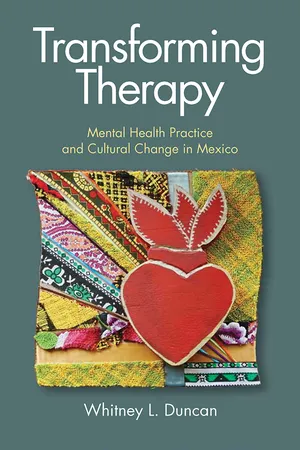
Oaxaca is known for many things—its indigenous groups, archaeological sites, crafts, and textiles—but not for mental health care. When one talks with Oaxacans about mental health, most say it's a taboo topic and that people there think you "have to be crazy to go to a psychologist." Yet throughout Oaxaca are signs advertising the services of psicólogos; there are prominent conferences of mental health professionals; and self-help groups like Neurotics Anonymous thrive, where participants rise to say, "Hola, mi nombre es Raquel, y soy neurótica."How does one explain the recent growth of Euroamerican-style therapies in the region? Author Whitney L. Duncan analyzes this phenomenon of "psy-globalization" and develops a rich ethnography of its effects on Oaxacans' understandings of themselves and their emotions, ultimately showing how globalizing forms of care are transformative for and transformed by the local context. She also delves into the mental health impacts of migration from Mexico to the United States, both for migrants who return and for the family members they leave behind. This book is a recipient of the Norman L. and Roselea J. Goldberg Prize from Vanderbilt University Press for the best book in the area of medicine.
eBook - ePub
Transforming Therapy
Mental Health Practice and Cultural Change in Mexico
- English
- ePUB (mobile friendly)
- Available on iOS & Android
eBook - ePub
About this book
Information
Topic
MedicineSubtopic
Psychiatry & Mental Health1
Go Where There Is No Path and Leave a Trail
Do not follow where the path may lead.
Go instead where there is no path and leave a trail.
Muriel Strode, “Wind-Wafted Wild Flowers.” *
Two Scenes from Oaxaca’s World of Psy
The Wild West of Psychiatry
On a hot morning in September, my psychiatrist friend Alfredo picked me up for the Southern Regional Conference of the Asociación Psiquiátrica Mexicana (Mexican Psychiatric Association, www.psiquiatrasapm.org.mx), a multiday event where he and many other psychiatrists from southern Mexico were presenting. Alfredo had kindly offered to help me get around the meetings not only because I would likely be the only nonpsychiatrist but also because I had a sprained ankle and was going to be navigating the event on crutches. My plan had been to attend as much of the conference as possible, but the injury—sustained during Mexican Independence Day festivities—kept me away for the first few days. Now, with the conference in full swing, we arrived at the Hotel Fortín Plaza, a tall hotel overlooking Oaxaca City, fully outfitted in psychiatric paraphernalia and green, red, and white Mexican flag–themed decorations to celebrate the “Psychiatry of Bicentennial Mexico: Achievements and Expectations.”
After parking, Alfredo and I slowly made our way to the lobby, stopping for me to photograph the barrage of pharmaceutical advertising in the outdoor entryway. The first poster we saw welcomed us to the conference and presented the logo of the meeting’s main sponsor, psicofarma, and its catch phrase, “al servicio de la salud mental” (at the service of mental health). The conference schedule was printed on a large Valdoxa (agomelatine, an SSRI antidepressant) poster next to a Paxil-CR (paroxetine, another SSRI antidepressant) poster with photos of people miserably holding their heads, apparently in the throes of depression, juxtaposed with a circled photo of a smiling woman. This was just the entryway.
Psychiatrists, pharmaceutical representatives, and other conference attendees, all of whom wore nametags around their necks on lanyards printed with the names of pharmaceuticals, were milling around the conference, some hurrying to make it to panels, others chatting in the hotel’s various nooks and crannies. Alfredo helped me to several panel presentations that discussed epidemiological findings (e.g., rates of depression and ADHD) in southern Mexico, psychopharmaceutical treatment efficacy, and the need for more research, increased access to services, and more widespread psychological education.
After a few hours observing panels, Alfredo was clearly keen to go upstairs to the commercial area. We made our way into a large room filled with colorful, high-tech pharmaceutical company stands from which representatives distributed free medication samples, t-shirts, water bottles, backpacks, and promotional pharmaceutical literature. The room was inundated with illuminated signs printed with phrases like “Life as it’s meant to be lived” next to photos of smiling people playing in parks, hiking in mountains, and lounging on sailboats. There was a palpable excitement in the room as hundreds of people made their way from one stand to the next, filling their bags. “Good morning, doctor. Have you tried Lexapro with your patients?” the representatives asked. “How are you, doctor? Did you know Seroquel can be used in conjunction with antidepressants for treatment-resistant patients?”
Initially hesitant, I kept clarifying that I was not a psychiatrist, but soon I submitted to the flow and eagerly accepted the generous handouts. Alfredo, who was enthusiastically jumping from stand to stand, found me a free, bright red Zoloft backpack so I could carry my pharmaceutical booty hands-free on crutches. The bag was already practically full—bottles of pills, pens, highlighters, books, and a collapsible Frisbee—when Alfredo pointed out a stand that would print your photo on a Pristiq (desvenlafaxine, an SNRI antidepressant) coffee mug. He led me to the stand and, laughing, told the vendor to take my photo. It turned out to be my favorite souvenir: next to my color portrait on the coffee mug and several Pristiq logos, it reads, “In matters of mental health, I trust my psychiatrist.”
A bit later, sipping an iced coffee frappe sample at another stand, relishing a moment without movement, I suddenly noticed that people had begun streaming out for an invited luncheon. Alfredo said he would see me later: I was on my own, apparently not invited to the event. I stood outside for a few minutes wondering what to do with myself, then saw an empty chair in the back of the darkened luncheon room that I just couldn’t resist, not only because I was desperate to sit down but because the room was so strangely enticing. Brightly colored stage lights flashed while a sign with a photo of an old-fashioned saloon announced, “The Adventure Starts Here!” and advertised a “REWARD” in old Western film font. The whole place was decorated in an American Wild West aesthetic consistent with the name of what was apparently a quiz-show competition, “Los más buscados” (The most wanted). It was clearly a not-to-be-missed event. The winner’s REWARD would be a free trip to the Mexican National Psychiatric Association conference. From there, he or she would be eligible to win a trip to Prague for the 2012 World Psychiatric Association’s International Conference.
I slipped in as subtly as possible and no one seemed to notice. They were absorbed by the movie being played on a large screen: Anger Management, a 2003 film in which Jack Nicholson plays Adam Sandler’s psychopathic psychiatrist. The film had been dubbed, but not with direct translations from English to Spanish. Rather, Sandler and Nicholson were speaking in Spanish about “complete remission of symptoms with Rivotril,” the trade name of Klonopin (clonazepam, a benzodiazepine for anxiety) outside of the United States. Sandler complained to his girlfriend about the medication side effects, but she told him he had to stay on it for his own good. He and Nicholson bickered about treatment and got some laughs from the audience members, most of whom were sipping sodas, eating chips, and snapping photos of the event.
Soon waiters began handing out boxed lunches and an actor in full Western getup—cowboy hat with a sheriff’s badge on it, a red bandana around his neck, a red collared cowboy shirt, and black jeans—started his on-stage performance. His job was to engage the audience and get us riled up about the competition; to that end, he made jokes, danced, incited audience members to dance and sing, and walked around poking fun at people, accompanied all the while by bright stage lights, sound effects, sensational music, the camera flashes of many professional photographers roaming the room, and dancing helpers also dressed in cowboy garb. Via remote control, psychiatrists keyed in their answers to quiz questions like “How long do patients have to present with anxious symptoms before they qualify for Generalized Anxiety Disorder?” The cowboy ran up and down the aisles calling on people, and the correct answers were displayed on the large screen, complete with more music and fanfare.
Global Treatments, Local Selves After the quiz show, I hurried as quickly as I could to a panel organized by psychiatrists from Cruz del Sur, Oaxaca’s public psychiatric hospital where I had been conducting research. The psychiatrists had been putting the panel together for months—my first day at the hospital six months before, psychiatrists had asked me if I could recommend sources on complementary medicine, New Age healing, and why people utilize these forms of care. Frustrated by patient “non-compliance,” they wanted to know more about the nonpsychiatric treatments their patients consistently sought instead of adhering to psychiatric medications and attending consultations at the psychiatric hospital. The panel was the culmination of their research on these topics.
Finally, I arrived at a small, out-of-the-way room just off the hotel restaurant; it was not easy to find, and the panel was not particularly well attended. I was struck by how sharply it contrasted with the cowboy quiz show, where the prestigious world of globalized biomedical psychiatry had been hyperpresent. American film and music; an American-style cowboy enthusiastically quizzing psychiatrists about DSM diagnoses and pharmaceutical prescription practice (which practitioners had brushed up on in the commercial area); an award with the potential to send them to the World Psychiatric Meetings in Prague; and the very visible sponsorship of an American pharmaceutical marketing company, moksha8—a name appropriated from Hindu philosophy that refers to the ultimate release from cycles of death and rebirth—had all combined to create a distinctively global and postmodern milieu.
While the Cruz del Sur panel was attempting to address similar issues, including how to persuade patients to adhere to these globalizing pharmaceuticals and accept their biomedical psychiatric diagnoses despite the many other options available to them, there was no fanfare. Rather than a celebratory, noisy pastiche of American iconography, the panel room felt quiet, and there was an air of defensiveness to each presentation. I had learned in the prior months that these psychiatrists tended to feel stigmatized in Oaxaca’s culture of health, in which only very recently had psychology and psychiatry emerged as legitimate forms of care. They frequently mentioned that their services are still viewed by many Oaxacans as reserved for “crazy people,” not as a valid form of treatment for a wide range of psychological maladies.
It was therefore extremely important to hospital psychiatrists, along with many other mental health practitioners in the region, to correct what they saw as a grave set of misperceptions, but the fact that it was so hard seemed to confirm to them the backwardness of their own state. Since there is no psychiatric specialization in Oaxacan medical schools, all of these psychiatrists—most whom are Oaxacan themselves—had studied in other areas of Mexico. They sometimes compared Oaxaca to those more cosmopolitan states, not without a hint of longing. But these doctors were committed to serving the underprivileged of their home state; after all, they could be making more money working with less severe cases in private practice in Oaxaca City or larger urban centers. Rather, they want to accessibly provide what they see as much-needed services by working at the public hospital.
There, they tirelessly seek to educate Oaxacans about mental health issues, to spread awareness, “concientizar” (create consciousness), as they put it. In fact, the perception that stigma against both mental health problems and mental health care is rampant acts as an incitement to action for many psychiatrists and psychologists in the state, who engage in explicit efforts to spread psicoeducación. The civilizing undertone to the consciousness-raising project is clear: part of psicoeducación consists of dispelling so-called pensamiento mágico (magical thinking) and disparaging both traditional and complementary medical practice, which from psychiatrists’ perspective is at best a waste of time and at worst exacerbates mental illness. While patients are taking herbs and getting limpias (spiritual cleanses), they could be taking much-needed psychiatric medications. Instead, practitioners say patients wait until illnesses have become much more severe and unmanageable until finally, as a last resort, they seek care at the hospital. The Cruz del Sur panel at the Southern Regional Conference of the Mexican Psychiatric Association was thus part of a broader endeavor to better understand patient treatment-seeking practices.
The first few presenters discussed various forms of CAM such as reiki, acupuncture, and biomagnetism, and hazarded guesses as to why people were drawn to them. A psychiatrist named Dr. Silva explained that the use of these treatments was very “cultural”; people are drawn to them, she explained, because they “engage the emotional, spiritual, and social” and claim to be “natural.” Reviewing the evidence for these treatments’ efficacy, another psychiatrist, Dr. Juárez, asserted, “They are not based upon authoritative knowledge.” Wound up in the discussion was Mexican and Oaxacan medicina tradicional, which the psychiatrists distinguished from CAM practices only insofar as the former was considered to be local while the latter was understood as imported and thus constituted what Dr. Juárez referred to as “emergent phenomena” requiring much more research.
Finally, a psychiatrist named Dr. Ramos presented a rather philosophical essay on spirituality and on how traditional and alternative treatments, unlike psychiatry, purported to fulfill patients’ search for spiritual answers, meaning, and well-being. These promises were particularly hard to resist in moments of crisis or illness, he explained, but many spiritual treatments could have negative effects, like depersonalization, even psychosis, and traditional and alternative practitioners were not trained to deal with serious problems of mental illness. This was the crux of the psychiatrists’ concern: on the one hand, they were confident that their psychiatric services were the appropriate form of care for mental illness and emotional problems, but, on the other, they knew people were resistant to such services and in search of more holistic forms of healing, either through complementary or traditional medicine. How could psychiatrists better market themselves?
In closing, Dr. Ramos mentioned limpias for the treatment of mal de ojo (evil eye), mal aire (bad air), witchcraft, soul-loss, and susto. Limpias—“you know, the kind your grandmother used to give you,” Dr. Ramos said, getting a laugh from audience members. They had all had limpias themselves at one point or another.
At the “Most Wanted” quiz show, the idea of Mexican or Oaxacan “culture” felt far away, and it was supposed to: the psychiatrists were engaged in a global endeavor to detect, diagnose, and treat mental disorder. The conference confirmed the legitimacy of the endeavor, whereas “local” cultural forms, practices, and ideas were understood to distract from it. At the Cruz del Sur panel, however, we can see how the project of promoting mental health becomes much more complicated on the ground. Unlike in the idealized world of global psychiatry—which seeks to be acultural, based upon notions of universally present psychiatric disorders treatable with universally effective psychopharmaceutical medications—the Cruz del Sur psychiatrists had to confront the fact of “culture”: they were faced with it every day.
Managing Emotions
The Southern Regional Conference of the Mexican Psychiatric Association was not the first time I had attended a mental health event at the Hotel Fortín Plaza. In fact, just as I was beginning my main fieldwork stay about nine months earlier, I began to see posters throughout the city advertising an event there called El Estrés y el Manejo de las Emociones (Stress and the Management of Emotions) with Dr. Alfonso Ruiz Soto, the founder of the Instituto de Semiología (Semiology Institute) in Mexico City. The advertisements, taped on storefront facades, telephone poles, and bus stop shelters, depicted Dr. Ruiz in a suit and tie, looking meaningfully into the camera, his brow furrowed and his chin resting on his hand. With slicked-back grey hair and a severe yet pleasant face, Dr. Ruiz looked accustomed to posing for photos. A massive canvas, again with Dr. Ruiz’s face and stress and THE MANAGEMENT OF EMOTIONS in bold red letters, had been strung in front of the Hotel Fortín Plaza so passersby on one of the city’s main thoroughfares, Niños Heroes de Chapultepec, were sure to see it.
Despite all this publicity, I was still surprised to find so many people there when I arrived. Entrance cost 300 pesos (about US$23 at the time)—five times the daily minimum wage in Oaxaca and enough to pay for several hours with a private psychotherapist. Dr. Ruiz had a healthy following, however, and did not have trouble filling the event space. Young, well-coiffed women wearing heavy makeup and tight matching business suits greeted attendees, handing us flyers and promotional materials for pharmaceutical labs and various alternative and spiritualist healers in the area. In the room was a stage with two large screens mounted on either side. On the stage itself was nothing but a modular white leather armchair bathed in the glow of a single spotlight.
As we waited for the speaker to emerge from backstage, the screens lit up with a video of Michael Jackson live in concert, fans fainting with excitement. There was no explanation for the video—I could only imagine it was screened to get the crowd geared up for Dr. Ruiz’s appearance. Finally, Dr. Ruiz and his crew materialized, looking as though they had stepped off a film set. Dr. Ruiz was wearing a grey pinstriped suit and a pink tie, his grey hair impeccably gelled. A sharply dressed male and female pair took turns reading off our speaker’s many qualifications and accolades, including a PhD in English from Oxford, a PhD in Semiology from University of Nottingham, and a 1993 book called La Mirada Interior (The inward gaze).
When the introduction ended, Dr. Ruiz, hooked up to a wireless microphone attached to his lapel, walked through the auditorium making eye contact with attendees as he began his lecture. “What meanings do our lives hold?” he asked theatrically, pausing frequently to let the impact of his words sink in. He explained that this talk was just one in a series of workshops entitled “La Semiología de la Vida Cotidiana” (The semiology of everyday life). “What concerns us tonight is a theme...
Table of contents
- Cover
- Title Page
- Copyright
- Dedication
- Contents
- Acknowledgments
- Preface: Convivencias
- Introduction
- 1. Go Where There Is No Path and Leave a Trail
- 2. Psicoeducación in the Land of Magical Thoughts
- 3. Prozac and Pura Plática
- 4. Transnationally Shaped Sentiments
- 5. Psy-Sociality at La Paz
- Conclusion: Transforming Therapy
- Notes
- References
- Index
Trusted by 375,005 students
Access to over 1.5 million titles for a fair monthly price.
Study more efficiently using our study tools.
Frequently asked questions
Yes, you can cancel anytime from the Subscription tab in your account settings on the Perlego website. Your subscription will stay active until the end of your current billing period. Learn how to cancel your subscription
No, books cannot be downloaded as external files, such as PDFs, for use outside of Perlego. However, you can download books within the Perlego app for offline reading on mobile or tablet. Learn how to download books offline
Perlego offers two plans: Essential and Complete
- Essential is ideal for learners and professionals who enjoy exploring a wide range of subjects. Access the Essential Library with 800,000+ trusted titles and best-sellers across business, personal growth, and the humanities. Includes unlimited reading time and Standard Read Aloud voice.
- Complete: Perfect for advanced learners and researchers needing full, unrestricted access. Unlock 1.5M+ books across hundreds of subjects, including academic and specialized titles. The Complete Plan also includes advanced features like Premium Read Aloud and Research Assistant.
We are an online textbook subscription service, where you can get access to an entire online library for less than the price of a single book per month. With over 1.5 million books across 990+ topics, we’ve got you covered! Learn about our mission
Look out for the read-aloud symbol on your next book to see if you can listen to it. The read-aloud tool reads text aloud for you, highlighting the text as it is being read. You can pause it, speed it up and slow it down. Learn more about Read Aloud
Yes! You can use the Perlego app on both iOS and Android devices to read anytime, anywhere — even offline. Perfect for commutes or when you’re on the go.
Please note we cannot support devices running on iOS 13 and Android 7 or earlier. Learn more about using the app
Please note we cannot support devices running on iOS 13 and Android 7 or earlier. Learn more about using the app
Yes, you can access Transforming Therapy by Whitney L. Duncan in PDF and/or ePUB format, as well as other popular books in Medicine & Psychiatry & Mental Health. We have over 1.5 million books available in our catalogue for you to explore.