- 656 pages
- English
- ePUB (mobile friendly)
- Available on iOS & Android
eBook - ePub
About this book
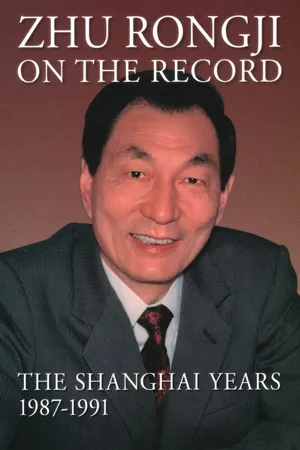
Zhu Rongji served as party secretary and mayor of Shanghai from 1987 to early 1991. During that time, he began to reorganize state-owned industries, cracked down on bureaucratism, planned major reforms in land leasing and public housing, initiated massive infrastructure projects, launched construction projects in Pudong, which eventually doubled the developed land area of Shanghai, and laid the groundwork to transform Shanghai into China's financial center. In addition to these reforms, he became known for his work to eradicate corruption and was also responsible for maintaining calm in Shanghai during the political turmoil of June 1989. Many of these experiences as mayor influenced national policymaking when he went on to serve as China's Vice Premier and premier.
2
MAKE THE SUPPLY OF NON-STAPLE FOODS FOR SHANGHAI’S RESIDENTS A BREAKTHROUGH POINT IN OUR WORK1
FEBRUARY 10, 1988
Before arriving at my current job in Shanghai, I twice asked Mayor Li Ruihuan of Tianjin for advice. He felt that to do good work it’s important to lift people’s spirits and boost their confidence. When you strengthen people’s confidence, they will trust you and be willing to cooperate with you, so it will be easier to get things done. Otherwise, no matter what you do, nobody will answer your call. In his experience, you also have to pick a good breakthrough point.
In Shanghai’s case, it would be too hard to make urban construction a breakthrough point—the challenge is too enormous and the backlog of work is too large. I’ve been giving this a lot of thought and think that Tian Jiyun’s suggestion of starting with a “vegetable basket” could work. Apart from pork, Shanghai wouldn’t have too much trouble achieving 80–90% self-sufficiency in non-staple foods. For its part, Beijing has handled the supply of chickens and eggs well, though supplies are being limited at the moment mainly to stop outsiders from coming in to buy in quantity. And Tianjin has done well with aquaculture. As Li Ruihuan has pointed out, “If we work very hard for three years, having fish to eat won’t be a problem.” Tianjin built large fish ponds with an area of 500 mu each, for a total of 100,000 mu.2 Now they average over 30 jin3 of fish per capita, which both guarantees a supply and benefits the farmers. If Shanghai works very hard for three years, it won’t have trouble providing fish to eat either. Where pigs are concerned, we still have to do comparative studies to see if it’s more economical to bring some in from other places or to raise them in Shanghai. But supplies of other non-staples can all be increased fairly quickly.
The first step would be to focus on producing the equipment needed at production centers for non-staples. Some of this is equipment needed to build the centers themselves. Both funding and technology are available for Shanghai in this regard. Some equipment can be imported, and some we can make ourselves. If we do this well, we can even supply this kind of equipment to the rest of the country. At present, however, the technology levels of the products made at the Jinshan County Agricultural and Animal Husbandry Equipment Factory are too low. Our industrial departments have to work on this.

In conversation with Politburo member, Party Secretary and Mayor of Tianjin Li Ruihuan at the Second Session of the Seventh National People’s Congress on March 21, 1989.
Second, we have to improve the supply system for non-staples. To make a breakthrough here, we must not only do a good job of building production bases, but must also work on the supply system. I’ve always advocated focusing on production to begin with, and the same holds true for exports. If you don’t focus on production, there will be no goods and talking about exports would be meaningless. Of course, Shanghai has some strengths of its own: its fiscal and financial systems are quite tightly and effectively organized. However, the experiences of Tianjin and Beijing will also provide some lessons in reforming the circulation system, delineating functions, and clarifying responsibilities. This is a large subject and needs to be studied carefully.
Third, we must focus on the processing and storage of non-staples. To do a good job of supplying non-staples, we will also have to add several safeguards: we must build a sturdy agricultural infrastructure and strengthen our ability to cope with disasters; we must even out surpluses and shortages between slow and busy seasons and between years of disaster and years of bumper harvests; and we must aim for more product variety and more channels to ensure that non-staples are evenly marketed and supplied. We can’t have supplies shrinking suddenly or their prices spiking whenever vegetables are hit by cold temperatures. To keep the market stable, you need to have supplies on hand. Therefore we should build some processing factories that operate when there’s a surplus and stop when there’s a shortage, because when you look at the overall picture, this is still worth doing. In the future, we can also develop a prepared foods industry to export its products and earn forex.
1. These are the key points of Zhu Rongji’s remarks in response to a work report by the Shanghai Municipal Agricultural Commission.
2. One mu is equal to 666.7 square meters.
3. One jin is equal to 0.5 kilogram.
3
UTILIZING FOREIGN INVESTMENT AND DEVELOPING FOREIGN TRADE1
FEBRUARY 12, 1988
At present, some of our government agencies are managing things they shouldn’t be managing. Not only is this a drain on their energies, but it also often leads to mistakes because they don’t understand the circumstances involved. When we engage in contracting, the contractor knows best how well the project is doing and whether or not he is up to the task. If things go wrong, he is responsible and we need not interfere excessively.
By way of example, when Mei Shouchun2 of Shanghai’s Municipal Textiles Bureau sent me a list of 27 joint venture projects that had already been negotiated with foreign companies, the city agencies in question procrastinated and wouldn’t give their approvals, so the foreign companies all went to Guangdong. What a pity! I feel that we should “let go” and allow people to do their jobs. If they perform poorly, they will be responsible for it themselves.
We Must Be Bold in Devolving Powers
The intellectual caliber and management standards of Shanghai officials are good and should be acknowledged—they won’t make a mess of things. In fact, a report by the Municipal Agricultural Commission suggests that the authority to approve projects of up to US$5 million, or RMB 10 million, be devolved to districts and counties. The general departments need to devolve those powers. The central leadership is asking Shanghai to procure US$10 billion to $20 billion in foreign direct investments, but so far we only have US$1.8 billion, and we won’t be able to reach this level unless we devolve powers. We must let approval power in particular go to districts and counties and let them decide for themselves. But they will have to file reports with higher levels, and the general departments should supervise them.

At a preview of the Shanghai Commodities Trade Fair, August 23, 1990. Second from left, Zhang Junjie, director of the Shanghai Office of Finance and Trade. (Photograph by Wu Wenji)
The Rule of Law Must Supersede the Rule of Man
These days it is truly hard to get a project approved at the grassroots level. According to one count, it takes 109 chops [official stamp]. In some cases, the officials in question tell you that it’s all right, then a little later that it isn’t; or one person might give it the green light, but the next person won’t. There’s no basis for any such decisions. Instead things should be managed in accordance with the law. If you first compare the facts of a project with the relevant laws and act according to those laws, you won’t have to require so many chops.
But remember this: if upon inspection the departments concerned later discover that the project does not accord with laws and regulations, you will be heavily penalized. We want to follow the rule of law, not the rule of man. Right now it’s the rule of man. Officials have too much power and can hold you up if they please. Hence the term “increasing efficiency” rings hollow.
Policies Must Be Further Eased and Enthusiasm Generated for the “3+1” Industries3
To promote the 3+1 industries and large-scale exports and imports, our policies must be a bit more preferential. In some areas we can’t just copy Guangdong’s methods. It already has a good foundation for such industries and thus can be a bit tighter with enterprises about the division of forex earnings. We, on the other hand, are just getting started, so our policies have to be more preferential than the current ones in Guangdong. Initially, we have to give enterprises enough of a stimulus—give them big profits, give them a real jolt here—for otherwise no one will be willing [to engage in 3+1 industries]. In dividing the forex earnings of 3+1 industries over the first two or three years, apart from what must be turned over to the central government, the [city] government should keep just a little and give all the rest to the enterprises. The district or county bureau can keep a bit, but the ratio mustn’t be high.
Focus Hard on Good Foreign Trade Contracting
Contracting is very important in foreign trade and should be implemented as soon as possible down to the grassroots level. Contracting with foreign trade companies just isn’t enough; it should be done all the way down to industrial enterprises. In contracting with industrial enterprises, profits that should be turned over to higher levels should be integrated with forex earnings from exports. This might be done as follows:
1. An enterprise may deal directly with the foreign party. For those enterprises (including enterprise groups) that have the authority to deal directly with foreign parties, the targets for forex earnings should be separated out, and the enterprises should assume contract responsibility for these.
2. A company may combine industry and trade. This in turn can be divided into three scenarios. The first concerns existing industry and trade companies and ones in the process of being established. Explicit forex and subsidy targets should be given to them. Since we must integrate industry and trade to export certain products, attention should focus on setting up new industry and trade companies and on transferring some foreign trade people who know the business to these new companies to support them during their development.
The second scenario relates to industrial enterprises or enterprise groups that are responsible for their own profits and losses and that have foreign trade companies acting as their agents. Forex and subsidy targets should also be given to these companies.
In the third scenario, a foreign trade company has a contract to purchase the products of an industrial enterprise. In this case, both the foreign trade companies and industrial enterprises must sign and implement the contract. The foreign trade company contracts to do the work of earning forex, while the industrial enterprise must supply the goods and services specified. The contract signed by the two parties covers product types, quality, quantities, and prices, and both the trade and industrial companies are bound by the contract.
1. These are the key points of remarks by Zhu Rongji in response to a report by the Shanghai Municipal Foreign Economic Relations and Trade Commission.
2. Mei Shouchun was then director of the Shanghai Bureau of Textile Industry.
3. The “3+1” industries are ones that process imported material, process imported samples, assemble imported parts, and engage in compensation trade.
4
CHANGES IN THINKING CAN BRING GREAT HOPE TO SHANGHAI1
FEBRUARY 27, 1988
When I was working at the State Planning Commission and the State Economic Commission, I was very concerned about Shanghai. Perhaps it’s the bystander who sees things most clearly, but it struck me that if we don’t change our way of thinking and don’t raise our awareness, it will be very hard to revitalize the city. Eagerness alone without a change in thinking just won’t do. Three problems need to be resolved here.
The first is self-satisfaction and smugness. People tend to talk about how well their enterprises are doing compared with their past performance or that of others in the whole country. What they say may indeed be the case, but their situation is actually very precarious and some have already been outdone by others [outside Shanghai]. Guizhou, for example, used to sell goods from Shanghai, but now these have been displaced by goods from Guangdong. Bonuses at some enterprises now amount to seven or eight months’ wages, while those at others account for half of their income. This doesn’t occur anywhere else. The general sense is that Shanghai bonuses are quite high and people are living very comfortably.
The second problem is grumbling and blaming heaven and earth for everything. The reality is that enterprises are not actively engaging in technical upgrading, they don’t follow up, and factory directors aren’t in a hurry. “Give me the policies they have in Guangdong and I can do better.” This kind of sentiment has become widespread.
The third is conservatism and complacency. When you talk to some people, they won’t disagree to your face, but back home they’ll say your ideas are unworkable. I’m talking specifically about the Municipal Agricultural Commission. Their objective—which is to improve the supply of non-staple foods within three years—is not bad, and the work they’re doing is also not bad. But given the circumstances in Shanghai, as well as the contracting system, if you marshal your forces, might it not be possible to accomplish this ahead of schedule? You should look into this.
As we were on our way to do surveys in one county, s...
Table of contents
- Cover
- Title Page
- Copyright
- Contents
- Publication Note
- Acknowledgments
- Introduction
- 1987
- 1988
- 1989
- 1990
- 1991
- Index
Trusted by 375,005 students
Access to over 1.5 million titles for a fair monthly price.
Study more efficiently using our study tools.
Information
Publisher
Brookings Institution PressEdition
1Year
2018Topic
HistoryPrint ISBN
9780815731399
Subtopic
Chinese HistoryeBook ISBN
9780815731405
Index
HistoryFrequently asked questions
Yes, you can cancel anytime from the Subscription tab in your account settings on the Perlego website. Your subscription will stay active until the end of your current billing period. Learn how to cancel your subscription
No, books cannot be downloaded as external files, such as PDFs, for use outside of Perlego. However, you can download books within the Perlego app for offline reading on mobile or tablet. Learn how to download books offline
Perlego offers two plans: Essential and Complete
- Essential is ideal for learners and professionals who enjoy exploring a wide range of subjects. Access the Essential Library with 800,000+ trusted titles and best-sellers across business, personal growth, and the humanities. Includes unlimited reading time and Standard Read Aloud voice.
- Complete: Perfect for advanced learners and researchers needing full, unrestricted access. Unlock 1.5M+ books across hundreds of subjects, including academic and specialized titles. The Complete Plan also includes advanced features like Premium Read Aloud and Research Assistant.
We are an online textbook subscription service, where you can get access to an entire online library for less than the price of a single book per month. With over 1.5 million books across 990+ topics, we’ve got you covered! Learn about our mission
Look out for the read-aloud symbol on your next book to see if you can listen to it. The read-aloud tool reads text aloud for you, highlighting the text as it is being read. You can pause it, speed it up and slow it down. Learn more about Read Aloud
Yes! You can use the Perlego app on both iOS and Android devices to read anytime, anywhere — even offline. Perfect for commutes or when you’re on the go.
Please note we cannot support devices running on iOS 13 and Android 7 or earlier. Learn more about using the app
Please note we cannot support devices running on iOS 13 and Android 7 or earlier. Learn more about using the app
Yes, you can access Zhu Rongji on the Record by Rongji Zhu in PDF and/or ePUB format, as well as other popular books in History & Chinese History. We have over 1.5 million books available in our catalogue for you to explore.