- 457 pages
- English
- ePUB (mobile friendly)
- Available on iOS & Android
eBook - ePub
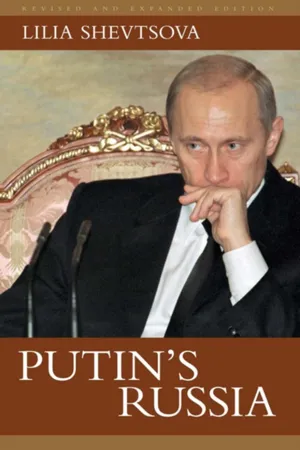
Putin's Russia
Information
Chapter 1
THE KREMLIN’S POWER PLAY
Yeltsin on the wane. The Primakov formula. Who runs Russia?
The Kremlin seeks an heir. The Bank of New York scandal.
Enter Putin. Russia wants order. The uses of war.
It is Moscow in the spring of 2000, less than half a year since Vladimir Putin emerged in the Kremlin as the new leader of Russia. Oligarchs, once arrogant and bullying but now living in fear of a visit from secret police in black masks, have already moved their money and their families abroad and are keeping a low profile.1 Only notorious tycoon Boris Berezovsky, one of those who orchestrated Putin’s ascent, desperately tries to build an opposition to challenge the new Kremlin boss; but no one will dare to join him. Russia’s governors and other regional lords, many of whom ran almost independent fiefs under Putin’s predecessor, Boris Yeltsin, now look to Moscow in servile fashion. The corridors of the Kremlin are full of people with a military bearing and nondescript faces. Women, particularly middle-aged ones, swoon over President Putin, lifted from obscurity and named prime minister, victor in the March presidential election, champion of the “strong hand” in Chechnya and of “verticality of authority” (a term coined by Russian elites to describe a top-down system of governance based on subordination and a domineering role for the executive branch). Some declare their love for their slender, athletic leader in television interviews. Putin, with his tireless activity and determined air, baffles observers accustomed to watching a chronically ailing leader and speculating about who rules Russia. This new president stirs anxiety among various groups; after all, no one is sure what is on his mind.
Editors in chief and heads of major television networks censor the mass media, steering clear of any topic that might disturb the new boss in the Kremlin. The intelligentsia returns to the kitchen to berate the authorities over a cup of tea or a glass of vodka, their criticism driven back inside, as in the long-forgotten Brezhnev years. Ordinary Russians just lie low.
Remembering too well Yeltsin’s final phases, I keep wanting to pinch myself. Just six months ago, Russia was a different country. By the end of the 1990s, Yeltsin had lost control of it and himself. Berezovsky whispered his plans for Russia into the ear of the president’s sweet daughter, and she and a few friends elevated and toppled high officials and made government policy. Oligarchs kicked open the doors of government offices and ran for their own benefit the remnants of the economy, which had been decimated by long-standing weaknesses and the August 1998 financial collapse. Regional leaders ruled over their provinces like little tsars, either paying no attention to the Kremlin or blackmailing the Moscow courtiers and the president himself.
The Russian state eroded, losing its power and the ability to perform elementary functions of government.2 Russia sank deeper and deeper into social and economic crisis: falling life expectancy (for men, from 64.2 years in 1989 to as low as 57.6 years in 1994); a resurgence of contagious diseases that had been eliminated in the Soviet Union; decaying schools; hundreds of thousands of homeless children; millions of migrants; a shrinking economy that during Yeltsin’s tenure contracted in real terms by 40 percent; and finally, rampant lawlessness and corruption that had become a lifestyle passing for “normal.” Ordinary people had lost both the past and the future, and the present was confusing for many. But neither the president nor elites seemed to notice—they were busy pretending to rule, struggling for a place at the top, robbing the state.
The newspapers attacked Yeltsin ruthlessly, but ordinary people had wearied of their unprecedented freedom to criticize the government, because it brought about no improvement. The president was regarded with both pity and scorn. The authorities were blamed for everything from failed hopes for a normal life after the fall of communism to people’s feelings of helplessness. The Kremlin had totally lost the aura of sacredness and mystery that had surrounded rulers of Russia through the ages, revealing itself as a marketplace where everything could be bought and sold.
In another dispiriting development, the Russian presidency seemed to have reverted to the Soviet pattern of gerontocracy, in which one old man hung on as leader until he died, only to be replaced by another old man. President Yeltsin, once powerful and charming, with an astonishing strength of will that had enabled him to destroy the Communist Party and the Soviet empire, now hid from the world, shuttling between dachas outside Moscow. Few besides his family and physicians had access to him. His physical decline was tortured. It was not only his heart condition—though he later admitted he had had five severe heart attacks. He seemed to have problems with everything, including walking, holding himself erect, concentrating, and even comprehending what he was being asked about. When he was shown to the public, his doctors alone knew the effort it took for him to hold himself together. And he was not that old as we watched him deteriorate; he was still in his late sixties.
Like Yeltsin, the other denizens of the Kremlin were more and more removed from society and its ills. Neither constant charges of corruption nor crushing national problems worried them; they thought only of holding on to their power and perquisites. Those who formed the Kremlin entourage were reckless, sure of themselves and their control of the game. They seemed to have no premonition that the game might end.
At the end of the 1990s, in fact, no one was really running the country. Beginning in 1996, the political class was preoccupied with when Yeltsin would step down and who would rule Russia after him. How did Tsar Boris look today, was he compos mentis or not? How long would he last? Everything else was secondary. Society settled in for what it assumed would be the patriarch’s prolonged good-bye, while Russia continued its political and economic decay.
Who then had even heard of Vladimir Putin? Who outside a tiny circle in Moscow knew his name even in early 1999? The few who had met him had trouble later recalling the man or remembering that Yeltsin had made him head of the Federal Security Service (FSB), formerly the KGB. In 1998 or much of 1999, a suggestion that Putin would be the next president of Russia would have elicited bewilderment, if not laughter.
The slow crumbling of governmental authority seemed well-nigh irreversible then, and rapid assertion and consolidation of central control highly unlikely, but very soon those and other expectations would be stood on their heads. It seemed that Yeltsin would never leave office voluntarily, much less before his term was over—that he would sit (or lie) in the Kremlin until he died. It seemed that there would be a vicious struggle among the main “power clans,” or interest groups; the heads of some were already imagining their victories and gloating. It seemed clear that the two leading contenders for Yeltsin’s throne were Moscow mayor Yuri Luzhkov, who successfully competed with federal authorities for power and money, and recent prime minister Yevgeny Primakov, experienced apparatchik, former head of the Federal Intelligence Service (SVR), and current foreign minister. Finally, whatever the result of the power struggles at the top, many assumed that the Russian people had gotten used to a free and spontaneous life, to constant political bickering, to the unruliness of elites, and would reject any return of the “iron hand.” But those who thought so turned out to know little of the Russian soul, or of how panic and fear can suddenly change the political mentality of millions.

As the 1990s drew to a close, economic and social emergencies and the febrile mood they created among the populace were ready to speed up events in Russia. In 1998, Russia moved inexorably toward a financial crash. Russian stocks were plummeting. State bonds were paying 130 to 140 percent. The Central Bank was trying desperately to keep the ruble stable. On August 19, the Ministry of Finance had to cover 34 billion rubles worth ($5.7 billion before devaluation) of GKOs (state short-term bonds). The treasury did not have that kind of money, nor could it borrow it anywhere. The $22 billion International Monetary Fund and World Bank credit granted to Russia—under heavy pressure from U.S. president Bill Clinton—had vanished to parts unknown.
During what for many ordinary people was a painful postcommunist transformation, Russians had become used to labor strikes, hunger strikes, suicide, and self-immolation driven by despair and hopelessness. But the situation grew more volatile in 1998. Desperate miners from state-owned mines, who had not been paid for months, began blocking railroad tracks. Their representatives came to Moscow and set up a tent city in front of the White House, where the Russian cabinet sits. The miners demanded not only back pay but also Yeltsin’s resignation. I remember the men, stripped to the waist in the broiling sun, sitting in the street and rhythmically beating their miners’ helmets on the hot cobblestones. I remember their angry looks at officials’ limousines with closed and shadowed windows hurtling past. Moscow was suddenly back in the throes of class hatred dredged up from long ago. The hungry Russia of the provinces had come to Moscow to remind the capital of its existence, and the wake-up call was ominous. In the late 1980s, it had been the miners—when they wanted Yeltsin in the Kremlin—who had rattled the throne beneath Gorbachev. Now they wanted him out. The power in the Kremlin was registering seismic movement again.
The miners were left unmolested, however, and mayor Yuri Luzhkov gave orders that they be allowed to demonstrate and even had them fed. As a pretender to the highest Kremlin post, Luzhkov had an interest in keeping the miners in Moscow as long as possible: They could hasten a new distribution of power, and he was the first waiting in line to claim his prize.
Russia cried out for leadership at this critical juncture, but neither the president nor the cabinet nor other political figures had the answers to the country’s problems. The doddering Yeltsin had almost disappeared from view, making occasional public appearances only to confirm that he was still alive. “Working on documents,” the official explanation for his absences from the Kremlin, drew a skeptical smile from Russians. Even usually sure-of-themselves liberals seemed to have lost their nerve. The 37-year-old prime minister, Sergei Kiriyenko, dubbed by the press “Kindersurpriz” (after a chocolate popular with Russian children), looked perplexed. When elevated to prime minister shortly before, he had brimmed with self-assurance. Now, in an apparent attempt to hide his confusion, he talked nonstop. His words, like persistent, boring rain, meant nothing.
Left to deal with a deepening financial crisis, Kiriyenko didn’t have time—much less the ability—to gauge its seriousness. His experience as a Komsomol (Communist Youth League) leader and then a provincial banker in Nizhny Novgorod until coming to Moscow the year before had not prepared him for this. I remember the reaction of officials at international organizations who dealt with Kiriyenko. “My God, how will he cope?” they asked, clutching their heads. “He doesn’t even know which buttons to push.”
Before the end of 1998, treasury officials had to find 113 billion rubles ($18 billion) to pay the interest on GKOs and OFZs (state loan bonds). Moscow also had to pay salaries and pensions for public-sector workers, and the nonpayments had been accumulating since the beginning of the year. Tax revenues would not exceed 164.6 billion rubles ($22.5 billion). The fragile Russian banking system was on the verge of collapse. The economy was disintegrating. The West could no longer help. Russian citizens were still being patient, but that could end at any moment. And then—no, no one wanted to contemplate what could happen in Russia then.
Some of the members of Yeltsin’s team quickly figured out that the financial chaos, with millions of rubles streaming out of the country, presented a unique opportunity for enrichment for people who kept their heads. In any case, everyone in power in 1998 not only survived the crash but continued to do well financially, even better than before. Russian history has shown how much advantage can be extracted from a crisis, especially if you are the one managing it.
After some hesitation, on August 17, 1998, the Kiriyenko government declared Russia bankrupt, deciding to go for default and devaluation at the same time—this after Yeltsin’s promise that there would be no devaluation. The small circle that reached the decision on bankruptcy included leading reformers Anatoly Chubais and Yegor Gaidar. The previous day, Kiriyenko and Chubais had flown to Yeltsin’s dacha with proposals that the president had been forced to approve, having no other solution. A demoralized Yeltsin had lost control over events.
Acknowledging the influence of the powerful oligarchic clans, Kiriyenko met with their representatives late that night to give them a report on what had happened. Most likely, Yeltsin’s oligarchs knew what was coming. Grigory Yavlinsky, the leader of the democratic movement Yabloko, openly accused Kiriyenko of acting on behalf of the tycoons, saying, “The financial collapse was Kiriyenko’s fault, because his actions had been ineffective and, most important, favored certain oligarchic groups.” In any case, all the tycoons had gotten their money out of the failing banks in time, and soon they established new banks and continued to prosper, while ordinary Russians lost their savings in the collapse and had to start from scratch.
Yet the Kiriyenko government was not fully accountable for the August 1998 financial crisis. The emergency was partly a reaction to the Asian economic meltdown that had begun the year before. Moreover, the preconditions had been established in Russia under the government of prime minister Victor Chernomyrdin, who had survived for quite a long while in the time of Yeltsin’s permanent cabinet reshuffles. Appointed premier in 1992 after Gaidar’s dismissal, he was fired in 1998 only because Yeltsin suspected him of harboring an interest in the president’s job—which Chernomyrdin definitely did. (One of the catalysts for his firing was a visit to the United States, during which he met with his old negotiating partner Vice President Al Gore and Gore treated “Cherno” like a future leader of Russia. Yeltsin could not tolerate that.)
What had led to the financial collapse were parliamentary populism and the premier’s craven behavior. Instead of fighting for a workable budget, Chernomyrdin chose to create the GKO pyramid—to borrow money at a high rate of interest. As for the parliament, which pumped unsecured rubles into the budget, we know that venting and caving in to populist demands for fiscal irresponsibility are always among the functions of parliaments. In the case of Russia, that populism gets more play because the Duma, the lower house of the parliament, does not form the government and is not responsible for its actions. That was true in Yeltsin’s era, and it is still true in Putin’s.
Nor was Kiriyenko’s government blameless. Kiriyenko had enough financial know-how to have realized he could avert catastrophe by devaluing the ruble gradually, but he did not do so. Either he panicked or he was certain that his luck would hold. Or else he was working in the interests of certain oligarchs, as Yavlinsky suggested.
Russians rushed to save their money, desperately trying to withdraw funds from private banks. But many lost everything. Foreigners lost their money as well. Most of them closed their offices and left the country. The Moscow gold rush seemed to be over for good. After some vacillation, Yeltsin fired the government of Kindersurpriz Kiriyenko and decided to bring back Victor Chernomyrdin, whom he trusted, hoping that that political heavyweight would find a way out. Yeltsin himself remained at his dacha, unable to face his people as their country slid toward the abyss.
Yeltsin’s absence during the crisis gave rise to rumors about his stepping down. CBS News in the United States reported that the Russian president had signed a letter to be read after the parliament approved Chernomyrdin’s candidacy, in which Yeltsin resigned from office and handed over all power to his successor. Chernomyrdin’s close associates assiduously spread that rumor, hoping to push events in that direction. Journalists hurried to update their political obituaries of Yeltsin yet one more time.
Finally, when rumors of his resignation had become the top news story of the day, Yeltsin appeared in public. On August 21, the ailing president made a point of inspecting Russia’s Northern Fleet and visiting the nuclear-powered battleship Peter the Great. It was a warning—“Don’t touch me, I have military might behind me.” Yeltsin was accompanied, as Brezhnev had been in his day, by an entire hospital. But even though at that moment he could barely speak, Yeltsin could still create a lot of trouble. The old bear had the power to fire people, to shuffle and reshuffle the cabinet, to use force if necessary. God alone knew what an unpredictable Kremlin boss could do when threatened or feeling depressed or angered, or when at a loss as to what to do.
On August 28, Yeltsin gave a television interview, his first in a long time. Much care must have gone into preparing and editing it. Nevertheless, Yeltsin looked extremely ill and old during the interview; it was hard for him to talk and, it appeared, even harder for him to think. He grew animated just once, when he declared firmly, “And I won’t retire.” Only then did he come alive, the old stubbornness in his eyes. The interview had been d...
Table of contents
- Title Page
- Copyright Page
- Contents
- Foreword
- Acknowledgments
- Prologue
- Chapter 1
- Chapter 2
- Chapter 3
- Chapter 4
- Chapter 5
- Chapter 6
- Chapter 7
- Chapter 8
- Chapter 9
- Chapter 10
- Chapter 11
- Chapter 12
- Chapter 13
- Notes
- Index
- About the Author
- The Carnegie Endowment for International Peace
Trusted by 375,005 students
Access to over 1.5 million titles for a fair monthly price.
Study more efficiently using our study tools.
Frequently asked questions
Yes, you can cancel anytime from the Subscription tab in your account settings on the Perlego website. Your subscription will stay active until the end of your current billing period. Learn how to cancel your subscription
No, books cannot be downloaded as external files, such as PDFs, for use outside of Perlego. However, you can download books within the Perlego app for offline reading on mobile or tablet. Learn how to download books offline
Perlego offers two plans: Essential and Complete
- Essential is ideal for learners and professionals who enjoy exploring a wide range of subjects. Access the Essential Library with 800,000+ trusted titles and best-sellers across business, personal growth, and the humanities. Includes unlimited reading time and Standard Read Aloud voice.
- Complete: Perfect for advanced learners and researchers needing full, unrestricted access. Unlock 1.5M+ books across hundreds of subjects, including academic and specialized titles. The Complete Plan also includes advanced features like Premium Read Aloud and Research Assistant.
We are an online textbook subscription service, where you can get access to an entire online library for less than the price of a single book per month. With over 1.5 million books across 990+ topics, we’ve got you covered! Learn about our mission
Look out for the read-aloud symbol on your next book to see if you can listen to it. The read-aloud tool reads text aloud for you, highlighting the text as it is being read. You can pause it, speed it up and slow it down. Learn more about Read Aloud
Yes! You can use the Perlego app on both iOS and Android devices to read anytime, anywhere — even offline. Perfect for commutes or when you’re on the go.
Please note we cannot support devices running on iOS 13 and Android 7 or earlier. Learn more about using the app
Please note we cannot support devices running on iOS 13 and Android 7 or earlier. Learn more about using the app
Yes, you can access Putin's Russia by Lilia Shevtsova in PDF and/or ePUB format, as well as other popular books in Politics & International Relations & Russian Politics. We have over 1.5 million books available in our catalogue for you to explore.