- 110 pages
- English
- ePUB (mobile friendly)
- Available on iOS & Android
eBook - ePub
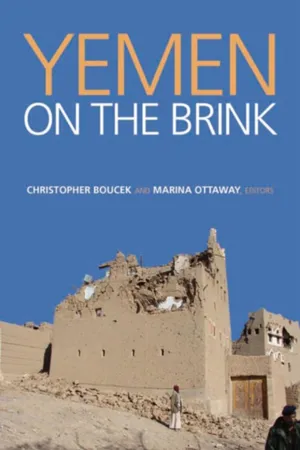
Yemen on the Brink
Information
YEMEN: AVOIDING A DOWNWARD SPIRAL
Christopher Boucek
Yemen is beset by a host of challenges that endanger both its domestic stability and regional security. The United States and the international community must act now, before conditions deteriorate further, to help Yemen meet these challenges. While Yemen has survived crises in the past, they have tended to be singular events, while the many problems it now faces are unprecedented in range and scope.
The problems include international terrorism, violent extremism, religious and tribal conflict, separatism, and transnational smuggling. Attempts to build effective national governance are frustrated by porous borders, a heavily armed population, and a historical absence of much central government control. Between Saudi Arabia and Somalia, Yemen is strategically located—part of two different yet interconnected regions, the Arabian Peninsula and the Horn of Africa. This fact often frustrates policy analyses; Yemen is excluded from the wealthy Gulf Cooperation Council, but is in many ways more resilient than its East African neighbors. More than 3 million barrels of oil pass through the treacherous waters off the country’s coast every day. The constant risk of attack by Islamist terrorists and Somali pirates threatens to disrupt the flow of vital hydrocarbons and international commerce more broadly.
Interrelated economic, demographic, and domestic security challenges are converging to threaten the stability of Yemen. At the heart of the country’s problems is a looming economic crisis. Yemen’s oil reserves are fast running out, with few viable options for a sustainable post-oil economy. Moreover, the country’s limited water resources are being consumed much faster than they are being replenished. A rapidly expanding and increasingly poorer population places unbearable pressure on the government’s ability to provide basic services. Domestic security is endangered by Islamist terrorism, magnified by a resurgent al-Qaeda organization, an armed insurrection in the North, and an increasingly active secessionist movement in the South.
These challenges are compounded by corruption and an absence of central government control in much of the country, as well as by the pending transition in political leadership. President Ali Abdullah Saleh has ruled the Republic of Yemen since the unification of the Yemen Arab Republic in the North and the People’s Democratic Republic of Yemen in the South in 1990. The next presidential election is scheduled for 2013. It is unclear whether Saleh will be eligible to stand for re-election for what would be a third term, and he has no obvious successor. The post-Saleh government will be severely strained by a combination of reduced revenue and diminished state capacity.
Yemen is the poorest country in the Arab world, and its population growth rate, which exceeds 3 percent per year, is among the world’s highest. The government has been unable to provide adequate educational or other public services for the rapidly expanding population, more than two-thirds of which is under the age of 24, and illiteracy stands at over 50 percent. The faltering economy and poorly prepared workforce have pushed unemployment to 35 percent, on par with the Great Depression in the United States. The country’s dire economic circumstances will soon limit the government’s ability to deliver the funds needed to hold the country together. The population is expected to double to 40 million over the next two decades, by which time Yemen will no longer be an oil producer, and its water resources will be severely diminished.
Yemen has been frequently discussed by observers as a failing state, and with good reason. Owing to the central government’s weak control, the country has often been on the brink of chaos, yet it has always managed to muddle through. One of its crises was precipitated by the Saleh regime’s failure to support United Nations Security Council resolutions calling for the use of force to evict Iraqi troops from Kuwait in 1990. U.S., Western, and Gulf Arab aid was cut dramatically in retaliation, and nearly 1 million Yemeni workers were expelled from Saudi Arabia. The unification of North and South Yemen earlier in 1990 and the 1994 civil war in which the South attempted to secede have also presented major challenges for the central government. However, unlike these individual challenges, the problems facing the country today are multiple and interconnected, each one posing serious threats to the future of Yemen, and together potentially overwhelming the state’s limited capacity.
Any single event—or more likely a confluence of worst-case events beyond the ability of the Yemeni government to control—could lead to a further erosion of central government authority in Yemen and destabilization of the region. A major humanitarian crisis, triggered perhaps by severe famine or crop failure, could, for instance, result in a large refugee emergency in which the government would be unable to provide even rudimentary relief services. A balance-of-payments crisis in which the regime could no longer afford to placate the urban areas that receive government services would be disastrous. An inability of a post-Saleh president to balance Yemen’s competing interests and stakeholders could create a power vacuum, with separate regions possibly growing more autonomous and independent from the central government in Sanaa.
Still, Yemen boasts a relatively resilient society that has already endured much, with little assistance from Sanaa. In some regards, in fact, low expectations for the Yemeni government to deal with future crises may help lessen their potential impact. Because rural muhafazat, or governorates, the administrative divisions in Yemen, do not currently rely on Sanaa for goods and services, what happens at the national level in the future may make little difference to much of the population.
If, however, the central government’s authority and legitimacy continue to deteriorate, Yemen may slowly devolve into semi-autonomous regions and cities. This trajectory has occurred in other countries, such as Somalia and Afghanistan, with disastrous consequences. Such a slow, emerging state of semi-lawlessness in Yemen would provide opportunities for extremists directed or inspired by al-Qaeda to regroup, organize, train, and launch operations against U.S. and allied targets throughout the Gulf region.
No perfect solutions exist for Yemen’s problems today, and none of its many pressing challenges can be fully averted. Steps, however, can be taken to lessen their impact. The United States has a stake in helping Yemen deal with its problems; given the country’s strategic importance to American national security interests and foreign policy objectives, the cost of inaction would be too great. Furthermore, failure to act now would lead to fewer and even worse options in the future.
Interlocking Challenges
Yemen’s future lies at the intersection of three major interconnected challenges: economic, demographic, and domestic security.
Economic Challenges
Vital natural resource depletion, the effects of the global economic downturn, corruption, unemployment, and inflation pose the most significant longterm economic threats to the country. Yemen is the poorest country in the Arab world, and it is getting poorer because of government policies, complicated by rising prices and an inability to absorb a growing population into the domestic labor market.
Resource Depletion: Oil. Oil exports, which generate more than 75 percent of government revenue, are absolutely critical for the Yemeni economy. The government relies on the hard currency provided by oil sales to fund state expenditures. More importantly, in the absence of mature and enduring state governance institutions, oil revenue helps to maintain extensive patronage networks that balance competing interests among various tribes and other stakeholders.
Rapidly decreasing oil reserves, however, coupled with a dramatic fall in global oil prices have had a severe impact on the Yemeni economy. Production is decreasing in both areas where Yemen’s oil reserves are concentrated—the Marib basin in the middle of the country and the Masila basin in the East—as the fields approach the end of their useful cycles. Yemen’s oil reserves are divided into 97 onshore and offshore exploration and production blocks, of which only twelve produce oil. The most significant of these are Marib (block 18), Masila (block 14), East Shabwa (block 10), Jannah (block 5), and West Iyad (block 4). British Petroleum has assessed Yemen’s proved reserves at 2.8 billion barrels (the Yemeni government maintains that this figure grossly underestimates the reserves, but Sanaa’s claims remain unsubstantiated).
Oil exports in Yemen have declined sharply in recent years, from more than 450,000 barrels per day at the peak in 2003 to roughly 280,000 barrels per day in January 2009, according to Amir Salem al-Aidroos, the minister of oil and minerals. Barring any major new discoveries, energy experts generously estimate that Yemen’s oil exports will cease in ten years. The World Bank posits that by 2017 the government of Yemen will earn no income from oil. Other assessments suggest that the proved oil reserves will be exhausted in just five years. The true extent of the oil production decrease has been masked by recent high prices, which allowed Yemen to earn more money despite selling less crude oil. Since global prices have fallen from their summer 2008 record high, the country has been hit doubly hard—both in revenue per unit and total units sold. While falling reserves account for much of the drop in production, poor maintenance and limited capacity in Yemen’s oil sector have exacerbated the problem.
The Ministry of Oil and Minerals has identified several obstacles to greater production, including the absence of a long-term strategic plan for the energy sector and the failure to streamline production sharing agreements. There are currently three separate agreements: one for oil, one for gas, and another for a combination of both. As a result, there is no incentive for oil companies to develop resources not covered under a production sharing agreement. Any gas found during oil exploration, for example, is not developed because it was not what the operating company was licensed to extract. Moreover, each individual production sharing agreement must go before parliament for approval before production may begin, leading to months-long delays in some cases. To address this, the ministry is seeking the authority to issue and approve future agreements. Separately, the ministry wants greater geological study, through the use of costly seismic and advanced imaging technologies, to detect hydrocarbon deposits. It is unclear, however, that even the most sophisticated analyses would discover more oil, and in any case, difficult physical and security conditions would complicate further extraction.
As a result of decreased oil export earnings, the Yemeni government has sharply curtailed income expectations. During July 2008, crude oil was at a record high price of $147 per barrel; during the first quarter of 2009, according to the Central Bank of Yemen, it averaged just $43 per barrel, and the U.S. Energy Information Administration has estimated that prices will average $55 per barrel for the second half of the year.
Further complicating the national budget, which is dependent on oil revenue, is that most of the budget, including government subsidies, salaries, and pensions, has traditionally been politically off-limits. In recognition of the severe budgetary shortfalls, at the beginning of 2009 the Finance Ministry reportedly ordered budget cuts of 50 percent throughout the entire bureaucracy; according to the Economist Intelligence Unit, however, cuts of only 4 percent have been implemented. Furthermore, these reductions have not been applied universally across the entire government; the Defense and Interior ministries, among others, will not be affected. In actuality, the financial straits are much more severe than had been predicted. Data released by the Central Bank of Yemen indicate that revenue from oil exports hit a record low in the first quarter of 2009, down 75 percent from the same period in 2008.
Clearly, Yemen’s oil resources are running out, and finding new sources of oil reserves is not a feasible solution. Attempts to cut the budget, meanwhile, have not succeeded. It is imperative that the country prepare for a post-oil economy.
Resource Depletion: Water. While Yemen’s dwindling oil reserves are a major concern, ultimately more worrisome is the rapidly depleting water supply. Shortages are acute throughout the country, and Sanaa, whose population is growing at 7 percent a year as a result of increased urbanization, may become the first capital city in the world to run out of water. This crisis is the result of several factors, including rising domestic consumption, poor water management, corruption, absence of resource governance, and wasteful irrigation techniques. Until five years ago, there was no Water and Environment Ministry, and today legal oversight remains limited. According to a 2009 UN Food and Agriculture Organization report, Yemen is among the world’s most water-scarce nations, with one of the lowest rates of per capita fresh water availability. Because of an absence of any serious or enforceable legal oversight, water is being extracted from underground aquifers faster than it is being replaced. The water basin in Taiz, one of the largest cities, collapsed in 1998. Water extraction rates in Sanaa are now estimated at four times that of replenishment, and the basin there and in Amran are close to collapse, with the Saada basin estimated to follow shortly thereafter. According to one recent analysis, nineteen of the country’s 21 aquifers are not being replenished.1 In some cases, nonrenewable fossil water is now being extracted.
In recent years, the water table in Yemen has fallen about 2 meters, or 6.6 feet, per year, forcing wells to be dug deeper. This affects the quality of the water—the British think tank Chatham House noted in a sobering analysis that it is deteriorating because of increased concentration of minerals.2 The falling water table also often necessitates the use of oil drilling rigs. While a legal regime now exists to assure the fair and equitable usage of surface water, there is no such legal regime for groundwater. As a result, anyone who wants water (and can afford to do so) digs a well and draws out as much water as possible. Abdul Rahman al-Iryani, the minister of water and environment, has estimated that 99 percent of all water extraction is unlicensed.
The importation of drill rigs is not subject to any customs duty, licensing process, or taxation. As of January 2009, Water and Environment Ministry officials estimate that more than 800 private drill rigs are operating in the country. In contrast, there are only three in all of Jordan, and India—whose population is more than 50 times that of Yemen—has just 100.
In an attempt to address the country’s water crisis, the central government has sought to decentralize water and sanitation services, in essence making the governorates responsible for themselves. This effort fits within a larger government strategy of devolving control to local governorates to circumvent the fact that much of the territory of Yemen lies outside of central government control. According to al-Iryani, the water and environment minister, fifteen local water corporations have been created to manage local resources. Most of the country’s major cities have been covered through this project, including Ibb, Taiz, Hodeida, Aden, Mukalla, Amran, Dhamar, and Sanaa city (administratively, the capital is differentiated from the surrounding governorate, also known as Sanaa). This is important because most of the central government’s support comes from these urban areas. According to many observers, the Saleh regime prioritizes the delivery of services to urban areas at the expense of rural governorates. The failure to establish local water corporations in several governorates that historically have not received much support or social services from the central government, and where control is exercised largely by tribal authorities, has raised fear that a resurgent al-Qaeda may seek refuge. Local water corporations have not yet been created in Marib, Jouf, Shabwa, Sanaa, Mahra, and Mahwit governorates. The Water and Environment Ministry has also said that it is in the process of establishing a local water corporation in the northern Saada governorate, ostensibly as a means to advance security and stability amid an ongoing civil conflict. The central government has done little reconstruction work or social service provision there, however, and it is unclear how a local water corporation can be created while the military wages a fierce and often indiscriminate campaign against an increasingly...
Table of contents
- Cover
- Title Page
- Copyright Page
- Contents
- 1: Yemen: Avoiding a Downward spiral
- 2: Exploiting Grievances: al-Qaeda in the Arabian Peninsula
- 3: War in Saada: From Local Insurrection to National Challenge
- 4: The Political Challenge of Yemen’s Southern Movement
- 5: What Comes Next in Yemen? al-Qaeda, the Tribes, and Statebuilding
- 6: Stabilizing a Failing State
- Index
- Contributors
- Carnegie Endowment for International Peace
Trusted by 375,005 students
Access to over 1.5 million titles for a fair monthly price.
Study more efficiently using our study tools.
Frequently asked questions
Yes, you can cancel anytime from the Subscription tab in your account settings on the Perlego website. Your subscription will stay active until the end of your current billing period. Learn how to cancel your subscription
No, books cannot be downloaded as external files, such as PDFs, for use outside of Perlego. However, you can download books within the Perlego app for offline reading on mobile or tablet. Learn how to download books offline
Perlego offers two plans: Essential and Complete
- Essential is ideal for learners and professionals who enjoy exploring a wide range of subjects. Access the Essential Library with 800,000+ trusted titles and best-sellers across business, personal growth, and the humanities. Includes unlimited reading time and Standard Read Aloud voice.
- Complete: Perfect for advanced learners and researchers needing full, unrestricted access. Unlock 1.5M+ books across hundreds of subjects, including academic and specialized titles. The Complete Plan also includes advanced features like Premium Read Aloud and Research Assistant.
We are an online textbook subscription service, where you can get access to an entire online library for less than the price of a single book per month. With over 1.5 million books across 990+ topics, we’ve got you covered! Learn about our mission
Look out for the read-aloud symbol on your next book to see if you can listen to it. The read-aloud tool reads text aloud for you, highlighting the text as it is being read. You can pause it, speed it up and slow it down. Learn more about Read Aloud
Yes! You can use the Perlego app on both iOS and Android devices to read anytime, anywhere — even offline. Perfect for commutes or when you’re on the go.
Please note we cannot support devices running on iOS 13 and Android 7 or earlier. Learn more about using the app
Please note we cannot support devices running on iOS 13 and Android 7 or earlier. Learn more about using the app
Yes, you can access Yemen on the Brink by Christopher Boucek, Marina Ottaway in PDF and/or ePUB format, as well as other popular books in Política y relaciones internacionales & Libertad política. We have over 1.5 million books available in our catalogue for you to explore.