- 295 pages
- English
- ePUB (mobile friendly)
- Available on iOS & Android
eBook - ePub
Information
Year
2012eBook ISBN
9780870033056
1
What the World Needs Now?
Ann M. Florini and P. J. Simmons
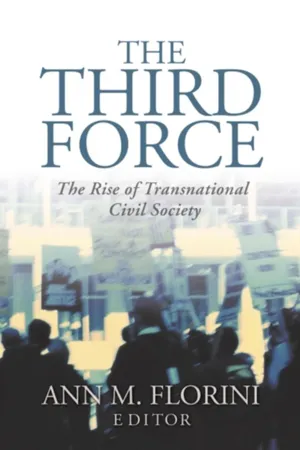
In Late 1999, tens of thousands of people filled the streets of Seattle in one of the most visible manifestations of civil society in recent decades. They had gathered to show their opposition to the World Trade Organization (WTO) and the broader forces of economic integration that it represents. The WTO, which was meeting to set an agenda for a proposed new round of global trade negotiations, found itself under scrutiny as never before. For several days, television news shows around the world displayed protesters being gassed and arrested by the hundreds. Although media reports portrayed the protesters as a combination of American labor unionists who wanted to protect their jobs at the expense of Third World workers and hippies left over from the 1960s, in fact the protesters represented a broad and to some degree transnational coalition of concerns. They objected not only to the WTO’s ability to override domestic environmental legislation but also to the very nature of the processes by which governments and corporations are fostering economic integration.
This is not the first time such groups have inserted themselves into global decision making, for good or ill. In recent decades, such stories have filled newspapers and scholarly journals alike.
• Every year, an international nongovernmental organization called Transparency International releases an index ranking the world’s countries on how corrupt they are perceived to be. Although Transparency International only came into existence in 1993, it has galvanized a global movement against corruption.
• Almost since the dawn of the nuclear age, scores of activist groups have campaigned vigorously for a ban on nuclear testing. They argued that a test ban, more than any other measure, could bring nuclear arms races and the spread of nuclear weapons to a screeching halt. In 1996, they got their way when 136 countries signed the Comprehensive Test Ban Treaty.
• For much of the twentieth century, countries around the world have constructed large dams on their rivers to create water supplies and electrical power. But in the past decade, would-be dam builders have found themselves in the crosshairs of a transnational movement protesting the environmental and human costs of these massive projects. Now, governments, the private sector, and transnational civil society have come together to create a World Commission on Dams, potentially setting a precedent for a new style of global problem solving.
• When an obscure guerrilla movement known as the Zapatistas took over four towns in the southern province of Chiapas in 1994, the Mexican government started to respond with force. When nongovernmental activists elsewhere (particularly in the United States) protested, Mexico put its troops on hold.
• In December 1997, 122 countries signed an international treaty to ban land mines, despite the vehement objections of the world’s most powerful governments. Standing beside the government delegates were representatives of some 300 nongovernmental organizations, members of the International Campaign to Ban Landmines, without whom the treaty would not exist.
• At the end of the 1990s, former Chilean dictator Augusto Pinochet found himself facing international legal charges based on his alleged violations of human rights in Chile. Nike found that its bottom line suffered dramatically when it was accused of violating the rights of its workers in poor countries. The new standards by which heads of governments and corporations alike are being judged originated and spread due to the determined efforts of a broad network of nongovernmental groups around the world.
Nongovernmental organizations (NGOs), informal associations, and loose coalitions are forming a vast number of connections across national borders and inserting themselves into a wide range of decision-making processes on issues from international security to human rights to the environment. But how significant is this flurry of apparent activity? Is transnational civil society becoming a permanent and powerful contributor to solving the world’s problems? And should global problem solving be left to a loose agglomeration of unelected activists?
These questions matter. Transnational civil society is a piece—an increasingly important piece—of the larger problem of global governance. Although the state system that has governed the world for centuries is neither divinely ordained nor easily swept away, in many ways that system is not well suited to addressing the world’s growing agenda of border-crossing problems. Even when governments find that their national interests coincide with broad global interests, political will is often hard to muster in the face of dangers that are incremental and long term, and most of the transnational threats to human well-being arise cumulatively rather than as acute crises. Even if states are able to bestir themselves, the transnational agenda is so complex and multifaceted that multiple sources of information and multiple points of intervention are needed. The sheer number of regimes and agreements needed to cope with the wide range of problems demanding governance is overwhelming the resources available to states, which in any case face increasing domestic demands.
And the transnational agenda is becoming more urgent. Thanks to the information revolution, the growing integration of national economies, and the rapidly increasing number of people in the world, human activity is less constrained than ever by national borders. People travel, migrate, communicate, and trade in ever-growing numbers, and the sheer number of economically active people is putting heavy stress on the environmental infrastructure on which everyone depends. All that integration across borders has important benefits—greater freedom of choice, enhanced economic efficiency—but it also creates (or makes people aware of) problems that threaten human well-being. Such threats include everything from the difficulty of regulating internationally mobile capital to the danger of global environmental change to the corruption of governments and societies around the world. And even when the problems take place squarely within national territories, as in the case of human rights violations or the construction of dams that may devastate local ecosystems and populations, the solutions often draw broadly on the international community.
In short, the world badly needs someone to act as the “global conscience,” to represent broad public interests that do not readily fall under the purview of individual territorial states or that states have shown themselves wont to ignore. This book sets out to determine whether transnational civil society can, and should, fill the gap between the supply of and the need for global problem solving. Will, and should, transnational civil society play a greatly expanded role in the ever-expanding set of global issues?
To date, a large and growing literature has not made clear whether transnational civil society can provide an appropriate and effective instrument across the board, or whether in the end it will prove to be sound and fury signifying nothing. The literature largely concentrates on other questions. Much of it examines civil society one country at a time or draws comparisons across countries about the status of national civil societies.1 Relatively few analysts have looked at the networks linking civil society organizations across territorial boundaries, and most of these have examined just one case at a time.2 Very few studies have compared the various transnational civil society networks to analyze the strengths and weaknesses of this emerging form of transnational collective action.3 And only a handful have looked systematically at what, if anything, transnational civil society should do—at whether, and under what conditions, it is desirable for transnational civil society to play a significant part in making the decisions that shape the future for all of us.4 (The annotated bibliography in this book lists some of the relevant literature.) This gap badly needs to be filled. Anecdotes and isolated cases cannot answer fundamental questions about the significance, sustainability, and desirability of transnational civil society.
This book sets out to fill the gap by comparing six stories. The stories are quite diverse—indeed, they were selected to cover a wide range of issues, to discover what commonalities might lurk beneath the surface. For the most part, they were chosen because at first glance they seem to be success stories. By teasing out what factors might account for success, or at least prominence, it is possible to move on to investigate whether those factors are widely shared. All the cases address the same three basic questions: How powerful is transnational civil society? How sustainable is its influence? How desirable is that influence?
The first case is in many ways the simplest. It is the story of the transnational network to curb corruption, a network that arose with astonishing rapidity in the 1990s to force corruption onto the international agenda. Unlike most cases of transnational civil society, this “network” consists primarily of a single international nongovernmental organization (INGO), Transparency International. Transparency International has created effective links with international organizations and national governments and has systematically cultivated the establishment of national chapters in scores of countries. But the basic story is about what a single man with a powerful idea at the right moment can accomplish through transnational nongovernmental means. Fredrik Galtung, the first professional staff member hired by Transparency International, brings us an insider’s account of this remarkable organization.
Rebecca Johnson’s chapter addresses a more diverse, and divided, network: the array of groups that campaign for nuclear arms control. As she shows, this motley crew uses very different strategies, from Greenpeace’s direct action to the Programme for Promoting Nuclear Nonproliferation’s behind-the-scenes meetings of government officials and nongovernmental experts. On occasion, members of the network have found themselves sharply at odds with one another over both tactics and goals. Yet the groups share a common dedication to reducing the risk of nuclear war, and their disparate approaches have proved complementary. Most strikingly, the chapter makes clear that without the active participation of transnational civil society, such fundamental nuclear arms control accords as the Comprehensive Test Ban Treaty and the permanent extension of the Nonproliferation Treaty would never have been signed.
Sanjeev Khagram tells a story that in many ways is the mirror image of Transparency International’s top-down approach. In his chapter on the gradual emergence of a global network opposing the construction of large dams, Khagram identifies the origin of the network in multiple national civil society campaigns. These campaigns emerged not only in North America and Western Europe but also in Brazil, India, Indonesia, China, and a host of other developing countries. The frequent complaint against transnational civil society—that it overwhelmingly represents the concerns of Northerners who have the time and resources to apply to civil society organizing, rather than the concerns of people in poor countries—clearly does not apply in this case.
Chetan Kumar looks at one of the most controversial of transnational civil society roles: the targeting of specific governments with the aim of changing not just the policies but the very nature of those governments. In case studies on the Zapatista movement in Mexico and the campaign to restore President Aristide to power in Haiti, Kumar grapples with profound questions about the morality and practicality of transnational nongovernmental efforts to influence domestic processes of democratization.
Motoko Mekata recounts the odyssey of perhaps the best known of the recent transnational civil society campaigns: the International Campaign to Ban Landmines. In addition to providing a comprehensive account of the transnational network’s activities and impacts, she shows the extent to which the loosely coordinated campaign depended on the quite independent activities of national-level civil society. She provides a particularly detailed insider’s account of the Japanese national campaign, which more than most depended for its success on its transnational counterparts.
In the final case study, Thomas Risse explains the complex processes by which transnational civil society has transformed attitudes toward human rights in the second half of the twentieth century. He elucidates the impact transnational civil society has had on setting global human rights standards and changing governmental behavior. And he raises major questions about the future of this large and seemingly well-entrenched sector of transnational civil society.
These quite diverse stories are all variations on a common theme: efforts to solve problems that span borders in the absence of border-spanning governments. This introductory chapter provides a common framework of definitions, questions, and context. Chapter 8 returns to those questions to see what answers have emerged.
The Nature of the Beast
At first glance, it seems odd that transnational civil society should exist at all, much less be able to sway mighty governments and rich corporations. Why should people in disparate parts of the world devote significant amounts of time and energy, for little or no pay, to collaborations with groups with whom they share neither history nor culture? These networks are unlike the other major collectivities in the world. States occupy clearly defined physical territories with the coercive power to extract resources from those territories and their inhabitants, enjoy legal recognition from other states, and can call on powerful sentiments of patriotism to cement the loyalties of their citizens. The various subsidiaries of transnational corporations are tied together by common economic interests and legal obligations.
By contrast, transnational civil society networks—the emerging third force in global politics—tend to aim for broader goals based on their conceptions of what...
Table of contents
- Global Policy Books
- Title Page
- Copyright Page
- Contents
- Foreword
- Acknowledgments
- 1: What the World Needs Now?
- 2: A Global Network to Curb Corruption
- 3: Advocates and Activists
- 4: Toward Democratic Governance for Sustainable Development
- 5: Transnational Networks and Campaigns for Democracy
- 6: Building Partnerships toward a Common Goal
- 7: The Power of Norms versus the Norms of Power
- 8: Lessons Learned
- Annotated Bibliography
- Index
- Contributors
- Japan Center for International Exchange
- Carnegie Endowment for International Peace
Trusted by 375,005 students
Access to over 1.5 million titles for a fair monthly price.
Study more efficiently using our study tools.
Frequently asked questions
Yes, you can cancel anytime from the Subscription tab in your account settings on the Perlego website. Your subscription will stay active until the end of your current billing period. Learn how to cancel your subscription
No, books cannot be downloaded as external files, such as PDFs, for use outside of Perlego. However, you can download books within the Perlego app for offline reading on mobile or tablet. Learn how to download books offline
Perlego offers two plans: Essential and Complete
- Essential is ideal for learners and professionals who enjoy exploring a wide range of subjects. Access the Essential Library with 800,000+ trusted titles and best-sellers across business, personal growth, and the humanities. Includes unlimited reading time and Standard Read Aloud voice.
- Complete: Perfect for advanced learners and researchers needing full, unrestricted access. Unlock 1.5M+ books across hundreds of subjects, including academic and specialized titles. The Complete Plan also includes advanced features like Premium Read Aloud and Research Assistant.
We are an online textbook subscription service, where you can get access to an entire online library for less than the price of a single book per month. With over 1.5 million books across 990+ topics, we’ve got you covered! Learn about our mission
Look out for the read-aloud symbol on your next book to see if you can listen to it. The read-aloud tool reads text aloud for you, highlighting the text as it is being read. You can pause it, speed it up and slow it down. Learn more about Read Aloud
Yes! You can use the Perlego app on both iOS and Android devices to read anytime, anywhere — even offline. Perfect for commutes or when you’re on the go.
Please note we cannot support devices running on iOS 13 and Android 7 or earlier. Learn more about using the app
Please note we cannot support devices running on iOS 13 and Android 7 or earlier. Learn more about using the app
Yes, you can access The Third Force by Ann M. Florini in PDF and/or ePUB format, as well as other popular books in Politics & International Relations & Civil Rights in Politics. We have over 1.5 million books available in our catalogue for you to explore.